
Executive Summary
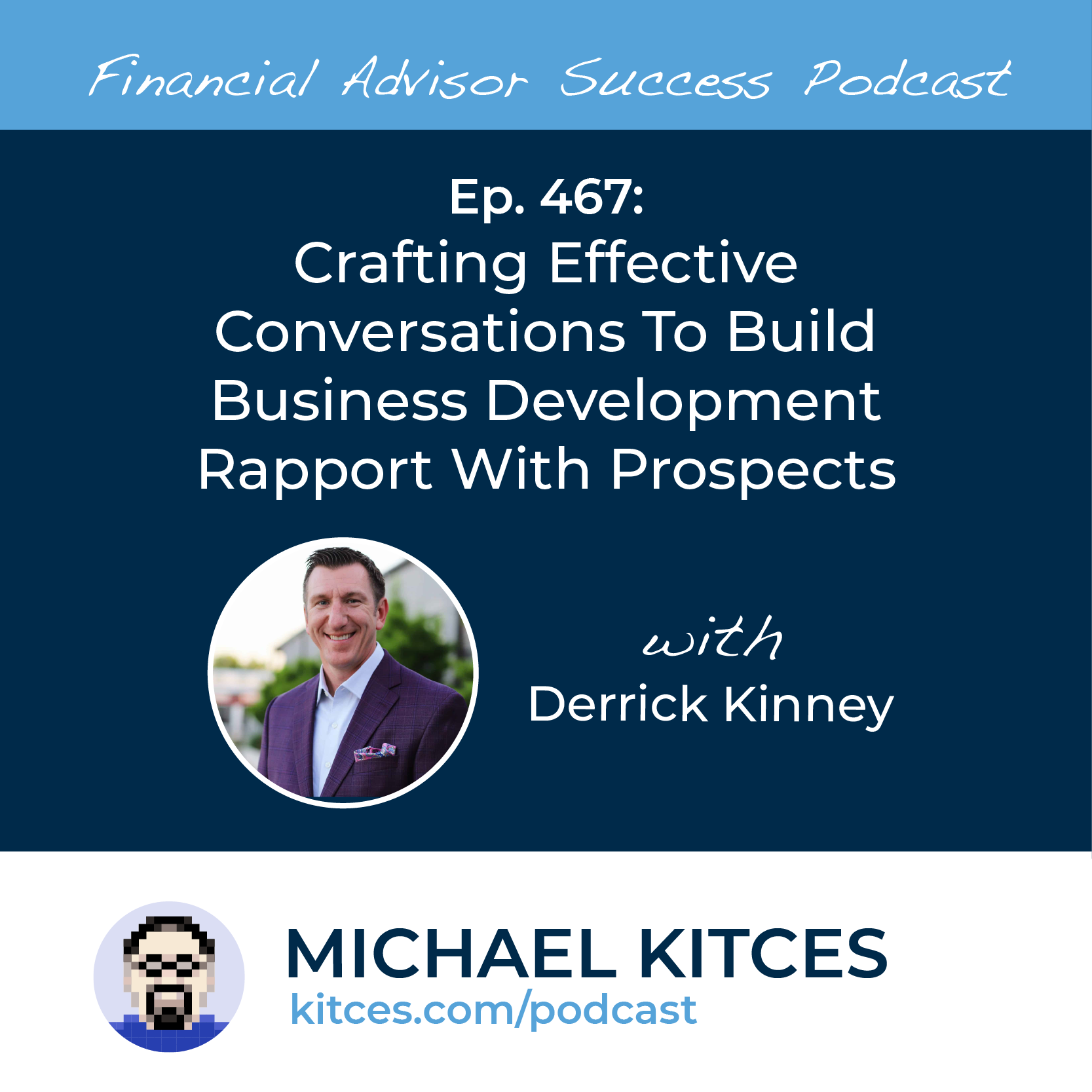 Welcome everyone! Welcome to the 467th episode of the Financial Advisor Success Podcast!
My guest on today's podcast is Derrick Kinney. Derrick is the founder of Success For Advisors, a speaking and coaching firm that helps financial advisors communicate more effectively with prospects and clients.
What's unique about Derrick, though, is how his approach encourages advisors to find an immediately relatable pain point for their prospective clients and then show how they help their clients solve similar problems (without actually solving the prospect’s issue until they become a client).
In this episode, we talk in-depth about how Derrick encourages advisors to create a pitch that begins with a "You know how…" statement that is an instantly relatable problem for a prospect, how Derrick sees value in using a "low and slow" speaking style to demonstrate the advisor’s seriousness in solving the prospect’s particular problem, and how Derrick finds that advisors can help move prospects from an initial encounter to an in-person or video "visit" by offering to continue to explore their pain point (without directly asking for a meeting in the short-term, which could make it seem like the advisor doesn’t have much other business).
We also talk about how Derrick approaches the first "visit" after an initial encounter with a prospect by asking what he calls "million dollar questions" (for example, "What would be the greatest service that we could provide for you?"), how Derrick then transitions into asking deeper, more personal questions (for example, "What would you say is the biggest financial mistake you’ve ever made") by first giving them "pre-meaning" and letting them know it will be a personal question (and giving them permission not to answer if they don’t want to), and how Derrick finds that advisors can effectively show a prospect how they can solve their specific problem by sharing stories from current clients and then asking "Is that something you’d like my help with?" (rather than outlining a specific solution for them, which he finds can reduce their urgency to continue on the path to becoming a client).
And be certain to listen to the end, where Derrick shares how advisors who engage in what he calls "scheduled spontaneity" by finding ways to engage with their best clients monthly can lead to better retention of this key group, how Derrick finds that younger advisors can turn their relative youth into an asset by proactively addressing their age with prospects and discussing how their particular skills (for example in leveraging technology or relating to the needs of an older prospect’s children or grandchildren) can lead to better service for their clients, and how Derrick has ultimately found success not only in his own businesses (including building and selling an advisory practice), but also by passing on his entrepreneurial spirit to his own children, who have all started businesses themselves without him necessarily encouraging them to do so.
So, whether you’re interested in learning about creating effective introductions when meeting prospects for the first time, asking effective questions to discover a prospect’s pain point, or how sharing client success stories can help a prospect see that you’re the best advisor to meet their unique needs, then we hope you enjoy this episode of the Financial Advisor Success podcast, with Derrick Kinney.

Podcast Player:




Resources Featured In This Episode:
 Derek Kinney: Website | LinkedIn | Podcast
- "Good Money Revolution: How to Make More Money to Do More Good" by Derek Kinney
- 10 Conversation Mistakes Holding Back Your Success – Download (PDF)
Are you a successful financial advisor, or do you know of one that would be a great fit for the Financial Advisor Success podcast? Fill out this form to be considered!
Full Transcript:
Michael: Welcome, Derrick Kinney, to the "Financial Advisor Success" Podcast.
Derrick: Michael, thank you. It's such a pleasure to be with you today.
Michael: I'm really excited to have you join us and to get to talk about the wonderful art of having good conversations with prospects, particularly more affluent prospects, and just trying to actually get them comfortable to do business with us. And I think in part, just the fact that there is remarkably little training in how to actually do this anymore. If you came to the industry 30 years ago, most advisors worked for captive firms, insurance companies or big brokerage firms. And the big firms had a lot of training in sales and business development, often for very grindy strategies: cold knocking, cold calling, cold deck working. They taught you what to say and how to say it to try to get prospects to engage. And today, there's just remarkably little of that training anymore. I feel like, as more advisors have gone independent and increasingly want to work with firms where they own their clients, they maintain their autonomy. The good news is, you get your autonomy. The bad news is, the firms don't exactly want to invest into training you when you can just up and leave anytime you want.
So, training in all things business development seems to have just continued to wane over the past couple of years. And I know you have lived this journey, both as a successful advisor who I'm going to guess also went through sales training early on, and then adapted it to your own strategy. And now someone who sold their firm and is building a business fulfilling this lost art of teaching advisors how to actually develop business, and get new clients, and just engage with prospects to get them genuinely interested in working with you. So, I'm excited to delve both into the conversation of how to have better conversations with prospects so they hopefully want to hire and engage you, and just how advisors in today's world learn to do that better.
How Derrick Approaches The Question "What Do You Do For A Living?" [04:55]
Derrick: What's interesting, what you said is so true. I began as a financial advisor 25 years ago with Ameriprise Financial. Loved my time there.
Michael: That would've been American Express back then?
Derrick: American Express at the time. That's right. And converted to Ameriprise. And I operated very much like an independently minded advisor. I just had a real passion for financial planning. But what I realized was, there was a problem that I had, and it caused me a lot of frustration. So, when people would ask me, "Hey, Derrick, what do you do for a living?" And I would say, "I'm a financial advisor." You could just see people's eyes start to glaze over. They slowly tiptoe backwards.
Michael: I was going to say, their eyes just glazed over. Because for me, they started stepping backwards slowly, carefully, but there was often a lean away or an actual step or two away.
Derrick: And then they murmur under their breath, "I already have enough insurance." And I was like, "What the heck? All I said was, I'm a financial advisor. Why this type of visceral response?" And so, I used to cringe walking into social settings, hoping people would not ask me, "What do you do for a living?" I became an expert at diverting the question to, "Let's talk about you. Let's talk about your life."
Michael: Which, of course, is just so painful in so many levels, both literally, you say, "I'm a financial advisor," and they say, "I already have enough insurance." "Cool. Now I understand what my industry did to you. I'm sorry." And the fact that I can't be proud of what I do. I'm literally trying to hide what I do, which doesn't feel very good. I feel like just the irony of, "Well, it would be a lot easier to get people to work with me as a financial advisor if I could tell them that's what I do and not have them take several steps backwards." It hurts at so many levels.
Derrick: It does. And what I realized was, there had to be a better way. And so, because that was my pain point, as I began to talk to other advisors, they also shared the same thing. And they said, "Derrick, that is my frustration too. I feel like I'm getting overlooked the moment I open my mouth." And so I found a way to get around that. And I want to tell you a quick story. So, let's say for all of our listeners, you are at a social event in your hometown. You've got your favorite beverage in your hand. And as you mingle around the room, you meet a man, and he asks you, "Hey, what do you do for a living?" And you reply, "Well, I'm a financial advisor." And he says, "Oh, okay." And you say, "Well, what do you do?" And he says, "Well, I'm a personal trainer. I design customized workout and eating plans so people can get into shape." And you ask a few other questions, and so forth. And as you mingle around the event later on in the evening, a woman approaches you and she says, "Well, what do you do for a living?" And you say, "Well, I'm a financial advisor." She says, "Oh, okay." And you say, "Well, what do you do for a living?" And she says, "You know how busy business owners and professionals, they always put everybody else's needs above their own so their health takes a backseat? We custom-tailor workout and eating plans that fit within their busy schedules and their tight budgets, so they not only feel good, they look great. And one day, they can be the cool grandparent that has the energy to chase their grandkids across the floor. We specialize in personal training for busy, caring professionals." Pause.
Now, Michael, one week goes by, and you happen to look in the mirror and you say to yourself, "I think I need a personal trainer." Which trainer would you call?
Michael: I want the one where I get to be the cool grandparent who chases kids across the floor. I can't be the only one who heard that story and wasn't immediately having actual mental images of trying to be the cool grandparent tracing little ones across the floor.
Derrick: Yeah. And so, when I asked that question to advisors, they unanimously pick number two, the person who created a picture in their mind, but more importantly, they connected with a pain point that was instantly understandable. Let me ask you two questions, and let me see how you respond. Michael, you know how it feels when you take your car to the mechanic, it often feels like you're getting taken advantage of or overcharged?
Michael: Yes.
Derrick: Next question. Now, picture this, two moms, and they both have teenage daughters. And one mom says to the other mom, "You know how it feels like when you talk to your daughter, what you say goes in one ear and right out the other?"
Michael: Yep.
Derrick: And so, those two comments, did those require you to burn any brain cells to instantly understand the point that was being made?
Michael: Nope. Those are both relatable, felt both, can identify with both. Fortunately, my 14-year-old actually is pretty good at listening so far, but I know it's coming.
Derrick: But it's an instantly relatable point. And so, the problem that advisors have is, when you answer the question, "What do you do for a living?" And you say, "I'm a financial advisor, I'm a wealth advisor, I'm a dream funder," whatever you say, you're forcing people to burn their brain cells to figure out what the heck you're talking about. And it does you a significant disservice. Now, the reality is, Michael, you and I know when we say financial advisor, what that means. And all of our listeners know the same thing. But outside of our bubble, people don't. And it forces them to try to think, "Well, I think my mom got ripped off by a financial advisor. Don't they just sell a bunch of insurance? Don't they overcharge you? Do I have enough money to do it?" And it causes them to wonder, "What in the world do you do?"
Michael: Well, I was going to say, relating back to your earlier story, a version of that that I'm sure so many of us have had. "Michael, what do you do for a living?" "I'm a financial advisor." "Oh, I already have enough insurance." The connection their brain is making is, "Oh, you're a financial advisor. I've worked with one of those before. They sold me a lot of insurance. Therefore, 'you're a financial advisor' means you're going to sell me insurance. And I don't actually really enjoy that, so I'm going to put up my walls and say, "I have enough insurance," and take two steps back. But to me, it gets to a version of that same point. If they have ever interacted with a financial advisor, they have some mental picture of what that means by their prior experience. It may not be the experience you would like to be related to, but if they've ever had an advisor, they are going to relate you to however this showed up for them last time.
Derrick: That's right. Here's what I discovered. If you want to make it rain, connect with pain. If you want to make it rain, connect with pain. And I discovered and created what I call "you know how" statement. And so, in that moment, whether it's at the Rotary Club or church or a social event, or wherever you are, your kid's birthday party, and someone asks you, "What do you do for a living?" The natural tendency is to say, "I'm a financial advisor." And then you've blown the whole thing again. Instead, you want to say, "You know how…" and then insert an instantly relatable problem.
Let me press pause right here, Michael, because if there's one huge takeaway, I want all of our advisors to not miss this key point. Some may ask, "Well, Derrick, how do I know what the instantly relatable problem is that I should talk about?" And I want to have you do what I call the five-and-five exercise. You want to look at your five most recent clients and then your five favorite clients. So, the five recent does two things. First of all, it tells you the recent and relevant rule of, who are you currently attracting right now? And half the time, shockingly, when I do this with advisors, they say, "Derrick, I only like about two of the five clients I brought on recently." And they recognize, okay, now there's a problem. So, by looking at it in terms of groups of five, now we can change what the next five look like. But the bottom line is asking yourself, "Of my five most recent clients, what was the problem they came to you to solve?" And then you want to ask yourself, "What emotion, how were they feeling when they came to you with that problem? And then how did they feel now, now that you're working with them, helping them solve that problem? What does the transformation look like?"
And then you want to do the same thing with your five favorite. Now, these people are ones that, if we're being honest with each other, when you see their names on your calendar, you smile. Not every client name is like that, we're just going to be honest about it. But these people take every word you say, and they do it. If you could have all of your clients look like this, they would be. So, you want to ask also, what problems did they come to you to help solve? And we did this with a client recently, an advisor. Picture a spreadsheet. And I had her write out, "Okay, here's your top five, favorite five." And we began to identify what person is her ideal client. And one thing that we discovered was, hardworking, high-achieving tech professionals was a theme that was woven through this particular advisor's practice. And so we said, "Okay, you know how so many 'insert high achieving hardworking tech professionals', and then 'insert emotion,' worry about?" Well, now we get to the, "What is the instantly relatable problem?" Well, as we began to look, some of them had complex stock options. They worried about too much month left at the end of their money, just complex situations, not spending time with their families. And so, we began to uncover, as we looked at that, what was an instantly relatable problem for that group of people?
And the visual that I gave this advisor, I said, "On a Friday night, picture, what is your ideal client sitting on their back patio with a glass of wine in their hand or coffee and telling their spouse, 'This is what worries me the most right now.'" And whatever they're saying, that's what you want to begin to picture as to what is that instantly relatable problem.
Identifying An Instantly Relatable Problem To Create A Connection With Prospects [14:56]
Michael: So, as you go down this path, my brain starts to now connect back to various industry advice over the years, that's something to the effect of, you need the ten-second elevator pitch. You have to be able to concretely explain what you do in relatively few seconds, which is how some of us get to— I think you'd said it before, maybe tongue in cheek, "I'm a financial advisor and a wealth advisor. I'm a dream funder who helps retirees make their dreams come true," or something to that effect. Is this a version of elevator pitches or should I be thinking about it differently? Help me connect these dots a little, or just connect the dots.
Derrick: Yeah. So, the goal is, you want to connect with people on an emotional and financial level in a way they instantly understand. So, here's what I like to say to people. When you tell someone something new, they don't always know what to do. But when you tell someone something true, it endears them closer to you. When someone tells you something like, "Man, does it feel like gas prices are always going higher?" Yeah, it does. "Does it feel like there's so much going on in the world right now it's hard to know which way is up and which way is down?" Yeah, it does. Just phrases like that all of us can instantly connect with. I'm going to share a crazy example with you, Michael. One client that we worked with, they really were struggling in the ultra-high net worth client acquisition space. And so we began to do a deep dive on what worries and concerns do ultra-high net worth founders and CEOs have. And this is going to sound crazy, I'm going to warn you, because it's not based on technical or the credential or the knowledge, it's just, what keeps somebody awake at night?
And so, I had this woman test this and answer to the question, "What do you do for a living?" She said, "Well, you know how successful founders and CEOs, what keeps them awake at night, is the thought of their lazy and entitled kids taking over their company or inheriting all that money? We help fix that." Pause. That connected with so many ultra-high-net-worth people. It wasn't about money, it wasn't about the returns, it wasn't about taxes or estate planning. It was about, "Yes, that is my biggest fear, that all I've worked hard for, my kids are not equipped and prepared to take it over. So, you can fix that?" And all of that was said in a simple one sentence. So, yes, think about an elevator pitch, but not just pitching what you do, because that goes back to your title and the things that you do. It's ultimately this, what is the instantly relatable problem that the prospect in front of me will make them say, "That person gets me. That person understands me. Finally, someone understands the pain or the problem I want solved."
And then the way to bookend that, we talk about, you know how so many people worry about, in this case, say, running out of money in retirement. Through our five-step financial planning process, we create a customized game plan so they no longer have to worry about how much money is enough and they can have peace of mind and confidence. We specialize in…" and then insert a specialty. For example, it might be retirement income planning. So, I was on stage at an event just a week or so ago, and I did something new. I brought on stage a box of Hershey chocolate and GODIVA chocolate. And I asked the audience, "If you were going to give a gift to the chocolate lover in your life, which gift would make you look better, the Hershey Bar or the GODIVA chocolate?" And hands went up, "GODIVA, GODIVA, GODIVA." And I said, "Well, why?" "Well, the packaging. The reputation." And I said, "Well, the Hershey Bar is $3.69, but the GODIVA chocolate is $14.99. And by weight, there wasn't that much more chocolate." So, I asked them a question. I said, "Now, let's say that you needed to have a delicate procedure on your shoulder done. You've been in pain for a while. Would your natural tendency be to go to the general practitioner who knows a little bit about a lot, or would you think to go, 'I need to see a shoulder specialist?'" You go to the shoulder specialist. The person, all they do 24/7, shoulders. Now, what expectations would you have prior to that visit? If you called them at 4:00 today, would you expect to see the specialist tomorrow morning at 9:00? No.
Michael: I almost worry, if you can actually take me first thing tomorrow morning, are you not that booked? Are you not actually that good? I'd assume if you were really good, you definitely shouldn't have an opening first thing tomorrow morning.
Derrick: There'd be a wait. You would assume there would be a wait. Now, based on your insurance, this could vary, but would you expect to pay more to see the specialist? Yeah. And then third, would you come expectant, probably about to take the advice of the specialist. You wouldn't think, "Well, I'm just going to do this myself. Whatever this specialist says, I'm going to listen." And so, I asked the audience, I said, "Let me be candid with you for a moment. In your local community, do your clients and your higher net worth prospects view you as the Hershey bar or the GODIVA chocolate?" And that's when a few advisors tried to rush me off the stage. No, just kidding. But it was personal in the sense that perception and packaging, and now what I would add, problem solving, leads people to become the irresistible advisor in their local area, or the one who will keep being overlooked.
Michael: So, as you talk about this framework, am I trying to customize this to each prospect?
Derrick: Sure. So, the key with this is, you want to position yourself in the best way to connect with the problems of the people you're in the room with right there. So, for example, if you're about to walk into the Chamber of Commerce business of the year luncheon, well most of those people are probably business owners or somehow related. And so, identifying what is the pain point of those business owners? Now, you can choose to be very, very specific or more general, but the key is asking yourself, of the five recent clients and your five favorite clients, and even clients who you want to begin aspiring to attracting, what are those concerns? And so, it could be people who are worried about running out of money in retirement if I'm focusing on that 50 to 65 age range, or something more specific.
Well, we find Michael, and this is where the psychology of this gets very interesting, when you give a concrete example...but the problem has to make sense. This is where you have to test this. And again, this will sound very simplistic, but I believe that words equal wealth. And so, the right word spoken at the right time, said to the right person about the right painful problem leads to great profits. And so, when you can connect and use words on a third-grade level where people require no brain cells to figure out what you're talking about, because it's easy even with one sentence, advisors naturally get more complex. You want to keep it super, super simple. So, identifying, first of all, who is your ideal prospect? And are there slight variations of that? For example, if you're going to walk into a room with teachers, well, that may not be your ideal prospect. And so, even talking about, "Well, what we specialize in is this." And if someone asks for that type of help, "Hey, let me refer you to a colleague of mine." Those kinds of things. The key is identifying what is the problem that you will own. I like to say, "If you own a problem, you own your success." And so the key with that is, again, knowing what words to say, but also the least amount of words wins. The goal is building curiosity and intrigue for someone to say, "Now, tell me more about that."
Well, let me share a story with you about a recent client that came in, and then you've got a story ready to go. The goal is, it's almost like a funnel where you are then letting them know, "This person gets me. They understand me." Here's the process they use. Here's how people feel when they work with you. Here's what we specialize in. Now, does it guarantee that every client works with you? Well, no. But I would submit it's going to go a long way further than people shutting you off instantly when you say, "I'm a financial advisor."
Michael: So, take me further down the road of this conversation. You alluded to it there of what comes next, but I think I want to understand more of what this process looks like. So, I'm starting with my, "You know how dot-dot-dot." "You know how successful CEOs stay up at night worrying about their lazy, entitled kids taking over the company, wasting the money. We help with that." "Oh my gosh, yes. I'm A CEO, and our company has become very successful, and I'm really concerned about this." So, now they pause. So, what am I doing next? Where am I taking this conversation? How do I keep down this path?
Derrick: Let me go back just a second. The key with all this is to personalize this problem to as close to the problem of the person you're already working with or want to work with. For example, I mentioned earlier in the analogy of hardworking high-earning tech professionals. One of the areas we identified for this particular advisor, again, it's different for each person, was, "Who make a lot of money, but feel like their family life is failing. We help fix that." See, the goal is to identify what is an instantly relatable pain point that that category of people has. And often, they will have said it to you. You will have dug into, and they will talk about that. So, we talk about that "you know how" statement. Then the key is identifying, what is your framework or the steps that you use to solve and work with a perspective client. It might be your six-step financial planning process, or "We use a five-step framework to custom-tailor a plan for each client." You want to tell them, "Here's the problem that we help solve. Here's what we do to solve that. And here's what you no longer have to worry about and how you'll feel that transformative word that you'll feel by working with us. We specialize in..."
So, the goal of all of that is..and tonality is very, very important here, Michael. So, for example, I'll talk in a moment about, I like to use a phrase that says, "Communicate like you cook a brisket, low and slow." When you're bringing a topic like a problem you solve for people, if you say it in your regular voice, in your regular pace, it can often sound less sincere than it should be. But what I teach advisors to think about is, you literally hold the medicine for that person's financial pain. And so, for example, if I had a cancer diagnosis and the doctor said to me, "Derrick, hey, you've got cancer. Feel bad about it. But we're going to do some treatment and see how it goes." Well, he may be very well-meaning, but it comes across as a bit flippant to me. But if he says to me, "Derrick, I've got some bad news. There is a cancer diagnosis. We're going to walk alongside you through this. We've got a system that I think is going to help you, but I want you to know how badly I tell you about this news. We feel for your pain right now." Well, that type of tonality tells me, "Hey, this doctor has my back. They understand me. They've been down this road with other people before." Does that make sense?
Michael: Yep.
Derrick: So, it's very, very important, and I like to use leaning in a little bit and talking just a little bit lower and a little bit slower so that the person you're talking to, they're leaning in, as if to say, "What is this person talking about? They're clearly the expert." And just by the words you use and the tonality, it instantly makes you sound credible and more trusted and more empathetic by the words and the tonality that you choose to say those words. Now, does this happen overnight? No. So, I don't want advisors to think of, "Derrick, you clearly have done this many, many times," but it just takes practicing and connecting with people's pain. Even if you miss all the other points, as long as you can say to someone, "You know how so many people they struggle about how much money will be enough to retire? You know how many founders and CEOs feel like they're making tons of money, but they're literally seeing their family slip through their hands? We help them fix that." So, it's saying something where they say, "Yes, that's exactly the pain point that I've got." Now, the next part of that is then the goal is for that person to say, "Boy, that's something I need," or, "I know someone who needs that." So, the next part of that would then be once the person is on the Zoom or in the office, walking them through the framework of then how to build concern there.
Getting Prospects To Take The Next Step After An Initial Conversation [28:27]
Michael: So, I want to come back to that in a moment, what happens once they're in my office or on a Zoom, how did I get them there?
Derrick: So, there's a couple ways. First of all, when someone is asking you, "What do you do for a living?" The goal is, how can you build rapport and relationship quickly? So, typically, when you connect with a painful problem, now there's a bond that occurs where the person says, "Yeah, that makes sense." Even if they don't have that exact problem, they can relate to it. And then it opens up a dialogue for you and that person. And so then, there's one of two things that happens. Rarely does somebody say, "Well, I need to meet with you tomorrow." It's, "You know what? I'll be happy to keep in touch with you. Let me get your card. We send out a newsletter that people find very, very informative on these exact problems. I'd be happy to include you there. Maybe we could have coffee together." The goal is very soft and you're letting your understanding of the problem they have sell the urgency they now have to want to visit with you at some point.
Michael: Because ultimately, what I'm shooting for here is, it sounds like, is not to say to them, "So, would you like to meet next Tuesday to talk about this further?" What I'm fishing for is for them to say, "Oh my gosh, I have that problem. I think I need to talk to you. I think I need to meet with you more." Because at the idea, I'm trying to get them to say they want a solution to this problem. I'm not trying to get a meeting, set an appointment. I'm not driving it?
Derrick: Well, one of the things that you can say, and think about this, if you were to answer someone, "I'm a financial advisor, Hey, you want to meet next week to talk about it?" It gives that reputation of like, "Well, this person must not have any other business." So, one of the things I like to do is say to someone, when you can tell the concern...we're all relatively smart people, and you can tell when the person is capturing, yes, okay, that is a problem I have. Clearly, you know the solution to this." One thing I like to say is, "Hey, listen, I don't know if you want my help or even if you need my help, but if you want to explore this further, I'd be happy to set up a coffee together, or we could schedule a visit. It may take a couple of weeks for us to connect just given our busy schedule, but I'd be happy to visit with you." Boom. And so, I always like to do the wording of, I'm never directly saying, "Hey, let's meet." "Listen, I'm not sure if you want my help or even if you need my help, but if you'd like to explore this further," and then offer that opportunity. And so, that's more of an advisor judgment call.
And even if you say, "You know what? Let me get your card, I'd be happy to keep in touch with you," and you just finesse it from that standpoint there, Michael. So, I tended to build my practice based on the reputation piece of when the person knows you connected with them, even if it was later on that night, circling back, "Hey, I really enjoyed our conversation together. I got to thinking, I didn't even ask you if you wanted me to follow up. Would you like me to keep in touch with you? Or how could we keep in touch together?" And do the the "almost forgot" follow-up is very effective as well.
Moving Prospects Towards Becoming Clients During The First "Visit" [31:44]
Michael: So now, take me to the next step of what happens when they're in my office or on the Zoom, or we actually got the coffee meeting that I offered a few weeks out and they said yes.
Derrick: Yeah. So, one of the biggest frustrations that advisors share with me is they say, "Derrick, I had a great visit." And by the way, we call them visits and not meetings. A meeting you have with your proctologist, which can feel cold, it can feel like you're just a number in the room, but a visit is something that feels warm and inviting. You have a visit with people you care about. So, I believe that words are important. So, I will tell prospects, "Hey, let's schedule a 'visit' together." It just sounds very less threatening and very inviting. So, in that initial visit, whether you're on Zoom or in person, I like to say, "Face to face wins the race and voice to voice is the best choice." You want to get a as eyeball to eyeball as fast as possible. One of the key things that most advisors miss is they don't determine what does the prospect really want at the beginning of the visit. They go through this entire timeline and then they end it. And the prospect leaves. The advisor thinks it went great, and then they ghost them, and they wonder what happened. I call these the million-dollar questions.
So, million-dollar question number one. There's several, I'll just cover a couple today. One is asking, "What would be the greatest service that we could provide for you?" Now, it sounds so simple, but ultimately, you want to have that perspective client tell you what is the greatest service they could provide for you? And they might say something random "Well, my CPA said I needed to call you," or, "When we talked to lunch that day, what you said really piqued my attention," or, "I've got a burning desire to figure out, are we going to be able to retire or not?" Or they might say, "I have no idea why I'm really here. You just sounded really convincing." Whatever they're going to say is whatever they're going to say. Well now you get to take out your shovel and dig right there. So, that way, we're no longer waiting to the very end of the visit to wonder, what did the client want? They're telling you. And if there's any further clarification you need, "Well, tell me more about that. You said that you're not quite sure why you're here. What would cause you to take time out of your day to spend 45 minutes or an hour with me? Why is that important to you?" We're now digging in, trying to figure out what the concerns are, if that makes sense.
Now, one of the other pieces that's very, very important in the client visit, and it's often overlooked by advisors, is asking at least two personal questions. Now, most advisors will ask questions about, "Now, tell me about your job, or tell me about your goals. Let's talk about the investments," and so forth. And those are all good questions, but I find those are shallow-end-of-the-pool questions. So, what I will tell people is, "Okay. Walk with me. We're going to walk down to the deep end of the pool." And two of my personal favorite questions are, number one, "What would you say is the biggest financial mistake you've ever made? What is the biggest financial mistake you've ever made?" And number two, "Of all the financial decisions you've made, what is one that you are most proud of? Of all the decisions you've made, what is one that you are most proud of?" Now, most people would say, "Derrick, those are pretty decent personal questions, but what I would tell you is, they're not good enough." So, we're going to go down to the very deep end of the pool. We're going to climb up the diving board ladder. Let's walk out onto the diving board, and we're going to jump into the deep water.
And the way to build rapport and relationship fast is you need to give a personal question, and please don't miss this, pre-meaning. Because by itself, all those questions are good, and you know they're personal questions yourself in line with other questions you're asking. The prospect doesn't have a clear definition of incoming personal question. We want a vulnerable response. And so, what by pre-meaning is you want to say the following. "Now, Michael, would you mind if I asked you a personal question? And by the way, you don't have to answer it if you don't want to. What would you say is the biggest financial mistake you've ever made?" Pause. Now, see, what I did there was, I set up the importance and the significance of the personal question. And then typically, they green-light it, and then we go on.
Michael: So, what else in terms of questions?
Derrick: So, one of the key parts of all this...I was speaking at a large advisor event about a month or so ago. And the moment I stepped off stage, a line of people formed to ask some questions and want to talk. And one woman was very upset, and she said, "Derrick, if you had said what you just said ten years ago, I could have probably quadrupled the size of my business." And here's why she was frustrated. She said, "I've been solving the prospect's problems in that initial visit." And so the visit would go great, the prospect would thank her, they would leave, she was thinking they'd become her next best client, and they'd ghost her. And what I told her was, "You want to stir the problem and not solve the problem." Now, for many advisors, this might sound very controversial because oftentimes we're problem solvers at heart. We want to make sure that we're helping add value to people's lives. And I would jokingly tell people, "No fee, no me." And that was my mantra as a financial advisor. I became this brilliant, amazingly smart financial advisor able to solve all our clients' problems the moment they signed the paperwork and they paid me a fee. I became just brilliant. It was crazy how the knowledge just happened to me.
And what I tell advisors is, "If you're solving too many problems in the visit, you're decreasing the urgency that the prospect has to work with you, and you're also doing yourself a disservice and you're doing them a disservice because they think that this surface-level problem is all they've got. But there's a whole lifetime of potential problems you'll walk through with them and their kids and their grandkids and so forth." And so, the question that I had her do, and I had all the advisors in the room practice, is, instead of solving the problem, the moment your lips want to utter the answer to the problem, just simply ask, "Is that something you'd like my help with? Is that something you'd like my help with?" And then go to the keyboard or write down on your piece of paper and utter underneath your breath, "He would like my help with knowing how much money it will take to not run out of money in retirement." "Is that something you'd like my help with?" "Yes." And so the psychology at play here is you're asking the person to tell you in their words what they want your help with. You are repeating it back to them and asking them, "Is that something you want my help with?" Then they're seeing you write it down. And these are what I would call commonly just checkoffs to confirm, yes, we're validating a concern. Because ultimately the goal of that visit is you want to secure them as a client because you can help them once they pay you and become a client.
The advice you're giving them... And the reality is, if we're being honest about it, most advisors are so skilled, you could probably design, if we're being honest here, probably 85% to 90% of the case in front of the person because there's not many things you haven't seen. So, you have to hold that back and keep building concern. But I would say that one of the biggest questions at the very end is to ask the person, "Okay, we've talked about a lot of pieces today, a lot of concerns you've got," and list those out. "Let me ask you another question. Twelve months from now, if we're sitting down together, what needs to have happened for you to say, 'I'm sure glad that you hired Michael Kitces and his team?" And then you just wait for them to tell you what they're going to tell you. And the purpose of that question is, they are verbally telling you what transformation looks like. "Well, I just want to double my money." And you just write down, "Wants to double his money." "I want to do this, I want to do that." And then you go back and address each one.
So, the whole purpose of this visit is you're managing reality and also letting them know who you are and also who you're not. For example, if someone says, "Well, we just want to double our money, that'd be the minimum expectation." "Well, do you realize how impossible that is, candidly, to double your money in one year? And I would not be worth an advisor and what you want me to do if I were to tell you that. So, listen, if that's what you're looking for, I am not the person. We are not the team that's going to be best for you. I'm so sorry." And what we find is, when you are straight up honest, and you push back on higher net worth prospects, they build respect with you. "You know what? That does make sense. I'm glad that you were honest with us and you told us, and you were a voice of reason to help us with this." So, then we go into the fee part of the process. But ultimately, those million-dollar questions are intended to build rapport, build relationship, go deeper, and also build a concern funnel for them to say, "Look, this person clearly understands me." And the only problem that you are solving in that visit is in their mind, do you have the ability to solve their problems?
Using Stories To Show How The Advisor Solves Problems For Their Clients [41:07]
Michael: So, in that vein, and I find for a lot of us, trying to answer that question, do I have the ability to solve their problems? Is why, when they start talking about problems, I start helping them solve them. Maybe not all, but at least some. Some version of showing my competency, showing my knowledge, showing my capability. So, I think I'm trying to reconcile...your counsel earlier was, when they state the problem, and you're super tempted to start solving on the spot, to instead pause and say, "Is that something you'd like my help with?" I get that. That's a powerful mental shift. But then where, or how am I doing whatever I'm supposed to do to demonstrate that I have said ability to solve said problem beyond just asking them if they'd like my help with it, and then risking that they're going to say, "No. Well, I don't know if you're any good at it"?
Derrick: Great question. The key here is the power of client stories. One of the key parts of this is, what I want to get away from as advisors, "Well, should I do the traditional or the Roth IRA?" "Well, you need to do the Roth IRA." Well, suddenly, that's an answer to a question that in your mind is one tip of the iceberg. But for them, they might think, "Well, that basically just solved my whole problem." Does that make sense?
Michael: Yep.
Derrick: And so one of the things that I will often weave in and coach advisors on is, think about stories of clients who came into you who had a problem that you could help solve, and sharing with, "It's interesting, we had a couple come in the office recently who were struggling. They made good money, but they felt like they were falling further behind. And they wanted to know how much money was going to be enough in retirement. And one of the things that we found was by asking them their specific goals, and even having them live on what we call a practice retirement budget. Itt enabled them to actually retire a bit sooner. Is that the type of planning work that you're looking for?" "Yeah. That's what we're looking for." "Okay." So, the point is, when you're answering too specific of questions, I believe, and people can disagree with me all the time, but I just know that what I'm talking about works for top advisors. It helps build concern and rapport with these people. And also, even using your words to say, "You know what? That is a great question. And candidly, as tempted as I am right now to just give you just a point-blank answer, here's what I find, is, there's a lot of intertwined issues here of what some of your goals are for retirement, and then estate planning, and taxes, and all these pieces that blends together. Once we do the planning process, then we can give you, as I promised you, working with a specialist, that's when we can determine then what's the exact best course of action for you. I just don't want to give you general advice that may be appropriate for everybody. I think you deserve more tailored advice for your situation."
So, it's sometimes just how you say the words that matter. Now, if it's a simple question, you just make the judgment call on that. I just find that most advisors, once they start down that path, it can be very, very hard to leave that path. And the worry and the urgency tends to go down the more specific answers to their problems you give in that initial visit.
Effectively Discussing Fees With Prospects [44:32]
Michael: Are there any other, I guess, questions or conversation mistakes you would highlight beyond, if you answer too many of their questions outright, you're going to actually decrease their urgency? What else should we be mindful of?
Derrick: Yeah. Now, once we go to the end of the visit. Let's go there. And one of the biggest mistakes advisors make, I talked about earlier about communicate like you cook a brisket, you want to go low and slow. And so, one of the biggest things, and I observe this when I work with advisors, is when they begin to talk about their fees, they often lean in and their voice goes higher and they talk faster. They don't even know they're doing it. And it's like a billboard behind them flashing and saying, "You're about to be sold something. Beware! Beware!" And we want to make sure that that doesn't happen. So, what I coach people on is, if you're in a Zoom, then lean back. And take your hands and pull them apart. Use open-handed gestures. Let the person see your torso. You want this to be very open-ended and very relaxed, is the goal. If you're at a table or a couch in front of them, and you want to say the words to something like this, "Now let me share with you how we work with our clients and how we get paid." Pause.
It's very, very important for them to hear you say the words, "How we get paid." Because you know they're thinking it and they're wondering it. And so, when you call it out, it makes it less of an issue. It's like, Oh, okay, now he's going to talk about how we get paid." This is Derrick's preference, but we test this with advisors and it's working very well, is, "As you know, we are not the only financial advisor in town." They chuckle, I laugh a little bit. "One of the reasons that so many people choose to work with us is they're looking for someone who specializes in..." and then insert your specialty. And then at that point, you go into, "Here's how we work. Here's our fees," and so forth. Now, let me throw this in, Michael. Now, this will apply to some advisors, others, it may not. One of the things that I found to be highly effective is to have fee ranges. So, the goal of this entire conversation is that you're working in a very custom, tailored, almost a concierge, a type of approach. The person feels like, "This person gets me, they understand me, I'll be treated like a very important person here at this firm." And so, oftentimes you then say, "Well, the fee for that's going to be $4,000." And you just shoot a number out there, it begins to minimize your unique value and how they perceive you as a specialist. For example, when I was an advisor to Ameriprise, again, my mantra was, "No fee, no me." I just firmly believed in the value of true financial planning, but more importantly, the value of the relationship. They weren't just paying for a book of numbers. They were paying for access and problem-solving solving and a relationship with our team throughout the entire year, and what would we need to charge to add the most value to their lives so they could achieve their goals.
Michael: So, that, "No fee, no me" statement is meant to express, "You don't get me unless you pay a financial planning fee."
Derrick: That's right.
Michael: That's framing. Okay.
Derrick: Yeah. And again, that was how I built my practice because when you position yourself as knowing their problems, and as the specialist that has the ability to solve those unique problems, as I gave the example earlier, people's expectations are, "I'm probably going to pay more to this person because of their unique understanding and their ability to communicate. They have the ability to solve this problem," if that makes sense. And so, as an example, I might say, "Given your situation, the goals," and I will list those out, "the yearly fee..." And again, everybody's model is different, Michael. So, this is purely as an example, "That's going to be between probably $10,000 to $13,000 or so a year. And what we'll do is in our next visit together, we'll determine what that exact fee amount would be because we just want to make sure that we're adding the most of value to you."
But I said, "Now let me ask you a question, though. Let me pause for a second. Let's have a candid discussion. How do you feel about that fee? Does that feel reasonable to you?" Pause. So, now, we have a big boy and a big girl discussion. And the point is that there's no surprises. Now, we're just two adults talking, and I want to hear their feedback on, is that fee reasonable? Is it high? Is it low? So, the whole goal here is that there's nothing that's unsaid that needs to be said. If they're secretly thinking, "I was thinking it was going to be just $500." Okay. Well, then say that. Now, we can address it right there. Or, "Yeah, I was thinking in that ballpark. That makes sense." So, the key is having these open dialogues, especially with these higher-net-worth people, because a lot of trust is built on how you explain how you're paid and letting them have the ability to push back on you.
When you just say, "Here's the fee, this is it," it can come across like it's sort of a packaged cookie-cutter type of deal. That just wasn't how I built my practice. And most of these other top firms, again, it's based on their pricing model and how they want to charge, the fee range model can be very effective. But what's even more effective is in the next visit when I would then do paperwork to bring on these clients, I would say, "We talked yesterday or the last week about a range of $10,000 to $13,000, given your situation, that's going to be right at about maybe $11,500, $12,000, right in that ballpark, I think that will work." So, they come in thinking that, "Well, he's going to charge us $13,000." That's their mental hook of value that they associate with you. So, when you come down a little bit, they're like, "Oh, this really was thought out and more customized." And so, again, it builds trust very early in the relationship. Very, very important.
Michael: So, I'm thinking or presuming just from mechanically do our fee models, I need to be charging a standalone fee to be able to quote a range and then try to hone it in either to make them feel like it's more customized or just to literally be more customized, or sometimes we get into further details like, "Oh, you have a lot more complexity than I realize. That fee definitely needs to be a little higher in the range." Or, "Oh, this will actually be pretty simple. I can take it lower in the range." But for all of us in a traditional AUM model, we typically don't have fee range in AUM. It's not like, "Well, if you're a simple client, it's 1% on the first million, but if you're a complex client, it's 1.1% on the first million." So, I guess by an inference, this is primarily something we can do when we have that separate planning fee distinct from whatever we might also charge for investment management or portfolio management.
Derrick: So, in that scenario then, the key, Michael, and the principle holds true whether you have a fee range or not, the key is then, if you have positioned your expertise as the specialist, "We're not the only advisor in town. Here we have a clear understanding of your concerns and worries. Let me explain our fee model to you," and then giving them the chance to comment on it. That's really the ultimate key. Whether it's just AUM, a fee-only, hourly, whatever the case may be, as long as you give them a chance to tell you their feeling about it, because if not, then it raises the opportunity for an objection that they initiate. And if they initiate the objection, it's going to be a stronger need on your part to overcome that, as opposed to you inviting the objection and saying, "Hey, let me press pause. Let's have an open discussion. How do you feel about that?" And then they say whatever they're going to say.
And what I find is in that approach, it dramatically reduces down friction. If there's going to be a friction moment, it typically comes when stating the fee. Fee friction is very, very high if not articulated really smartly.
Sending A Handwritten Summary Letter And Personal Note To Build The Post-Visit Relationship [52:40]
Michael: So, anything else to reflect on in this process? I feel like we're getting to the end of the visit. We've gotten to talking about fees and getting to a moment of engagement. So, anything else to just reflect on as we get to the end of this meeting we've been discussing?
Derrick: One of the things that I found was perhaps the most important part, all of this has been very, very important, but a summary letter, either old school, which is going to sound wild, mailed to them, which makes you stand out, or emailed to them within 24 hours. And it's not just puffery, it's detailed, "Hey, one of the things you said that you were concerned about was retirement. You were worried about this. I understand your concerns and worries about this. Here's what we're going to do to help solve that. As we talked about, here's the fee range." And so, sending them... I know it sounds old school, but people love when they go to the mailbox to see stuff that's actually hand-addressed to them. Now, again, the game we're playing is, how can you stand out?
An email summary letter, great. But when you mail it to them, typically now they're unfolding it, they're touching it, they're showing it to their spouse, they're sitting down with a cup of coffee, they're looking at it, they're feeling the paper. All those tactile pieces help you stand out. And that's the game we're playing right now. So, identifying those clear concerns, but then also the nice touch of a nice handwritten note after the visit. And when I walked into the office every day, I would have my assistant put three note cards and three bottles of water right by my keyboard. And I wasn't allowed touch the keyboard until I wrote my three notes every morning. And so, one of those notes was the prospects I saw the day before, or clients expressing how much we appreciate having them as our clients. And so, when the note card, very specific, "Dear Tom and Susan, loved our conversation together. It's no wonder why you are so successful and care so deeply about your family. I did pick up on your worry and concern about," insert their most painful problem.
"And so, we were listening carefully, and we will have a plan to help solve that. And we are so excited to begin working with you. Warm regards, Michael. Warm regards, Derrick." And then they get that in their mailbox. And that's the kind of note, when you see a nice card with cursive or printed, they open it up from the mailbox of their house, they show their spouse, they put it on their refrigerator. So, all of those things, you're buying mental space that says, "And this person was listening. They understand me. They actually heard everything I said. It's almost like they were in my head. They took such detailed notes." And ultimately, that lays this foundation that you can build on.
How Derrick Attracted And Retained Clients As An Advisor [55:27]
Michael: So, let me zoom out for a moment now. So, help us understand your journey. Just where you learned this, developed this craft, crafted this technique. And you mentioned earlier that you started your career with Ameriprise, American Express. But help us understand a little bit more the journey and where this got developed.
Derrick: So, one of the things I realized, I kept feeling overlooked. When I was a new advisor, I was 26 years old. And the problem I had is I looked like I was 13. I wondered, "Who would invest with this baby face? No wrinkles, no gray hair, no contacts, no connections, etc. There were a lot of other smarter "advisors" out there. But one of the things that I realized was I had a passion for supporting local education. And I had this idea to go back to my alma mater high school, and I presented a $50 Amazon gift card to the teacher of the month and a $25 Amazon gift card to the student of the month. And just wanted to breathe life into them, because when I was a senior in high school, nobody successful ever came back to our school.
And I was like, "That is not right. I want to help change that." And I wanted also to let these teachers know the impact they were really having. And so, the principal, of course, said, "Yeah, we're under understaffed here and underfunded, do whatever you want to do." Great. So, back in the day, we had these things called newspapers. And we put a picture of myself and the student and the principal, and the teacher in the newspaper. And I got phone calls a couple months later. And one woman, what she said to me changed my entire business perspective. She said, "Derrick, we want to work with you. We know you're young, we know you're new, but we want to work with you because you care about what we care about."
She said, "You care about what we care about." And I was like, "Oh my gosh." It was like this weight lifted off my shoulders. That meant that I didn't have to be the smartest or the best looking or the most well-connected, I just needed to care about what the people I most wanted to work with cared about. And that's when I doubled down on local education. I began to sponsor teachers and students of the month at all of our local high schools and even some of our junior highs. And one thing I realized was that affluent, high-net-worth people, they love working with advisors who they see as being active and engaged in their community. And it wasn't making the $10,000 donation to the symphony or being on this fancy board or giving $100,000 to the Girl Scouts. It was just seeing you caring about teachers and students and helping make their lives better and recognizing them.
And what we found is that high-net-worth people, and really everybody in general, they derive status by working with professionals who are involved in the community. So, that's what was powering our entire success. And so, I became known as basically the education-friendly financial advisor here in Arlington, Texas, where I live today. And some of those students that I recognize have gone on to be on the school board, they've gone on to start stuff. It's really, really cool. But I did it because I was just passionate about, I don't want to be another student that feels invisible and is just told, "Just go do your history class and math class, and everything's going to be okay." I wanted to let them know, "Hey, you have potential and you have a big bright future in front of you." And so, what I realized was when I could find a cause that I cared about, that's what transformed everything that I did.
And so, the book I wrote called "Good Money Revolution," the whole premise is what's called the generosity purpose. And that is so many advisors I meet, they are on the verge of burnout. They're making their bulging bank account their number one goal. But instead, what I found out was, when you can connect a cause to your cash and money to meaning and purpose to your profits, now you feel this renewed motivation to go make money, go make a lot of it by helping other people make money, so that you can do more good supporting the causes that you care about. And oh, by the way, you can choose to give privately, which is great. But what I found is by sharing my passion for giving to the local schools, the teachers and students, it attracted clients like a magnet. They were like, "Well, most advisors, the reality is we're all sort of commoditized, but when you work with Derrick, you're part of something bigger." And that was the story.
So, I would encourage every advisor listening right now, whether your passion is education, you could do a teacher or student of the month. You could do a first responder of the month, a nonprofit of the month, entrepreneur or business owner of the month, whatever it may be. The key is, with $75 a month, you begin investing in your local community. And with the power of social media, most of the schools would then promote a picture of me and the teacher, or the teacher with a gift card. And they're like, "Derrick, you're everywhere. It's really cool. So, at our yearly Christmas events we would do for our clients, we would have the principal and some of the students come. And while I thought they were there to hear me, that's what I told myself anyway, they loved hearing from the principal, "Hey, when you work with Derrick and his team, you're helping make a big difference in our school and in the lives of our teachers. Thanks for that."
And our clients would talk about it all year. I thought they wanted the returns, and they got good returns, and they got results, and so forth, but they left feeling like we're part of something bigger. That was the key.
The key also, Michael, I don't want people to miss this. We've talked a lot about today about how to attract your next best client. And you go through this process and you feel good about, "I just got a great new high-net-worth client." The problem is, and this is the reality, your newest client is now another advisor's top prospect. And if you don't provide good service and consistent quality and good communication, over time, the person you work so hard to bring on is at risk of going to someone else. And so, one thing I want to add real quick is, I call this scheduled spontaneity. And that is the 80/20 rule. We know that typically 80% of your results come from the top 20% of your business. So, it's very important to protect the top 20%.
And one technique I found that was very effective, and we test this with other advisors and they've experienced very similar positive results, is having your team schedule calls with your top 20% once a month. Now, the crazy part about this is back in the day, meeting quarterly with your top people used to be enough. That was like premium service. But things have changed, the internet, social media, TikTok, instant news access 24/7. What we find is that if clients don't hear from their advisors, at least every month, they become a bit susceptible to wondering, "Well, what's my advisor doing? Are they watching my accounts?" And so, the way to solve that is, it's scheduled for you, but it feels spontaneous for them.
And this is typically like a one to two minute conversation and you're hoping you get the voicemail, "Hey Michael. Derrick Kinney here, watching your account closely. There's one investment that we're keeping a really close eye on. There's a lot of volatility right now. For now, let's keep it like it is. But just wanted you to know, we're keeping a very close eye on your account. And as always, we appreciate having you as our client. Have a great day," click. You're hoping for voicemail. The bottom line is, what that does is it buys you about 30 days worth of recent retention that the client says, "Oh yeah, I just talked to my advisor. I just heard from my advisor." So, I call that the moding process.
Keep in mind, your clients are still getting the free steak dinner invites in their mailbox. They're still getting the best marketing reach-outs from other advisors who want your clients to become their clients. But when you have a cause you care about, they hear from you on a regular basis, and you're always using the phrase, which I love, which is so sincere, "I want you to know how much we appreciate having you as our client." You see, even the most successful people love to be appreciated and told on a regular basis how valuable they are to you.
Michael: So, I'm just trying to process very practically, it's a lot of calls every month indefinitely. Are you scheduling these? Are you time blocking these? Can my team do these, or does it lose the special if it's not me? Or I'm talking about investment things, that has to be a registered person? Help me process through the time it takes to do that repeated monthly indefinitely.
Derrick: Good question. And that would be one thing to think about. What I like to think about is, ultimately, how do you protect at all times your highest and most dollar-productive clients? So, that might be, "We're going to focus on our top 5% and let's build our system where I'm the one calling or even letting them know." And the key here is to prepare the client for the level of service that you're providing. Because all clients know is what you tell them to be true. So, if in the next visit you say, "Hey, by the way, on a monthly basis, either myself or one of our team members will touch base with just some thoughts on the account and so forth," great. Then they think it's going to either be you or a team member.
But I would encourage you, start small. The key is focus on your highest and most valuable. And I say valuable loosely based on revenue to the firm, assets, etc., because you're running a business here. And then gradually expand from there.
Derrick’s Transition To Coaching And Speaking For Advisors [1:05:05]
Michael: So, you're not currently doing advisory work as I understand it.
Derrick: Right.
Michael: So, what changed? It catches up a little bit more to present. What changed?
Derrick: What changed? So, funny story on this. Was an advisor with Ameriprise for 25 years and loved my client relationships, loved my team. Two things occurred. One, and I demonstrated this on stage at Future Proof. There was a team meeting that occurred about ten years ago. I sold the business about five years ago. And I wanted to go and grow, but I sensed my team felt hesitant and slow. And so, I stood up and I walked over to the center of the room and I laid completely flat on the ground and I put my hands over my chest and I said, "I've just had a medical emergency. I won't be able to see clients for three months. What are we going to do?" It felt like an eternity, Michael, until somebody said something. I heard a voice that said, "Should we try to resuscitate him? Should we help him?"
And finally somebody said, "Okay. I see what Derrick's doing here. If he can't see clients, we need to figure out who else can see them, and how do we structure things without him?" I stood up and I quietly walked over and I sat back down. And that was the moment we moved from the "me show" to the "we show". That was the moment that I empowered my team and gave them ownership, where we realized actually I was the bottleneck. I was the one holding things back. All the systems were Derrick included, and they needed to be Derrick optional. And once we made Derrick optional from these systems and structures that another advisor could step in, it allowed us to scale and grow. So, as this is happening, I go on a yearly sabbatical for about five days completely by myself to think and pray, and journal. And I ask myself three questions. Number one, how do I be a better husband? How do I be a better father? And how do I be a better business owner?
Those questions guide what I'm going to do. What I realized was I had a character, just problem in the sense that I am a big goal setter and I tend to run really, really fast. But if I'm not super clear on what I'm running fast toward, I'm running fast in a circle, and getting nowhere. And so, the purpose of the sabbatical is to get really clear on, "I'm going to take one week so I know what to run fast toward the other 51 weeks out of the year." So, I'm at the W Hotel in Boston. This was July 2019. And I just began to write out. I began to feel that maybe it was time to begin to look at what was next for Derrick. And I began to write out a list of all the things I wanted to do. Wrote down, "Write a book, launch a podcast, coach, speak, consult. Could I build a business that would rebuild the recurring revenue that I had built as an advisor?"
And on the list, shockingly, was not being a financial advisor. That's when I knew. That's when I knew. And that's when I began the process of actually beginning to sell. And it became my greatest marketing project ever. I'm a good marketer. But it became my greatest marketing project ever was to package my practice to sell it. And it was within the Ameriprise system to another advisor.
But the reason why it was such a coveted practice was we had built systems and processes that were Derrick optional. So, another advisor could step in, I could step out, and things continued to roll really, really fast. Now, I will tell you, though, one of the hardest things I've ever done is I was servicing about 100 clients myself, had other advisors on the team with the rest.
So, I called personally, each one of those clients. It took me about a month and a half to do it, and it was emotional. I wrote down things that people said, "Hey, Derrick, we're happy for you." A few people were upset with me because they felt like I was abandoning them for their goals. One lady, though, summed it up really well, she said, "Derrick, if you're going to have a midlife crisis, just buy a Corvette. It's a whole lot cheaper." But just being completely vulnerable with you and our audience.
The last man, it hits me, thinking about it now. The last call I made, I broke down in tears. It was such an emotional weight that I felt because I wanted to not just hand off these clients, I wanted to hand them up. And selling your practice when you feel like you're the best advisor there is for your clients, what you're saying is, "I'm finding another advisor who is better than me." It's the ultimate humility. And ultimately, in most places, that feels like weakness. But it was the greatest form of strength I found. And even to this day, five years later, clients are like, "Derrick, you really handed us up well. We love the firm." And so, the win was finding someone better than me. And so, all of that came from me laying down on the ground, having us adopt systems and processes that weren't dependent on me.
Michael: So, now catch us up to present. What is the, I guess, the coaching business or offering as it exists today?
Derrick: Sure. So, when I sold the business, I didn't sell it based on, "Okay, here's the next job, here's the vision." I had ideas of what I wanted to do, but my whole goal was, I'm going to bet on myself again, because if I did it once, I believed I can do it again. And that is building something from nothing essentially. And what's happened over the past is, I wrote the book and launched the podcast, and really began to work with advisors and entrepreneurs. I'm following demand now, is what I like to call it. And I'm getting asked by these top often firms and advisors to say, "Look, we don't want someone to change our lives or change our whole business plan. We just want someone to give us the simple steps that lead to big results."
And so, the conversational sales framework that I now call it, that I used as an advisor that was very effective to build rapport and relationship fast with higher-net-worth clients, now we're teaching that on stages around the country, whether they be broker-dealers, RIAs. And then what's part of that is doing some private workshops. So, as groups of advisors say, "Hey, Derrick, can you come do a two-hour workshop and really delve deep on this and help us craft our language, our marketing, and help us really identify our painful problem that we can instantly relate to with people?" And then what that morphed into is now group coaching. And then as time allows, some exclusive one-on-one coaching.
Now, one of the biggest challenges, Michael, and this is what led me to be an advisor, was recurring revenue and not having you have to be a part of it. The game I'm playing right now is the time game as we figure this out because demand is higher than supply. So, now we're looking at how can technology, which by the way, I do believe that tech gives you space for more face-to-face. How can technology help me scale what I'm doing?
Michael: And so, what does it cost at this point to go through these group coaching models just for folks who are listening and really interested, "I want to do more of the stuff that Derrick was talking about"?
Derrick: So, one of the things that we've done, we've got a six-month group coaching cohort. And you may ask, "Well, Derrick, why six months? Why not longer?" One of the things that I'm a big believer is quick start, is how do we accelerate your growth quickly? And so, we packaged a six-month plan there. That's typically, on average, about $1,000 a month for the group coaching. And what we find is, typically after the first month, we're seeing advisors begin attracting higher-net-worth clients.
On the one-on-one coaching, it's based on what the advisor's unique needs are. For example, as crazy as this sounds, one advisor said, "Derrick, I want you to make me into a local celebrity like you are here in town, where people know your name." And so, we craft a plan for that. Or, "I want you to help me design a game plan to attract more high-net-worth clients in this field." Typically, that ranges between probably $2,500 a month to $3,500 a month, and those are 12-month commitments there.
What Surprised Derrick The Most Building His Advisory Business [1:13:21]
Michael: Okay, thank you. So, as you reflect back on this whole journey, what surprised you the most about building an advisory business?
Derrick: Oh, how hard it was going to be. It's funny, I was working full-time out of college and took one personal finance class in college, but I just had a passion for finance. I enjoyed investing, enjoyed making money, and saw my parents struggle and my parents' friends struggle. And it just seemed like everybody was on the struggle bus and nobody was getting off, and I wanted to help change that. And so, when I became an advisor, that for me was my way of helping these people. And that was my goal.
Michael: But what changed that it was, did not go as well as expected, I guess, if it was a surprise that it was so difficult?
Derrick: One thing that someone told me was, "Derrick, remember that the phone is your friend." And back in the day, there would be... I think in our training class, there might have been 50 people that came in very bright in finance, all different companies, that left their job to give this a try. And there were two of us left after a year. And what I realized was that how I internalized rejection early on was not healthy. That if I would call someone or talk to someone about what I did for a living after taking all these license exams, and all the things you would think there'd be like a phone, people calling in that wanted me. And that wasn't the case. So, what I began to realize was when someone said no to me, they weren't saying no to me personally. They were simply saying no to themselves based on their goals, their timeframe, what their needs were. And if they sounded off-putting about it, it might've been just because I somehow hit a nerve that they felt badly about. It was rarely ever about me.
And so, what I began to realize was, I wish I would've realized this sooner, but I was on a treasure hunt. And the treasure hunt was, how quickly can I get to the people who want my help but don't know I exist yet? And the game is the quicker... I like to jokingly say, "Tell me yes, tell me no, tell me quick so I can go." And the goal is I want to get to the people who can pay for my advice, and who will receive it and use that advice to help them create the life they've always wanted. I wish I would've discovered that sooner.
The Low Point On Derrick’s Journey [1:15:50]
Michael: So, what was the low point on this journey for you?
Derrick: The low point for me was being questioned by well-meaning people. When you work at a company, this is early on, there had been a couple lows, people question you, and it's not because they're doubting you, it's just because they would've never thought they could take the risk that you're taking to launch something new, "You're just going to build something from scratch?" "Yeah. That's the vision, and know that it's going to work out. But I would say the lowest of the lows for me was right around 2008. I was in acquisition mode and there was a practice that became available to buy in Richardson, a suburb of Dallas. And it was going to double the size of our practice. And I went to my banker friends, I went to people I respected and said, "Hey, do the numbers look good to you?"
They all said, "Derrick, this looks great. If you have to liquidate your 401(k), do it." And the reason they said that was, back in the day, you couldn't get a loan based on recurring revenue. Most banks simply didn't understand that concept. So, you were on your own. So, what ended up happening was we figured out a way to creatively finance it. Well, the practice I bought, the owner had bought from a couple other advisors about a year earlier, and I bought the consolidated version of that. Well, what happened within a short amount of time is those advisors who had all signed non-competes, all began to violate their non-compete agreements. It was the worst business experience I've ever been a part of. And I hit a very, very low and dark place. You asked, and I'm answering.
And I remember talking to my wife and she said, "Derrick, when you have faced hard things, you have never run backwards. You have always run into it. You got to do that again." Literally, I had flittered the word bankruptcy that I've never ever said that before. It's like, "Nope. Put me against the wall, I'm going to run out of it." And that was the moment where I realized, "Okay, we have to take ownership in this." So, in the office I was at, those advisors were there, we ended up...imagine clients walking by their former advisors who they know them and don't know me, and they're just picking them off left and right. And so, I ended up having to move the office across the highway, took a big financial hit. But the crazy thing out of the story was, it was just, "Okay, I'm going to go through this with God's help, prayer, and just sheer determination. And no, other people aren't doing this."
And so, it sort of empowered me to say, "Not a lot of other people have the same challenge, but Derrick, you're going to see through it." And that's what led us. And what happened was the market was in a free fall at the time. It was the 2008 economic crisis. So, I would buy stock and stocks that was like at $100 a share was now like at $9 or $10 a share. What was crazy was by continually investing, even as things were going down, what appeared to be a business, a just a complete catastrophe with these non-competes, my net worth grew to its highest point because in March of '09, the sun came back out, all the money placed in the ground, like seeds in the ground, began to blossom, and things began to grow again.
And so, what it taught me was a year later, and I say this in all humility, I didn't lose a limb. I didn't have any long-term sickness that came out of this. I survived. And what it taught me was if you did it once, then you can do it again. And it taught me that not every opportunity is perfect. Once you get into the opportunity, then you have to make it perfect. And so, we went on to buy four other practices. Because of that experience, it gave me confidence to know that if I did it then, I could do it again.
Derrick’s Advice For His Younger Self And For Newer Advisors [1:19:39]
Michael: So, what else do you know now you wish you could go back and tell early you from 20-plus years ago?
Derrick: Well, that I was a terrible leader early on. I would go back and I would shake myself really hard and say, "Can you understand this? You were a terrible leader, Derrick, and you tried to do it all yourself." That would be the number one mistake that held back early success thinking that, "Well, nobody can do this as good as me. The clients only want to work with me. I've got to be involved in every part of everything." A wise mentor told me one time, "Derrick, getting to about that $750 million mark. Yeah, you can do it yourself. You're going to feel stressed and you're going to feel burned out, but you can do it. But if you really want to grow and scale, then you have to do it through other people. That is the key. You've got to become not just the business owner, but the owner of the vision for the business. And that's going to mean they may not do it exactly how you would want and exactly how it looks like you want it. But when you empower people and make them feel like it's their business, their entrepreneurs working in your business, that's how you're going to scale."
That's a lesson I wish I would've learned earlier. I learned it later on. And that's one thing that I teach in my coaching as quickly as possible, getting people comfortable with, the greatest role you have as business owner is thinking of your firm like a teaching hospital. That everything you're doing, can you be training someone else to do it? Can you be involving someone else? It's going to make you pull your hair out sometimes, it's going to make you lose your patience sometimes, but if you want to grow and scale, leaders who lead are going to grow practices bigger than the person who thinks, "I can only do it all myself."
Michael: Any other advice you would give younger, newer advisors coming into the profession today, getting started today, and looking forward to their careers?
Derrick: Yeah. So, let me share a story with you. So, I got a call from an advisor, this was about three weeks ago. And he said to me, "Derrick, I'm really frustrated. I need your help. I've got a 24-year-old advisor, been with me about a year, and she is struggling to bring on clients." They wanted to bring on high-net-worth clients, but she was struggling with everybody. I said, "Okay, tell me more about her." And I said, "Would you be open to having me do a couple coaching sessions with her?" He said yes. So, I talked to the advisor and I said, "Okay. Tell me what happens as you're talking to a prospect." And she said, "Well, when someone asked me what I do for a living, I say, 'I'm a financial advisor, and I've got this designation and went to school here and so forth.'" And she said, 'I can just feel the person questioning me in their mind as if they're saying, 'Is she even old enough to drive?'"
And I said, "Okay, would you be open to doing something very crazy and non-traditional?" And she said, "Yeah, I'll do it. I have nothing to lose." So, I said, "Let's practice this dialogue." And I said, "The next time you're in that situation, what you want to do is, first of all, we're not going to say you're a financial advisor." We walked her through the "you know how…" statement, and we came up with a relatable problem. We practiced that. But I said, "Once that's done, then if you feel like the person is...you can just feel it, call it out." And I said, "What happens is when you call out what someone is thinking, or you believe they're thinking, it neutralizes the whole topic and it takes the sting out of it."
She said, "What do you mean?" I said, "Well, try this." I said, say, "You know how so many people worry about etc., etc." And this was a high-net-worth business owner. In this case, and again, everybody's situation is different, we said, "How so many business owners that are very, very successful worry about, they've built up this big business, and what often keeps them awake at night is they're worried about their kids not being prepared to take over the business?" "Yeah." And then she said, this is going to sound crazy. She said this to the prospect, "Sometimes in my mind, I think that people are questioning how young I am. Like they're thinking, 'What is she like? 18 years old?'" Well, the guy starts laughing, so the prospect is laughing and basically she was like, "Yeah, I was kind of thinking that."
So, what she said next was the key. This is what we practiced. She said, "Well, the reason the firm pursued me so hard was most of the successful high-net-worth business owners and founders that we work with, they want advice and they want someone to help their kids be prepared to manage money and to one day take over. And that's one part that I help specialize in because I can connect with them. The other piece, secretly, there's so much technology here, and as the youngest person, I'm the one that actually understands all the technology. So, we can provide a really good experience for you. You would love working with our firm. You ought to give us a call." The person became a client.
So, the whole point, Michael, of that was, so many next-gen young advisors right now, they're feeling like they're less than. And what it causes them to do is oversell themselves. And what happens is the prospect senses it, "Well, you look young, how much experience do you have? I know you have a designation, but, but." So, when you call it out, it turns a liability, in this case, into a total asset. And so, what I would tell newer advisors right now is, please don't ever buy the lie that says, "Well, I've got to wait a couple years to be successful. I've just got to wait. And apparently, my age group people don't trust." No, there are people right now all over your local area in the world who need your exact service. It's a game of knowing what to say and do so high-net-worth clients or clients in general choose you.
What Success Means To Derrick [1:25:20]
Michael: So, as we come to the end, this is a podcast about success. And just one of themes that comes up is that that word success means very different things to different people. And so, you've traveled this journey and already built and sold the successful business. So, the business path is clearly followed successfully. How do you define success for yourself at this point?
Derrick: Well, two things I think about... It's such a deep question. One is, every day, am I letting tomorrow's version of Derrick giving them a reason to be proud of Derrick today? Am I doing the hard things? Am I resting on my laurels, or am I making the courageous calls? Am I doing things that make me clearly uncomfortable so that when I watch my Netflix show tonight, have I worked a day where I feel proud of what I did? That's number one. Number two is at this phase in my life, we've got four kids. My daughters are 26 and 24. Our boys are 22 and 20, and all of them now own their own businesses. They are all entrepreneurs.
Michael: Oh, very cool.
Derrick: It's amazing. It really is cool. But man, you're hitting me with questions that cause me to get that tear in the eye, Michael. So, I'm going to tell you two quick stories. My oldest daughter, 26, she said this to me about six months ago, she said, "Dad, you realize that if you hadn't had the courage to launch your own business, then none of us would have the courage to launch ours." I lost my breath. It just hit me like a punch to the stomach. I hadn't thought of it like that. Literally, I knew for me, I couldn't let someone else determine my economic value with a 4% yearly raise every year. That was not what Derrick was cut out for.
So, the other part of the story is my youngest, who's 20, we're on a Jeep ride together. And one thing I've learned for you dads out there, if you want to talk to your sons, oftentimes a car ride, listening to their favorite playlist, heading to their favorite burger place, looking straight ahead, not actually at each other, can be the most powerful way to communicate. So, we pull up at a stoplight and I ask him, I said, "Hey, Dylan, so what are you thinking about doing?" He said, "Well, I think I may start my own business," he said. And I just happened to say, "Well, why?" And he said, "Well, that's what we do in our family." And it hit me again, "Oh my gosh. This whole concept that more is caught than taught."
And what I've landed on, and I've been posting about this recently, about family and raising an entrepreneurial mindset with your kids, is an advisor listening right now, please don't ever undervalue what you're doing because you're not just building a business for your clients, and you're not just building a great standard of living for your family. What you're building is a path of hope and optimism, and courage for your kids. And even some of your friends who may say, "Man, if he or she can do it, that gives me the confidence to do it." I didn't know that all four of our kids would become entrepreneurs, but what I do know now is that they were watching along the way, and me beginning to tell them, a little bit too late, but I would tell them the mistakes that dad made. And I've learned kids learn better from lessons and lectures.
Michael: I love it. I love it. Well, thank you so much, Derrick, for joining us on the "Financial Advisor Success" Podcast.
Derrick: Michael, I have enjoyed every minute of this. Thanks for having me.
Michael: Thank you.





Leave a Reply