Executive Summary
Client referrals have long been a cornerstone of organic new client growth because they tap into a resource every established advisor already has: an existing client base. But before getting into specific referral strategies, there is a prerequisite to receiving any referrals at all: clients need to feel that the advisor provides enough value to be worth recommending. After all, referrals require clients to spend their time and put their own reputation on the line with those in their network. Clients who aren't highly satisfied are less likely to think of recommending their advisor in the first place—let alone trust the advisor to take good care of someone they refer.
The emphasis on clients 'feeling' that the advisor provides value – as opposed to simply 'providing value' – is deliberate. What matters for referrals isn't just the work the advisor does, but whether clients recognize its value. That is, value must be both created and communicated. One example identified in our Kitces Research data is the use of client service calendars, which help practices demonstrate ongoing value and avoid 'shadow work' that advisors complete behind the scenes without clients' knowledge. Practices using client service calendars have a 1.1-percentage-point greater referral-driven client growth rate than practices not using them, and a 'failure rate' (i.e., gaining no new clients via referral over the last 12 months) of less than 0.5%, compared to 9%. This suggests that helping clients see the value being delivered can also make them more comfortable referring others.
Once advisors are running the kind of practice worth referring to, many will naturally start asking their clients for referrals. But doing so can feel awkward for both parties; clients may feel 'put on the spot' and question whether the advisor's motivation is genuine concern for their well-being or generating additional revenue. Interestingly, we find that asking for referrals doesn't actually correspond with getting more of them: practices that never ask have a referral-driven client growth rate of 5.4%, declining to 3.0% for practices that ask more than once per year. Which suggests that any referrals generated by asking in the moment may be offset by clients becoming less inclined to refer in the future!
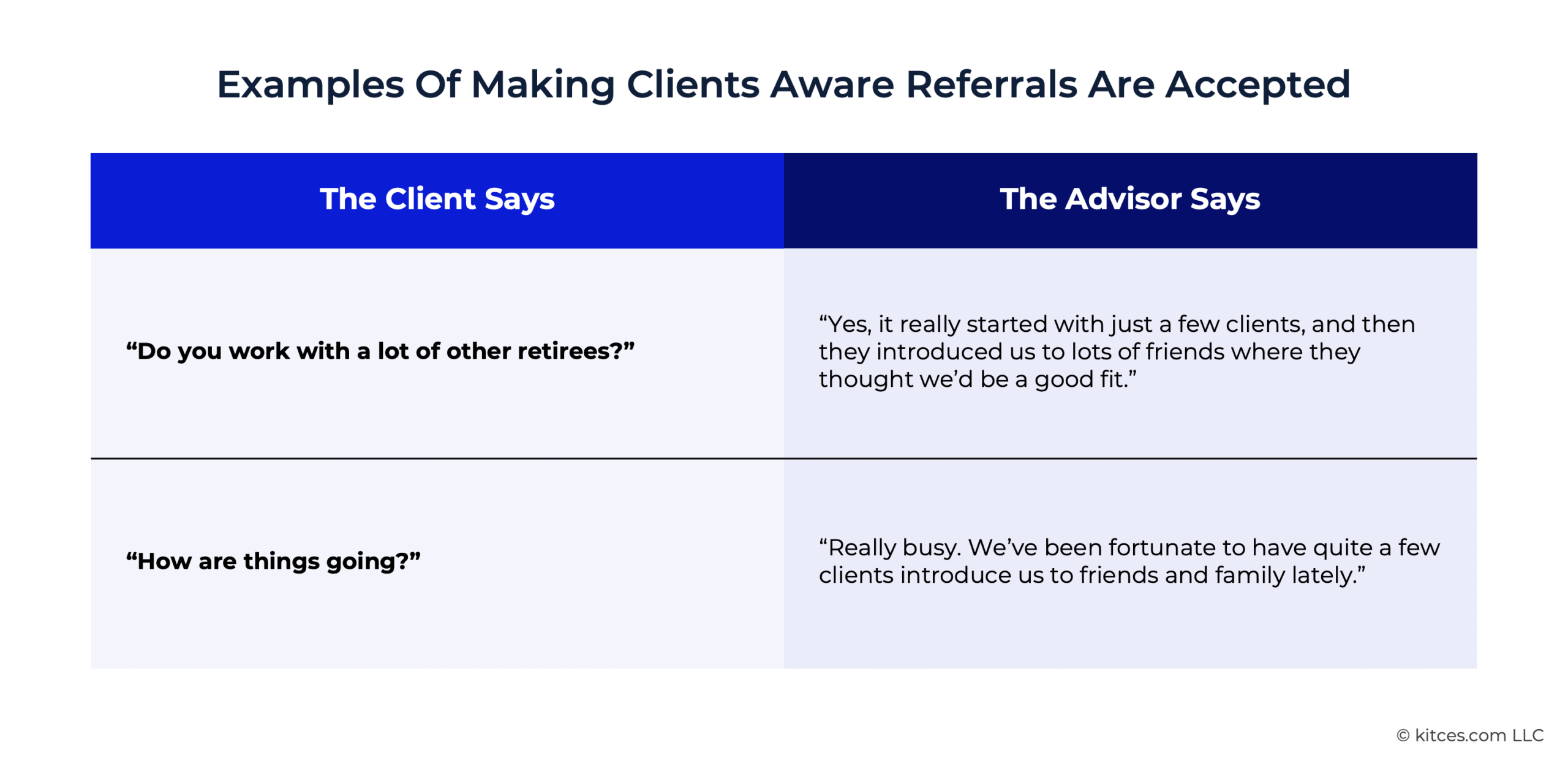
What does seem to help is simply making clients aware that referrals are accepted and appreciated, thus keeping the idea top of mind without explicitly asking. Advisors can do this on their website, in standardized communications, or through regular conversations with clients.
It's also important that clients know who they should refer. Some argue that conveying an ideal client persona (ICP) creates too much of a burden by requiring clients to remember the advisor's target market and judge who fits it, ultimately reducing referrals. However, we find the opposite: knowing the ICP helps clients recognize when someone in their network is a good fit, making them more likely to refer: advisors who verbally articulate their ideal client persona for referrals have a referral-driven client growth rate of 5.0%, versus 4.3% for those who don't.
A final, often underappreciated step is simply thanking clients for referrals. Advisors who don't thank clients have a referral-driven new client growth rate of 4.2%, rising to 5.2% with a personal "thank you" correspondence and 6.5% when that correspondence is coupled with a gift.
While these strategies are all designed to help advisors increase their number of referrals, some important context is necessary for how advisors should think about referrals within their broader marketing strategy. Our research has consistently found that practices achieving standout organic growth get only 25%–35% of their new clients from referrals, compared to 60%+ for practices not achieving standout growth. Which means practices looking to accelerate growth – or overcome persistently low growth – are unlikely to get there by optimizing referrals alone. Doing so ultimately requires succeeding with other marketing strategies that demand more work and/or capital. So while referrals aren't the solution to organic growth challenges, they are an important piece of the broader marketing recipe – and these strategies can help advisors make the most of the referral potential already embedded in their client base.

Client Referrals: The Most Widely Used And Well-Liked Marketing Tactic
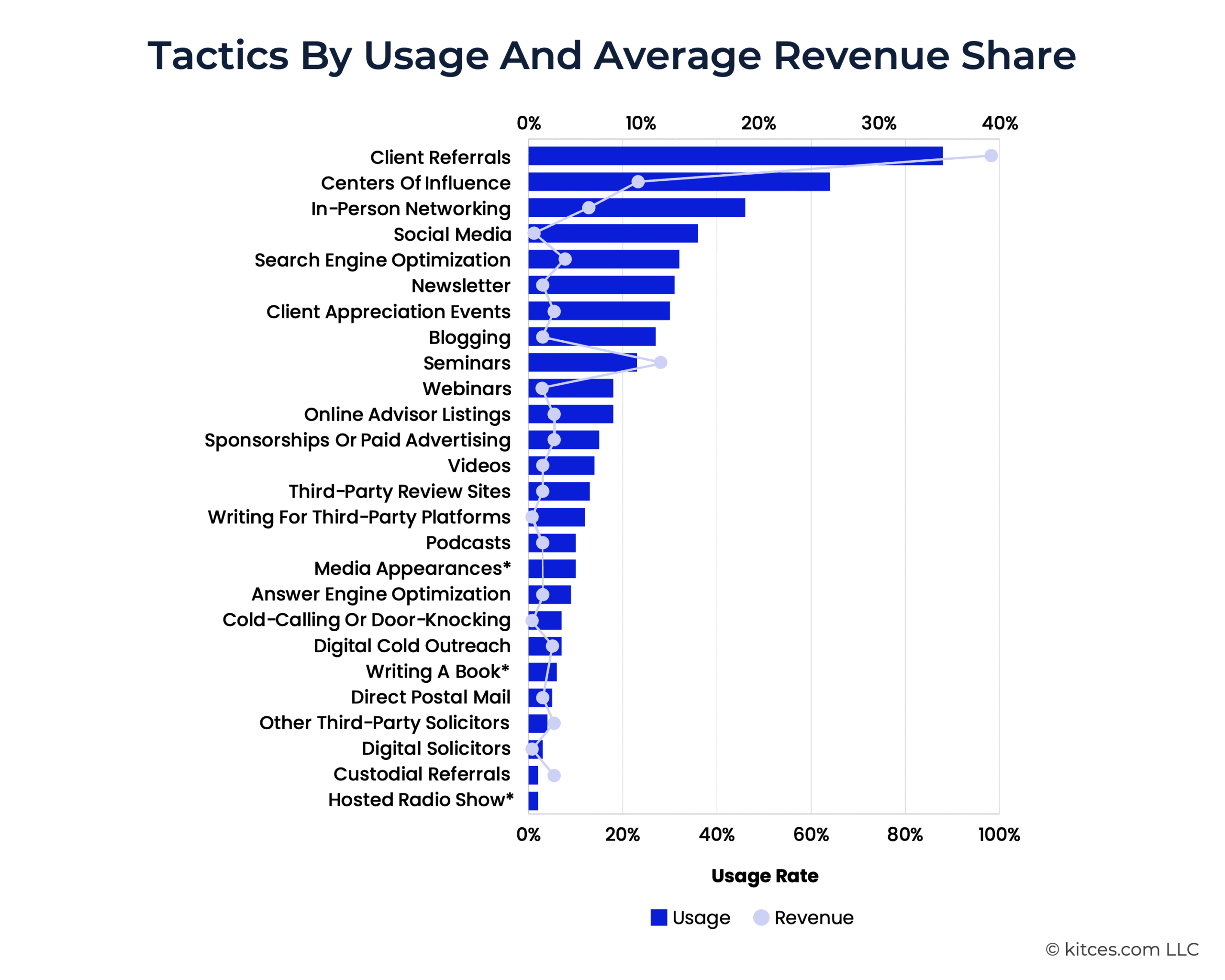
Client referrals have long been a cornerstone of advisor marketing. According to our recently released Kitces Research Study on Advisor Marketing (which is now available to download for free), client referrals are the most widely used marketing tactic, employed by 88% of financial advisors. They are responsible for an average of 44% of organic new clients, and for 48% of organic new client revenue. As the graphic below shows, no other marketing tactic comes close to client referrals in terms of widespread usage among advisors or the number of new clients it brings through the door.
 New Kitces Research Study on Advisor Marketing
The latest Kitces Research Report on Advisor Marketing is now freely available on the Kitces.com website! This is one of four original research studies – on advisor wellbeing, technology, productivity, and marketing - conducted by Kitces Research and shared with Kitces.com readers on a rotating schedule every two years.
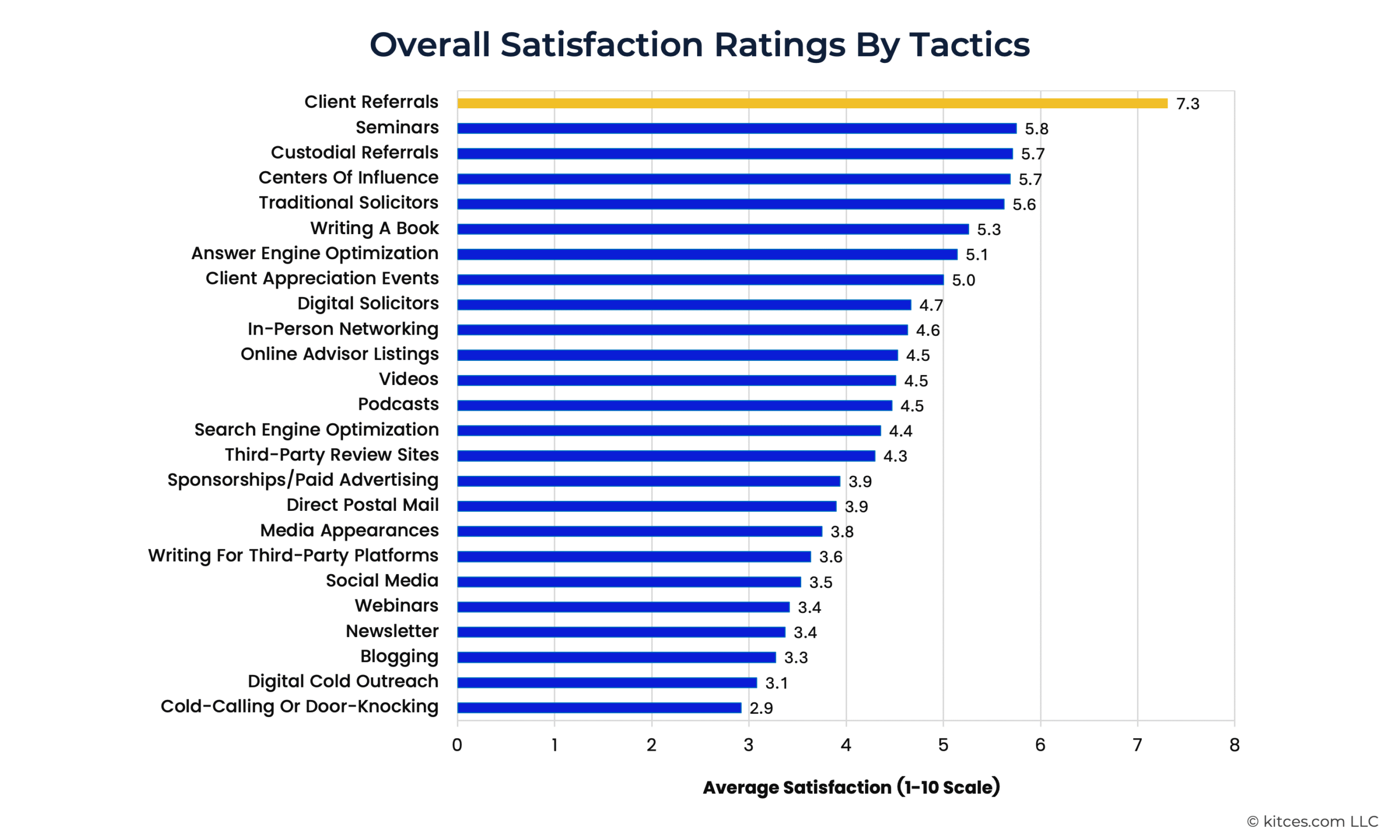
Given referrals' reliability for driving new client growth, it's perhaps not surprising that advisors tend to view them more favorably than other marketing tactics. When financial advisors are asked to report their overall satisfaction with the marketing tactics they use, client referrals stand out among the 26 possible tactics examined in our Kitces Research reports as the only one to average a rating above 6 on a scale from 0 (lowest satisfaction) to 10 (highest satisfaction).
The reasons behind the popularity of client referrals are straightforward. One is simply that referrals naturally play to most advisors' strengths: building trust and developing client relationships to the point where clients feel comfortable referring someone in their network to the advisor. In contrast, far fewer advisors would characterize their natural strengths as putting out generalized, compliance-approved content or cold-calling strangers.
A second reason behind their popularity relates to 'who' does the referring. Most marketing strategies can be thought of as 'active' in that their success directly hinges on the actions of someone within an advisory firm – whether an individual advisor knocking on doors, a centralized marketing team creating content for social media or spending money on paid advertisements, or a junior advisor proofreading emails generated by an AI-enabled prospecting tool before sending them out. Client referrals, by comparison, are a 'passive' marketing tactic. While there are strategies that advisors commonly employ to increase referrals (the subject of this article), fundamentally, the ability to generate new clients through this tactic hinges on actions taken by the client rather than the advisor. Specifically, it depends on the cultivation of personal and professional networks and, most importantly, the decision to refer someone from those networks to the advisor.
The passive nature of client referrals makes this tactic remarkably cost-effective when considering both 'hard dollar' marketing expenditures as well as the 'soft dollar' value of advisor (and staff) time spent marketing. In principle, client referrals require no 'hard dollar' marketing expenditures compared to, for example, paying for SmartAsset leads, buying postage for direct mail, or renting a venue for an in-person event. In fact, in our data, the typical advisory practice using client referrals spent $0 on them over the last year. And when practices do opt to spend money – such as on a small thank-you gift for clients – it generally doesn't add up to very much.
Turning to 'soft dollar' costs, unlike time-intensive tactics such as personally writing a newsletter or blog post, cold-calling, or door-knocking, client referrals don't incur much expense in the form of advisor and staff time because, again, successful referrals fundamentally hinge on actions taken by the client. Steps that advisors can take to increase referrals either don't take very long (e.g., asking for them) or can be part of the work you're 'already' doing for the client and thus don't necessarily constitute additional work (e.g., building trust and demonstrating value so clients want to refer others to you).
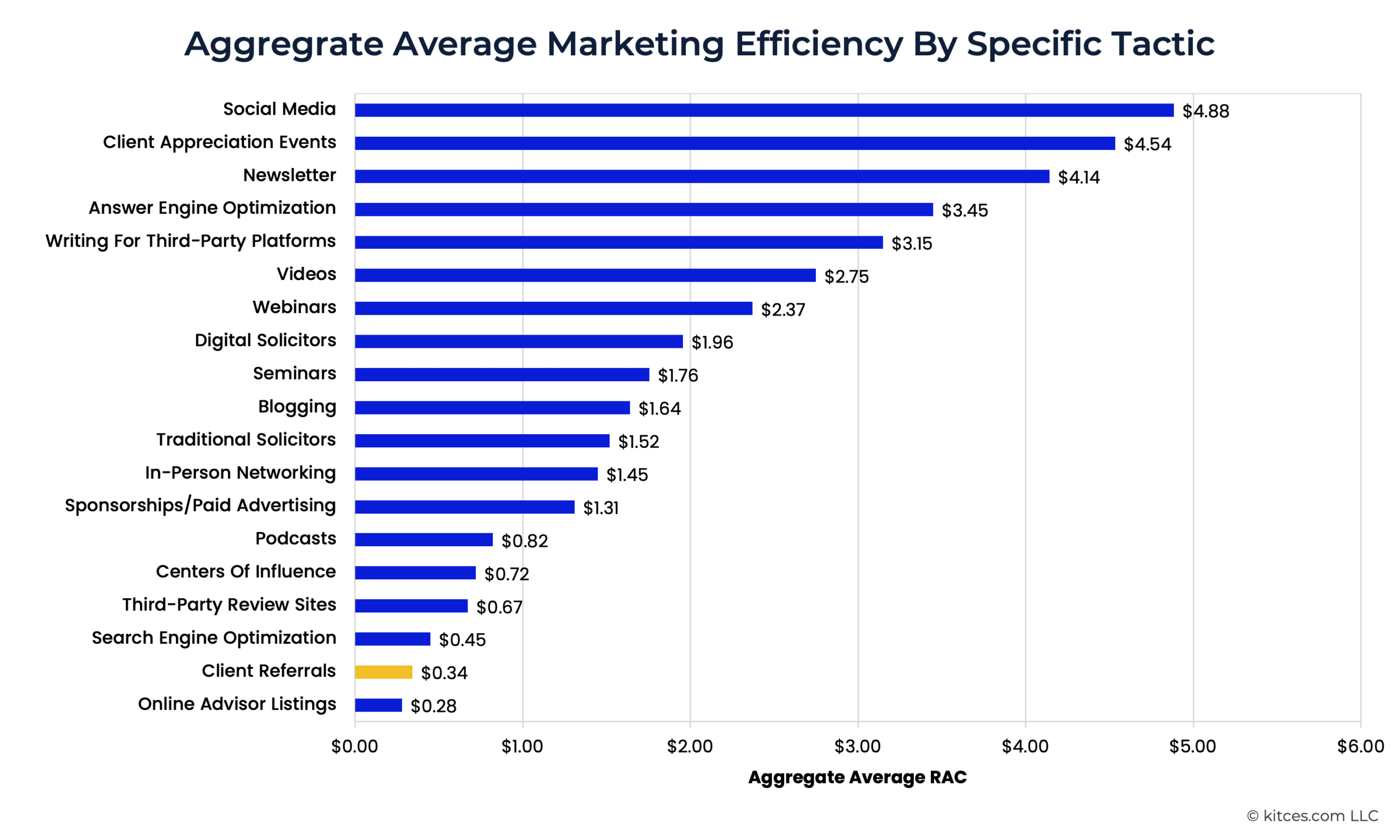
When viewing the hard and soft marketing costs of various tactics in conjunction with the new client revenue they generate, we can compare the cost-effectiveness of different marketing tactics by calculating revenue acquisition costs (RACs) – defined as the amount practices must spend to generate each additional dollar of annual new client revenue. This metric for the cost of acquiring new revenue may be familiar to those following the growing wave of M&A deals throughout the financial planning and wealth management space, where advisory firms are commonly priced as multiples of current revenue.
The high volume of referrals advisors receive coupled with the low hard and soft costs associated with this 'passive' tactic means that client referrals maintain one of the lowest RACs of the marketing tactics we examine: $0.34 vs the all-tactics average of $2.01.
The Downside Of Relying On Client Referrals For Growth
While the 'passive' nature of receiving client referrals explains why it is both so widely used and relatively well-liked as a marketing tactic among financial advisors, the fact that its success hinges on clients' own personal networks (as well as their willingness to make the referrals at all) means there are limits to how much client growth advisors can reasonably expect to generate via referrals.
One reason for this is that at some point, clients run out of individuals in their networks to refer. We can shed light on this dynamic by comparing client referrals (as a marketing tactic) with in-person networking (done by 46% of advisors). Advisors doing in-person networking are, by definition, themselves responsible for continually meeting new people and expanding their networks in order to create a steady stream of new prospects, and an increase or decrease in the time an advisor spends on networking activities generally leads to a corresponding increase or decrease in the amount of growth they achieve from this tactic. Advisors, therefore, have an incentive to keep expanding their own networks, and have the option of increasing their efforts (and therefore their potential growth via networking) through a greater time commitment.
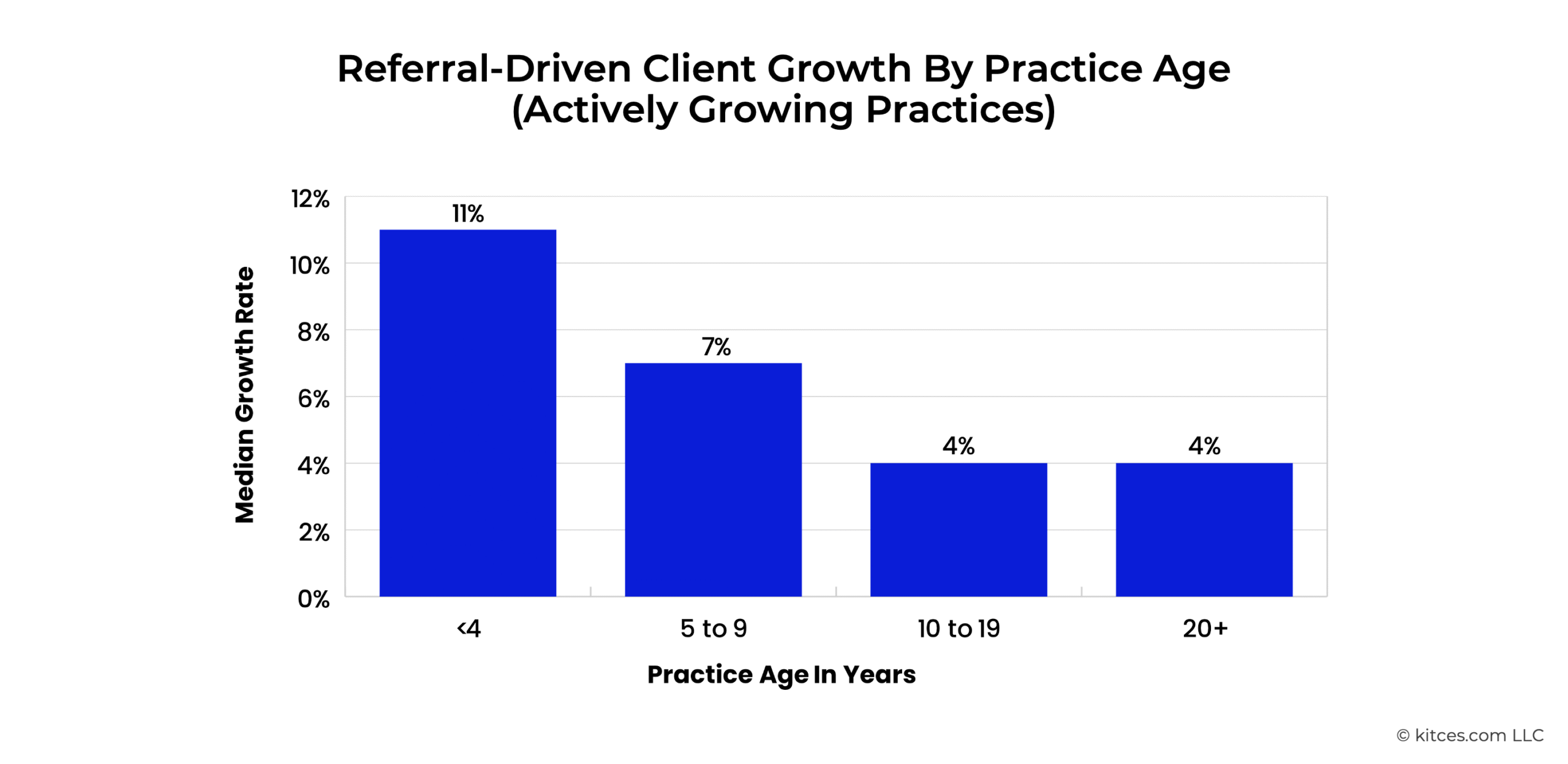
When it comes to client referrals, though, which are based on clients' networks, advisors have no assurance that clients are putting the same effort into intentionally cultivating and growing their personal networks as the advisor does into their own. In fact, it's generally safe to assume they are not. Which explains why, over time, our data indicates that the 'referral well' eventually runs dry as existing clients have fewer and fewer individuals within their networks to refer. As shown in the graphic below, among actively growing practices (i.e., excluding 'mature' practices no longer seeking further growth) organic new client growth rates attributable specifically to referrals decline from 11% for practices less than 5 years old, to 7% for those 5 to 9 years old, to just 4% for practices 10 years or older. This 'well running dry' dynamic in turn creates a negative feedback loop on organic growth, where referrals from existing clients begin to slow, resulting in fewer new clients with untapped networks who can in turn refer others.

Nerd Note:
The primary metric of referral success in this article is a practice's "referral-driven growth rate". This refers to organic new client growth attributable specifically to client referrals that advisory practices experienced in 2025. For example, if a practice's overall organic growth rate is 8%, 5 percentage points of which come from client referrals, their referral-driven growth rate is 5%.
And worse yet, because client referrals hinge on actions taken by clients, when firms hit a period where growth inevitably slows for one reason or another – and the data show it will if the natural decline in referrals isn't offset by other tactics – relying on referrals to the exclusion of other marketing tactics means advisory firms have fewer levers to pull to drive growth back up.
Client Referrals Alone Are Insufficient To Achieve Standout Growth
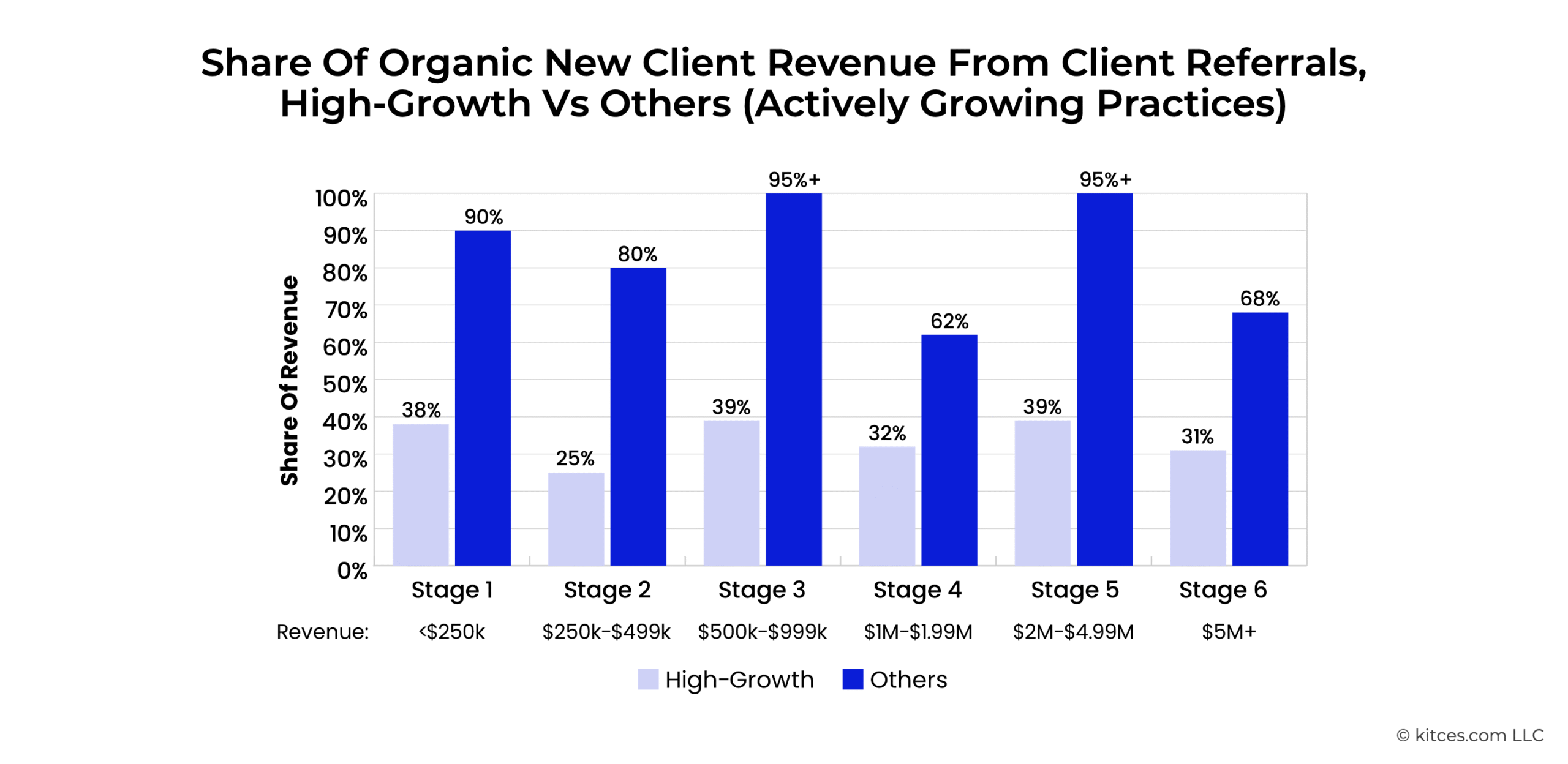
For these reasons, one finding we have repeatedly identified in our research reports on advisor marketing is that the fastest-growing advisory firms of all sizes are less reliant on client referrals and more reliant on tactics over which they have greater control. Indeed, among "actively growing practices" (i.e., practices seeking to grow through marketing, excluding "mature" practices no longer prioritizing growth), we see that "high-growth practices" (defined as those in the top third of organic new client revenue growth for their level of practice revenue) never receive more than 40% of their new client revenue from referrals. By contrast, among practices not achieving standout growth rates, this figure never falls below 60%!
Spending 1,000 words acknowledging the problems inherent in a heavy reliance on client referrals surely seems like an odd way to begin an article focused on optimizing this tactic. However, it's worth stating these problems plainly given the sheer number of advisory practices that fall into a 'referral coasting zone,' in which, once practices grow to a point where they receive 'enough' referrals to generate a modest but steady stream of new clients, they ultimately stop investing energy in alternative marketing tactics that demand far more time, energy, and hard and/or soft marketing costs from firms to execute successfully. Indeed, in our latest survey on the subject, a whopping 50% of practices (1) are actively seeking further growth, (2) are failing to achieve standout growth rates relative to peer practices of their size, and (3) receive more than 90% of their new clients from client referrals. Therefore, if you're a practice struggling with growth that is heavily reliant on client referrals, the solution to your growth challenges is unlikely to come from the implementation of tips to optimize client referrals found in this (or any other) article. Instead, it is going to come from the difficult work of, at minimum, learning to execute one non-referral 'anchor tactic' successfully so that your growth is more directly within your control.
And so, rather than viewing client referrals as a central growth engine, they should be thought of as one important ingredient within an advisor's broader marketing 'recipe'. Optimizing a client referral strategy is simply a matter of taking full advantage of a growth resource that all advisors have access to: their own clients.
Value: A Prerequisite To Driving Referrals
When a client refers their advisor to someone in their network, there's often very little direct benefit for them in doing so. In the best-case scenario, the referral works out for the advisor and for the individual that the client refers, and it's those two parties who get most of the benefit from the referral. But if the referral doesn't end up working out – e.g., if the referred prospect isn't a good fit and doesn't become a client, or even worse, if they do become a good client but don't feel that they receive good service from the advisor – the original client may feel that their personal reputation is at risk with both parties. A major prerequisite, then, for getting clients to spend their time and put their own reputation on the line to make a referral is for the client to feel like the advisor is providing real value that they don't want others to miss out on. This is because clients who aren't highly satisfied with the services the advisor is providing are less likely to even think of recommending that advisor throughout their daily interactions with others – let alone trust that the advisor will provide good service to someone whom the client refers.
The use of client-centered language in the paragraph above (i.e., "feeling like" the advisor is providing value – as opposed to "providing value") is deliberate here, because it gets at the importance of not just the deliverable or action taken by the advisor, but also how it is communicated or presented to the client. No matter how well-constructed a portfolio is or how high-quality the solutions in a financial plan are, if clients are unaware of the value provided (or if it's presented in a way that clients don't understand, such as with overly technical, jargon-heavy language), they won't feel compelled to go out and tell others about it. In short, advisors must both create and communicate value.
One way that the power of demonstrating value shows up in the Kitces Research on Advisor Marketing data is when comparing practices' organic new client growth rates from client referrals based on whether or not the advisor uses a client service calendar. Client service calendars refer to schedules that dedicate particular client service activities for all clients to occur during specific periods throughout the year. Client service calendars can vary in terms of the number of client service periods per year (e.g., four – aligning with each quarter, or six – each spanning two months), the number of activities within each period (e.g., one or two deliverables per period), and the specific activities included within the calendar. Regardless of the specific structure, Kitces Financial Planning Nerd Adam Van Deusen, CFP, characterizes these calendars as helping advisory firms demonstrate ongoing value to their clients, and avoiding the buildup of "shadow work" that advisors complete behind the scenes without clients' knowledge.
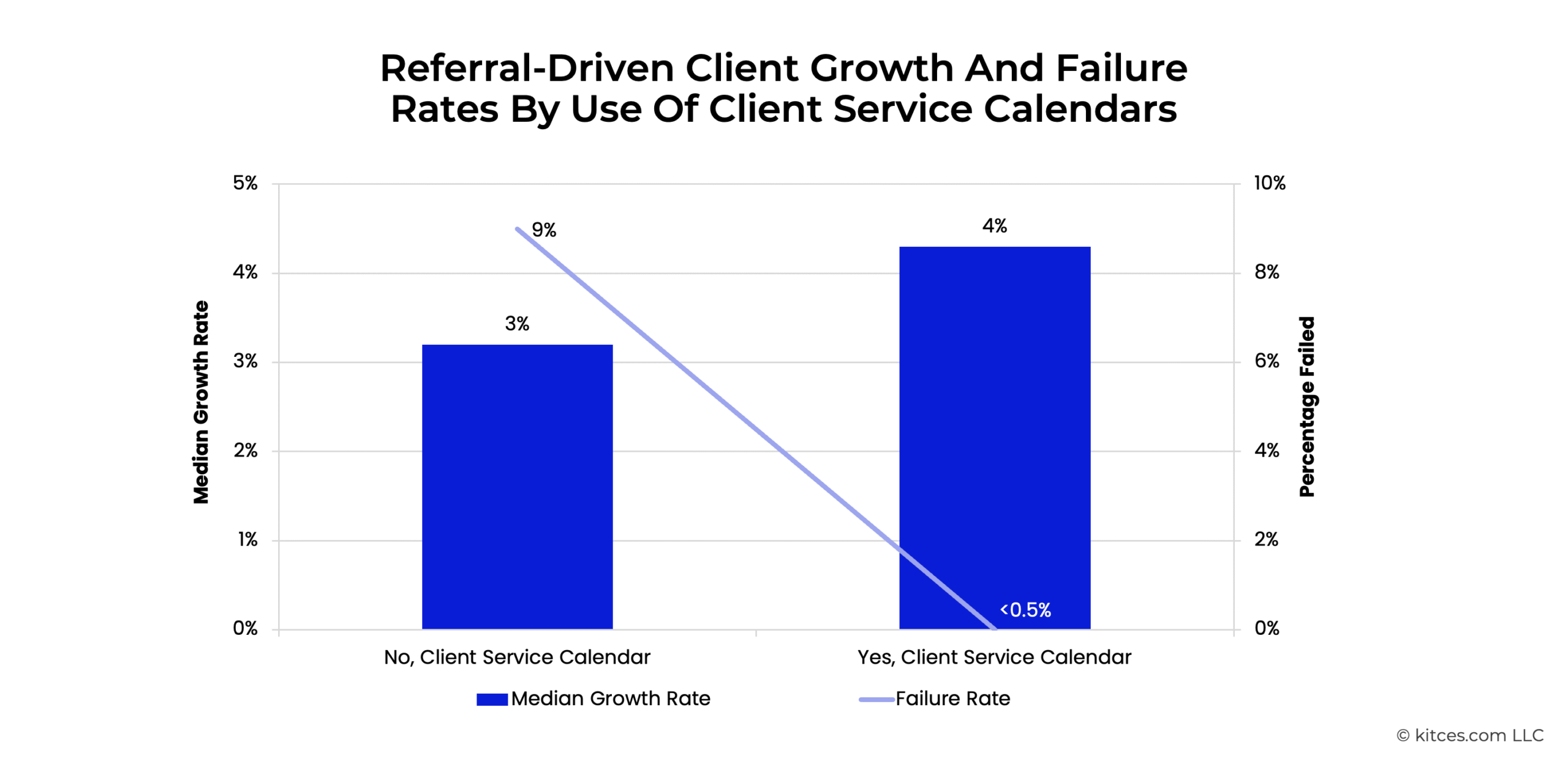
As shown in the graphic below, among actively growing advisory firms using client referrals as a marketing tactic, those using client service calendars have a 1.1-percentage-point greater referral-driven client growth rate than practices not using them (e.g., a practice with 100 clients generating 4 clients per year from referrals instead of 3), and have a "failure rate" (i.e., not gaining any new clients via referral over the last 12 months) of less than 0.5%, compared to 9%. Which suggests that the structured way in which client service calendars can help advisors deliver and communicate their value may also help clients feel more comfortable in referring the advisor to people in their network.
Notably, although client service calendars aren't a marketing tactic themselves, there is data suggesting that they can aid advisors' marketing efforts by helping the advisor clarify their value proposition: actively growing practices using client service calendars had overall organic client growth rates of 15% versus 10% for advisors not using client service calendars. Which suggests that in addition to increasing the likelihood of referrals from existing clients, client service calendars can also help convert prospects into clients because they effectively demonstrate the ongoing value-delivery system the advisor has in place.
Ultimately, this high-level comparison of the use of client service calendars is simply a useful approximation of the benefit of creating and communicating value. A client service calendar is just one way for advisors to articulate their value, but many advisors excel at these skills without using one. The key point instead is that, prior to asking clients for referrals, advisors can first ask themselves how much of the value they think they're providing clients is really behind-the-scenes "shadow work" from which clients are, by definition, perceiving no real benefit – and which therefore creates no compelling reason for clients to recommend the people they know to benefit from that value themselves. Ensuring that value is both created and communicated is the crucial first step toward getting clients to take the time and have the trust to refer others to you.
Asking For Referrals: Increased Frequency Does Not Translate Into More Success
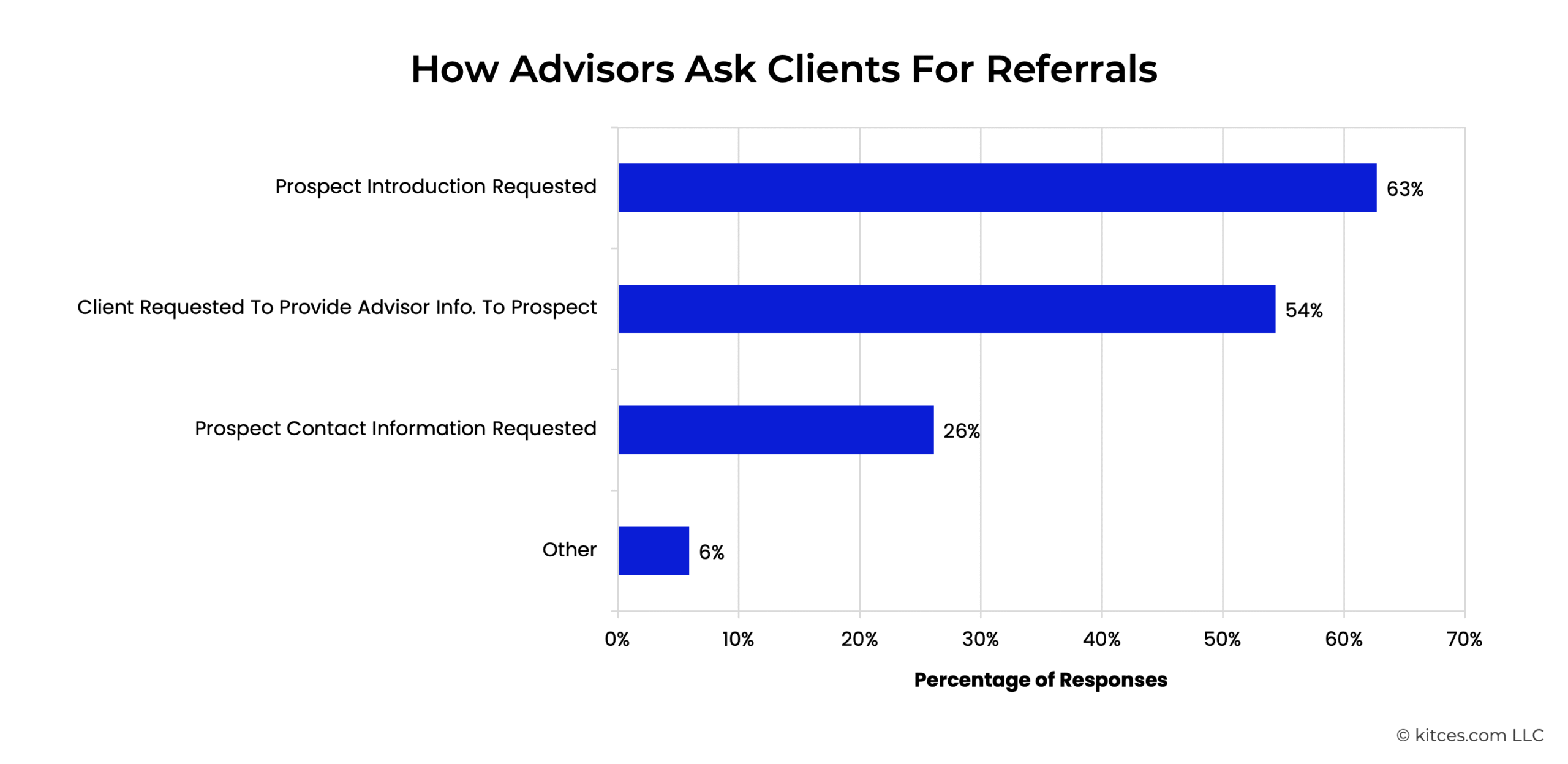
The natural starting point for generating referrals is to explicitly ask clients for them. As shown in the graphic below, the most common approach taken by advisors is asking the client for an introduction to the prospect (done by 63% of advisors who ask for referrals), followed by asking the client to provide the advisor's information to the prospect so they can take the first step and reach out (54%), as well as asking for the prospect's contact information so the advisor can reach out directly (26%).
Regardless of which of these (or other) strategies advisors use to ask clients for referrals, the process can often feel awkward for both advisors and clients in the moment because it can put clients 'on the spot' and potentially lead them to question whether the advisor's primary motivation in providing guidance throughout the meeting is genuine concern for their well-being or simply generating additional revenue.
The unpleasantness of this experience from the advisor's perspective can be seen in the graphic below, where the blue bars show advisors' average satisfaction rating with client referrals as a tactic on a 1–10 scale. While advisors who ask for referrals just once over the course of the advisor-client relationship actually have a slightly higher satisfaction rating (7.6) than advisors who never ask for referrals (7.5), beyond this single ask, referral satisfaction declines as advisors ask more frequently, falling to 6.9 for those who ask more than once per year. In other words, in general, the more advisors keep asking the same client for referrals, the less enjoyable this tactic is for them.
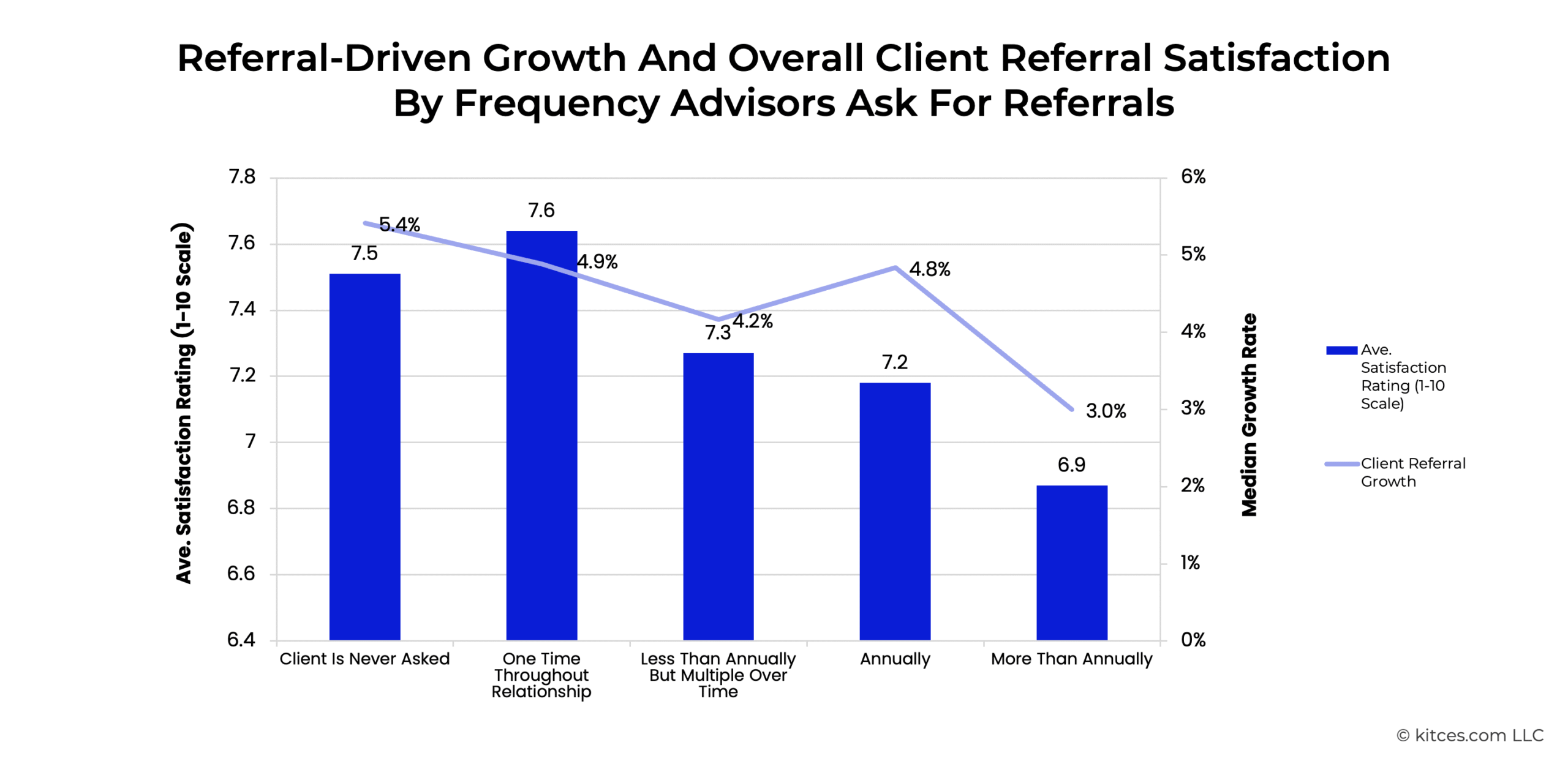
Of course, from a business perspective, a little discomfort might be worth it if it results in more client referrals overall. However, this doesn't seem to be the case. As shown in the same figure above, the light-blue line representing referral-driven client growth rates generally declines as advisors ask more frequently, falling from 5.4% for advisors who don't ask at all, to 3% for those who ask clients more than once per year. To account for the possibility that this decline may be attributable to older practices already experiencing lower referral rates (because of the 'well running dry' phenomenon discussed earlier) and therefore being more likely to ask as a last-ditch attempt to increase referrals, we also ran a version of this analysis segmented by practice age. We found some evidence that, for practices older than 10 years, referral-driven growth rates remain fairly level rather than declining as practices ask more frequently. But we found no evidence that asking more frequently increased referrals for practices of any age. This indicates that, to the extent clients may voluntarily provide advisors with referrals in the moment, being asked for referrals can turn them off from providing referrals in the future, such that total referrals either decline or at best remain level as advisors ask more frequently!
Making Clients Aware That Referrals Are Accepted
Beyond explicitly asking for referrals, though, advisors can simply increase awareness among their clients that referrals are accepted and appreciated, thus keeping referrals top of mind for clients without risking an unpleasant experience. There are many ways advisors can do this, such as indicating it on their website, noting their openness to referrals in standardized communications (e.g., a newsletter or email signature), or integrating the message into more personalized conversations with clients. Examples of how advisors can work the fact that they accept referrals into regular client conversations are shown in the table below.
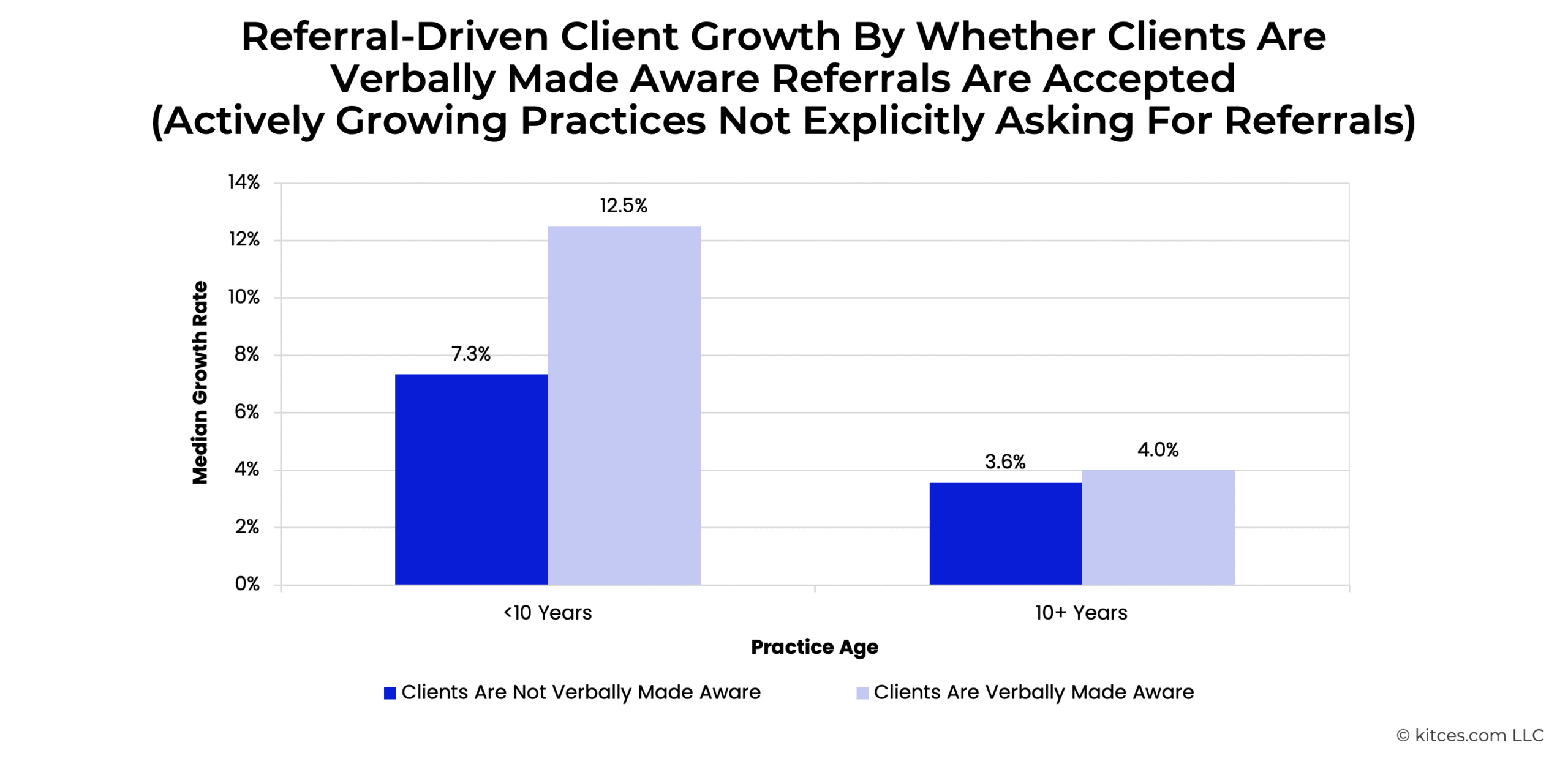
Among actively growing practices that don't explicitly ask for referrals, passively encouraging them does correspond with an increase in client growth, from 7.3% for practices that don't passively encourage referrals to 12.5% for practices that do, as shown in the graphic below. Beyond the 10-year mark, though, this disparity falls to 3.6% and 4.0%, respectively. The first implication is that proactively making clients aware that referrals are accepted really does seem to increase referral volume without clients being turned off by the negative interaction of explicitly asking. But a second implication is that the fact that volume declines so considerably after the 10-year mark underscores a point made earlier in this article about the importance of diversifying marketing strategies beyond client referrals before the well runs dry and volume inevitably slows. Taken together with our earlier findings, then, this suggests that explicitly asking for referrals doesn't generate nearly as many as simply making clients aware that the door is open. Advisors don't have to ask; they just need to put the idea in front of clients and reinforce it in whatever ways make sense.
Having (And Conveying) A Clear Ideal Client Persona
In addition to making clients aware that they're able to refer friends or colleagues to the advisor, it's also important to ensure that clients know who they should refer.
On the surface, it may seem that placing any sort of limits on the types of individuals that clients can refer will, by definition, result in fewer referred prospects. However, as many advisors are aware, referrals are very often outside of an advisor's Ideal Client Persona (ICP), e.g., by being outside of the advisor's niche, unable to meet minimum fees, or otherwise not a good fit. These prospects are either ultimately not accepted by the firm or – sometimes even worse – are accepted, which risks the firm accumulating too many clients that are either unprofitable or who don't have the types of needs or financial circumstances that the advisor has built their value proposition around serving.
Stating explicitly which types of referred prospects the advisor will or will not accept as clients can in theory reduce the number of potential bad-fit prospects (as well as potentially awkward situations where the advisor must turn away a prospect that their client took it upon themselves to refer). But in terms of whether advisors communicating their ICP to clients can successfully increase the number of referrals within that ICP, there are generally two opposing schools of thought.
The first approach posits that conveying ICPs for referrals to clients will not be successful because doing so places too much of a burden on the client, which ultimately serves to discourage referrals altogether. This is because clients must not only remember an advisor's ICP when interacting with others in their network, but must also make a judgment as to whether those individuals align with that profile. Which doesn't necessarily mean that advisors shouldn't have an ICP – instead, under this school of thought, rather than the responsibility for maintaining an ICP falling on the referring client, the advisor should have a robust screening process to filter out prospects who fall outside of their core target market (and ideally, politely refer them to another advisor who may be a better fit).
A second school of thought posits that conveying an ICP actually helps advisors increase the number of referrals within target population because this knowledge helps clients more readily identify whether someone in their network is a good fit for the advisor. For example, a client who knows their advisor specializes in helping recently retired physicians may be more likely to think of the advisor when a physician colleague announces their retirement.
Ultimately, our Kitces Research data offers far more support for the second view. The graphic below displays referral-driven client growth rates (y-axis) based on whether advisors do each of the things displayed on the x-axis.
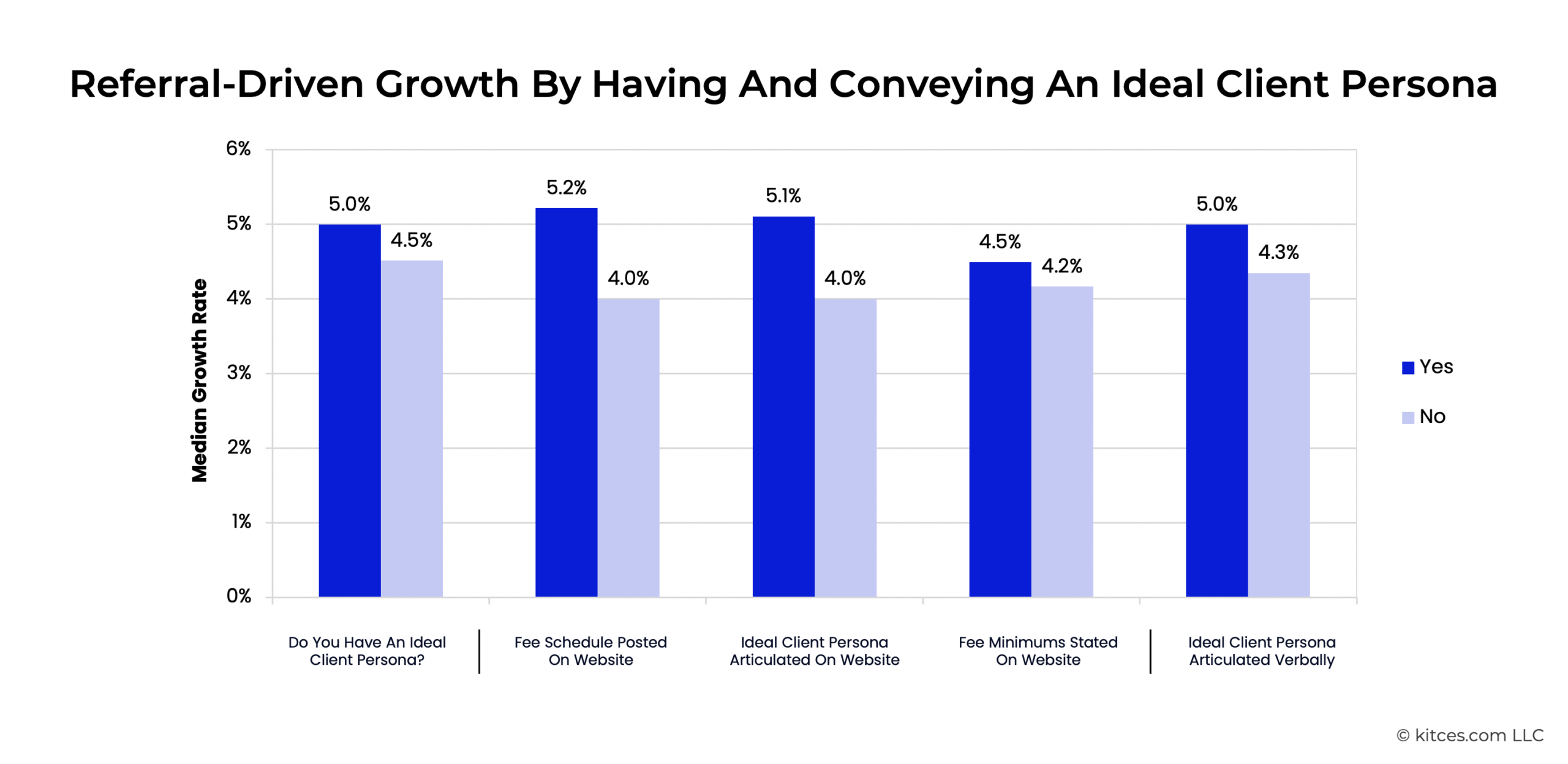
On the left-hand side, we see that merely having an Ideal Client Persona (as opposed to serving a wide variety of clients who don't neatly fit into a single persona) corresponds with receiving more referrals (5% median growth rate versus 4%). The middle of the chart looks at ways advisors can convey their ICP on their website – both explicitly, and indirectly (by, for example, posting their fee schedules and minimums, which can convey the level of affluence required to work with the advisor). Each of these website markers corresponds with receiving more referrals. And finally, the right side of the graphic looks at verbally conveying an ICP to clients, which also corresponds with receiving more referrals. Taken together, rather than placing too much of a burden on clients, having (and conveying) a clear ICP really helps clients gain clarity on whom would be a good fit to work with the advisor, leading to more referrals as a result.
Thanking Clients For Referrals
There is a final, simple – but often underappreciated – step that advisors can take to make the experience of providing a referral more positive for the client: thanking them! Even if doing so doesn't always lead to more referrals, expressing appreciation is important because it can strengthen the level of goodwill that made the client willing to make a referral to begin with (and that will hopefully keep them as a paying client to begin with), and hopefully make them feel good about having taken the risk of putting their own reputation on the line on the advisor's behalf.
However, the graphic below makes clear that showing clients gratitude for their help really does make them more willing to send referrals: advisors who don't thank their clients after receiving a referral have a referral-driven client growth rate of 4.1%, compared to 5.2% for advisors who 'just' offer a personal thank-you, and 6.5% for advisors who couple a personal thank-you with a gift, meal, or some other gesture of appreciation.
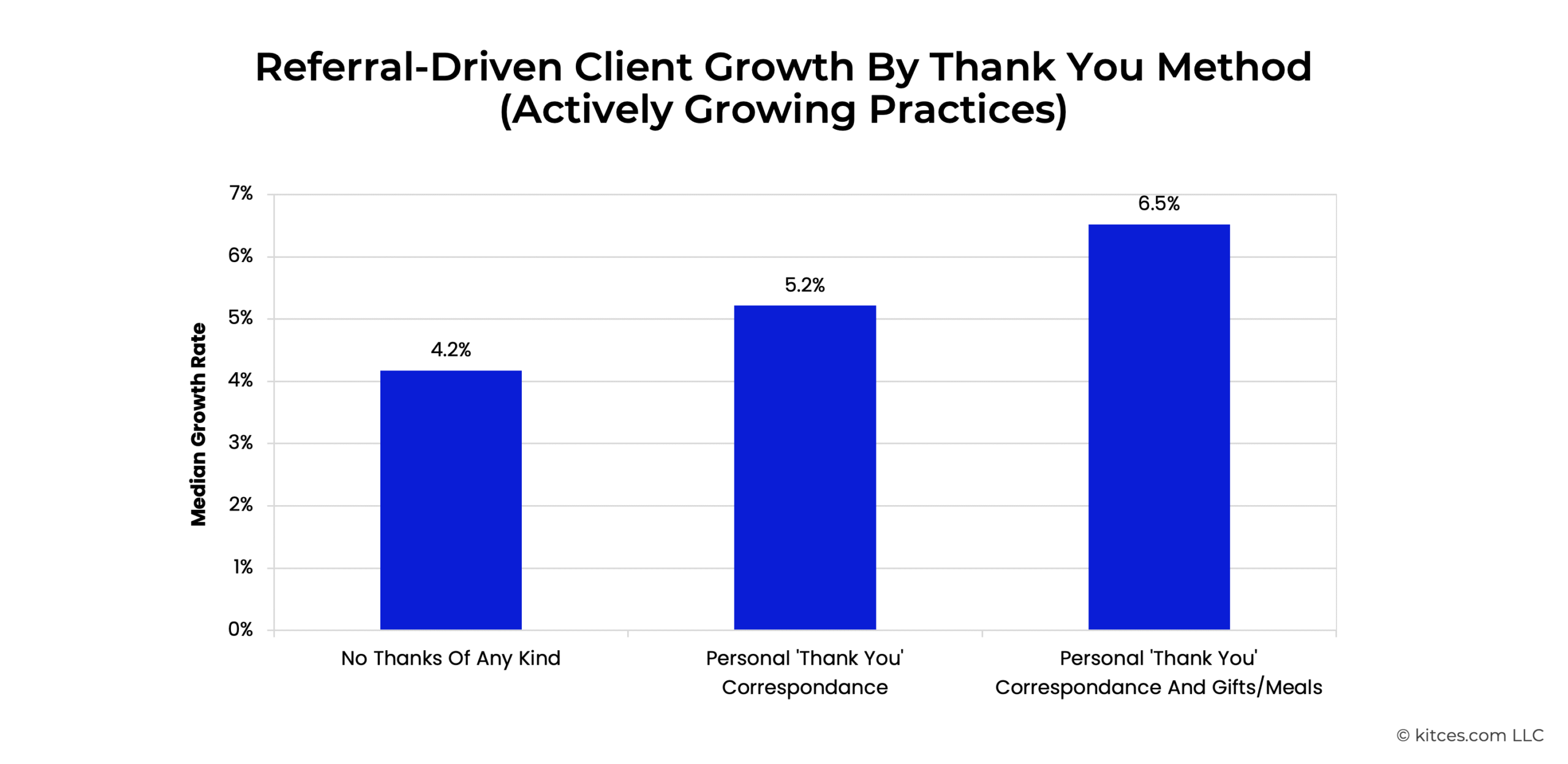
In other words, even though referring their advisor to a friend or colleague might put the client in a vulnerable or potentially uncomfortable spot, the experience of being rewarded (or even just feeling appreciated) for doing so can make them more willing to do it again.
Ultimately, while advisory practices achieving standout growth rates are the least reliant on client referrals, referrals still comprise about a third of these high-growth practices' new clients. Which means that while optimizing referrals isn't going to be a panacea for practices with persistent organic growth struggles (who ultimately need to break out of the 'referral coasting zone' and begin to excel in other marketing tactics), advisors aren't powerless to increase the number of referrals that they receive – despite the success of this tactic hinging on the actions of clients. Specifically, if advisors deliver value to clients in a way that makes that value apparent to them (e.g., by systematizing deliverables into a client service calendar), increase awareness among clients that referrals are accepted without explicitly putting anyone on the spot, clearly communicate an Ideal Client Persona so clients can more readily identify when someone in their network is a good fit, and remember to show appreciation to clients (both with a personal thank-you and a small gift or other gesture of appreciation), then advisors stand a higher chance of fully realizing the growth potential of their existing client base!