
Executive Summary
The typical estate planning process entails inviting clients to decide what will happen to their wealth when they are no longer alive (i.e., "who inherits what"), and the selection of individuals who can make financial and health care decisions on their behalf in the event they are incapacitated (whether due to accident or disability or dementia in their elder years). For most clients, these decisions are relatively straightforward: their primary heirs are their children and grandchildren, who can also step in as their medical and financial attorneys-in-fact in the event of incapacitation and serve as executors and trustees after the client passes away. Yet the reality is that nearly 25% of the adult population is "Childfree" – whether by choice or by circumstance – and for those clients, the traditional estate planning process breaks down the moment they realize that there are no children (or other immediate family members) to be named as executor, attorney-in-fact, or trustee.
In this guest post, Dr. Jay Zigmont, founder of Childfree Wealth and Childfree Trust, explores how the unique circumstances of Childfree clients turn traditional estate (and long-term care) planning upside down, to the point that relying on traditional estate documents and their standard provisions can actually cause outright harm to the Childfree client's planning goals.
The starting point is to recognize that for Childfree clients who don't have children, 'just' coming up with someone to serve as attorney-in-fact, executor, and/or trustee, can be a remarkably difficult decision. In the event of having no "obvious" choices in their immediate family, many will defer planning altogether, resulting in a stalled estate plan. In other cases, they may choose a more distant relative, not recognizing the problematic conflicts of interest that arise when their financial and medical decision-maker is also the one who will inherit all the dollars not used (and therefore have a direct incentive to minimize how much of the individual's own money is spent on their care, increasing the risk of elder financial abuse).
In addition, because the focus of estate planning for Childfree clients is disproportionately focused on enjoying and utilizing their money while they are still alive (as there are no children to prioritize for an inheritance), traditional estate planning clauses like limiting distributions for HEMS (Health, Education, Maintenance, and Support) are unnecessarily limiting to trustees of Childfree clients' trusts. Instead, "Exhaustion for Care" provisions (that explicitly grant permission to the trustee to use most or all of the trust funds for the grantor's care while still alive) become crucial to ensure trustees really can safely use the Childfree clients' funds for their needs. And long-term care insurance also becomes a more integral part of the plan, when there are no children (or often any other immediate family members) to provide care.
Fortunately, though, there are a growing range of options for Childfree clients to find proxies who can serve to fulfill their key roles (without putting advisors themselves into the awkward position of serving as trustee and making end-of-life decisions about their own clients). Some states like California and Arizona have state-licensed fiduciaries. Many advisors have local bank and trust companies that are willing to serve (albeit not always for the unique pet, exhaustion-for-care, and other circumstances of Childfree clients). And Zigmont himself created a service called "Childfree Trust" to help solve for the gap for Childfree clients in states that don't have effective local solutions.
Ultimately, the key point is to recognize that the traditional estate planning approach just doesn't work for Childfree clients. Not simply because they don't necessarily have children as immediate heirs that they wish to preserve for and pass on assets to, but because the lack of children often means a lack of caretakers (in the event of long-term care needs), and potentially paralyzing uncertainty about who to name into key attorney-in-fact, executor, and trustee roles, while traditional estate planning documents include terms that can outright limit trustees from fully utilizing a Childfree client's assets for their actual care. As a result, planning for Childfree clients requires a more tailored approach to the unique challenges and goals when serving such clientele.
In the day-to-day practice of comprehensive financial planning, an uncomfortable, profound silence occurs entirely too often when working with a Childfree client, meaning someone who doesn't have kids and doesn't plan on having them ever. You sit across the conference table, meticulously walking through their net worth projections and their estate planning flowcharts, and you ask a standard, baseline question: "Who will make your medical and financial decisions for you if you become incapacitated?"
For most clients with children, answering this question takes thirty seconds. They name their spouse as the primary agent and list their adult children as contingents. The document gets drafted, the signatures are notarized, and the financial plan moves forward to the next module.
When you ask a Childfree client this exact same question, they freeze. They stare back at you. They do not know who to choose. It is a question that Childfree people get all the time: "Who is going to take care of you when you are older?" It is an area they know is a problem, and because you, the advicer, likely do not have a vetted list of professional alternatives to offer, the entire financial planning process hits a brick wall.
The financial planning industry relies completely on a set of societal assumptions I like to call the Standard LifeScript. We build our software, workflows, and legal documents on the premise that a client will go to school, get a job, get married, buy a house, have kids, retire, and pass on whatever generational wealth they didn't use by the time they pass away. As part of that journey, we implicitly assume a built-in safety net of adult children who will automatically step in to act as default caregivers, Powers of Attorney (POAs), and Executors.
For the approximately 25% of the United States population identifying as Childfree or permanently childless (per research from Michigan State University), these boilerplate assumptions fracture. The lack of adult children fundamentally alters the trajectory of their later years. When you plan for a client without children, you cannot wait for late-stage life events to trigger the estate planning process. You cannot rely on a spouse who is aging at the exact same rate as your client, nor can you assume a distant niece or nephew is equipped or willing to handle complex medical advocacy.
I previously detailed the foundational elements of serving this demographic for Kitces in Financial Planning for Childfree Clients. That piece established the groundwork: how SINKs (Single Income, No Kids) and DINKs (Dual Income, No Kids) require a radically different approach to cash flow, how they want to "Die With Zero", why Own-Occupation Disability Insurance is significantly more critical than life insurance when no one relies on your income, and how to adapt your intake processes to avoid alienating these clients.
But recognizing the demographic niche and addressing cash flow are only the first steps. To truly fulfill your fiduciary duty, advicers must systematically address the most complex and critical gaps for single and Childfree clients: long-term care (LTC) and estate planning. Remember that as a fiduciary you have a responsibility to understand your clients' specific needs and goals, and then adjust the plan accordingly.
To scalably and ethically serve Childfree clients, advicers must completely invert the traditional long-term care and estate planning timeline. We must initiate "lifetime care defense" by the time the client reaches their mid-40s, and preferably earlier. Failing to systematically address the legal and care planning gaps for single and Childfree clients leaves them dangerously exposed to state-run court guardianships or conservatorships, which is virtually never the clients' stated preference, yet becomes an inevitable outcome if a better alternative plan is not actually implemented.
The Systemic Vulnerability Of The "Next-Of-Kin" Default For Elder Care And Support
The foundation of the financial planning industry's estate and long-term care planning framework is the next-of-kin default. We build our models assuming a linear hierarchy of family members ready not only to inherit assets but also to execute a client's wishes. For a quarter of the American population, this hierarchy simply does not exist, which not only leaves a gap for who will step in to act, but removes what is otherwise a common trigger to begin the planning process in the first place.
As while parents are often motivated to plan by the birth of a child—a powerful, non-negotiable catalyst to name guardians and secure life insurance—Childfree individuals lack this specific trigger. If it isn't having kids that drives them to create an estate plan, it is often buying a house, which is also something I have found fewer Childfree people are doing. This leaves a "motivation vacuum" that advicers must proactively fill. Without this inherent prompt, financial advicers cannot rely on traditional life-stage triggers to initiate the estate planning conversation for Childfree clients. We must step in and guide the client through the difficult reality of aging without a traditional familial safety net.
The "Decision Void": Heir Paralysis And Agent Anxiety
When an advicer asks a Childfree client who will make their decisions during a period of incapacity, the workflow stall is not merely a symptom of procrastination. It is rooted in a deep psychological barrier identified in the 2025 Childfree Trust white paper "The Childfree Care Crisis: Estate and Long-Term Care Readiness in the Childfree Population" as the "Decision Void."
According to the data, this void is characterized by two distinct phenomena: Heir Paralysis and Agent Anxiety.
Heir Paralysis occurs because the client lacks default beneficiaries. Without children automatically inheriting their wealth, deciding who gets the money becomes a complex, emotionally heavy process. They must evaluate their relationships with siblings, nieces, nephews, friends, and charitable causes—a task many find completely paralyzing.
Agent Anxiety is the profound difficulty in selecting an appropriate person to act in critical roles such as Executor, Financial Power of Attorney, or Healthcare Proxy. Appointing a sibling or a close friend of a similar age raises immediate concerns about their own longevity and cognitive capacity. They will likely age at the exact same rate as the client, making them highly unreliable proxies for late-stage life events. Alternatively, naming a younger niece or nephew can feel like placing an unfair, monumental burden on someone busy building their own life and career. As one respondent in the 2025 study noted, "All our nieces and nephews are still very young, so it doesn't feel appropriate to sign them up for such a big task."
Because the decision is so fraught with anxiety, the client avoids the estate planning process and paperwork entirely. The 2025 study found that only 19.9% of Childfree people had a will in place, and that the top reason they did not complete their estate plan was the lack of someone to name as executor. The estate planning module of the advicer's workflow remains permanently stuck in the "pending" phase.
This inaction leaves the Childfree client's assets completely unprotected. If a Childfree individual suffers a severe medical event without appointed agents, the state steps in. The court appoints a professional guardian or conservator to make medical decisions and manage their assets, handing your carefully crafted financial plan over to a court-appointed stranger. No one wants a court-appointed stranger making decisions for them.
Perpetual Inaction Is The Only Result Of "Go Think About It"
What actively prevents advicers from solving this roadblock is our industry's heavy reliance on traditional estate planning attorneys and online legal services that utilize boilerplate documents designed exclusively for nuclear families.
Standard practice dictates that when a client needs an estate plan, the advicer refers them to an attorney. The attorney sits down with the client, asks the exact same question about proxies, and receives the exact same blank stare. The attorney then tells the client to "go think about it and come back when you have a name."
Weeks pass. Then months pass. Then years. The documents are never drafted, and as the client ages, the risk of cognitive decline increases both the likelihood of needing to exercise documents and the potential that clients will no longer have the capacity to execute documents in the future.
In theory advicers could intervene to get the planning process on track, but many (or even most?) fail to do so, because they lack a vetted network of professional fiduciaries that they could suggest to the Childfree client to step into these proxy roles. Advicers are rigorously trained in asset allocation, tax optimization, and safe withdrawal rates. We are not historically trained to source, vet, and integrate professional healthcare proxies or corporate executors for clients. Consequently, advicers unwittingly leave their Childfree clients stranded in an endless loop of inaction, instead of helping them overcome the inaction by aiding the process of finding an agent.
In fact, it's not uncommon for Childfree clients to ask their advicer to become their POA and trustee! Yet in practice, this is not a practical solution for most; besides the fact that it would immediately give you custody, including the higher regulator scrutiny, it comes with a lot of risk and responsibility outside the advicer's typical processes and workflows. Especially since planners are not trained to make medical decisions on behalf of clients.
Demographics Reveal An Escalating Planning Crisis
Demographic data proves this is an escalating crisis that the financial planning profession can no longer ignore. We are not dealing with a fringe subset of clients; we are looking at a massive, structural demographic shift.
When we look specifically at the aging population, approximately 11% of Americans aged 55 and older are Childfree. Yet Michigan State University research published in PLOS One highlights that roughly 20% of the U.S. population is Childfree by choice, with an additional 5% being childless not by choice (permanently childless due to medical or circumstantial reasons). Which suggests that a disproportionate of Childfree individuals today are younger… leading to a rising percentage of Childfree seniors in the coming decades as they age.
Similarly, the U.S. Census data compounds this reality, finding that amongst childless adults, 32.1% will never marry, compared to just 2.6% of parents. This means an enormous segment of the Childfree population is aging not just without children, but as "Soloists" or solo-agers, meaning individuals entirely lacking the built-in support system of even a spouse.
The end result of these trends is that even today, approximately 60% of Childfree people over 55 are single. Which matters because if you are single and don't have children, you are at the most extreme risk of having a court-appointed stranger step in.
Despite this demographic reality, the lack of formal preparation is staggering. The 2025 Childfree Trust survey revealed a severe planning gap. While national data from Caring.com's 2024 Wills And Estate Planning Study shows that 32% of American adults have a will, only 19.9% of the Childfree cohort have one. A staggering 70.5% of Childfree respondents reported having completed zero foundational estate documents (no Will, no Trust, no Medical POA, no Financial POA). Breaking the numbers down further, only 16.7% have a Medical Power of Attorney, and just 12.8% have a Financial Power of Attorney.
The deficit extends directly into long-term care preparation. According to survey data from the 2025 Childfree Trust report, only 12.8% of the Childfree cohort holds long-term care insurance. The survey also revealed that 31.1% admit to having absolutely no plan for long-term care, offering responses like, "Your guess is as good as mine" and "I have no damn clue!" We are staring down a crisis where millions of Americans are aging without a safety net, without legal documentation, and without an advocate to protect them.
Fiduciary Risk Vs Elder Abuse Risk: Flipping The Estate Plan's Purpose
To serve Childfree clients ethically, advicers must fundamentally rethink the core purpose of the estate plan. With a traditional estate, the goal is typically capital preservation or intergenerational wealth transfer, and the purpose of trusts is typically to protect the family wealth from being unreasonably dissipated by irresponsible spendthrift behaviors of heirs (or the risk of their future legal debts). In the case of Childfree clients, though, estate planning and the establishment of trusts in particular are there to protect and ensure the money is used for the client themselves.
Simply put, when advicers map standard trust methodology onto Childfree clients, we can unintentionally harm them. A Childfree estate plan isn't meant to limit the use of assets to preserve for heirs, it must prioritize active use of the client's assets for their absolute comfort and aggressive care defense.
Winding Down Wealth And Overcoming The "Blueberry Problem"
The key insight requires flipping the estate plan's purpose from wealth transfer to lifetime care defense.
For clients with children, trusts are traditionally designed to protect the next generation (capital preservation). Advicers use generation-skipping transfer tax strategies, worry about step-ups in basis, and draft documents that balance the current income needs of the grantor against the future principal needs of the heirs.

Nerd Note:
While this article is about estate planning for Childfree people themselves, it is important to talk with all of your clients about whether their kids are going to have kids. Traditional structures such as generation-skipping trusts (GSTs) fall apart when there are no grandchildren!
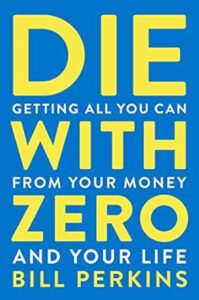 While true for some traditional clients as well, when it comes to Childfree clients it is even more common for them to not care about leaving behind millions of dollars, when there are no children as heirs to support. Their goal is to wind down their wealth, or to "Die With Zero".
If a client works until they are 65, lives frugally, and dies with $4 million in the bank, standard planning software calls might project that as a 95% success rate in a Monte Carlo simulation. A 95% success on Monte Carlo for a Childfree person is actually a 95% chance of failure, and almost guaranteed underspending. I call it a complete failure. It means the client spent decades on the gerbil wheel, working a high-stress job to accumulate wealth for an estate they have no interest in preserving, sacrificing their own joy along the way.
Advicers have an opportunity to actively coach clients past "the blueberry problem." I frequently work with clients who have millions in the bank but still buy frozen blueberries because they are a dollar cheaper than fresh ones. They are trapped in a scarcity mindset. If you do not help them break this mindset, not only may they struggle to enjoy their wealth, but they will never authorize the spending required to fund premium long-term care when they actually need it. The estate plan and the financial plan must work in tandem to give the client (and their proxy) explicit legal permission to spend down their assets on their own joy and their own premium care.
If they have a charitable mindset, the key is to give money to charities with a warm hand rather than a cold one (after they pass). Giving while alive allows them to not only see the impact but to get a tax deduction. CRUTs are one of my favorite tools for Childfree people. With a CRUT, they can get a tax deduction and set up an income, while leaving anything that happens to be left to a charity, fully embracing the Die With Zero ethos. From a tax perspective, CRUTs for Childfree clients become a powerful tool for handling assets with a low cost basis, and can serve as an alternative to 1031 exchanges.
Remember that Childfree people are not planning on leveraging a step up in basis when they die, so it changes not only estate planning but tax planning as well.
The Danger Of The HEMS Standard For Childfree Clients
When drafting a trust, traditional estate planning attorneys rely heavily on the HEMS standard (Health, Education, Maintenance, and Support) to govern distributions. While HEMS is standard practice to prevent estate tax inclusion for beneficiaries who may also be trustees, and to protect the principal from creditors of the beneficiary, it severely restricts trustees' ability to make lavish or non-standard expenditures in situations where the purpose of the trust is not to preserve assets for heirs but to use assets for the Childfree grantor.
"Maintenance and Support" is legally and traditionally interpreted as maintaining the client's current or historical standard of living. For a Childfree grantor whose primary goal is winding down their wealth, HEMS is a disastrous limitation. Corporate trustees often interpret HEMS very conservatively to avoid breach-of-fiduciary-duty lawsuits by remainder beneficiaries.
If a Childfree client suddenly requires a drastic upgrade in their standard of living during their final years – such as liquidating $250,000 to hire a private executive chef, secure premium 24/7 in-home nursing, or book a private medical transport jet—a trustee bound by HEMS might feel obligated by the typical legal interpretation of the HEMS standard to deny the distribution. The trustee will argue the expenditure violates the historical standard of living and depletes the principal reserved for the remainder beneficiaries (the charities or nieces/nephews named in the trust that were not truly intended as heirs to preserve assets for, but simply those who step in as successors for whatever the grantor simply didn't have an opportunity to use for themselves). For a Childfree client, limiting the ability of trustees to use the money for the grantor's rising lifestyle needs in their later years defeats the entire purpose of accumulating wealth!
A trust written specifically for Childfree people typically states that the primary goal is to care for the Childfree person, without limiting distributions to HEMS, and with beneficiaries only as an afterthought. Accordingly, advicers must explicitly guide attorneys towards including "Exhaustion for Care" and "Absolute Discretion" clauses overriding HEMS. The trust language must legally indemnify the trustee from lawsuits brought by remainder beneficiaries for depleting the trust principal, explicitly prioritizing the grantor's direct comfort over capital preservation for heirs that receive after the grantor's death.
The Perversely Problematic Incentives That Arise When Naming Distant Relatives
Because advicers want to get clients through the financial planning process, and ensure clients have at least some legal (estate) documents in place, they frequently encourage clients to "just pick someone" for their POA to get the documents completed. They suggest naming a distant nephew, a neighbor, or a second cousin just to get a signature on the dotted line so the client isn't proceeding with nothing.
While this cures the immediate urgency, in practice it can make clients feel like their estate planning is "done", shelved for the indefinite future… even as the actual solution of naming a distant relative can expose the client to severe elder abuse risk.
As unfortunately, the reality is that for a Childfree person, naming a distant relative introduces massive vulnerabilities. When a Childfree person names a distant relative as their Financial POA and Medical POA, and simultaneously names that same relative as the residuary beneficiary of their estate, they create a terrifying, perverse conflict of interest. The relative is now completely in control of the client's checkbook, and stands to inherit whatever principal is left over when the client dies.
Therefore, every single dollar that the relative spends on the client's premium long-term care that they could otherwise afford is a dollar taken directly out of the relative's own future inheritance. This structure financially incentivizes the human proxy to cut corners. It incentivizes them to place the client in the cheapest, lowest-quality, state-funded Medicaid facility available to maximize their eventual payout. You are effectively asking a distant relative to choose between authorizing $15,000 a month for the client's high-end memory care facility, or putting the client in a less expensive facility so the relative can buy themselves a new house when the client passes away.
Case Study: The $7M Washington Soloist
The risk that distant relatives will struggle with the conflict of spending their own inheritance on the grantor's care is not theoretical.
Consider a real-world case study: A 75-year-old single woman in Washington state with a $7 million net worth contacted me because she couldn't find a decision-maker. She had no debt, significant liquidity, and absolute mathematical capacity to self-insure for the highest quality of long-term care available in the country.
However, she considered leaving her estate to a nephew she barely knew solely so he would act as her POA. Her sole motivation for this massive bequest was to use the inheritance as a "bribe" so the nephew would agree to act as her Power of Attorney if she suffered cognitive decline.
Look at the structural failure of this advice. While she had ample assets to self-insure for high-quality LTC, a poorly designed estate plan effectively incentivized her POA to cut corners in her care to maximize his payout. She was actively preparing to place her medical autonomy and $7 million into the hands of a near-stranger who would directly profit from minimizing her care. I feel strongly that we must protect Childfree clients from the very people the industry pressures them to name as proxies.
We always hope for the best, but the statistics are shocking. AARP found that 10% of elders report financial abuse each year. That is the reported statistic. The reality is that elder abuse is underreported. And that number represents both those where their own kids are abusing them as well as strangers or distant family. Unfortunately, leveraging a remote relative is just setting up an elevated-risk opportunity for abuse.
The Childfree Fiduciary And Estate Planning Framework
To scalably and safely serve Childfree clients, advicers must abandon boilerplate estate planning documents and consider a more specialized Childfree Fiduciary and Estate Planning framework. Which, notably, must be initiated early as a process.
Do not wait until a client's cognitive decline becomes a factor, and they can no longer implement documents for themselves. Advicers should consider introducing lifetime care defense planning by the time the client reaches their mid-40s (or even earlier).
The Net-Worth Heuristic For Long-Term Care Funding
To ensure long-term care, Childfree people need a plan in place to pay for care. They do not have the safety net of adult children to provide free, informal caregiving. The reliance on professional caregiving is an absolute certainty.
A scalable framework advicers can use to guide Childfree clients on their long-term care decisions divides strategies based on net worth, as shown and explained further below.
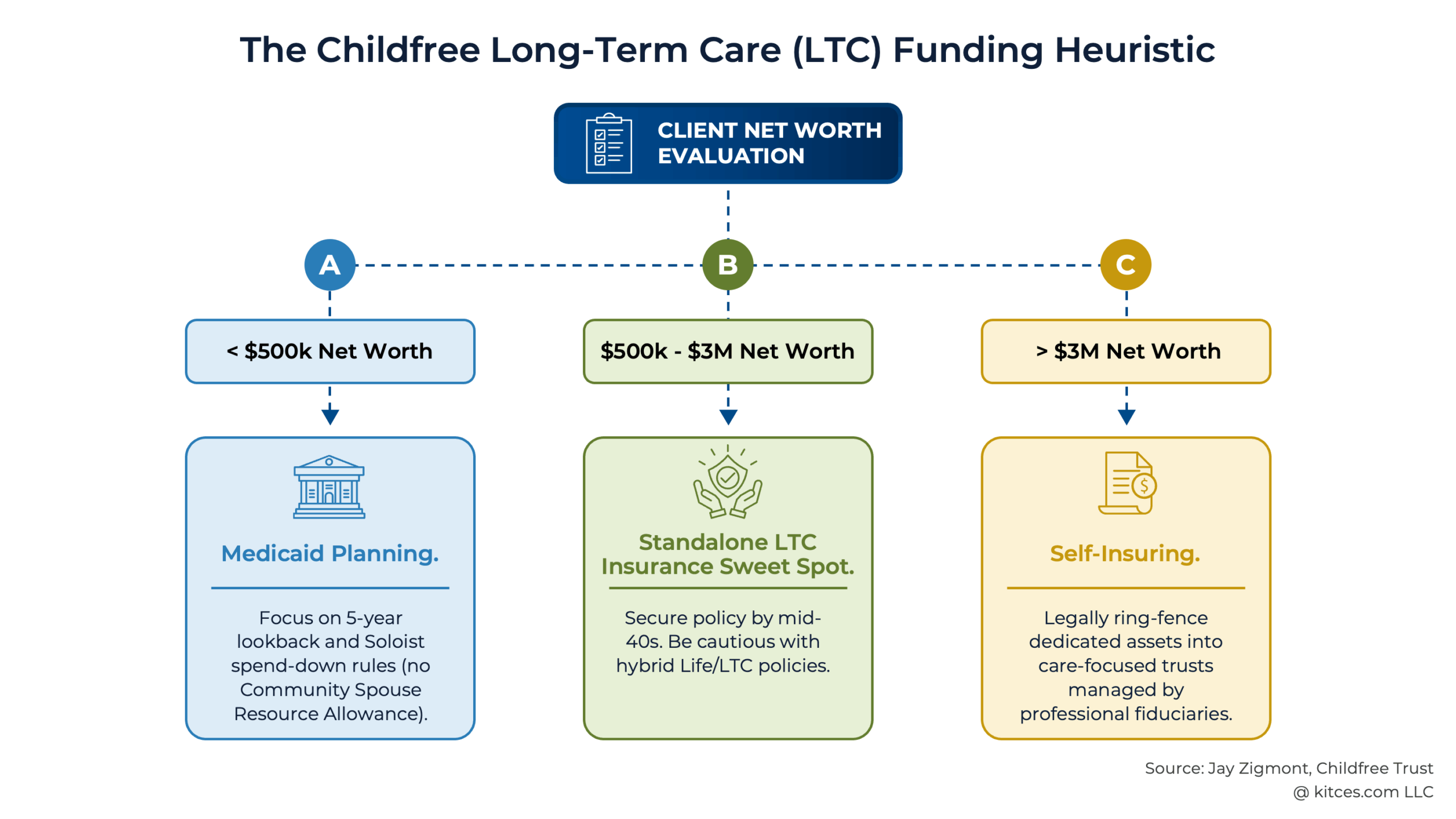
Under $500k: Medicaid Planning And The Soloist Penalty
Childfree clients with under $500k of net worth are highly likely to eventually require Medicaid as the payor of last resort. Standalone long-term care insurance premiums will mathematically drain their cash flow prematurely. The advicer's instruction here is optimizing cash flow for care of last resort and setting up Medicaid asset-protection strategies early.
Advicers must be highly mindful of the 5-year lookback period and the specific Medicaid rules that penalize Soloists. Married couples benefit from "spousal impoverishment" rules, which allow a healthy community spouse to retain a certain amount of assets and income while the ill spouse qualifies for Medicaid. Soloists have no such protection.
Without a community spouse, a single Childfree client faces a brutal, absolute spend-down of their assets. In most states, they must deplete their countable assets down to just $2,000 before Medicaid will pay a dime for their care. Furthermore, Medicaid Estate Recovery programs will place a lien on their primary residence to recoup costs after they pass away.
To protect clients in this tier, advicers must proactively investigate Medicaid Asset Protection Trusts (MAPTs) well before the 5-year lookback period begins. The goal is to legally structure their assets using irrevocable trusts and purposeful spend-down strategies early in their 60s, so they can secure the best possible care of last resort without leaving themselves entirely destitute during their healthy retirement years.
$500k–$3 Million: The Standalone LTC Insurance Sweet Spot
Childfree clients with $500k to $3M of net worth are in the critical middle ground for long-term care planning. Clients in this bracket have too much wealth to easily qualify for Medicaid (even with proactive spend-down and Medicaid Asset Protection Trust planning), but not enough capital to safely self-insure a prolonged, multi-year stay in a memory care facility without risking total portfolio depletion. Remember that, on average, care in a skilled nursing facility costs $125k per year. Men will spend an average of 2.2 years in care, and women will spend an average of 3.7 years.
For this group, standalone long-term care insurance is an absolute requirement. And it is unfortunately a bit more expensive for some, as LTC policies often offer a discount for couples (expecting their spouse will care for them for a while), but that is not the case for our single Childfree people, only Childfree couples.
Consequently, Childfree clients need to be introduced to (and encouraged to outright purchase) an LTC insurance policy by their mid-40s. The earliest a client can typically get a standalone long-term care quote is age 30. If a Childfree client that almost certainly will want and need LTC insurance waits until their late 50s, the premiums may begin to feel exorbitant. Worse, if their parents develop Alzheimer's or dementia in the interim (as by the time the Childfree client is in their 50s, their parents may be well into their 70s or 80s), that family medical history event drastically reduces the client's ability to pass LTC underwriting and even get coverage (or at best results in a less favorable underwriting risk classification and higher premiums).
I tend to recommend that the LTC policy have a $10k monthly benefit, a 3% inflation rider, and a 3–4-year term. LTC costs are increasing by 5% a year, and ideally, you would have a 5% inflation rider, but for cleints in the lower end of this net worth range it may still feel cost-prohibitive. For Childfree couples, I love shared care riders, which allow flexibility in how the care pool is used.
When discussing insurance, advicers also need to make sure there is a Disability Insurance policy in place to protect income during the working years, as standalone LTC insurance is intended for later life. Life insurance is rarely needed for SINKs and DINKs unless someone explicitly relies on their income.
Be cautious when recommending whole or hybrid life insurance policies with an LTC rider to Childfree clients. Selling a Childfree client a massive whole-life policy with an LTC rider forces them to pay internal insurance costs (and in most cases, commissions) for a death benefit they do not need as someone who often has no one dependent on their income, just to access a substandard monthly care benefit for LTC needs themselves. There are some cases where a life insurance policy with an LTC rider works, but effectively, consider zero'ing out the value of the life insurance part of the policy as it doesn't add value for most Childfree clients. Which means, even though its upfront premiums are typically higher, standalone LTC insurance – that has even more leverage on those premiums in the event of actual claims – is still usually the better fit when planning for Childfree clients.
Over $3 Million: Ring-Fencing Assets For Self-Insuring
Clients above the $3 million net worth threshold have the mathematical capacity to self-insure. However, self-insuring does not mean passively leaving funds floating in a standard taxable brokerage account and hoping for the best.
I tend to recommend $500k as the minimum to set aside for long-term care self-insurance, invested to beat 5% inflation. I use $500k both for single Childfree people and couples, as single people are likely to need to pay for care earlier and longer while couples require care for two but tend to spend for fewer years given spousal care support. At a minimum, any money for self-insuring LTC needs to be segregated from retirement funds and not used in any planning calculations. It is not enough to mentally set aside the money, it needs protection both from the client and potentially others.
Advicers should instruct clients to legally ring-fence specific assets explicitly designated for their future care. This requires working with an attorney to establish an irrevocable or revocable care trust funded specifically for this purpose. This guarantees that if cognitive decline sets in, the funds are legally restricted, protected from elder fraud, and managed by a fiduciary whose sole mandate is to pay for the client's medical and physical comfort, completely bypassing the probate courts.
Nerd Note:
A "care trust" is not a specific type of trust like a CRUT (Charitable Remainder Unitrust) or ILIT (Irrevocable Life Insurance Trust). It is about ensuring the trust language is focused on care of the grantor rather than, and ahead of, any responsibility to beneficiaries. It also includes language around what to do in case of incapacity and identifies a trustee to serve as conservator and guardian if the court requires one to be appointed. As a simple example, if there is a choice between spending more for better long-term care for the grantor and preserving assets for the beneficiary, the answer is always to care for the grantor.
The Advicer's Estate Audit Checklist For Childfree Clients: Rewriting Boilerplate Trusts
Advicers cannot passively accept the documents drafted by traditional estate attorneys or by document creation services. You must proactively audit your clients' estate documents and explicitly guide estate attorneys to adjust their standard trust language to match a Die With Zero philosophy and the Childfree clients' true goals.
Use this Advicer's Audit Checklist when reviewing a Childfree client's estate plan:
- Removing Standard Beneficiary-Centric Language (Overriding HEMS)
As discussed, audit the trust for the HEMS standard (Health, Education, Maintenance, and Support). This language must be stripped entirely or explicitly overridden. There is no next generation to protect; the trustee's singular duty must be to the grantor and proactively using assets for their care (not in a manner that preserves assets beyond their lifespan). Advicers should explicitly guide attorneys to consider "Exhaustion for Care" and "Absolute Discretion" clauses.
- Inserting "Exhaustion For Care" Clauses
Trusts for Childfree clients should have legally binding instructions that authorize the fiduciary to exhaust the trust entirely for the client's care, comfort, and joy. Ensure the document explicitly states that the trustee is authorized to liquidate the portfolio, even all the way down to zero (especially for clients who were anticipating on eventually relying on Medicaid thereafter anyway).
The language must fully indemnify the trustee, legally protecting them from residual beneficiaries (such as distant nieces, nephews, or charities) who attempt to sue them for a fiduciary breach for depleting the estate that wasn't really intended to go to those heirs in the first place.
- Establishing The "In-Case-I-Die" File
Heavy emphasis must be placed on practical, early administrative paperwork and guidance for whoever will handle the affairs of the Childfree client.
Advicers should help clients build a comprehensive, securely stored "In-Case-I-Die" file containing all digital assets, automated bill schedules, physical key locations, contact information for advicers and attorneys, and specific end-of-life wishes. There are a series of electronic vault tools such as what Wealth.com and Empathy.com offer that can be used. Some services such as Childfree Trust have these documents integrated in their offerings. For people that are still living in a physical document world, I love the NOKBOX. Some clients use shared drives like Google or Dropbox, but these need to be secured appropriately if used.
When there is no spouse or child to automatically clean out the house upon incapacity, this document is the only way a professional fiduciary can step in and immediately manage the estate during a crisis without spending months performing forensic accounting.
- A Legally Binding Pet Trust
The 2025 Childfree Trust survey revealed that 76.9% of the Childfree cohort owns pets. For many Childfree individuals, their animals are their primary dependents. A standard Will treating a pet as mere "property" to be handed off with a lump sum of cash to a friend is legally insufficient and highly prone to failure.
Advicers must ensure the estate plan includes a legally binding Pet Trust. To properly draft and fund this trust, you must establish a mechanical separation of powers to prevent fraud. The trust must name distinct roles:
- The Caregiver: The individual who physically houses, feeds, and provides daily love to the pet.
- The Trustee: The fiduciary who controls the funds, reimbursing the Caregiver for vet bills and dispensing a monthly stipend only upon proof of the animal's continued health.
- The Trust Enforcer (or Protector): An objective third party designated to ensure the Caregiver isn't simply pocketing the money and neglecting the animal.
To calculate the funding amount, use this specific formula: (Annual veterinary and food cost × remaining life expectancy of the breed) + a $5,000 end-of-life care buffer. For ballpark numbers, I start with $25k per pet. Discussing pet planning serves as a highly effective, tangible "gateway" conversation to get hesitant clients engaged in the broader, more intimidating estate planning process.
In creating a Pet Trust, the client needs to assign priorities. For our clients, we default to funding the Pet Trust before any other beneficiaries. In this way, their pets come first, in line with the typical Childfree client's priorities. Additionally, keep in mind that pets come and go across our lifetimes. The Pet Trust document needs to have flexibility to add and subtract pets, ideally without having to resign and amend the core document.
- Planning For Mom And Dad (The Open-Faced Sandwich)
Childfree adults represent the "open-faced sandwich." Unlike the traditional "sandwich generation" caring for aging parents and their own children at the same time, Childfree clients do not have children, and as a result society and family often automatically assume they have "unlimited" free time and money to take care of aging parents.
This expectation can drain the Childfree client's resources, and drastically accelerates their own need for bulletproof long-term care planning. Advicers must ensure the estate and financial plan establishes strict boundaries regarding the care of the client's aging parents. Advicers should guide Childfree clients who may feel undue pressure to support their parents (given that they don't have children to support) to explicitly budget a capped limit for parental support to prevent them from bankrupting their own living future.
Sourcing The "Professional Care Team" To Support Childfree Clients
If distant relatives are a liability and an elder fraud risk, who actually executes these documents and then stands in to serve in key trustee and attorney-in-fact roles for financial and medical decisions? Advicers must proactively build a "decision-maker bench" of paid professionals to step into these proxy roles when working with Childfree clients.
This requirement applies equally to Soloists and DINK (Dual-Income No-Kids) couples. DINK couples often assume they are safe because they have each other. But spouses age at the exact same rate. If one spouse suffers a severe stroke or early-onset dementia, the healthy spouse becomes a full-time medical caregiver, completely derailing their own life and financial plan. In addition, when the healthy spouse predeceases the ill spouse, the surviving partner becomes a Soloist instantly. Relying exclusively on a spouse is a flawed long-term contingency plan.
The Fiduciary Paradox: Trusting Strangers Over Family
To build this bench, advicers must first overcome a psychological hurdle. The 2025 Childfree Trust white paper identified a "Fiduciary Paradox" within the Childfree community: while 47.4% of respondents recognize the practical need for a professional fiduciary to manage their affairs, a majority (51.3%) harbor significant mistrust, fearing the impersonality of a "stranger" managing their lives and fearing potential exploitation.
Advicers have the opportunity to bridge this gap by vetting highly credible options that can serve as effective fiduciaries for Childfree clients, and facilitating introductions early in the client relationship, turning a cold, theoretical transaction into a trusted, long-term partnership.
Here is how advicers can build and vet a network of professionals when family isn't an option:
State-Licensed Professional Fiduciaries
In states like California and Arizona, there is a robust system of state-licensed Professional Fiduciaries. These individuals are licensed, bonded, highly regulated, and specifically trained to act as objective proxies. They can step in to act as the Healthcare Proxy, Financial POA, and Executor.
Advicers in these states should immediately network with local fiduciary associations to build a trusted referral bench, completely bypassing the emotional baggage and risks of family proxies. Interview them to ensure they understand Die With Zero or as we call it, Winding Down Wealth concepts. We tend to use the term "Winding Down Wealth" to be a bit more accessible as no one really wants to die with zero and end up on the streets eating cat food.
Vetting Corporate Trust Companies
Corporate trust companies and local bank trust departments are excellent for handling the Financial POA and acting as the successor trustee. However, advicers must ask specific interview questions to uncover their limitations before referring a Childfree client:
- "Are you willing to act as a Financial Power of Attorney while the client is still living, or do you only step in as Executor after death?"
- "Will your trust officers sign on to act as a Healthcare Proxy, and if not, who do you partner with to fulfill this role?" (Corporate trustees almost universally reject acting as a Medical POA because they do not want to make end-of-life medical decisions. Advicers typically must source a separate human healthcare proxy if using a corporate trustee.)
- "Our client intends to die with zero. How do your fee structures align with a trust that is actively being depleted rather than preserved?" (Many require $5M to $10M minimums and charge based on AUM, making them misaligned with Dying with Zero or Winding Down Wealth).
- "Will you administer a funded Pet Trust, and how do you audit the Caregiver's expenses?"
- "Will you accept language that indemnifies the trustee against lawsuits from remainder beneficiaries when making distributions for the absolute comfort of the grantor?"
Specialized Nationwide Proxy Services
Because of the medical proxy gap left by corporate trustees and the fragmented nature of state fiduciary licensing laws, there is a massive gap in the market for nationwide, comprehensive proxy care. Childfree Trust is a company I founded specifically to solve this.
Childfree Trust's services are explicitly designed to act comprehensively as the named Medical POA, Financial POA, Trustee, and Executor for Childfree individuals. Childfree Trust charges an annual subscription fee of $999, which includes the creation of all estate and care documents. There is an additional charge of $275 per hour when actively serving as POA, Executor, or Trustee. This annual subscription-plus-hourly model was specifically designed to reflect the financial needs of people without kids who want to Die With Zero. The Childfree Trust service provides 24/7 emergency support, executes on the "In case I die" file, administers Pet Trusts, and guarantees the client's care is managed exactly to their specifications, completely bypassing the conflict of interest inherent in family defaults.
My wife and I are Childfree and Childfree Trust clients as well; we have lived through these decisions and understood first-hand the need and gap to be solved. The way I put it is: if we are in an accident together, who is going to make our medical and financial decisions, and who is going to let our dog out? My wife says I'm wrong (as is normal), but I know that if we are in the hospital together, she'll worry more about how Colt, our dog, is getting his dinner on time and who will let him out.
Childfree Trust is our emergency contact and the one we rely on. My wife is listed first as my POA, but can decline to serve at any time and let Childfree Trust step in so that she can focus on caring for me, and vice versa.
Scripting The Professional Fiduciary Pitch To Childfree Clients
Clients often experience sticker shock when told they must pay an hourly rate or an annual retainer for a professional fiduciary or a specialized proxy service. Advicers must proactively address the Fiduciary Paradox and reframe this cost not as a burdensome administrative expense, but as the ultimate insurance policy for their autonomy and physical safety.
Consider using this conversational script when introducing the concept and cost of paid fiduciaries to a Childfree client as a way to ease the discussion:
Advicer: "Because you are Childfree, you hold a distinct financial advantage. You do not have to pay the hundreds of thousands of dollars it costs to raise a child, nor restrict your spending in retirement to preserve a dynastic inheritance. You get to wind down your wealth, bounce your last check, and spend your money on your own joy.
However, the critical trade-off is that our legal, financial, and medical systems are not built for you. They default to adult children to make crisis decisions. If you do not explicitly hire someone to make decisions for you, the state will eventually appoint a stranger to do it, and you will lose control over your care.
I know it feels uncomfortable to think about paying a professional to act as your proxy, especially when society assumes family will step in for free. But I want you to view this differently. By hiring a professional fiduciary or a specialized proxy service like Childfree Trust, you are buying an impenetrable firewall between your wealth and your medical care.
A professional fiduciary is legally bound to follow your exact wishes. They carry no emotional baggage, and they have absolutely no financial conflict of interest in preserving your estate for their own inheritance. You are paying for the ironclad guarantee that your money will be used exclusively for your comfort, your care, and your dignity, without compromise. It is the ultimate defense plan for your later years."
The financial planning industry cannot continue to serve the 25% of the population living a Childfree life by relying on boilerplate legal documents and family defaults that simply do not exist. Advicers have a fiduciary duty to plan for the client sitting in front of them, not the client society expects them to be. By fundamentally rethinking the purpose of the estate plan, securing robust long-term care funding early via the Net-Worth Heuristic, auditing trust documents to ensure they fit the realities of what Childfree clients need, and actively sourcing a bench of professional fiduciaries, advicers can eliminate the elder abuse risks inherent in traditional planning. Doing so ensures you grant your Childfree clients the autonomy, protection, and absolute peace of mind they deserve.





Leave a Reply