Executive Summary
The job of a financial advisor may be, first and foremost, to serve their clients. Still, for independent advisors who own their own firms (or at least their own book of business), there are often many other duties they are responsible for. From marketing their services to meeting their compliance obligations to investment-related functions like research and trading, these tasks span a variety of subject matters. In fact, the breadth of duties is so vast that it would be almost impossible to gain mastery in all of them. And unlike advisors who work as employees of an RIA or wirehouse broker-dealer that provides these services at the firm level, independent advisors must either perform all these functions themselves – despite their lack of expertise – or hire or outsource someone to do it for them.
That's why, ever since the movement toward independence took hold in the 1990s, an accompanying ecosystem of advisor service providers has grown (and continues to grow) around it. And while many of these service providers concentrate around 'core' service functions like marketing, consulting, and investment management, they've also expanded into numerous other niches – from granular marketing strategies like SEO, social media, and video, to virtual paraplanners and client service associates, to outsourced tax and estate document preparation, to outsourced IT and cybersecurity, to advisory firm recruiting and training. Additionally, there's another layer of coaches and consultants in areas such as practice management, marketing and sales, M&A, and succession planning to help advisors improve their businesses.
The caveat, though, is that while many service providers are available to financial advisors, it's not always easy to find them. With many service providers being small businesses, it doesn't always make sense for them to invest in mass marketing or conference booths to attract the attention of advisors (since the provider can only take on so many new clients at once). And so, when an advisor starts to look for a service provider who can help them, they usually end up either turning to other advisors for a recommendation, or to Google – which in either case might not result in them finding the solution that works best for them.
That's why we're now launching the first edition of the Kitces Advisor Service Providers Map. As a categorized compendium of service providers across multiple domains – marketing and business development, business and practice improvement, financial planning, investment management, operations support, legal and regulatory, people and talent, transitions and succession, and turnkey RIA platforms that handle everything for the advisor – the new Map seeks to ease some of advisors' pain in finding providers to help them with the work that they need done. Additionally, we hope to shine a light on the many providers who serve the advisory industry – some of which are well established and known, but many of which could otherwise fly under the radar of an advisor for whom they might be a great fit!
Ultimately, we aim to add to and evolve the Kitces Services Map over time (as we do with the Kitces AdvisorTech Map), to reflect the ongoing evolution of the advisor services landscape. If we've missed some service providers, we welcome submissions for new companies – both from the providers themselves and from advisors who work with them. Eventually, we also plan to launch a searchable Advisor Services Directory to make it even easier to find service providers that are a good fit for the advisor's needs. In the meantime, advisors can use the Services Map to connect with the services and solutions that can help them better succeed as financial advisors and independent business owners!

The Rise Of Independent Advisors (And Service Providers To Support Them)
The early years of the financial planning profession (ranging approximately from the 1970s to the early 1990s) were long enough ago that most planners working today – myself included – didn't encounter them firsthand. It's difficult to comprehend, then, just how much the business of giving financial advice has changed over that time.
 In his recent book A Behind-The-Scenes History Of The Financial Planning Profession, veteran journalist Bob Veres provides a glimpse of what the industry was like when he began covering it as the editor of Financial Planning magazine in the early 1980s. The advisor landscape back then was dominated by the wirehouse broker-dealer firms, with Independent Broker-Dealers (IBDs) just beginning to emerge as an alternative to the mega-institutions. Only a truly minuscule handful of advisors opted to sever their broker-dealer affiliations and instead form an independent RIA to hold themselves out as "fee-only" advisors. At the time, there were significant questions about the viability of the independent RIA business model, and there was debate – albeit mostly fomented by the broker-dealer firms to deter their representatives from going independent – about whether it was even legal to hold out as a financial advisor without holding a Series 6 or 7 license, affiliating with a broker-dealer, and submitting to NASD (i.e., the predecessor of FINRA) regulation.
In those days, when most advisors were affiliated with wirehouse broker-dealers and therefore in the business of selling those firms' financial products, advisors had primarily one job, which was, well, to sell financial products. The broker-dealer provided most of the support structure that the advisor needed to do their job: technology infrastructure, marketing, due diligence and compliance oversight (such as it was at the time), back office and administrative staff, etc. Nearly everything except the actual meeting with clients and closing of sales was handled by the mothership of the broker-dealer firm. Functionally, financial advisors were just the sales employees who plugged into the wirehouse broker-dealer as the channel through which the wirehouse distributed its financial products to consumers.
But as advisors began to shift first from wirehouses to IBDs, and then to independent RIAs, they began to progressively gain more independence from the top-down structure of the old system. Starting in the 1980s with the IBD model, registered representatives were no longer employees of a wirehouse firm controlled by a Wall Street investment bank (and therefore beholden to that firm's own investment products). Instead, IBDs had more latitude to choose among products (e.g., mutual funds) from various asset managers that were stocked by the IBD platform. In the 1990s and 2000s with the introduction of the independent RIA model, advisors were free of any product sales obligation and instead recommended products based on whether they were in their clients' best interests.
On the whole, the shift toward independence was a good thing for advisors and their clients. First, it gave advisors greater control over how they chose to serve their clients (including giving real advice instead of centering every client interaction around a product sales pitch) and allowed them the freedom to design the systems they would put in place to run their practices. And second, it usually resulted in advisors keeping a higher percentage of the revenue they generated from their clients: Advisors who had gotten payout percentages of 35%-45% under the wirehouse firms could earn closer to 80%-90% under the IBD model, while independent RIA owners got to keep 100% of the revenue that they earned.
The downside of the movement towards independence, however, was that advisors were increasingly responsible for arranging their own support services that had previously been provided by their broker-dealers (which was why the more independent business models were able to offer higher payouts to begin with). Advisors needed infrastructure in place for numerous functions, including portfolio management (e.g., investment research, trading, opening client accounts, and moving money in and out of portfolios), financial planning (e.g., creating and analyzing financial plans), operations (e.g., administrative support and choosing which technology to implement amid an exploding AdvisorTech landscape), compliance (e.g., completing required annual filings with the SEC and state regulators and fielding periodic examinations), and human resources (e.g., hiring, training, and paying the staff on whom the advisor relied to handle all of the areas above). All while somehow making time to meet with the clients and prospects who were the firm's sole source of revenue.
In other words, with the shift to independence, advisors were also shifting from being employees with a narrowly defined job description to being owners and managers of their own practices. Who, as such, needed to make their own decisions about what systems and processes to put in place, what technology to use, and which tasks to handle themselves versus bringing in outside support.
But advisors can't do all of this on their own. Yes, technology has streamlined many previously time-consuming tasks – from robo advisor technology incorporated into portfolio management systems to automated investment model management and rebalancing to API integration between software tools eliminating duplicative data entry to AI notetakers expediting the process of recording and following up from client meetings – which has allowed many solo advisors to stay solo while serving a client load that may have required them to hire one to two additional staff members just a few years ago. But there are still areas where advisors don't have the knowledge, the interest, or the time to do all of the work they need to do themselves.
One of many examples is compliance. Advisors generally understand their high-level fiduciary and ethical duties to clients and recognize the importance of performing their obligatory compliance tasks. But few advisors are truly experts in compliance, and can (or want to try to) navigate the nuances of the many SEC or state-specific regulations that apply to them. Similarly, numerous other necessary RIA functions, from trading to marketing to IT and cybersecurity to HR, often require highly specialized expertise to carry out well – all of which put an enormous burden on financial advisors trying to do it all themselves (especially smaller RIAs who must compete with the bigger firms with the resources to hire their own specialists in those areas).
And so, concurrent with the rise of independent RIAs has been the emergence of an entire ecosystem of service providers to support them, in the form of both "platform"-style businesses (e.g., IBDs, corporate RIAs, and advisor networks that offer varying levels of support services in a single package) as well as a large marketplace of individual service providers whom advisors can hire to support them in individual areas.
Why It's So Hard To Find (Good) Advisor Support Service Providers
Despite the growing number of advisor service providers, much of that sector flies under the radar for most advisors.
In contrast to technology solutions, whose scalability incentivizes rapid user growth and justifies big marketing investments in conference sponsorships, magazine ads, and CE webinars to increase their visibility (often funded by external capital to further accelerate their growth), advisor service providers tend to remain small and grow slowly. Because, as many advisors can attest from their own experience with their firms (which are service businesses themselves), service businesses often do not scale quickly: The need for employees with the skill and knowledge necessary to deliver the service rises linearly with the number of clients served.
The fact that service businesses are fundamentally constrained, growing only as fast as they can develop people to deliver the services, removes much of the incentive for the company to grow beyond its founders and a handful of support staff. Which sets a natural cap on the number of clients most firms can serve – or at least the number of clients they can add in any particular year – and so whereas the largest advisor technology companies often serve in the range of tens of thousands of users, most of the biggest service provider's clients likely number in the hundreds, and the majority have capacity only for a few dozen at most.
For service providers, then, there's a limited return on investment for marketing to reach a broad mass of financial advisors. Because in the 'best-case' scenario in which a marketing campaign turned out a meaningful percentage of advisors who wanted to sign on as clients, the service provider might need to turn most of those potential clients away anyway, or at least put them on a waiting list until the provider can either work through its backlog or staff up to meet the demands on its capacity. As a result, while numerous technology companies have made themselves into household names among advisors by marketing themselves and jostling for maximum market share, most advisors can likely name only a handful of service providers for financial advisors outside of the ones they actually use.
This makes sense from the service providers' perspective, as while nearly all of them are looking to add more clients, few are aiming for the kind of rapid growth that would justify a mass marketing campaign. But for advisors, this landscape makes it hard to find service providers who can solve for their specific needs, instead relying on serendipity or word of mouth to find the right provider.
And so, the big question for advisors is: How do you find the service provider who's right for you when so few of those providers are actively marketing to you?
Unfortunately, there's no equivalent (yet) of the Yellow Pages – or a more modern counterpart like Yelp – where advisors can simply browse through the whole list of service providers that support financial advisors and reach out to the ones that might be right for them. Some people like James Cantwell of WealthTech Select and Joe Moss of Advisor Tech Book have worked to curate lists of service providers with expertise in the financial advice industry, but those aren't necessarily intended to cover the entire landscape of advisor services – just a subset of vetted and/or established providers. Which is great for those who would rather limit their search to the most established core service providers. But it doesn't work as well for those who would prefer working with a smaller service provider if the fit is exactly right for the problem they're looking to solve.
As a result, for advisors who are in the market for a certain service – whether they need a website designer, a compliance consultant, a virtual assistant, or anyone else who can help them solve a need they can't or don't want to solve on their own – there are basically two ways to find a provider. Either they can fire up Google (or increasingly, ChatGPT or Claude) and sift through the results themselves to find a provider who might be a good fit, or they can ask around for recommendations from other advisors online or in-person (e.g., in Facebook groups or industry association forums or a local FPA chapter meeting).
But both approaches are at least somewhat problematic. Search engines or AI may bring back a list of potential providers, but there's really no way for an advisor to know whether the subset of search results that the algorithmic black box delivers to them represents a complete list of the right firms that could be a fit for their needs. And while asking for recommendations can be preferable to DIY searching (since they at least usually come from actual people who have used the service and can give an unbiased report on their experience), that method is still highly dependent on which people actually see the question and take the time to respond. Which again may leave some potentially good fit service providers undiscovered.
Surveying The Landscape Of Outsourced Service Providers For Financial Advisors
Given the depth and breadth of the landscape of advisor service providers – and the difficulty of finding any one provider whose services are the right fit – we're excited to launch the first edition of the new Kitces Advisor Service Providers Map, created in collaboration with Joe Moss of Advisor Tech Book!
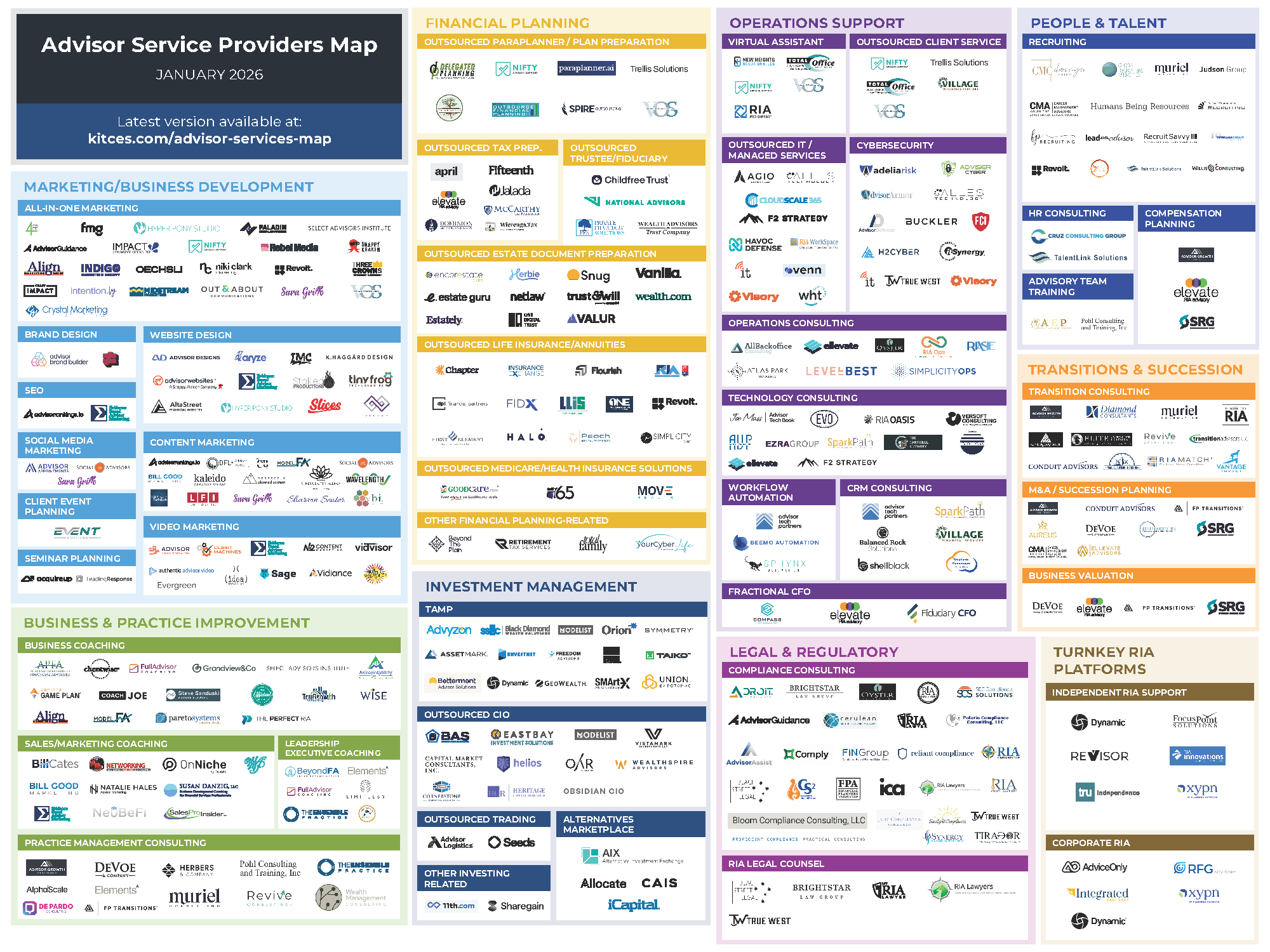
Click here for a downloadable PDF version of the Advisor Service Providers Map, with clickable embedded links to each solution's website.
The new Advisor Services Map will likely look familiar to those who have seen the Kitces AdvisorTech Solutions Map, as we've maintained the AdvisorTech Map since 2018 in light of a similar difficulty in navigating the kaleidoscope of technology offerings available for financial advisors. Over the years, we've needed to turn down a number of providers for inclusion on the AdvisorTech Map simply because their solution wasn't truly a 'pure' technology (i.e., software that helps an advisor do a certain task themselves) but was more appropriately categorized as a "service" (i.e., a third party that does the task for the advisor). The distinction is important because technology solutions built for a 'do-it-yourself' approach have a fundamentally different value proposition from 'do-it-for-you' (or at least 'do-it-with-you') services, with services often costing on the order of 10x more than technology that supports the same job function. And so, it's hard to evaluate and make decisions about what solution to use when both technology and services are mixed together, since what the advisor is actually getting (and what they'd be paying for it) varies so vastly between the two.
With the Services Map, we aim to make it easier for advisors who prefer to outsource certain functions to a third party to find providers that can help. In doing so, we also hope to shine a spotlight on the many service providers doing great work for advisors – many of whom might have flown relatively under the radar. We hope that this new resource can contribute to the success of both advisors and the people who serve them.
Insights From Version 1.0 Of The Kitces Advisor Services Map
When researching the advisor services landscape, it became clear that the types of services available for advisors coalesce into several high-level domains, which in turn break down into a number of more granular categories. This helped us organize the Map by which providers could help advisors with a certain function. (Many companies provide services in more than one category, where advisors might independently hire the firm for each, which is why there are a number of providers listed in multiple categories on this Services Map as opposed to the Technology Map where most providers have a clear 'primary' category for which advisors won't likely use their other functions if they don't engage with the software in its primary category first.)
The core domains of advisor services – and thus some of the most populous categories on the Map – are those that cover the functions that had traditionally been handled by broker-dealers and other centralized platform providers, like investment operations, compliance, marketing, HR, and IT.
Investments
On the investment side, the type of service an advisor might use depends on which part(s) of the portfolio management process they want to outsource and which they want to keep in-house across the three primary functions that have to be executed: investment research to design the portfolios, trading to implement the portfolios, and investment operations to support the ongoing needs of clients whose portfolios are being managed.
For advisors who would rather let someone else handle the creation of investment management strategies (e.g., investment research, due diligence, and model creation) but can handle the trading and investment operations themselves, they can hire an Outsourced Chief Investment Officer (OCIO) like East Bay Investment Solutions, Cornerstone Portfolio Research, or Obsidian CIO. Or if they prefer to do their own portfolio construction but want to outsource the trading operations, they can hire an outsourced trading solution like Advisor Logistics or Seeds. And if they'd rather outsource all parts of portfolio management, they can use a TAMP like AssetMark, GeoWealth, or Modelist.
Compliance
Compliance consultants cover a critical role for many advisory firms throughout their entire lifecycle. In the startup phase, compliance consultants can help RIAs craft their required supervisory policies and procedures and complete their initial state or SEC registration filings. And on an ongoing basis, compliance consultants can help firms with their annual filings and serve as a liaison between the RIA and regulators in the event of an examination.
Some compliance specialists don't 'just' consult on compliance systems and processes, though, they also provide bona fide legal counsel for RIAs (e.g., Beach Street Legal, My RIA Lawyer, and True West Consulting), ranging from representation in litigation, arbitration, and M&A matters to drafting client agreements and business formation documents to setting up private funds.
Marketing
For marketing, advisors can choose whether they want to outsource all or just a portion of their marketing process. 'All-in-one' marketers like Indigo Marketing Agency, Rebel Media, Craft Impact, and Out & About Communications (as well as the service arms of predominantly tech-based platforms like FMG and Snappy Kraken) handle marketing strategy and execution across a broad number of channels, from websites to email campaigns to social media.
But a number of more specialized marketing services exist to serve advisors in solving specific marketing support needs, from brand design (e.g., Advisor Brand Builder and FinArt) to website design (e.g., Advisor Websites, Hyper Pony Studio, Slices, and TinyFrog Technologies) to content creation (e.g., Constellar Creative, Kaleido Creative Studio, and Perfectly Planned Content) to social media (e.g., Advisor Appointments and Social Advisors) to SEO strategy (e.g., Advisor Rankings and Evidence Based Advisor Marketing) to client events and seminars (e.g., Event Advisors and AcquireUp), to a surprisingly large number of providers specializing solely in video-based marketing strategies (e.g., Authentic Advisor Video, Idea Decanter, N2 Content Marketing, Vidiance, and VidVisor) given the recent rise in popularity of video on social media in particular.
Talent And HR
In an environment of increasing competition for experienced financial advisors (which is only expected to increase further as the gap between retiring advisors and new advisors expands the talent shortage in the industry), a segment of advisor services has arisen to help RIA firms attract and retain talent.
At its core are recruiting services (e.g., Claire Myers Consulting, FP Recruiting, Lead Advisor, and New Planner Recruiting) to connect candidates with open advisory firm positions, both advisor-specific roles and other support staff or even leadership roles in the advisory firm.
Additionally, providers also work with RIAs in more HR support functions such as planning their compensation structures (e.g., Advisor Growth Strategies, Elevate RIA Advisory, and Succession Resource Group), general HR strategy (e.g., Cruz Consulting Group and TalentLink Solutions), and on training advisory team members (e.g., Advisory Education Partners and Pohl Consulting, as well as our own Training Courses here on Kitces.com!).
IT And Cybersecurity
IT support is one thing that it's easy to take for granted when working for an employer, but even when operating independently it's nice to have someone to call when computer and network issues flare up.
Managed service and outsourced IT providers like Agio, F2 Strategy, RIA Workspace, Venn, and We Handle Tech: 4 Advisors help RIAs set up and maintain key infrastructure pieces like virtual desktops, cloud environments, cybersecurity software, and disaster recovery, and offer support hotlines to take care of any issues that arise. Additionally, providers like AdviserCyber, Advisor Armor, AdvisorDefense, Buckler, and FCI focus specifically on cybersecurity for financial advisors, allowing them to comply with their obligations to protect client information under the SEC's Regulation S-P and similar state regulations.

Nerd Note:
The Managed Services and Cybersecurity categories were included up until now on the Kitces AdvisorTech Map. Which made sense on one level given their close proximity to technology used by advisors – but it also became clear while building the Services Map that managed services and cybersecurity were more appropriately categorized as services than technology, since ultimately they exist to handle IT and cybersecurity for advisors as a true service-provider, rather than to facilitate advisors managing those functions themselves as a technology-only solution. So, we have moved them onto the Services Map and removed them from the Technology Map (though they'll remain in the Kitces AdvisorTech Directory until the eventual launch of a Kitces Advisor Services Directory).
Virtual Operations And Financial Planning Staff Support
The aforementioned categories have long been traditional domains that advisors evaluated whether to insource or outsource, but as the industry has evolved, other categories (and providers) have emerged to solve for the newer pain points of advisors. This is especially true given the rise of remote work arrangements since COVID, which in turn has helped to foment a wider range of outsourced virtual staff support.
For instance, there is a sizeable number of advisors who want to delegate some of their administrative tasks to increase the time they have available for meeting with clients (which Kitces Research on Productivity has shown is the single biggest factor correlating with an advisor's productivity), but who don't want to take on the commitment and managerial burden of hiring staff to delegate those tasks internally.
Thus, there are companies that provide outsourced support for advisors in areas like financial plan preparation (e.g., Delegated Planning and paraplanner.ai) or client service (e.g., Village Financial Services) or both (e.g., Trellis Solutions, Nifty Advisor Support, and Virtual Outsource Solutions), as well as virtual assistants who provide more general administrative support like calendar management, email and phone answering, and bookkeeping (e.g., Total Office, New Heights Solutions, and RIA Pro Support).
Specialized Tax And Estate
Additionally, there's an expanding number of solutions for advisors who want to provide more services for their clients beyond financial planning and investment management – like tax preparation, estate document preparation, and insurance and annuities placement – but who don't want to become tax preparers, estate attorneys, or insurance agents.
Accordingly, our Services Map documents how advisors can offer outsourced tax preparation to clients with services like McCarthy Tax, Jalada, and Fifteenth; help clients procure estate documents through tech-enabled estate providers like Vanilla, Wealth.com, EncorEstate Plans, and Trust & Will; provide insurance and annuity solutions through outsourced insurance providers like LLIS, DPL, and Flourish Annuities; and connect clients with Medicare and other health insurance plans with providers like Move Health, i65, and Goodcare.
Coaching And Consulting
On top of that, there's a whole range of specialized providers who work with advisors to help them optimize the way their businesses are run, either as a coach (that helps to develop the advisor in how they run their business) or a consultant (who analyzes challenges and providers the advisor an answer in how to improve).
Accordingly, there are business, marketing, and sales coaches like Libby Griewe (The Efficient Advisor), Kristen Luke (OnNiche), and David DeCelle (ModelFA) – among many others – who work with advisors at a one-on-one level to improve the skills that will help them grow their business.
Then are consultants who provide answers at the firm level, in areas from practice management strategy (e.g., Herbers & Company, The Ensemble Practice, and Muriel Consulting) to operations (e.g., Level Best, Atlas Park Consulting, and Simplicity Ops) to technology (e.g., Ezra Group, The Oasis Group, and The Cantwell Advisory).
There are even consultants in more specialized granular areas like CRM (e.g., Advisor Tech Partners and Stephanie Dennebaum Consulting) and workflow automation (e.g., Sphynx Automation and Beemo Automation).
And for advisors who plan to transition from one firm to another, hand their practice off to a successor, or sell to a third party, there's a field of transition, M&A, succession planning, and business valuation consultants to help the process go smoothly (e.g., FP Transitions, DeVoe & Company, Revive Consulting, and Ellevate Advisors).
Turnkey RIA Platforms
And finally, because some advisors might not want to sort through the entire landscape of service providers for solutions to each of their individual needs but would rather just pay a single provider to do it all (or at least most of it), there are various turnkey RIA platforms that offer much of the support structure that broker-dealer or large RIA platforms do, while still allowing advisors under their umbrella to control their brand, operations, and revenue stream.
These include independent RIA support platforms like XY Planning Network, FocusPoint Solutions, and RIA Innovations (which operate on a membership model, bundling services together for a monthly or annual fee while the advisory firm continues to operate as a standalone RIA), as well as corporate RIAs like AdviceOnly, Dynamic Advisor Solutions, and RFG Advisory (which act as the RIA itself, with the advisor operating as an IAR under the corporate RIA's entity but retaining independence over their brand).
The key point is that for any one advisor who encounters a pain point in their work life, there are likely many other advisors – numbering in the dozens, hundreds, or thousands – who have that same issue. And if the pain point is bad enough that a meaningful number of those advisors are willing to pay someone else for their expertise in solving it for them, that's enough to provide a business opportunity for a provider who can offer a solution and connect with a critical mass of advisors whose needs fit with what they provide. Because whereas the cost for most advisor technology solutions tends to hit a natural cap at between $100 and $150 per month, service providers are often able to charge many multiples of that for the expertise and solutions – from several hundred (or thousands of) dollars per month for retainer engagements to upwards of $10,000 or more for single engagements – meaning that they can often run a sustainable business with 'just' a few dozen clients. And so, even for niche problems that might seem somewhat rare ("Who can I pay to plan and set up my client event?"), there's usually someone out there with a solution to that problem.
How To Get Listed On The Kitces Advisor Services Map
It's our intention for the Services Map to be comprehensive, and to include every provider who is actively offering services to financial advisors. That said, even as we've launched this map with nearly 300 service providers to advisors, it's almost certain that we've missed providers in our research for the inaugural version of the Services Map. Like the AdvisorTech Map, we're planning to regularly update the Services Map with new solutions that come to our attention.
That's where you come in. If you're a financial advisor who uses a service provider that isn't yet included on the Map, please go to our Advisor Services Map website and fill out the New Company Submission Form to request their inclusion on the Map.
And if you are a service provider for financial advisors, and you don't see your solution on the Map (or if you feel it should be in a different category from where we've put it), please also go to our Advisor Services Map website and fill out the New Company Submission Form. We'll review each submission individually and reply if and when we've included it on the next version of the Map.
Going forward, we plan to also release an Advisor Services Directory (akin to our Kitces Financial AdvisorTech Directory) that allows advisors to search for specific solutions and browse individual categories. So stay tuned for news on that front, but otherwise we hope that the new Kitces Advisor Services Directory represents a step towards making it easier for financial advisors to get connected with the solutions that can help them better succeed as financial advisors and independent business owners!