Executive Summary
Advisor/client relationships can span multiple decades, if all goes well, running through the end of their working years through retirement and welcoming grandchildren. Advisors often get the responsibility and privilege of sitting with clients through crucial money-related decisions, which can vary from healthcare coverage to housing decisions to making memories. As such, advisors and clients can get quite close over the years – which can make it all the more devastating when a client declines and eventually passes away. For advisors, their role as a confidant and guide is often more important than ever… yet at the same time, the advisor is often grieving the loss of someone they cared for themselves.
In this 204th episode of Kitces & Carl, Michael Kitces and client communication expert Carl Richards discuss how advisors can navigate loss to both support clients… and get the support they need themselves.
In order to best show up for clients, advisors may feel the gap between their technical training and the emotional need of the client, and resources such as Amy Florian's work can help them close that gap. In the moment, spending time to reflect on what the advisor will miss about the client (e.g., "I'll really miss his smile") may offer more comfort than only offering condolences. And advisors may want to give grieving clients the opportunity for distraction, emphasizing that while certain tasks are not time-sensitive, the client may choose to start now if they need something to distract themselves. In sum, simply taking a moment to share memories, then giving clients some choices on how to proceed, can go a long way in the short-term.
For advisors themselves, it's important to understand where, and how, the advisor can process their emotions of grief. Some clients may welcome grieving alongside them, and for others, the advisor may need to be particularly stabilizing. Advisors may need support from their own families or outlets such as exercise, baking and gardening, or other activities that will give them time and space to reflect. The method for processing this emotion may vary by the advisor, but it is still important to do, especially given that advisors may find themselves in this space repeatedly.
Ultimately, the key point is that grief is challenging for everyone involved, and advisors occupy a unique space of both being a trusted person for the family's emotional and financial state… and grieving the member of the family themselves. The reality is that the right balancing of grieving with the family, lending support, and processing the emotions alone will vary by each advisor's personality and preferences – and, likely, will be further individualized for each client situation. Over time, advisors can iterate towards something that is both genuinely supportive and individually sustainable – allowing them to continue to show up for clients in the long-term!
Authors:

***Editor's Note: Can't get enough of Kitces & Carl? Neither can we, which is why we've released it as a podcast as well! Check it out on all the usual podcast platforms, including Apple Podcasts (iTunes), Spotify, and YouTube Music.
Show Notes
 Titan: The Life of John D. Rockefeller, Sr, by Ron Chernow
- Compassionate Communication: Desktop Reference for Times of Transition by Amy Florian
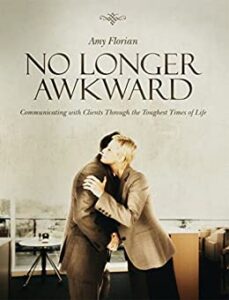
- No Longer Awkward: Communicating with Clients Through the Toughest Times of Life by Amy Florian
- Amy Florian
- The Defining Personality Traits Of (Successful) Financial Planners, by Meghaan Lurtz, PhD
Kitces & Carl Transcript
Michael: Well, greetings, Carl.
Carl: Michael, I have a question for you before we start.
Michael: Another one? You had a question for me last time. I was going to ask you a question.
Carl: I know, I know. One podcast, book, or article that you read recently that you'd recommend to somebody. It's got to be quick.
Michael: Oh, the biography of John D. Rockefeller. I have been fascinated lately. Now that we have a trillionaire and it's like the second Gilded Age, I decided to get on a kick of reading things about the first Gilded Age and some of the biographies. And the biography of Rockefeller was quite fascinating in what they were doing then, how they thought about the world. They lived in an era where startup oil companies were competing against each other, borrowing a ton of money to do it, and then losing money at unviable rates of oil. But they kept pumping more oil out of the ground because it was better to at least keep making your debt payments a little bit longer before you defaulted. And so they would crash the price of oil on themselves and then take everybody out of business.
And the only way that they could come up with to stabilize the market so companies did not continuously bankrupt themselves on the business cycle was to form a cartel to stabilize the price of oil. And then when people kept breaking the cartel, Rockefeller basically just bought them all and found the easiest way to have a cartel is just to own all of them, which we would commonly today know as a monopoly. But they did it from the best of intention. It was not done to jack up prices and make them unfair to everyone. It was to stabilize prices because otherwise the oil industry was not going to survive. The byproduct of that is, when you create a monopoly to stabilize prices so that we can build the oil industry, it turns out whoever owns the monopoly kind of ends up being disproportionately wealthy.
So fascinating perspective on different ways that they thought about competition, business competition, 150 years ago, just completely flipped around from where we are today. This was not unique to Rockefeller. This was prevailing thinking of the time. It's the same reason Carnegie ended up doing what he did in iron and steel. This was the prevailing view. The primary way to stabilize commodities businesses so that they could expand and serve more consumers was that you had to eliminate the competition so that literally competitors did not create self-destructive price cycles.
Carl: Well, that's a nice light read.
Michael: Yeah, nice light read. It's 1,000 pages. So just read a couple of pages.
Carl: I have a one-inch rule. That sounds way above my one-inch rule. If it's more than one inch thick, I can't read it.
Michael: Well, I read it on Kindle, so it was a fraction of an inch thick all the way through.
Carl: That's great. I imagine we're not talking about oil prices.
Giving Support As An Advisor When A Client Passes Away [03:27]
Michael: We're not talking about oil prices, although I guess we could at some point because those have been interesting lately as well. No, I actually want to go a different direction with what I think is actually a really hard, challenging conversation and situation that crops up for a lot of us that I just kind of want to tackle head-on, and I'm curious for your thoughts, which is just kind of give it as the simple scenario that usually plays out. So it's Monday morning, and you're coming in for the week, and you check messages. And the first message is from one of your very long-standing clients that you've been working with them for so many years. "Larry died last night. And I don't know what to do."
So your newly widowed client just reached out, and it's game on as their advisor, confidant, support system, and how you handle that. And I'm thinking less from the technical end of the checklist of the financial planning things. How do you handle that as an advisor navigating death of clients, particularly a lot of these are clients that we have 5-, 10-, 20-plus-year relationships with?
Carl: Yeah. Yeah, that's a really great question. Fun's not the right word, but an interesting topic to sort of figure out how to handle. Because it certainly happens to all of us. And the first thing that came to mind was Amy Florian's work. Because the very first thing is the response to the client.
Michael: Yep.
Carl: And I think that's important to remember. You handle it. For a minute, you just remove all advisor and just become a human. The very first thing, we got to respond to the client. And what do you say? And then we can talk about, "Okay, great. What does it mean for us?" I think it'd be interesting for us to talk about, "How do we handle?" And this is a very specific example in a broader category of, often, we're the release valve for other people's bad news or anxiety or worries or concerns. And I think, I don't know that we have any data on this, you might, because if anybody does, you do, that some of the burnout we see in our industry could be a result of...it's actually quite hard to be the release valve to continually walk people off ledges.
But back to Larry, as I recall, I saw Amy speak in the last 12 months. I can't remember where we were. But she has a quick reference guide, a desk guide, as I recall. It was so useful. And so something along the lines of not what I would normally have said, which is, "I'm so sorry." Amy is like, "That's actually not what anybody really wants to hear." Because they would be like, "Yeah, you and everybody else are not nearly as sorry as me." But more something along the lines of, "Oh, my gosh, I'm going to miss Larry." And even better is something really specific. The example she gave in one of her talks was, "You know what I'm going to miss most about Larry is a smile. When he walked in a room, he lit the place up." It's like, wow, if you can think of something that you... In other words, what if we were just human for a minute? So that was the first thing that came to mind.
And then, obviously, giving the client the reassurance that there's nothing to be done right now, that you have the... Maybe there are a few little technical things, but largely, "Hey, take your time. This is the last thing you need to..." To the degree that this would be useful or helpful or maybe even a distraction for you. I'm happy to engage in any conversation. But if it'd be a helpful distraction to get some to work on, there's things that need to be done, but none of them need to be done right away. Just know that I've got it, and we'll talk soon. That feels to me like the first thing that comes to mind. Is that what you're thinking?
Michael: I don't know what I'm thinking. I was never... God, these were always tough situations for me and particularly hard, because the second firm I worked at over the years worked with retirees, with a big focus on later retirees. We had a huge portion of the client base that was well into their 70s or in their 80s. And this was back in the days where advisors had 300 to 500 clients. The firm had probably 1,200-plus clients for 3 advisors. And so that many clients and that size of client base, we had a client death or two every month, all year long. That was fairly standard in how many passed away. And it was a huge struggle for me just trying to figure out what to say that was not awkward in this situation.
I will likewise give a shout-out for Amy Florian's book, which is very aptly titled, "No Longer Awkward." And it's how to communicate with clients through tough times of life, no longer awkward. So I'm sure it's still on Amazon somewhere for folks that want to check it out. It is very good and very concrete, and just, as you noted, things that folks say that is actually not as helpful for someone going through those moments of grief and other things you might say instead.
Carl: Yeah. I was really...I think it'll be useful. One of the things she suggested that I've actually, unfortunately, had the opportunity to use more than once since I saw her speak was being at a funeral where you don't really know the person that well. So this could apply to a client scenario. You may know one spouse, and the other spouse maybe not as well or anything. And you may not be able to say, "What I'll miss most about Larry is that smile," or, "What I'll miss most about Larry is how much he loved the grandkids. He was always talking about them all. One day, when I have grandkids, I'll be thinking about Larry," that kind of thing. If you don't have something like that, remember, as you're walking into the funeral, there's all those pictures. And there's a picture of Larry fishing. So when you get up to say something to the client you knew really well, the widow, you can say, "Gosh, Martha, I didn't really know Larry all that well, but there's this great picture of him out there fishing. Can you tell me a little bit about that?"
I just thought that's the most amazingly generous, beautiful suggestion. And I actually did that at a funeral recently. Not recently, but in the last couple of months. And yeah, it was super interesting. People really engaged. So I love that idea of, okay, do what a human would do. Well, maybe do what a human would do based on Amy's suggestions. And then...because I know I was always doing the wrong thing. And then the idea of, "Hey, Martha, I'm assuming you called not just to tell me, but also, like you said, you don't know what to do. I just want to assure you there are things that need to be done, but nothing needs to be done right away." And I like the idea of a useful distraction. "If it would be helpful to you, there are some things that we could work through, but I want to assure you they don't need to be done. So it might be better right now to be focused on the planning and preparation you're doing because everything's fine." Or, "There's these two things," or, "I need this document."
So just, "Whatever it is, let me review and get back to you if anything needs to be done." Maybe that's even a better answer. You can call back and say, "Hey, there's one thing we need. Other than that, this can all wait for a couple of weeks, even a month, if we need to." And by the way, it'd be a useful distraction to work through some things. We can do that too. So I love that.
The Challenge Of Grieving As An Advisor While Offering Support [12:50]
Carl: And then it's like, okay, because I was curious about what you said. Tell me about what you said, "It was always so hard."
Michael: Yeah. Going through deaths of clients, it was hard then. Ironically, well, it got easier once I moved on from the firm. We didn't have a client passing away every other week. It got harder because the relationships got longer. At least at that firm, they had a lot of relationships, but these were not clients that I had brought in and worked with here for 10 or 20 years because I didn't get them when I was in high school. So they weren't my longstanding relationships. It got easier in some ways when I just went to a firm where the volume was less, and harder when some of the relationships were then people that I had known for many years.
Carl: Let me ask you real quick. What do you mean by "hard"? You don't mean tactically, financial planning hard.
Michael: No, no, emotionally hard. I liked them, and I liked spending time with them. And they were cool people to be hanging out with. Just in the very dark sense, grieving a loss of a client that was, at the least, a close client, sometimes a close friend. You form relationships, right? A lot of us have been to weddings and family gatherings of some clients over the years. So they start as clients and often end up being much more than that, at least for some. And so those become particularly painful that, in essence, I think you said it earlier, the challenge of being the release valve for a few of those, where they were very longstanding clients, I'm grieving. I'm in a shock of grief because I just found out Larry died. And I also consider Larry a friend that I've worked with for 18 years... not literally, but in a scenario like this.
So I'm now managing to my own grief of finding out Larry died after 18 years of working with him and Martha. And so enjoying the fact that I was out on their boat a couple of times and I was at their daughter's wedding, and now Larry's gone. Oh, and apparently, I don't even get to do my own grief thing right now because I'm supposed to be Martha's rock.
Carl: Right. Right. Yeah. What did you find over the years? Have you read anything? Did you learn anything that was useful for you? Because we're not trained or very good at this. It's humans, and especially in Western culture, we don't know how to grieve.
Michael: Yep. I don't know if I found a lot. I don't know if I found a lot to help. For me, very directly, it was a lot of hug your kids, hug your loved ones when you get home kinds of moments and talking with a spouse or close friends because I can't say to the client, "Well, I'm really sad that..." Well, I could say, "I'm really sad that Larry died," but the client is not there to comfort me. I'm there to comfort the clients. I need to go to something else then, where I can have the conversation about how sad I am that my client, Larry, I've been working with for 18 years, passed away. So someone can do a little bit of the grief support for me.
Carl: Yeah. Yeah. I think...
Michael: And just that compartmentalization, I think, is tough. And I don't know, I guess that's different for different folks. I can think of a few advisor friends who I suspect would simply outright share in the grief moments with the clients. In the moment, we're both grieving together now. I don't know if it's style or personality or something else. I at least very much felt that pressure, I think, that you articulated. I think I'm supposed to be the rock in this situation for a client that's grieving or needs some support. So I always felt the pressure that I need to be the rock in this situation. So I got to figure out how to compartmentalize my grief and deal with this a little bit later. That's not fair, but...
Getting Support As An Advisor During Highly Emotive Periods [17:35]
Carl: Yeah. I'm actually quite curious about that. Do you think, just with the benefit of hindsight now, do you think that's true? And my main question is, does being stable and the rock for somebody mean that you...do you think your view of that has changed, or do you think that's true?
Michael: I think, now, in retrospect, I would probably say it's client-specific. I think there were clients where that really is true. That was part of the nature of the relationship. I think there are others. I could have pulled out a handkerchief and cried right along with them, and we would have been fine. And that would have been part of the shared journey of grieving the loss.
Carl: Yeah. Yeah. Yeah, I don't know. That's really interesting. What comes to mind for me is just there's a lot of recent literature around leadership largely because we're either beginning to recognize that the world is more complex than we thought, or the world actually has become more complex – one of those two, that we often knew... Leaders, it used to be about command and control, and now we're realizing leadership is...what's being demanded for us is largely the ability to create a safe container for shared interpretation of an experience.
And the one thing that comes to mind for me is I do know one thing... I was not very good at this, and it's caused a lot of problems. I'm way, way, way better at it now: feel all the feels. You probably have ways you do this for other things too, but the protocol of taking care of yourself and feeling the feelings becomes even more important in those moments. For me, it's largely the trails outside my house. Like you mentioned, there are friends, and particularly for me, my spouse, that I can go to. And I don't want to always be the one that dominates. So I ask, "Hey, do you have some time? I don't need anything fixed here; I just need to rant a little bit or feel something." Because what happens if we don't is it gets stuck. And if that gets stuck, then we've got some big problems on the road.
So learning to really... And, look, let's just open the scenario up just a little bit. Somebody has something bad happened to them. They spring it on you in a meeting that you didn't even know. Somebody's angry at you or the world. If we can create a container where you can literally be saying to them, almost, "Let it out. Is there anything else?" You're not defensive. You're not walled off. You're not trying to protect yourself from feeling something. But you can be... I've had business meetings recently where somebody was really upset at something, largely in the kind of startup venture capital stuff that we do some work in. And in fact, I'm speaking of...these guys make insanely mission-critical decisions. It's one of the most impactful private equity, distressed equity firms in the country. They make insanely mission-critical decisions with totally incomplete information, thousands of jobs. In some cases, communities. And they don't know. And so they're all...
And I was in a meeting with one of them. I was like, "No." They're like, "No, no, it's okay." No. Almost like, "Let it out. Let's hear it. Anything else? Dig down there." "I don't want to..." "No, yell." And I'm not suggesting this with somebody having a spouse passing away. I'm saying the metaphor is the same, and particularly for us, if we want to keep doing this, if we want to be able to be the release valve. And like you said, it's go time or game on time; like you said, those moments are kind of our little Super Bowls... in order to have that fundamental general resilience to be able to handle something in a meeting that just comes out of nowhere or to get that message about Larry. There's got to be some general resilience practice, whether that's naps or bubble baths or walks on the trails or throwing something heavy at the gym, something that encourages. And I would imagine the first place you went to was a person to talk to. What's the wine person that is really good at the restaurant? What's that person called?
Michael: Sommelier?
Carl: Yeah, I'm a therapy sommelier.
Michael: Okay.
Carl: Yeah.
Michael: Because you've sampled them all, and you...
Carl: I'm a connoisseur of therapists. Big fans. In our family, we are too. Do you have a place to process that? Because if you don't, it's going to get stuck. And if it gets stuck, your heart is going to be broken. Kind of broken, not functioning. So that's where I go with that.
Michael: You had made a comment earlier. I guess I'm also curious to hear a little more of your thoughts around, is this a burnout path for advisors or how many advisors? Burn out and leave on the emotional load of client work.
Carl: I'm hesitant because, like sample size problems, and maybe it's just because I've written and talked a lot about this. But it was a pretty big deal for me, 2008, 2009. It was a really big deal. And helping clients get through that, and I was really successful at helping clients, but I took those burdens on. So I think maybe because I've written and talked a lot about it, a lot of people have come to me with that. But my answer is, anecdotally, I hear a lot of stories about that. Between kind of a single client complaint or the firm treating me some way, this is kind of a tough rough-and-tumble. Generally speaking, when we go industry-wide, it's a rough-and-tumble place.
And so you could pour your heart and soul into something and suddenly find yourself laid off. You could really try to help a client forever, and then they leave to another advisor. When you take that personally, you could have economies and markets. You're largely a lot like these private equity guys that I'm workshopping with next week. You are looking people in the eyes. If you're honest about this, you're looking people in the eyes and giving them advice about things you don't know for sure. Now, you've done a lot of work to...I call that irreducible uncertainty. You've done a lot of work to reduce the uncertainty. But if we're honest about this, there's still a pile left.
Michael: Yes.
Do Advisors Tend To Be More Resilient To Emotive Environments (Than The General Population)? [25:17]
Carl: And when you're giving that kind of advice, you got to realize that you don't know, and making those kinds of decisions isn't easy. And it takes a toll, and the toll demands rest and restoration. So that's what I think. What do you think? Because you're much less "wear your emotions on your sleeve" than I am. Do you hear lots of these stories?
Michael: Yeah. Yes. Ironically, to me, I almost feel like there's a selection bias within the job, within the profession, that if you are someone that just tends to ride the emotional roller coaster a little bit more and carries the emotions, internalizes and carries the emotions of those around you, this becomes a really tough profession, because there's a lot of that with clients. We did a...one of our advisors, while being research studies years ago, we did, as a part of the study, we had advisors take a couple of personality assessment questions that we included in the questionnaire that are drawn in the psychology world, what are known as the big five traits of personality.
They're known as the big five because they've been really robustly measured and very consistently distinct dimensions of personality. It gets into extraversion, agreeableness, conscientiousness, openness to experiences. And there's a measure there called neuroticism, which has, I find, some negative connotations. In general use, the psychology framing, it's just a tendency to have more negative emotions or psychological distress, or just generally, less stability of your emotions. You tend to ride the roller coaster a bit more, the ups and the downs.
And what we found was that advisors are not terribly more likely to be extroverts than the general population, notwithstanding the stereotype of us. We're pretty close to consumers as a whole. We're pretty similar in openness. We're pretty similar in agreeableness. One of the biggest spots where we're different is advisors are very disproportionately low in neuroticism. Just means we are categorically more likely to be people who are "I'm a rock" sort of personalities, not universally in their wonderful range of human beings. But I almost take that as an inference that... These are stable traits. You don't tend to train out of them. That's the whole point. They're fairly stable traits.
And so, for financial advisors to be disproportionately low in neuroticism almost means we tend to attract people who are comfortable to be that rock and tend to get fewer people who ride that emotional roller coaster with their clients. Again, exceptions vary, but I look at that. It means advisors who ride that roller coaster more have a tendency to leave.
Carl: Yeah, that resonates with me. I also think the other thing it means is we've got to be very careful about the level of physics we have. If we are those sorts of people, it just means if something out of left field shows up, it could be even more dangerous.
Michael: Or what it says to me, at the least, you have to be really clear on what your release valves are to keep your mental health, if that's a little bit more of a roller coaster for you. And indirectly, I do know a few advisors in this vein. They keep fewer clients. Because otherwise, the days and the meetings get more overwhelming. It's one of the many reasons why I'm not so upbeat on this AI-centric, "Well, I'll have 200 or 300 clients."
Carl: We almost made it. We almost had two episodes with no...
Michael: With no mention of AI.
Carl: Artificial intelligence mention.
Michael: Look, it's not literally the AI part of it. It's this idea that we free up so much time so we can do more client meetings. Client meetings are a little tiring already. I don't know that I want to do six a day, five days a week. That's emotionally exhausting even before you get to the fact that some of those meetings may be clients who died. And frankly, if everybody ramps up to 200 or 300 clients per advisor, you have a lot more clients who pass away because you just got more clients. So mortality tables just play out on a large denominator at some point.
Carl: Yeah, I just think it's interesting to be...the question, the invitation I'm extending to myself to think about is, what am I doing to be prepared for that phone call? And I don't mean that phone call specifically. But what am I doing to...? Because as carefully as I construct this little world of mine, for everything to go exactly according to plan, you walk in on a Tuesday and get that phone call, and things change. And we're not even talking about...that phone call could be about somebody in your family. That phone call could be about your business. That phone call could be... I still remember, since we're recording this not long after September 11th, I still remember that morning of leaving my neighborhood, driving to my Merrill Lynch office, and huddling in the room. Or pandemics!
What do I have? What does that mean? Well, it means that event-specific resilience isn't quite as important as general resilience because we don't know what the thing will be. And so I spend a lot more time in the cold plunge and sauna. I spend a lot more time outside. I spend a lot. So that if somebody literally throws cold water on my face, I can hopefully be in a position to absorb that with empathy and then maybe even breathe in the pain and expel something close to love and give them a chance. And then, boy...
Michael: I'm sorry. You do this with literal cold water?
Carl: Well, the cold plunge. The reason you go do a cold plunge is so you can be trained at if somebody throws metaphorical cold water in your face. Yeah. But the cold plunge is cold.
Michael: Yeah.
Carl: Next time you're out in Utah, we'll go. It's one of my favorite things to take people to.
Michael: Because that really increases my excitement for the business.
Carl: Forty-four-degree water. And then you get in the sauna. But anyway, my point is really just, how do I train my ability to deal with uncertainty when it shows up? Because it shows up quick. The last thing on this is thinking and talking and planning to be punched in the face feels completely different than being punched in the face.
Michael: Well, that's why everybody has a plan until they are.
Carl: Right. So anyway, I just hope...this has been a soapbox of mine for a long time, so I'm glad we got to talk about it. Just what are we doing to make ourselves generally more resilient so we can be there for the people we love, that we call clients?
Michael: I love it. Thank you, Carl.
Carl: Okay, Michael, thanks for that.
Michael: Thank you.