Executive Summary
Welcome to the April 2026 issue of the Latest News in Financial #AdvisorTech – where we look at the big news, announcements, and underlying trends and developments that are emerging in the world of technology solutions for financial advisors!
This month's edition kicks off with the news that Wealthbox is introducing new AI agents to make it easier for advisors to query and take actions based on the client data within their CRM – which could help make it more competitive with encroaching tools like AI notetakers or AI-native CRMs that threaten to shrink its role in the advisor tech stack or reduce it entirely. But the amount of time it took Wealthbox to actually launch its new AI tools means that it may have a long way to go to catch up with the newer AI-native startups that appear to be iterating more rapidly.
From there, the latest highlights also feature a number of other interesting advisor technology announcements, including:
- Jump has announced a significant expansion beyond its roots as 'just' an AI notetaker, introducing a suite of "AI Operating System" tools – but it's not clear yet how much value advisors will really see in those additional features (and might actually just prefer a better alternative to their current CRM solutions, which ironically is the one thing that Jump still insists that it isn't building)
- RightCapital has launched a new AI tool for extracting information from client documents to automatically populate and update data in the clients' financial plan – which is perhaps a bad omen for technology providers that do document extraction on a standalone basis (and many other standalone AI tools that risk being undercut if their main functionality ends up being released as a "feature" that's bundled into a bigger incumbent technology)
- The Google-backed startup RIA Range, after several years of building a technology-forward AI-driven firm with human advisors, has reiterated its plan to gradually eliminate its human advisor workforce – but it remains to be seen whether Range can continue charging human-level planning fees for AI-only planning, given the vastly different economics of serving clients who value working with a human advisor (and are willing to pay premium fees for doing so) versus running direct-to-consumer technology platform that primarily appeals to price-conscious DIYers
Read the analysis about these announcements in this month's column, and a discussion of more trends in advisor technology, including:
- A new technology provider called WealthStream has launched with the aim of training newer advisors to think and act like more experienced planners by ingesting data on the advisor's clients and highlighting particular strategies the advisor can recommend – which could be useful for bringing newer advisors up to speed on an advisory firm's planning process and philosophy (especially at bigger RIAs where it's difficult to train and supervising hundreds or thousands of advisors), though in reality it's most often the skills of client communication, and not technical planning, that advisors need the most training on early in their careers
- As more and more advisors have become specialists in equity compensation owing to the complexity of the planning issues involved and the high potential for business growth (since company stock liquidated by an employee can subsequently be reinvested and managed by the advisor), several new equity compensation-focused planning technology solutions have arisen in the last few years – showing that advisors are often willing to pay more for specialized software that can help them do deeper planning for specialized clients
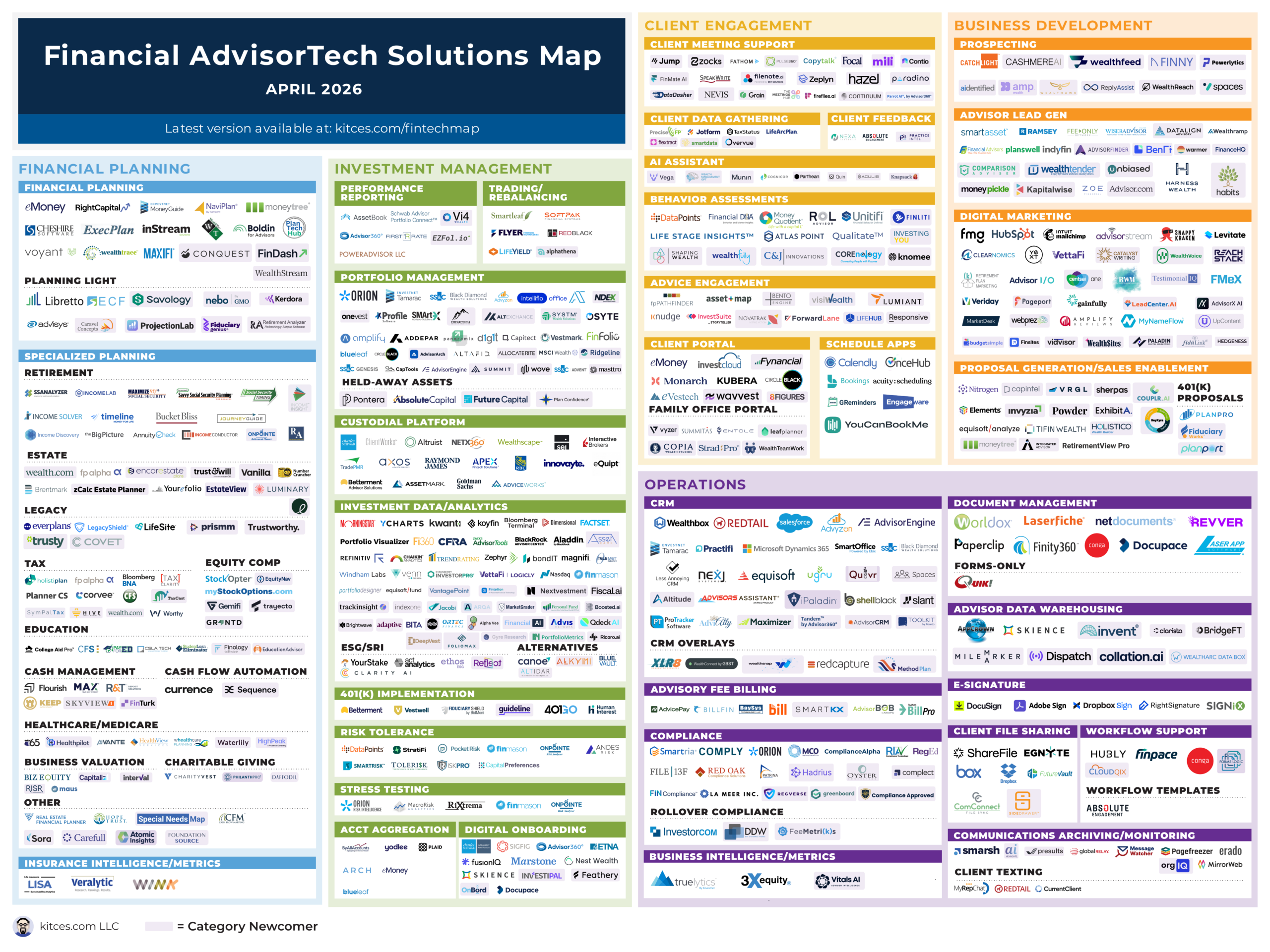
And be certain to read to the end, where we have provided an update to our popular "Financial AdvisorTech Solutions Map" (and also added the changes to our AdvisorTech Directory) as well!
*To submit a request for inclusion or updates on the Financial Advisor FinTech Solutions Map and AdvisorTech Directory, please share information on the solution at the AdvisorTech Map submission form.
Authors:


Wealthbox Announces New AI Agents, But Have They Fallen Behind Competing With AI-Native Third-Party Tools?
CRMs have taken on a variety of functions for financial advisors over the years. Beginning as essentially a simple digital Rolodex of client contact information, over time they gradually built in new functions based around that client record. They allowed advisors to write and store notes for client meetings, assign client-related tasks to team members (and organize sequences of tasks into templated workflows to standardize firmwide processes), and pull and push client data via API integrations with other tools like portfolio management systems and financial planning software. And for enterprise advisory firms in particular with many advisors accessing the same pool of client data, the CRM has also become the place where many of the firm's data governance practices are carried out – e.g., keeping audit logs, reporting, and setting and maintaining data retention policies. All of these functionalities helped to establish the CRM's status as the "system of record" for advisory firms; in other words, the authoritative source for a wide range of client data which then flows out to the rest of the advisor's tech stack.
So when AI tools like notetakers and agents began to proliferate in the AdvisorTech space, it seemed only natural that they would end up living inside of CRM systems. After all, data is the lifeblood of AI – not only are AI models trained on mass quantities of data, but their clearest use cases are where the tool can sift through large amounts of information and pull out answers in a fraction of the time that it would take a human – and CRMs are where most advisory firm data lives. Except it took a long time for the incumbent CRM providers to actually start building and releasing AI features. Among the leading advisor-specific CRM providers per our most recent Kitces Research on Advisor Technology, Wealthbox just launched its inaugural AI notetaker in the fall of 2025 and Redtail hasn't announced any internal AI notetaking or agent features (though Redtail will presumably be integrated with its parent company Orion's recently announced Denali AI platform – which is only particularly useful for Redtail users who also use Orion).
The slowness of the incumbent CRMs to adopt AI created an opening for newer startups to gain a competitive advantage: For instance, AI-native CRMs like Slant have emerged that include AI-powered search, notetakers, and workflows that are fully embedded into the platform (as opposed to being a separate add-on like Wealthbox's notetaker). And even AI notetakers like Jump and Zocks that don't (yet) aim to compete with CRMs directly have in many cases built interfaces that are better for interacting with CRM data better than CRMs themselves, threatening to reduce the CRM's role to a mere database rather than the hub at the center of the advisory firm's operations.
And so it's notable that Wealthbox has (finally) begun to ramp up the release of new AI features within its platform, including this month the announcement of an integrated AI Assistant and AI Agent.
The AI assistant appears to be a standard AI chatbot, where the user can search for data or request actions (e.g., creating a new contact or updating a specific field) via natural language prompts rather than having to navigate to a specific screen or editing window each time an action needs to be taken. The nice thing about this feature is the inclusion of "playbooks", which is essentially a dropdown list of common prompts – for example, when an advisor wants to kick off their new client onboarding workflow for a recently closed prospect, they can click on "New client onboarding" from the dropdown menu and the AI will automatically start the workflow (instead of the advisor needing to actually type the same prompt over and over each time they want to run the workflow).
Meanwhile, Wealthbox's AI Agent is designed to be set up once and then run continuously in the background without re-prompting – for example, a user can set up the agent to deliver a daily list of the most important client touchpoints for that day based on the contact and meeting history for each client.
For Wealthbox, these tools represent a step towards closing the gap between itself and Jump, Zocks, Slant, and other tools that have moved faster in building out their own AI capabilities. But the question going forward will be whether Wealthbox's AI add-ons will truly be competitive with the newer generation of tools that have embedded their own AI capabilities from day one?
What's striking about this month's Wealthbox announcement is how many of the new features are essentially shortcuts or automations of "normal" (non-AI) CRM functions. If an advisor wanted to schedule a daily report of overdue client interactions, or get a notification to send a client an email for their birthday, or kick off an onboarding workflow, it doesn't take an AI agent to set up those automations. Wealthbox's new features might make it easier to execute those actions via a natural language interface, but if that really represents meaningful time savings for Wealthbox users over the old interface, is that really just a commentary on how inefficient that old interface was? Or alternatively, for advisors who had already built out and liked their Wealthbox workflows, is it really necessary to have a new AI agent interface to prompt something that they could (or already did) build as a standard (non-AI) workflow within the existing interface advisor are already familiar and comfortable with?
From the industry perspective, however, Wealthbox's announcement highlights an emerging divide over whether AI tools that work with client data should live within the advisory firm's system of record or whether they should exist on a third-party platform. Wealthbox explicitly makes the argument for the former in its announcement, stating that "An AI layer that can suggest but can't execute within a governed system, that can summarize but can't maintain an audit trail, isn't carrying the weight that advisory firms actually need carried", whereas "When AI operates inside the system of record every action it takes is logged, auditable, and compliant by default." In other words, the firm's data governance policies are hard-coded into its system of record, and any technology running within that system will by definition abide by those policies – whereas if the AI is a third-party tool, there's no assurance it will actually comply with the firm's policies.
Wealthbox's argument makes some amount of sense – to the extent that AI tools execute changes or otherwise manipulate data within the system of record, it's best for them to adhere to the advisory firm's data policies. But the counterargument is that the growth of Jump and Zocks (as well as more specifically agentic AI tools like Vega and CogniCor) over the past few years has shown that many advisory firms don't have the same qualms about third party technologies handling their data compliantly (and in theory, if third-party tech triggers an action in the CRM, the CRM will still have an audit trail of that action and from whence the trigger came?). Because taken to its logical extreme, Wealthbox's argument could theoretically apply to any third-party technology with a two-way integration to Wealthbox – not just AI tools, but client data gathering tools, financial planning software, and portfolio management platforms as well. Is there anything that differentiates AI tools interacting with CRM data externally, from any other software the advisor uses with API integrations to their CRM… other than the AI tools' potential to compete with the CRM's role in the advisor tech stack?
If Wealthbox had rolled out its AI features sooner, before the other tools had time to gain traction, they may have found more success with their argument that AI should live inside the system of record, but we're over three years into the era of AI and creating agents, such that at this point and there is little evidence that advisors are worried about AI agents making "unauthorized" changes to their client data. Perhaps the better argument for Wealthbox's AI is that, for advisors who already use Wealthbox, it's one less third-party tool that they need to buy, and one that's deeply integrated into the tool they already use. Which was really the main case for CRMs to take on AI capabilities all along: Not necessarily because they contain all the firmwide data management controls and policies, but because they contain the data itself and already the platform the advisor logs into in order to interact with that data, and can easily plug into it with AI capabilities that don't require the advisor to buy a third-party solution. But now that third-party solutions have already proliferated, the onus is on CRMs like Wealthbox to give advisory firms a compelling reason to switch to their CRM's own embedded AI capabilities?
Jump Expands Its AI "Operating System", But It Still Isn't (Yet) A CRM
The first generation of advisor-specific AI notetakers was relatively narrow in focus. They transcribed advisors' meetings with clients, generated a summary of the conversation and takeaways that could be exported to the advisor's CRM, and in some cases drafted a client follow-up email that the advisor could personalize and send. All of which address a fairly large pain point for advisors for whom meeting follow-up tasks, including transcribing meeting notes, identifying and assigning follow-up tasks, and writing client emails from scratch, consume about a half an hour per client meeting according to the most recent Kitces Research on Advisor Productivity.
The advisor use case for AI notetakers was so clear, in fact, that new AI notetakers quickly proliferated after AI broke into the mainstream starting in 2022, turning Client Meeting Support into one of the fastest growing categories on the Kitces AdvisorTech Map. Before long it became clear that there were more AI notetakers than the advisor market could sustain (since the rule of thumb tends to be that most software categories will have at most 2-3 dominant players that consume most of the market share), and that those looking to differentiate themselves would need to offer more features to provide more value than 'just' notetaking or even pivot away from notetaking entirely and into a less crowded field.
And so AI notetakers (that stayed notetakers and didn't pivot away) quickly built out new features to tackle different advisor use cases. Some were still centered around meeting productivity, like the ability to draft meeting agendas based on prior meeting notes or to actually assign and kick off tasks that were discussed in the meeting. Others aimed to find new uses for the data found in the meeting itself, such as Jump's Client Sentiment Index that can provide insights into what types of advisor behaviors can improve clients' emotional states (and which advisors best exhibited them). And still others sought to go beyond client meetings entirely and create an entire 'AI layer' that allows the advisor to interface with data across multiple tools (not just their CRM) to answer questions, launch workflows, and report on business intelligence.
The ever-expanding role of AI notetakers took another step forward with the news this month that Jump has launched a new suite of tools that it is dubbing its "AI Operating System". Alongside its core meeting productivity tools, Jump now offers separate add-on modules focused around business growth (including tools for evaluating and scoring advisors' in-meeting performance, training tools for firmwide consistency, and a "Signals" tool that specifically flags client references to things like held-away assets or potential referral sources for the advisor to follow up on), as well as process and workflow efficiency (including a client intake form tool, data extraction from uploaded client documents, and automated email drafting).
Jump's announcement comes on the heels of its recent $80 million Series B funding round, after which it was clear that it could no longer be 'just' an AI notetaker charging $75-$100 per month (as doing so would require it to be used by nearly every single advisor in the U.S. just to meet its investors' growth expectations). The question was just how far beyond notetaking it would go, and whether it was planning to roll out its own CRM in competition with the combined CRM/AI notetaker Slant as well as Wealthbox and its newly announced agentic AI tools. But at least so far it appears that Jump is not yet adding CRM to its list of capabilities – rather, it seems that the goal is to continue living outside and atop of the CRM (along with all the other tools in the advisor's tech stack) and ingesting and orchestrating data from all sources. Jump's view seems to be that third party tools can create value by running off of the data contained in the advisor's systems of record without actually being the system of record, which is in direct opposition to Wealthbox's assertion that AI must live in the system of record to be beholden to all of the advisory firm's data management and compliance policies that are embedded into that system. But the implication of Jump's view is that CRMs serve as little more than a database for AI tools like Jump to siphon data from – in which case why wouldn't Jump just build its own database?
The other question going forward is how much traction Jump will get among advisors with its "AI Operating System" tools that aren't its core notetaker. Notably, Jump's basic AI notetaker has actually declined in price from $120 to $100 per month (and $75 for smaller firms), with some of its original features being spun off into the new growth and operations modules. Which suggests that Jump may be feeling real pressure from lower priced competition from the likes of Altruist's Hazel, Wealthbox's embedded AI notetaker, Slant's CRM (which is $150/month for both CRM and the notetaker), Nitrogen's Meeting Center, and any number of other AI notetakers that come either bundled in with an existing technology platform or available as a relatively inexpensive add-on. If that's the case – that Jump felt the need to strip features out of its AI notetaker so it could price its core product more competitively – it doesn't necessarily speak highly of the value that advisors place on those additional non-core features, which don't solve for as clear an advisor pain point as the original AI notetaker. If what advisors really want is just a well-functioning AI notetaker (which Jump is, at least according to the most recent Kitces Research on Advisor Technology in which Jump rated the highest in advisor satisfaction among notetakers), then it's not certain that they'll pay extra for additional features that go well beyond what most of Jump's users bought it for in the first place.
So while the general push for AI notetakers has been to offer more and more features in order to create value and stand out from the rest of the pack, there seemingly comes a point where what the notetaker provider is offering is no longer what advisors are demanding. Jump's expansion into becoming everything-AI-for-advisors makes sense from the perspective of not wanting to get caught in the increasing commoditization of AI notetakers, but it will likely take longer to convince advisors to see the value in things like meeting scorecards and intake forms than it did for saving advisors several hours each week in meeting follow-up tasks. Ironically, becoming a CRM – a category that has long been ripe for disruption with overall low satisfaction ratings in our Kitces AdvisorTech Research – might actually solve the next-clearest pain point for advisors, and one that has clear synergies with Jump's AI notetaker. But at least for now, that seems to be the one path that Jump isn't planning to take – and so time will tell whether advisors will see enough value in Jump's "AI Operating System" to spring for the full suite add-on features, or if they really just want a better CRM (and a basic AI notetaker that works alongside it).
RightCapital's AI Document Extraction Is The Latest 'Incumbent' AI Tool Threatening Standalone Providers
Most of the early AI tools for advisors were built by small startups that sold them on a standalone basis. In contrast to the larger incumbent platforms where new products or features can take multiple months or years to roll out, smaller companies could move quickly, going from an idea and a business plan to a minimum viable product in as little as a few weeks. Which meant that a developer who had an idea for an AI tool that could, for example, take notes and summarize client meetings or analyze market data or research prospects or extract information from PDF documents, could quickly spin up a product and start selling it. And at the time, there was a seemingly clear growth path for those companies since there was essentially no competition from the established incumbent players.
Which is why today there are numerous "AI for X" providers on the Kitces AdvisorTech Map, from AI notetakers (like Jump, Zocks, and FinMate AI) to tools for investment research (like Nextvestment, Qdeck, and ARQA), proposal generation (like VRGL and Sherpas), prospecting (like FINNY, Wealthfeed, and WealthHawk), and document extraction (like Powder and Flextract). All of which came about at a time when few, if any, of the larger incumbent AdvisorTech providers in core categories like CRM, portfolio management, or financial planning software offered anything similar on their platforms. And so for advisors who wanted to be early adopters of AI technology, the options were to either use a standalone provider or to wait and hope that one of the providers that the advisor already used would roll out similar capabilities – which could be a months or years-long process, if it ever happened at all.
But although incumbent technology providers may have been slow to introduce AI capabilities into their platforms, it's always seemed inevitable that they would start to do so eventually. And in the last few months we've now seen a flurry of AI-related announcements from established AdvisorTech providers, from Wealthbox's introduction of an AI notetaker followed by newly announced agentic AI capabilities to Orion's launch of its Denali AI overlay to Altruist's market-disrupting Hazel AI notetaker and tax planning tool. All of which go to show how the momentum in AI innovation in AdvisorTech seems to be slowly but inexorably shifting from the small standalone startups to the bigger multifeatured incumbents.
Yet another sign of this shift came this month with RightCapital's announcement of its new SmartImport feature that's designed to extract data from client documents to automatically populate data within the client's financial plan. For example, an advisor can upload a client's investment account statement to create a new investment account on the client's balance sheet and populate the holdings information (or update holdings on an existing investment account). Or they can upload a client meeting summary that includes key changes to the client's plan which the software will flag and propose changes for – for example, if the client discussed a planned upcoming vacation during the meeting, then upon uploading the meeting notes the software will create a new expense item for the vacation which the advisor can approve and add to the client's plan. Or the advisor can upload financial planning documents from a different software platform like eMoney or MoneyGuide to speed up conversion to a RightCapital plan (either for a client who moved over from an advisor who was using a different planning software or for an advisor who is moving their whole client base from one platform to another).
But what's perhaps most notable is that RightCapital is bundling SmartImport into all of its pricing tiers at no extra cost – and by doing so has effectively eliminated any reason for RightCapital users to use a third party solution for document extraction, or to pay for a higher pricing tier of a solution like Jump or Zocks to be able to extract data from documents and export it to RightCapital. Which is an ill omen for standalone document extraction providers like Powder and Flextract: If the function that's the main basis for their business model can be rolled out as a "free" feature by a provider that a large percentage of advisors already use (and it seems to be only a matter of time before other major providers like eMoney and MoneyGuide introduce their own document extraction tools), the market for the standalone providers could shrink considerably. Their main hope might be that their existing users will stick with them out of familiarity (along with some ancillary benefits like being able to export data to other platforms besides financial planning software, though in practice that's where most of the pain of data entry occurs for financial advisors) – but the problem there is that the switching cost from one data extraction tool to another seems fairly minimal given that the client data doesn't actually "live" in the tool but is just extracted and exported to other tools, which makes standalone data extraction providers particularly vulnerable to being undercut by competing tools from incumbent platforms.
From a broader industry perspective, the steady stream of new AI features from bigger incumbent platforms raises daunting questions about the future of countless "AI for X" tools on the AdvisorTech Map. Pressure from incumbents has already started to cause price compression in the AI notetaker category. Morningstar's recently announced AI assistant that will be embedded in its Direct Advisory Suite will undoubtedly put pressure on standalone AI-powered investment research tools. And it seems like only a matter of time before a portfolio management platform like Orion, Advyzon, or Black Diamond introduces an AI proposal generation tool that could eliminate the need for advisors to use a standalone tool like VRGL.
In the end, there will always be a contingent of advisors who prefer "best-of-breed" solutions over "all-in-ones", and who don't mind paying extra for a third-party tool if it delivers a better experience. But there's a thin line between the type of technology that's important and differentiable enough that there's really a market for providers who offer it on a standalone basis, and what's better suited as a feature that's part of a tool that advisors already use. As the trend of incumbent technology providers expanding their own AI capabilities continues, it will become clearer where that line falls for the various use cases of AI for which standalone tools have cropped up in the last few years - in other words, which of the early AI-based startups simply benefited from having little competition from incumbents at the time, and which had business models that can endure even when an established player like RightCapital enters the picture.
Range Reiterates Its Plan To Eliminate Human Advisors In Favor Of AI, But Will Its Clients Keep Paying Human Fees For AI Advice?
Every few years a piece of technology comes along that, at least according to its promoters, will eliminate the need for financial advisors. Back in the 1990s it was the rise of discount online brokerage firms like E*Trade and Ameritrade that made it far easier for individuals to buy and sell stocks, bonds, and mutual funds on their own without going through a financial advisor (at the time, a broker-dealer representative) as an intermediary. In the early 2000s it was the increasing power of search engines like Google to find answers to almost any financial question for anyone with an internet connection. Starting in the early 2010s it was the robo advisor movement with its proliferation of technology that could manage a client's asset-allocated portfolio automatically for a fraction of the cost of a human advisor. And now in the 2020s, it's artificial intelligence, which can ingest any number of data points about a user's financial situation and generate personalized recommendations in a few seconds' time.
Of course, none of those previous technological developments managed to truly threaten human advisors. Online brokerage firms might have disrupted the business of some full-service broker-dealers, but they didn't affect anyone whose business model wasn't based primarily on selling financial products. Google might have been a big help to knowledgeable DIYers, but not everyone wants to go through the work of discerning what is actually trustworthy among the dozens of pages of Google results containing often-contradictory information. And robo advisors only ended up threatening advisors who provided no value beyond managing a basic model portfolio (and often actually enhanced the value of planning-focused advisors by reducing the manual work of portfolio management and allowing them to go deeper into planning to attract more complex and higher-paying clients). In other words, the technology that once promised to disrupt human advice has so far failed to do so, either because it really only affected people who were inclined towards DIY solutions (and thus were unlikely to ever hire a financial advisor in the first place) or because it didn't end up meaningfully detracting from any of the reasons that people actually hire human advisors for (and may have even enhanced what human advisors can do by automating their own 'lesser-value' tasks).
All of which raises the question: Is there anything different this time about AI that will legitimately threaten the value proposition of, and consumers' willingness to engage with, human financial advisors? After all, artificial intelligence does hit on many of the areas where prior technology fell short: It can deliver actual planning recommendations (as opposed to just executing a portfolio allocation), and it can personalize its output based on the client's own situation (unlike the generic content of most search engine results).
But just because AI does those things better than previous technology iterations doesn't mean that it's actually capable of replacing human advisors, because there are still more reasons that clients hire human advisors which AI doesn't replace. For many people, it's the ability to delegate the thinking behind their biggest financial decisions to a person who can be held accountable for it. For others, it's developing a long-term trusting relationship with someone they know will truly understand them as a whole person and have their best interests at heart. And in some cases, it's simply that they can better trust a human to have the expertise to solve complex or niche planning challenges than AI technology that still notoriously tends to unwittingly give incorrect information and advice (which at financial planning levels of complexity, would be beyond most consumers' knowledge to even realize the advice might be wrong). But whatever the reason, it's clear that – despite there being ample tools available for individuals to manage their own finances – there remains a sizeable segment of the population who simply prefer to entrust that work to another human, and are willing to pay a premium fee to do so (since that fee is still most likely less costly than either doing no planning at all or making a mistake that compounds over years or decades).
So it's notable to see the announcement from the CEO of the startup RIA Range that they intend to replace most or all of their current two-dozen-plus advisors with in-house AI tools. The announcement itself isn't necessarily news – Range has been announcing its plans to replace human advisors since it emerged as a flashy, Google-backed startup nearly two years ago – but what is noteworthy is the route that Range took to get to this point. After launching and announcing its intent to eliminate human advisors, one of the first things Range did was…start hiring human advisors. In the words of Range's CEO, those advisors then served essentially as training material for Range's AI tools in order to "see what they do, how they think, [and] what makes them amazing financial advisors." And after several years of observing how their human advisors work and use technology (e.g., the Altruist platform where they custody assets), Range has purportedly "flipped a switch" so that AI, rather than human advisors, is operating most of the technology itself. Which now supposedly opens the door for Range to wind down its advisor workforce since, in its view, with AI in charge of managing the investments and conducting analyses to deliver planning advice, there isn't much of a role for left for the humans who were pressing the buttons.
That may all make sense when coming from the viewpoint that most of an advisor's job is to manage investments and operate planning software, such that they can be easily replaced by an AI tool that can do the same thing just as adeptly. In that view, the only difference between a full-service advisory firm and a direct-to-consumer technology company is whether a human or an internal AI agent is in the metaphorical driver's seat delivering the advice message. But the reality is that there's a much bigger shift when going from human advice to consumer-facing technology, that becomes apparent when looking at the economic models of each.
As a service business, human advice can only achieve so much scale since each advisor has a limit to the amount of time they have to meet with clients and thus the number of individual clients they can serve effectively, and so human advisors need to charge a premium fee in order to operate profitably (usually on the order of $3,000 dollars a year per client at minimum, according to the most recent Kitces Research on Advisor Productivity). And clients are willing to pay these fees because of the value the advisor provides in that relationship, whether that's by building trust, maintaining accountability, or providing expert advice. Whereas a technology business is all about scale and growing as large a user base as possible, often by heavily discounting fees to attract consumers who are more focused on minimizing cost than on paying a premium fee for a human relationship in order to get the most value. And so while Range is currently charging human advice-level fees (from $2,950 to $9,950 per year) rather than traditional direct-to-consumer software fees (e.g., $9.99/month!?), does it expect to continue to be able to do so once its clients no longer have human advisors to work with? Or will it find that its clients have expectations for the type of service they'll get for the (human-level) fees they're paying that AI tools alone aren't set up to deliver?
What's more likely is that Range will need to radically adjust its fees and business model if it truly aims to replace its human advisors with AI and successfully distribute to consumers. Which will also mean needing to deal with the completely different reality of client acquisition costs as a technology company versus a service business – e.g., it can make sense to spend $3,000 or more to acquire each client if the client pays $5,000+ in fees each year, but not so much when the client is only paying $500. Which is the same lesson that robo advisors learned over a decade ago, who assumed that consumers would abandon their financial advisors in droves in favor of a lower-cost alternative but ultimately ended up fighting for the business of price-sensitive DIYers while blowing up their business model in the process as high client acquisition costs in the financial services industry trumped the reduced unit economics of their low-price-driven DIY model. And even if Range can succeed in initial client acquisition, there will still be the matter of its ongoing retention rates, which are often 95% to 98% with human advisors… whereas if Range falls to 'just' 80% retention rates with a more DIY-price-sensitive clientele it would cut their lifetime client value to 1/4th of what it otherwise would have been (which, in turn, will once again make their client acquisition costs problematic).
And so the big question is: If Range has already built a successful tech-forward (but still human) advice business, why would it insist on radically pivoting into a technology-only model that has proven so treacherous in the past? The answer might be that the company doesn't have much of a choice in the matter, given its tech-focused investment backers (who invested into the thesis of a scalable technology business with tech margins, not a human planning business with human profit margins). But either way Range seems likely to find that going from human to AI advisors while still attracting and especially retaining clients is not as simple as flipping a switch, and that consumers who want to delegate their advice to a human have very different expectations for the level of advice they receive (and the fees they're willing to pay on an ongoing basis) than those who would rather manage their own finances with the help of an AI "advisor".
Wealthstream Launches An "Advice Intelligence" Platform To Train Newer Advisors, But Can AI Really Teach The Delivery Of Advice?
There's a lot of material that's taught in financial planning undergraduate programs and the CFP educational curriculum, but it's no substitute for the training that real-life, hands-on, client-facing work provides. The problem, however, is that few advisors get the opportunity to receive that training in any structured way. Senior advisors often have little time to sit down with their support advisors and go through the thought processes and judgment calls that go on behind the scenes of the advice they give. Few advisory firms have the resources to put towards dedicated training and education programs. And one of the most effective ways for newer advisors to see the inner workings of the financial planning process – by sitting in to take notes for the senior advisor during client meetings – is rapidly eroding with the advent of more efficient AI notetaking software.
This is a particular issue in an age of advisory firm consolidation, where more and more advisors and assets are concentrated under a single mega-RIA that is responsible for supervising the advice given by all of its employees. And the bigger the firm, the higher the odds that one advisor will give incorrect or misguided planning advice that at best costs the firm a client and at worst creates legal or financial liability for the firm and advisor. Traditionally this problem was mainly confined to the wirehouses and regional broker-dealers with thousands of advisors on their payroll, which dealt with it by severely limiting the types of "advice" their representatives could give (to put it bluntly, setting their policies based on what their single least competent advisor might do that would get them sued and dragging all the rest of their brokers down to the lowest common denominator). But that approach isn't an option in the RIA channel – even with the mega-RIAs – because most of these firms center their value proposition around the depth of planning advice their advisors deliver to their clients… in other words, their value proposition sets the bar too high to simply try to protect themselves by setting the compliance bar low, which makes actual training an imperative.
That's why it's notable to see the news this month about the launch of Wealthstream, a new "advice intelligence" platform for wealth management firms. It has a unique value proposition of helping to analyze a client's situation and serving up financial planning recommendations based on client data – not, as it says, on the basis of efficiency or to replace the advisor altogether, but to introduce planning expertise to less experienced advisors so those advisors can build familiarity with the firm's planning processes and philosophy. To put it more plainly, Wealthstream sees itself as a hands-on training tool for advisory firms to bring their advisors quickly up to speed on how the firm "does" financial planning by highlighting the specific strategies that an advisor might recommend for a given client scenario (in a manner that also ensures the advisor crafts those recommendations consistent with the firm's views about what an appropriate recommendation would have been in such client situations).
What's interesting is that there have been many versions of AI planning tools to come out in the last year that do some version of what WealthStream does (i.e., generate recommendations based on client inputs), but WealthStream is the only one so far to position theirs as specifically an advisor training tool. But in an environment where the cost of hiring advisors rises significantly with even a little bit of experience – e.g., according to CFP Board's 2025 Compensation Study, the median compensation for an advisor with less than 5 years of experience was $107,500, which rises to over $148,000 for advisors with 5-10 years of experience – it starts to make sense how firms might see the value in a tool that can theoretically help them train less experienced advisors to think and plan like more experienced advisors (while reinforcing the firm's own policies and philosophy) without having to pay the elevated market rates to hire a more experienced CFP professional that was already trained by another firm instead.
The question, though, is how much a tool like WealthStream can really train newer advisors to think and act like senior advisors. To be sure, a part of the job is recognizing patterns among client situations that might map to certain planning recommendations, and reinforcement from Wealthstream's AI might help advisors pick up on those patterns more quickly. But arguably a bigger part of the job – and the skill with the widest gap between newer and more experienced advisors – is the ability to listen, ask questions, and fully understand what really matters to the client. An AI tool might be able to serve up several possible recommendations that might each be appropriate for a client in some ways, but confidently deciding on which option to recommend, and figuring out how to deliver that recommendation effectively to the client themselves, requires truly knowing what the client wants to achieve and how to engage in the conversations that occur beyond the software.
And so if an advisory firm wants to go all-in on using AI for advisor training, WealthStream's planning strategy-focused tools might provide part of, but not all of the solution. There are other AI training tools like Shaping Wealth's Lydia conversational agents that can help advisors role-play conversations and practice listening and interviewing skills to expand the "delivery" component of the advice training process. There's also the client meeting scores embedded in AI notetaking tools like Jump and Zocks that give feedback on metrics like how much time the advisor spent talking during the meeting (versus letting the client talk) and how much empathy the advisor displayed. Which means at least at this point, any one AI tool – or even some combinations of them – are still just a part of a complete training program, not necessarily the whole thing.
In the end, then, for enterprise advisory firms that want to bring on more newer advisors, a tool like WealthStream can go part of the way towards getting up to speed on planning strategy (with the additional benefit for the firm that it nudges advisors towards certain firm-approved recommendations, reducing the odds that an advisor will go too far outside the box with their advice and end up creating a liability for the firm). But it's likely most effective not for teaching the concepts themselves, but for reinforcing what the advisor has already learned – through experience, informal training or mentorships, or formal advisor training programs – in other words, as a supplement to the training systems that the firm already has in place, not as a replacement for them.
Equity Compensation Technology Blossoms As Niching Advisors Drive Demand For Specialized Planning Tools
There are a number of reasons that financial advisors get into specific niches in the clientele they work with. Sometimes it's for business development purposes: In an environment where independent, fee-only financial planning firms are now numerous enough where that distinction alone isn't enough for an advisor to stand out from the next advisor down the street, building a brand around a certain niche clientele can help advisors differentiate themselves and drive new business. Sometimes it's out of passion, where an advisor really is truly interested in a solving a specific type of planning problem for a specific type of client. And sometimes it's just because the niche represents a good business opportunity, where the clients in that niche have both complex planning problems and the level of wealth that allows them to pay premium fees to specialists who can solve them.
One broad type of niche that fits in this last category is equity compensation. Employees who are paid with equity – e.g., in the form of ISOs, NSOs, RSUs, ESOPs, or any of the various other equity compensation structures – often have complex planning needs around questions like when to exercise options, whether and when to divest of company stock, and how to deal with the tax consequences of all of those actions. And equity-compensated employees can often fly under the radar of many financial advisors who may not have the expertise to answer all of those questions and may require more liquid assets than the employee currently has available. Which creates a great business opportunity for advisors who can help a client navigate the complexity of their equity compensation and then, once the employee eventually liquidates their company stock, can ultimately manage the investment of the proceeds.
As a result, the equity compensation niche has blossomed over the last few years (particularly as the growth in technology stocks has resulted in many startup employees with sizeable concentrated company stock holdings with significant embedded gains). And as that niche has grown, there has also been a growing category of technology on the Kitces AdvisorTech Map that's designed to help advisors visualize, model, and make decisions around clients' equity compensation. In addition to tools like StockOpter and MyStockOptions.com which have been around for decades, there's now also Gemifi, Trayecto, and Grantd (the latter of which actually purchased StockOpter and plans to absorb it into its own platform, though the two remain separate for now). Which may not be as meteoric of a growth rate as, say, the Client Meeting Support category during the rise of AI notetakers, but is fairly notable for a niche specialized planning tool.
What's interesting is that specialized planning software has historically tended to struggle to gain traction, with a few notable exceptions – namely tax planning (whose growth was largely due to the rise of Holistiplan) and estate (whose growth was driven not so much by new estate planning tools but instead by a proliferation of estate document providers like Wealth.com, Vanilla, and EncorEstate). But both of those, despite being categorized as "specialized planning" are relatively broad areas of planning that can be done with a wide range of clients. By contrast, only a small minority of financial planning clients have equity compensation issues, so it's striking that there has been enough of a market to spur the creation of three new technology providers in such a short time.
What's likely going on is that as more advisors are niching into equity compensation planning on account of the business opportunity it presents, they've found themselves unsatisfied with the longstanding incumbent providers (which haven't changed much in functionality and appearance over the years) and are willing to pay a premium for a better solution. The new tools have subsequently popped up to fill that demand with more modern features like AI document extraction, API data feeds to custodians, and advanced scenario planning.
At the broader industry level, the mini-boom in equity compensation tools demonstrates the intriguing business opportunity for specialized planning tools if they allow advisors to go deeper into planning in a specialized niche that helps them grow their business. That's in contrast to specialized planning categories like legacy planning, education planning, and charitable giving, where the business opportunity for advisors is at best indirect – while doing those types of planning may help the advisor deliver more value to their clients and make them happier and more likely to stick around in the long run, it doesn't necessarily manifest directly into more assets or revenue for the advisor (unlike equity compensation where the stock options and RSUs being discussed will eventually turn into managed assets), which makes it harder for advisors to justify the expense of a specialized piece of software to do that planning.
Conversely, there's potentially more of an opportunity for growth in categories like retirement income planning (where advisors can roll their clients' 401(k) plans into IRAs under their management to implement the income plans they develop), business planning (where working with pre-liquidity business owners can translate into managed assets after the business is sold) and cash management (since helping clients optimize their cash levels creates the opportunity to invest any surplus liquidity). But the bottom line is that as advisors get more comfortable growing into niches, they'll be willing to pay more for tools that help them do specialized planning for their specialized clientele.
In the meantime, we've rolled out a beta version of our new AdvisorTech Directory, along with making updates to the latest version of our Financial AdvisorTech Solutions Map (produced in collaboration with Craig Iskowitz of Ezra Group)!
So what do you think? Does it matter whether an agentic AI tool lives within the "system of record", or is the risk of a third-party tool acceptable? Is there any reason to pay for standalone document extraction if it's also a 'free' feature of a tool you're already using? How much can AI teach newer advisors about how to act and think like an experienced planner? Let us know your thoughts by sharing in the comments below!