
Executive Summary
When it comes to estate planning conversations, many clients come to the table with the goal of avoiding the probate process, which can trigger images of a lengthy legal process that unnecessarily slows the distribution of a deceased individual's estate. Relatedly, when some or all of a decedent's assets do go through the probate process, it is sometimes seen as a 'failure' of estate planning. In reality, probate is often a normal and necessary part of estate administration, even when planning has been done well.
To start, probate is not a punishment for failing to plan; rather, it is the statutory estate plan that applies to every resident of a given state. Probate serves as infrastructure for establishing who has legal authority to act, clarifying ownership of assets following a death, providing a process for identifying and resolving claims, and creating procedural deadlines and guardrails to ensure an estate is settled with finality.
Notably, probate procedures vary by state and the complexity of the estate, so the probate experience can be quite different depending on a decedent's particular circumstances (ranging from a simplified process to one with expensive court supervision and more cumbersome administrative requirements). Nonetheless, for certain clients, the public nature of the probate process can be a bigger concern than the administrative burden.
To attempt to avoid the probate process, some clients set up trust structures that bypass probate. However, doing so doesn't mean avoiding the need for administration, which requires many of the same tasks as probate (e.g., identifying assets, valuing property, and transferring ownership). In effect, trust administration functions as a 'private' form of probate, operating outside the court system but subject to similar responsibilities and risks.
Even when estate planning is done 'well', individuals can still be exposed to the probate because of what happens (or fails to happen) after documents are signed. Such issues include acquiring assets after their estate plan is completed (and not coordinating ownership and beneficiary designations), inconsistent titling, digital and intangible assets (e.g., online accounts, intellectual property, and social media accounts), and out-of-state property (which can trigger "ancillary probate" and the possibility of multiple probates in multiple states). There are also cases (e.g., when family conflict exists, when a guardian must be appointed, or when there are creditor concerns) where going through the probate process might be preferable to private administration, given the structure and clarity it can provide.
For financial advisors, the value of probate literacy is in part a matter of client expectation management, because if clients have been conditioned to believe that probate equals planning failure, the presence of probate can trigger frustration, distrust, and/or confusion. Conversely, if probate has been explained as a normal part of the process that may apply in certain circumstances, its occurrence is less likely to feel like a shocking surprise. Also, understanding probate can allow an advisor to serve as a 'central coordinating figure' after a client passes away, reducing uncertainty and smoothing the asset transfer process for the client's survivors and beneficiaries (allowing the advisor to build trust with this group throughout the process).
Ultimately, the key point is that by shifting estate planning conversations from "avoiding probate" to "coordinating administration", advisors elevate the discussion and set realistic expectations that can mean a better client experience and a higher likelihood of maintaining the relationship intergenerationally!

Ah, the "P" word. The thing that every typical estate planning educational session for advisors says their clients should avoid at all costs. Probate. But there is so much more nuance to what probate is – and why it is often sought to be avoided – than simply labeling it the boogeyman.
Every individual has an estate plan, whether they realize it or not. For those who proactively engage in estate planning, that plan is reflected in wills, trusts, beneficiary designations, and coordinated ownership structures. For everyone else, the plan is created by their state's legislature. Each state legislature has enacted a statutory framework that determines what happens when you die, who has authority, and how disputes are resolved (when no private planning has been put in place). That default framework is what we would commonly refer to as "intestacy" and inevitably involves probate.
In practice, probate is often treated as the opposite of estate planning. It is something that occurs only when planning has failed or was never completed. As a result, estate planning 'success' is frequently framed in terms of whether the client "avoided probate". This furthers the idea that probate is an outcome that should always be avoided rather than a system designed to fill gaps that private planning didn't or couldn't fill.
The truth is that even the most thoughtfully designed estate plan exists within (and alongside) a statutory framework. Trusts, beneficiary designations, and joint ownership are tools that may obviate the need for probate, but they do not operate entirely outside the legal system. When those tools do not apply, are not effectively (or comprehensively) implemented, or no longer reflect current circumstances, probate governs what happens next.
This distinction matters for advisors because clients and their families rarely experience estate planning as a deliberate event or process. They experience it when someone dies, and administration begins. When probate occurs unexpectedly, it is often perceived as evidence that something went wrong (i.e., the plan failed, the professionals involved missed something, or the process was flawed).
In reality, probate is frequently a normal and necessary part of estate administration, even when planning has been done well. Advisors who understand what probate is and can explain it clearly to clients and beneficiaries are in a much better position to manage expectations, reduce friction, and maintain trust during one of the most emotional and chaotic times that a family could face.
Having A Will Does Not Mean Probate Is Avoided
One very common client misconception is that having a last will and testament (a "will") allows an estate to avoid probate. In reality, assets passing through a will typically ensures that probate occurs.
Probate is the legal process through which assets titled in a decedent's individual name are transferred to their heirs or beneficiaries. A will is simply a set of instructions for how the probate process should happen.
It expresses the decedent's wishes regarding who should receive assets, who should serve as personal representative, and how certain decisions should be handled. But those instructions do not carry legal authority on their own outside of court supervision. The probate process is what gives them effect.
This distinction is often misunderstood because wills are commonly perceived as the primary estate planning document. Clients may assume that signing a will "handles everything", when in practice the will is designed to operate within the probate system rather than outside of it.
What Probate Is And Why It Is Commonly Misunderstood
Probate is not a punishment for failing to plan. It is the statutory estate plan that applies to every resident of a given state. Each state has enacted laws that govern how property is administered after death, how the authority of decision-makers is established, how creditor claims are handled, and how disputes involving the estate are resolved. When assets are titled in an individual's name at death, and no other mechanism controls their transfer, those assets fall under the state's unique probate laws, rules, and regulations.
Therefore, probate is better understood not as an 'avoid-at-all costs' court proceeding, but as an infrastructure designed for things such as:
- Establishing who has legal authority to act
- Clarifying ownership of assets following a death
- Providing a process for identifying and resolving claims
- Creating procedural deadlines and guardrails to ensure an estate is settled with finality
While probate procedures vary by state and by the complexity of the estate, most administrations follow a broadly similar process. The process generally begins with the filing of a petition with the probate court to open the estate and appoint a personal representative (or executor…or administrator – the terms vary by state and if there was a last will and testament). Once appointed, the personal representative receives the court's formal authority to act on behalf of the estate.
From there, the personal representative works to identify and inventory assets, obtain date-of-death valuations, and notify interested parties (which includes beneficiaries and known creditors). The debts, expenses, and taxes are addressed as part of administration, and estate assets may be managed or liquidated as needed to meet those obligations.
After liabilities have been appropriately addressed and the requisite deadlines have elapsed, the remaining assets are distributed according to the terms of the last will and testament (yes, probate can still be necessary even if there is a will), or, if no will exists, pursuant to state intestacy laws. The estate is then formally closed.
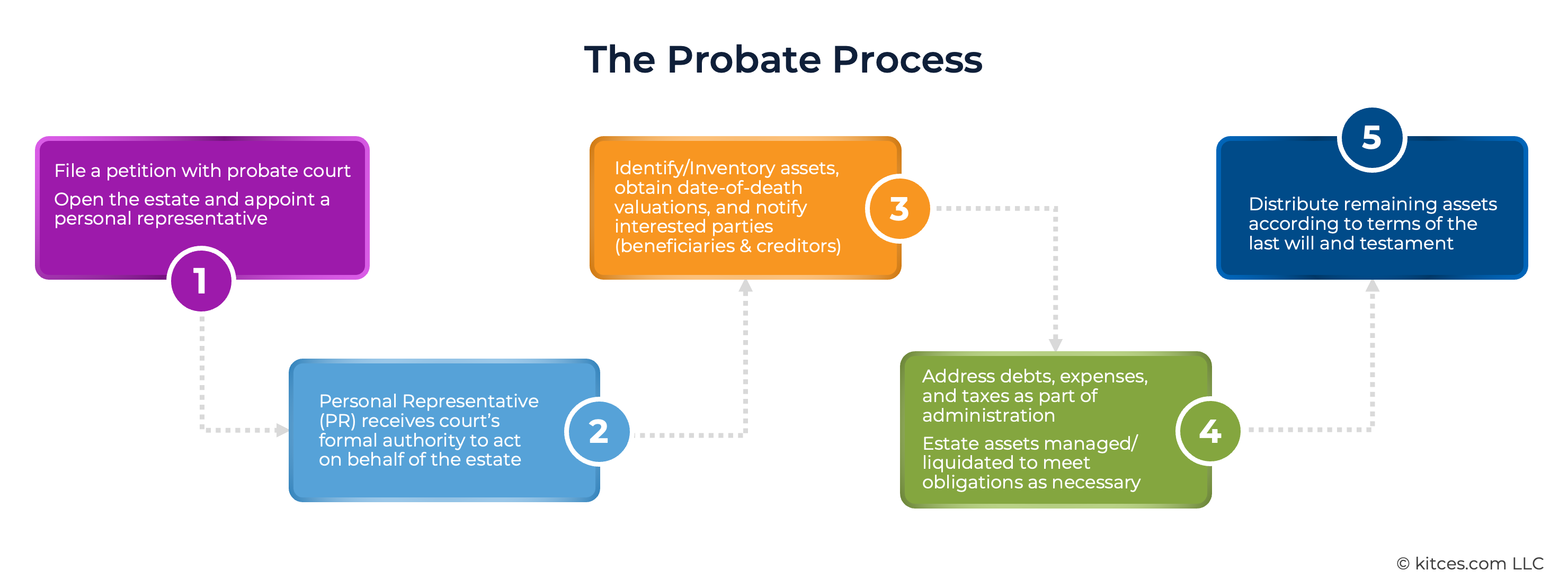
Accordingly, probate is not something that happens in the absence of estate planning. It is the legal framework through which assets are administered after death, whether a person has a will directing the process or state law determines the outcome in its absence.
Probate Is Not A Single Process
The experience of probate varies significantly based on state law, court procedures, asset composition, and family dynamics.
In many jurisdictions, estates below certain asset thresholds qualify for a simplified (or at least more informal) probate process that involves limited court supervision and less cumbersome administrative requirements. In other cases, probate may involve more extensive oversight, particularly where disputes arise or where statutory protections are triggered.
As a result, the time, cost, and complexity of probate are often driven less by the mere existence of probate and more by factors such as:
- The nature and location of assets
- The quality of ownership and beneficiary records
- Family conflict or lack of clarity
- The need for court intervention to resolve disputes
This variation helps explain why probate has developed such a polarized reputation. Some families experience probate as a largely administrative process. Others encounter delays, conflict, and expense that reinforce negative perceptions. Treating probate as a single outcome obscures these distinctions and oversimplifies its role in estate administration.

Nerd Note:
While probate is governed by state law, practitioners often observe that the administrative experience can vary by jurisdiction. Some states (such as Washington and Texas) are frequently viewed as relatively streamlined due to cost, procedural flexibility, and ease of administration. Others (such as Massachusetts and New York) are often perceived as more formal, costly, and burdensome.
These characterizations are anecdotal rather than definitive, and outcomes ultimately depend on estate complexity, court procedures, and local practice.
"Small Estate" Procedures
While probate is often discussed as a formal court process, some estates never have to go through full administration because they qualify for simplified procedures sometimes known as small estate affidavits.
These statutory processes allow certain assets to be collected and transferred using a simple sworn statement rather than opening a formal probate proceeding. While requirements vary by state, eligibility is typically based on the total value of probate assets falling below a specified threshold and the passage of a waiting period after death. Financial institutions may accept the affidavit, along with a death certificate, as sufficient authority to release funds or retitle property.
Thresholds and rules differ significantly across jurisdictions. For example, California's small estate threshold is high ($208,850 in 2026), whereas Maine's is comparatively low ($40,000).
In practice, probate is sometimes triggered simply because a single asset of modest value was missed or happens to fall outside the primary planning structure. When that occurs, the need for probate is often more administrative than evidence of a total plan catastrophe.
Why Probate Can Be Frustrating
One of the primary reasons probate can create frustration is not the court process itself, but the practical reality that financial institutions typically freeze accounts titled in a decedent's name once they are notified of the death. Custodians do this to prevent unauthorized transactions until they receive formal documentation confirming who has legal authority to act.
As a result, even routine expenses or planned distributions may be delayed until letters testamentary or similar court-issued documentation is provided. For an advisor, this can be critical because it may mean that trading on the account is not possible for an extended period. This can all feel like an unfair administrative hurdle, but from the institution's perspective, it is a necessary safeguard to ensure assets are released only to the properly authorized parties.
Another occasionally frustrating aspect of probate is that it is generally a public proceeding. Court filings may include the decedent's assets, liabilities, and the identities of beneficiaries. This is one of the reasons you may see the 'celebrity nightmare' estate stories after the tragic passing of a public figure (e.g., James Gandolfini) – because their will is relatively easy to find through publicly available websites/resources.
For some families, this transparency is not a huge concern. For others (particularly high-net-worth individuals or those with complex family dynamics), the loss of privacy can feel like a meaningful downside of probate compared to private trust administration.
Nerd Note:
Even when assets are held in a revocable trust, custodians may still temporarily restrict activity after the grantor's death until they receive certain documentation. Because most revocable trusts are treated as grantor trusts during life and use the grantor's Social Security number for tax reporting purposes, institutions often require a death certificate, a successor trustee certification document, and sometimes a new account be opened or other additional paperwork before allowing transacting on the account to continue. This may even be the case for a joint spousal trust (because the account is opened under a single 'primary' Social Security number).
"Avoiding Probate" Is Misleading As The Marker Of Estate Plan Success
Because probate is so commonly framed as something to be avoided at all costs, its presence is often interpreted as evidence that the estate plan failed. That interpretation is misleading.
Estate planning shouldn't just be defined by the absence of probate, but by a litany of other factors tied to the client's goals and priorities. A well-designed plan can still involve probate and be deemed a success. Alternatively, a plan that technically avoids probate may still be poorly implemented or difficult to administer.
For advisors, the risk of overemphasizing probate avoidance is that it creates unrealistic expectations. When beneficiaries encounter probate, frustration is often directed toward the planning process rather than toward the statutory system that governs post-death administration. Advisors who help clients understand probate as a normal component of estate administration (rather than as a failure) can reduce this risk and provide greater clarity at a critical moment.
Trusts Do Not Eliminate Estate Administration
Revocable trusts are often presented as a way to avoid probate, and in many cases, they do serve that function. However, avoiding probate does not mean avoiding the need for administration.
Trust administration requires many of the same tasks as probate (i.e., identifying assets, valuing property, transferring ownership, addressing creditor issues, and completing required tax filings). In effect, trust administration functions as a 'private' form of probate, operating outside of the court system but subject to similar responsibilities and risks.
When trusts are poorly funded, outdated, or inconsistently maintained, they create many of the same administrative challenges commonly attributed to probate. In those situations, probate is not the cause of complexity; it is simply the mechanism that addresses it.
Nerd Note:
"Testamentary trusts" (i.e., trusts created under a will that come into existence at death) are often misunderstood in discussions about probate.
With a testamentary trust, the will generally must be admitted to probate (because the trust was created under the will itself) so the court can validate the document and formally recognize the fiduciary authority it creates. In that sense, testamentary trusts are usually inherently connected to the probate process.
However, this does not mean that all assets ultimately administered under the testamentary trust necessarily 'go through probate'. Probate establishes the legal authority and oversees the transfer of probate assets into the trust structure, but once funded, ongoing administration occurs under the terms of the trust rather than through continued court supervision. Therefore, specifying a testamentary trust as beneficiary of an asset can create some administrative confusion as to whether a probate proceeding has been prompted versus leaving assets to an inter-vivos trust (i.e., a trust that was created during lifetime).
Meet George: A Typical Revocable Trust Plan
The scenario below is a hypothetical example and for illustrative purposes only.
George has done everything advisors typically recommend.
George created a revocable trust during life and transferred most of his major assets into it:
- Brokerage account titled to the trust
- Primary residence retitled in the trust's name
- Beneficiary designations appropriately updated
At first glance, it would appear George has structured a plan that completely avoids probate. When George passes away, no probate proceeding is necessarily required, as the trustee already has authority to act under the trust document. This is often described as "avoiding probate", but what happens next looks very similar to the probate process.
The Trustee Still Has To Gather And Confirm Assets
George was concerned about naming his parents as trustees because of their fiery emotions and lack of sophistication. He settled on his friend, Elaine, to serve as trustee. Elaine's first task is to identify and confirm everything George owned. Even without court involvement, Elaine still needs to:
- Obtain date-of-death values
- Confirm account ownership and beneficiary designations
- Identify liabilities and potential expenses of George's estate
- Review digital accounts
Therefore, administration begins immediately. Just privately.
Debts, Expenses, And Taxes Still Exist
Avoiding probate does not necessarily eliminate financial obligations that existed while the client was living. Elaine still needs to:
- Pay final bills and funeral costs
- Coordinate any necessary income/estate tax filings
- Evaluate potential creditor exposure
In a formal probate process, creditor timelines are governed by state statute and court procedures. In private trust administration, these decisions still must be managed, albeit without the definitive deadlines that the probate process demands.
Distributions Are Not Immediate
Beneficiaries often assume that avoiding probate means receiving assets quickly. In reality, Elaine must first:
- Carefully review her fiduciary obligations under the trust to make sure she administers it properly
- Confirm there is liquidity to satisfy the distributions and appropriate shares of the estate to each beneficiary
- Hold funds back for things like taxes and expenses
If she distributes assets too quickly and unexpected liabilities arise, she may expose herself to personal liability. This is not unlike a key probate principle that administration needs to happen before distribution.
The Advisor's Role Looks Very Similar
From the advisor's perspective, much of the work resembles what would occur during probate:
- Helping organize account inventories
- Coordinating with the drafting attorney and/or CPA
- Managing liquidity needs
- Explaining timelines to beneficiaries
The difference is visibility, not complexity. The process happens privately rather than through public court oversight. The primary distinction is that the process was managed privately under trust language and relevant statutory authorities applying to trusts, rather than publicly under the probate system, which requires court supervision.
For advisors, this distinction matters because clients may unwittingly equate "avoiding probate" with "avoiding administration". Setting expectations that administration still occurs in some form or fashion can reduce confusion and improve the beneficiary experience.
Why Probate Still Occurs (Even When Planning Is Done Well)
Probate exposure is often less about drafting quality and more about what happens (or fails to happen) after documents are signed. Even thoughtfully designed estate plans can leave assets exposed to probate for reasons that have little to do with legal sophistication and much to do with human behavior.
Common examples include:
Late-acquired assets. Clients purchase new real estate, open new accounts, or acquire business interests after their estate plan is completed. If ownership and beneficiary designations are not coordinated, those assets may remain titled individually at death.
Inconsistent titling. Accounts may have been retitled into a revocable trust at one institution but not at another. A transfer-on-death designation may have been completed for one brokerage account but not for a checking account.
Income received post-death. Refunds, social security payments, tax reimbursements, final compensation payments, or other checks payable to the decedent often require a probate estate to be opened in order to negotiate and deposit them properly.
Digital and intangible assets. Online accounts, intellectual property, cryptocurrency, domain names, and social media accounts may lack clear beneficiaries or a specific transfer process, and accessing them may require formal authority.
Out-of-state property. Real estate owned individually in another jurisdiction can trigger "ancillary probate", even if the primary estate plan is otherwise coordinated. This means there can potentially be multiple probates in multiple states (depending on where the client's assets were physically located).
In many of these situations, probate is not necessarily evidence that planning failed. It is simply evidence that ownership structures and asset flows are dynamic, and over time, misalignment can naturally occur without deep vigilance.
For advisors, this distinction is critical. Clients often assume that signing documents 'solves' their estate planning concerns that they had put off, and they can breathe a sigh of relief forever (or at least for a very long time). In reality, estate planning is a process that requires ongoing coordination, particularly as net worth grows, accounts move, and new property is acquired.
Probate Is Sometimes The Appropriate Mechanism
Another common misconception is that probate is always inferior to private administration. In practice, there are circumstances in which probate provides structure and clarity that a more private or informal administration may lack.
For example:
When family conflict exists. In high-emotion or contested situations, court supervision can provide procedural guardrails that protect fiduciaries from undue pressure and reduce the perception of favoritism.
When a guardian must be appointed. For families with minor children, probate courts play a central role in formalizing guardianship and ensuring that statutory protections are applied. A trust can ostensibly only control how assets are managed for a minor. Although a client can name trustees, define distribution standards, and create long-term protections, it does not determine who has legal authority to raise the minor child. That authority rests with the court (of course, while strongly taking into consideration the wishes of the client and the well-being of the minor).
This is an important distinction for advisors to communicate to clients who endeavor to avoid court proceedings. Avoiding probate does not mean avoiding every court proceeding connected to estate administration.
Creditor concerns. Probate provides a structured process for notifying creditors and limiting the time frame during which claims can be brought, offering a level of finality that informal processes may not achieve as cleanly.
For example, in Massachusetts, creditors generally have one year from the date of death to bring a claim against a decedent's estate.
Opening a probate proceeding allows the personal representative (i.e., executor) to:
- Provide statutory notice to known creditors
- Establish a clear administrative framework
- Create a structured process for evaluating and resolving claims
Once the statutory period has expired, the estate can close with a meaningful degree of finality. The personal representative has more clearly defined protection against late-filed claims, and beneficiaries can receive their inheritance with greater confidence that funds are not at risk of being clawed back because of a creditor's claim.
The Need For Probate Often Comes Down To Missteps In The Execution And Upkeep Of The Plan
Perhaps the most important insight for advisors is that probate exposure is frequently an execution issue rather than a document-drafting issue.
Estate planning documents can be carefully constructed, but probate may still arise because:
- Beneficiary designations were not updated after divorce or remarriage
- Assets were consolidated or transferred to new custodial platforms without coordinating the appropriate account titling
- Clients' delay and/or communication gaps in titling and coordinating assets
- Acquiring real estate or other assets without considering the estate plan
Advisors, by virtue of their ongoing relationships and visibility into asset movement, are often uniquely positioned to identify these risks before death or incapacity occurs. Regular estate plan reviews, beneficiary designation maintenance, and ownership/account titling confirmations can significantly reduce the likelihood of unintended probate exposure.
In that sense, probate literacy is not merely about understanding court procedures. It is about recognizing where execution gaps arise and helping clients address them proactively.
The Dangers Of 'Shortcut' Planning
Planning tools that operate contractually (i.e., beneficiary designations, transfer-on-death (TOD) arrangements) and similar tools are often appealing because they appear simple and efficient. They can bypass probate, transfer assets quickly, and require minimal administration. But simplicity at the asset level does not always directly translate into simplicity at the estate level.
For example, imagine Peter and Lois intend for their assets to be divided equally amongst Meg, Chris, and Stewie. Their will and revocable trust reflect that intent. But if a retirement account names only Meg as beneficiary and a TOD account names only Chris, those assets will pass according to the designations, not the trust or will, leaving Stewie with a smaller share despite the parents' stated plan. The issue is not the tools themselves, but the lack of coordination.
Some real-world (though less obvious) situations can be even more consequential. In one instance during my general practice days, a prospective client came in for a bankruptcy consultation and explained that his mother had added him to the title of her home before her death, with the understanding that he would later share the proceeds from the sale of the property with his sibling after her death. After she passed, he followed her informal wishes and transferred half of the home to his brother as requested. Years later, when creditor issues arose, that uncompensated transfer (because, after all, it was legally a gift from him to the sibling) created exposure because a bankruptcy trustee could seek to unwind the transfer and pursue recovery from the sibling.
These examples illustrate that asset-level decisions can carry downstream implications that may not be apparent at the time. Coordination across ownership, designations, and overall planning intent remains critical.
When these mechanisms are implemented without coordination, they can unintentionally override or upend the broader planning goals and objectives. It is not to say that advisors should not embrace these tools or that they should be avoided, but rather that they function best when integrated thoughtfully into the broader estate plan rather than used as standalone shortcuts.
Advisor's Role In Managing Expectations
The impact of a probate proceeding on a family is often shaped less by the process itself and more by expectations going into it.
If clients have been conditioned to believe that probate equals planning failure, the presence of probate can trigger frustration, distrust, and/or confusion. Conversely, if probate has been explained as a normal part of the process that may apply in certain circumstances, its occurrence is less likely to feel like a shocking surprise.
For advisors, the objective is not to minimize probate at all costs. It is to:
- Understand when probate is likely
- Identify where execution risks exist
- Coordinate proactively to reduce unnecessary exposure
- And prepare families for the realities of post-death administration (regardless of whether there is a formal probate process)
When probate is understood as part of the estate administration landscape (rather than a simplistic indicator of the plan's success or failure), it becomes easier to guide clients through it without eroding confidence in the broader planning process.
Why Probate Literacy Matters For Advisors
Understanding probate is not necessarily about mastering each state's court procedures. Most advisors will never (nor probably should they) file a petition for probate or attend a probate hearing. The value of probate literacy lies in client expectation management, oversight into the trust funding process, asset coordination, and maintaining relationship continuity during generational transition.
When a client dies, the estate plan shifts from being a theoretical plan to a plan-in-action. The time period following a death is often the first time beneficiaries directly experience the consequences of ownership decisions, titling structures, and administrative requirements. For many families, the advisor becomes the 'central coordinating figure' during that period. And how probate (and the estate administration process in general) is understood or misunderstood can materially influence how that experience unfolds.
The advisor often has the most complete understanding of the financial landscape: where assets are held, how accounts are structured, and what income streams exist.
If probate is required, the advisor's familiarity with the process can reduce uncertainty. Even when the advisor is not responsible for legal filings, at least understanding the procedural flow allows for better coordination with the estate planning attorney, executors, and trustees.
For example, an advisor would be prudent to:
- Know when letters testamentary (or equivalent authority) will be required for account access
- Anticipate liquidity and authority constraints while probate is pending
- Understand timelines for creditor periods before distributions can occur
- Recognize when ancillary probate may arise
These are not legal tasks, but rather, they are planning realities. Advisors who anticipate them can guide beneficiaries through the transition more smoothly. That smoother transition directly influences retention. Beneficiaries who experience clarity and coordination are more likely to continue the relationship than those who experience confusion and friction.
Reframing Success In Estate Planning
If the measure of estate planning success is defined solely as 'avoiding probate', advisors risk reinforcing a narrow and sometimes misleading objective.
A more durable measure of success might include:
- Clarity of authority at death
- Alignment of asset titling with planning intent
- Reduced conflict among beneficiaries
- Efficient coordination among professionals
- Preservation of family trust during transition
Probate may or may not be part of that picture. In some estates, probate will be minimal and administrative. In others, it will be necessary to establish order or resolve complexity. None of these outcomes, standing alone, necessarily defines the quality of planning.
For advisors, probate literacy is ultimately about replacing the 'avoided versus not avoided' with a broader understanding of estate administration as an often normal and appropriate part of the client experience.
The Practical Implication For Advisors
Advisors do not need to become probate experts. But they do benefit from understanding:
- When probate is likely
- Why it occurs
- How it differs across jurisdictions
- And how to explain it in a way that reduces surprise
Estate planning is rarely defined simply as the absence of court involvement. By shifting the conversation from "avoiding probate" to "coordinating administration," advisors elevate the discussion and set realistic expectations that can mean a better client experience and a higher likelihood of maintaining the relationship intergenerationally.
Ultimately, the key point is that probate is part of the legal landscape in which all estate plans operate. Advisors who understand that landscape (and help clients understand it as well) are better positioned to navigate the difficult transition that occurs at death or incapacity that ultimately tests every plan.





Leave a Reply