

Executive Summary
Social media marketing remains an attractive yet often elusive strategy for financial advisors seeking to build their client base. Its low cost of entry and potential for wide visibility give it a strong initial appeal. However, as the latest Kitces Research on How Financial Planners Actually Market Their Services shows, it is also one of the least efficient and most time-consuming marketing tactics in practice. While social media ranks as the fourth-most-used tactic among advisors, the research reveals that acquiring a client through social media can cost advisors an average of $16,700 when factoring in both hard and soft costs. These soft costs – time spent on content creation, adapting to shifting algorithms, trend monitoring, and building an audience – can add up quickly, particularly when advisors struggle to consistently produce high-impact content.
A central challenge with social media is that success often hinges on two distinct but rarely simultaneous goals: reach and conversion. One post may generate likes, comments, and new followers (reach), while another might prompt newsletter sign-ups or webinar registrations (conversion). Expecting a single post to achieve both is unrealistic, and the constant push to meet these divergent goals can lead to an exhausting and unsustainable content creation cycle. Making matters more difficult, social media platforms are increasingly saturated, making it harder for advisors to stand out without significant time investment or specialized skills in content strategy.
In this article, Sydney Squires, Senior Financial Planning Nerd, discusses how advisors can overcome this issue by using evergreen content, which retains its relevance regardless of current events or seasonality, and offers a scalable solution to the high soft costs of social media. A guiding principle in evergreen content strategies is harnessing what's called the "long tail" effect: a small percentage of content often generates the majority of results. In practice, this means that only about 10% of an advisor's posts will drive most of the engagement and conversions, while the rest produce little return. This dynamic poses a significant burden for advisors who feel they must constantly create fresh content in hopes of striking gold. However, recognizing and leaning into the long tail can be a turning point. By identifying which posts already perform well, advisors can repurpose top-performing content – especially evergreen content that remains relevant over time – and avoid the burnout of perpetual reinvention. Reposting content is not only efficient but also effective – audiences are unlikely to recall seeing a post months earlier, and repeated exposure often strengthens a message's resonance.
The success of evergreen social media content ultimately depends on strategic planning and performance tracking. Each post should be assigned a clear objective – either engagement or conversion – and performance should be measured accordingly. Tools like UTM codes and Google Analytics can help advisors track which posts are driving website traffic, while social media platforms and schedulers often provide data on in-platform engagement. Over time, advisors can refine their evergreen libraries through regular audits, removing outdated or underperforming content and adding newer, high-performing posts. Leveraging AI or working with copywriters can further streamline ideation and content creation without compromising the advisor's unique voice.
In sum, while social media marketing is often labor-intensive and inefficient when approached haphazardly, advisors can dramatically improve their return on time and effort by leaning into evergreen content. This strategy not only mitigates the pressure of constant content creation but also maximizes the value of high-performing posts. By developing and maintaining a well-curated library of reusable, relevant content, advisors can build a more consistent and scalable marketing pipeline that highlights their personality and expertise – helping them connect with prospective clients more meaningfully over time!

Social media is a marketing tactic that holds great promise for financial advisors – yet those who use it can attest that it is also very challenging to get results. According to Kitces Research on How Financial Planners Actually Market Their Services, social media is the fourth most-used marketing tactic amongst advisors; given its low barrier of entry and initial distribution costs (and a feeling of, "I've used social media– how hard can it be?"), it's only logical that many firms use some degree of social media marketing.
Yet, social media marketing can be expensive in another way: it takes considerable time and effort to yield results. While the 'hard' costs of social media marketing are often inexpensive, it cumulatively becomes very expensive in 'soft' costs: namely, the investment of creative time, but also learning social media strategy, evaluating and potentially adapting to trends, adjusting to algorithmic changes, and, of course, building an audience. It also requires a type of skill and effort that may not come naturally to the planner, which may, at minimum, make it challenging to post consistently – let alone post effectively. All of this accumulates into Kitces Marketing Research's finding that social media marketing, while popular, is also the third-least efficient marketing tactic, according to Kitces Marketing Research, and one of the most expensive – by the time an advisor has gained a client through social media, they have spent an estimated $16,700 between their 'soft' time costs and their 'hard' creation and distribution costs. In other words, by the time social media marketing brings in a client, the total 'cost' of acquiring that client can be quite high!
The Challenge Of Creating "Successful" Social Media Marketing
A successful social media marketing strategy relies on two congruent types of engagement. The first is momentum and followers. The second is converting followers to engage off-site, whether that's prospect inquiries or, more likely, things like joining a newsletter or signing up for a webinar. (Building trust takes a long time!) Each post usually only drives one result or the other, not both at the same time.
It takes time to get both results from a single post or campaign; it's generally best to alternate, aiming for one of the two. Posts that get engagement and comments feel good, but may not spur people to eventually join the firm; asking people to act without giving them context or information on why they should trust the firm/advisor also ends with inaction. And in a world where social media is only becoming more crowded, it can be challenging to stand out, gain trust, and speak to pain points in such a targeted way that readers actually act!
All of this to say, once social media marketing begins to work, it can become a robust pipeline for prospects and clients. Yet, it's a complex game to play, especially since not all pieces perform equally. And in fact, advisors may find that their social media engagement tends is feast or famine: some content gets highly engaged with, while other content languishes despite the effort put forth.
How The "Long Tail" Impacts Social Media Strategy
This uneven distribution of successful posts is an example of the 'long tail' phenomenon, a term created by Chris Anderson, originally used to describe sales at brick-and-mortar stores. In a physical area where space was constrained, 10% of media content drove 90% of sales in that department. For example, the majority of people purchased the same CDs (90% of people purchased the same 10% of media).
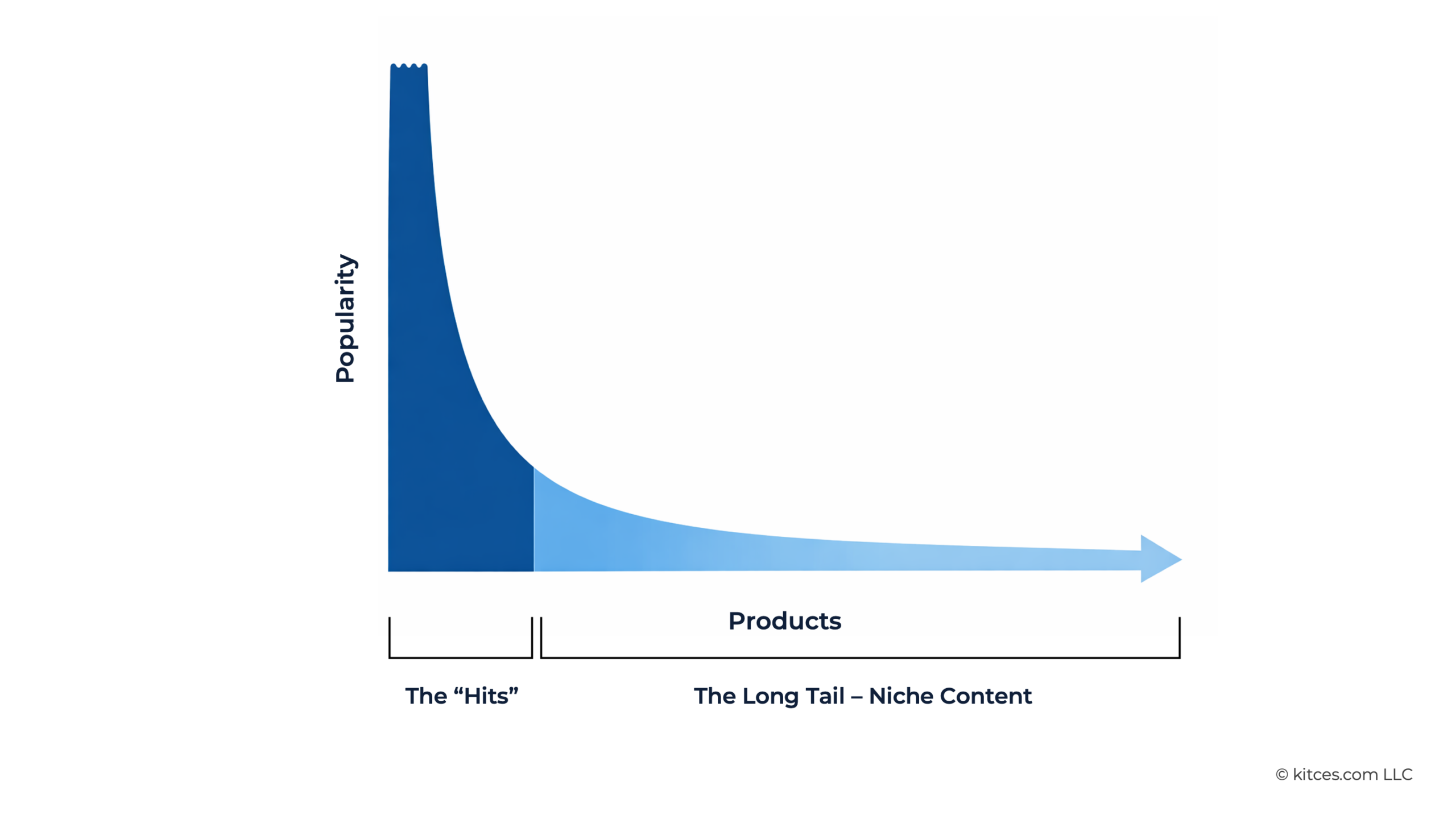
Anderson argues that this phenomenon has largely been eliminated in the era of online shopping – and certainly, the internet has enabled people to purchase increasingly niche products to solve niche solutions. However, the concept of the long tail has since been adapted to discuss media engagement as a whole. At an individual firm level, the long-tail phenomenon can be a consistent through-line. An advisory firm might build five resources, but one resource drives the vast majority of downloads. A firm may host a multitude of webinars, but only one or two of them end up being the 'big hitters' in terms of sign-ups and engagement. And in the world of social media (and content marketing generally), in the long term, 10% of the content will probably drive 90% of the results.
The Challenge Of Creating "All-Star" Content (Sustainably)
If the long-tail rule of engagement holds true and 90% of content gets 'okay' engagement (at best), while 10% of content gets great engagement, the challenge is that it's difficult to accurately anticipate which 10% of content will drive desired engagement (no one goes out to create content that doesn't get engagement!). But with good data-gathering to ensure that the right content is getting the right results, advisors can quickly begin to determine which elements are on the 'correct' end of the long tail.
This then poses a challenge and an opportunity. Some content is created to be one-and-done. For example, if legislation or market performance may impact a firm's niche in urgent ways that is important to address. However, this can also extend the soft cost of social media marketing – it's challenging to reinvent the wheel every single week, especially if one is hunting for some news to comment on every week, let alone write a response to (and get compliance approval)… that can exaggerate the 'soft cost' of social media marketing in the long-term.
As such, the more sustainable angle to manage the up-front load of social media marketing is to augment it with evergreen content, or content that is designed to be used at any time in the year, regardless of the news cycle, market performance, or other circumstances. This both makes it easier to produce content in bulk and to reuse it – tactics that can make it easier to run an effective social media marketing strategy.
Creating content in bulk is a great tactic to save time – working in blocks of time is a foundation of time management. This is especially true of deep work, where it can take some time to get into and out of the creative zone. And once someone is in that zone, the more that they can accomplish during that block of time, the better.
Perhaps the more powerful tool of evergreen content is its ability to be reused. Thomas Kopelman, a financial advisor and co-founder of AllStreet Wealth, who uses social media as a cornerstone of his marketing, sums up the power of reposting the social media content well:
People always ask me how I continue to post so much content. The name of the game is repurposing. For those who don't know, repurposing is all about reusing existing content created in the past versus reinventing the wheel and posting something new every time. The latter requires 10x the time and is often a wasted effort. Instead, you should repurpose by reusing, editing, and reposting the great content you have already created. …
A common fear I hear other advisors share is that people will remember they posted the same thing a few months back. But let's be real; most people see thousands of daily posts. It's extremely unlikely they'll remember what someone posted months ago. And even if they did, I would consider that a win in my book. That shows that the content stuck in their mind, and that's a great sign – it means it resonated with them that much!
But it's only really possible to repost and reuse content if it's still relevant to the target audience. Some content may be relevant at the time of publication (such as legislation that impacts the content), but it naturally has a short shelf-life. Other types of content have a long shelf-life – and as long as they're still relevant to the audience, they can be used repeatedly. The added bonus is that once the advisor has created something that 'works', they can reuse it, rather than going back to the drawing board every week. This culminates in a multi-layered time-saving effect in brainstorming, curating, and posting good content that resonates with the advisor's audience.
One small wrinkle to this is that not all engagement is created equal. According to Kitces Research on How Financial Planners Actually Market Their Services (2024), social media is commonly used alongside tactics such as podcasts/videos, blogging, newsletters, and SEO, as well as event-centric marketing like webinars or third-party platform appearances.
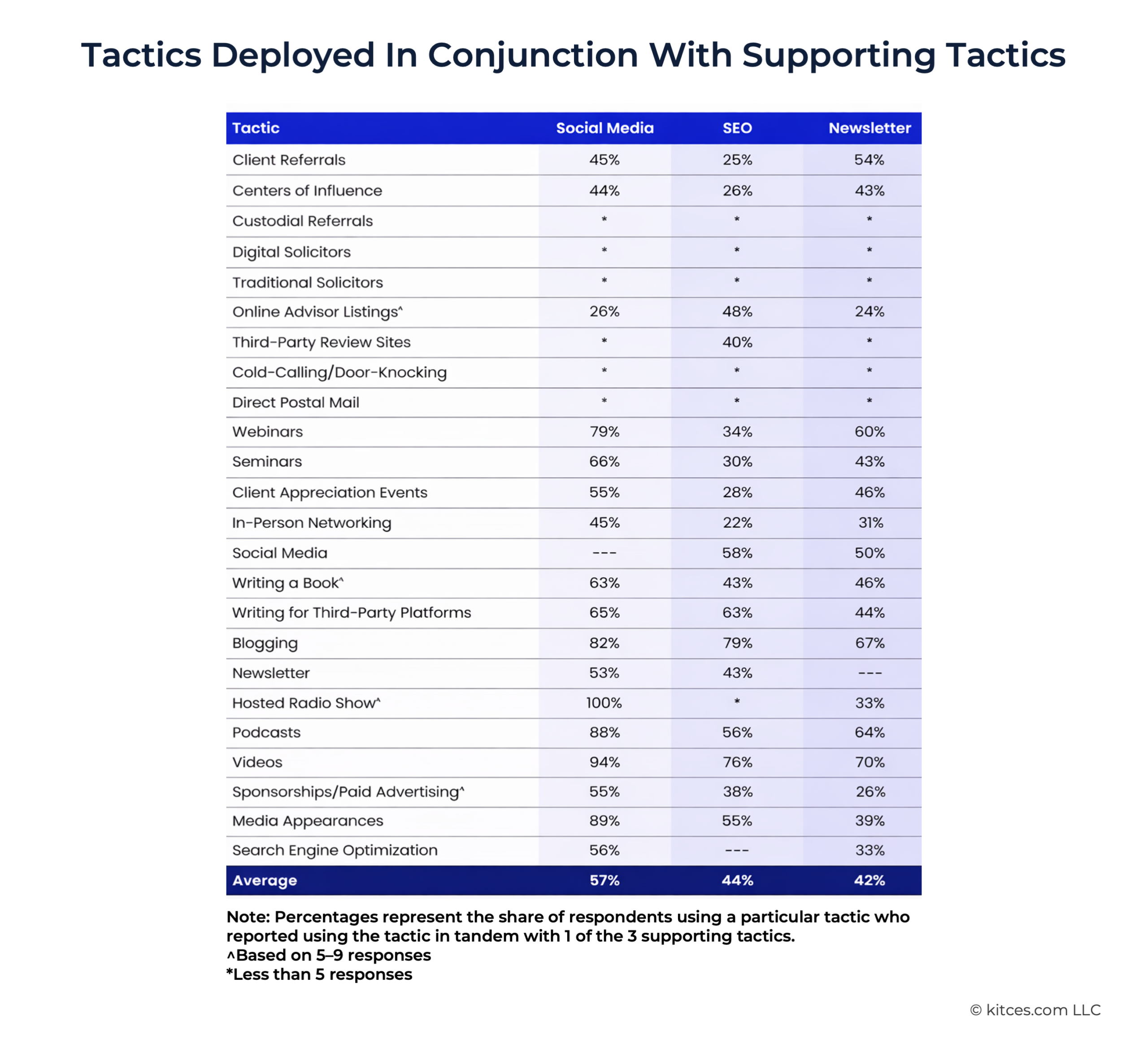
From these results, it becomes clear that social media is typically used as a 'discovery' tactic by financial advisors: it creates awareness of the firm's existence, services, and specialties. But the typical CTAs (calls to action) used in social media marketing aren't to get a prospecting meeting on the calendar. It's more likely that CTAs prompt prospects to engage with the firm in a more personalized, off-platform way, such as through webinars or newsletters. But it's very challenging to build a following if advisors only post CTAs – they don't know who the advisor is or why they should consider taking action. Thankfully, both discovery and promotional posts can be evergreen.
In summary, the ideal content to repost is something that has a job (of either reach or conversions), is a top-performer of that specific task (e.g., is at the top of the top of the 'long tail'), and can be posted at any time. This three-part checklist might be simple, but it's truly all that's needed.
Types Of Evergreen Social Media Content
While evergreen content can be an effective way to get greater yield out of an adivsor's social media efforts, there are many different topics that can be continually relevant. A firm may focus on a number of these categories, or may choose to curate only one or two that most resonate with their brand and proclivity.
Evergreen content ideas can be broken down into the following categories:
Personal And Professional Highlights
Particularly for solo and small firms, advisor personality is often a key factor in how clients ultimately choose their advisors. And for prospects seeking an advisor, it can be reassuring to see that a real person is on the other end. Contrary to the descriptor, 'personal' stories don't have to be intensely personal – and in fact, getting too personal too quickly can be uncomfortable for all parties involved. Some relatively surface-level stories about the advisor's personal or professional experiences can be more than enough.
In sharing personal stories, it can be helpful to follow the basic formula of summarizing the problem, discussing the action taken, and the lessons learned/takeaways – which keeps the stories largely positive and focused.
Sample Topics: The advisor's 'why', career success stories, hobbies, what it's like to work at the firm, highlights from firm get-togethers, introducing various team members, conference or professional development takeaways, personal or firm core values
Real-World Example:
Dave Haughton (Carson Group) on how an early career experience in law shaped his "why" and purpose for work.
Client Success Stories And Commentary About The Firm's Niche's (Ongoing) Issues
Sometimes, commentary on a niche's issues will be time-based; however, like death and taxes, some issues never change – especially for prospects who haven't yet begun working with an advisor. When it comes to ongoing commentary, the more specific it is to a niche's specific pain points, the better. The personal finance voices on the internet are loud and plentiful, but writing specifically about issues that impact a niche can lend a much closer level of focus.
A good starting point for this is an advisor's meetings with their clients. The issues that their clients are encountering are likely ones that prospects have, but do not yet have a solution for – and writing for a niche audience about that issue and solution is a powerful way to affirm the advisor's unique, specialized expertise.
Another angle to consider is to focus on results. Again, the more specific, the better. What does "peace of mind" look like for the firm's niche?
Sample Topics: Case studies, client personas (e.g., "you may want to work with me if…"), adding nuance to common client problems, (anonymized) client success stories or conversations.
Real-World Example:
Emily Rassam (Archer Investment Management) on the options her ideal clients have, and how she can help them craft a financial plan that works for them.
Calls-To-Action: Offerings/Resources/Newsletters
Social media can be incredibly powerful, but one of the core frustrations of the platform is that visibility is largely out of the advisor's hands. Changes to algorithms can completely shift a platform's average engagement overnight.
If social media is going to be a part of an advisor's ongoing strategy, adjusting to algorithmic changes is unfortunately just a part of that reality. However, as part of this dynamic – and to provide more targeted CTAs that spur prospects to action – it is usually wise to pair social media marketing with something that lets advisors speak to their audience more directly, such as a newsletter.
Some of these posts may be time-sensitive, such as promoting a webinar. But if an article has developed helpful white papers or downloadable resources, publishes a newsletter, or runs a blog, then adding mentions of it on social media is crucial. And they don't always have to write about the newest resource, blog post, or white paper – as long as the resource is still accessible, it may be someone's first time viewing it.
Sample Topics: Newsletter and resource promotions, blog highlights "from the archives", sneak peeks of different resources (e.g., highlighting one component of a white paper).
Real-World Example: Jane Mepham (Elgon Financial Advisors) explaining her ideal client's problem – with a clear call to action.
Sharing Third-Party Resources
It can feel counterintuitive to publish about what others are writing or doing – if the end goal is to promote the advisor's own expertise and firm, then discussing others' good work can feel diminishing. However, talking about others can help to diminish the feeling of 'sales' and make the page feel much more personal. It can also give the advisor a chance to signal a broader stance that they agree with. Some of this can be done ad hoc – if the advisor reads an article on a given weekday, for example. But other components may be relevant on an ongoing basis.
Sample Topics: Sharing quotes (with attribution), highlighting mentors, sharing books or videos that have been particularly impactful.
Real-World Example: Ashby Daniels citing Warren Buffet to explain his investment philosophy.
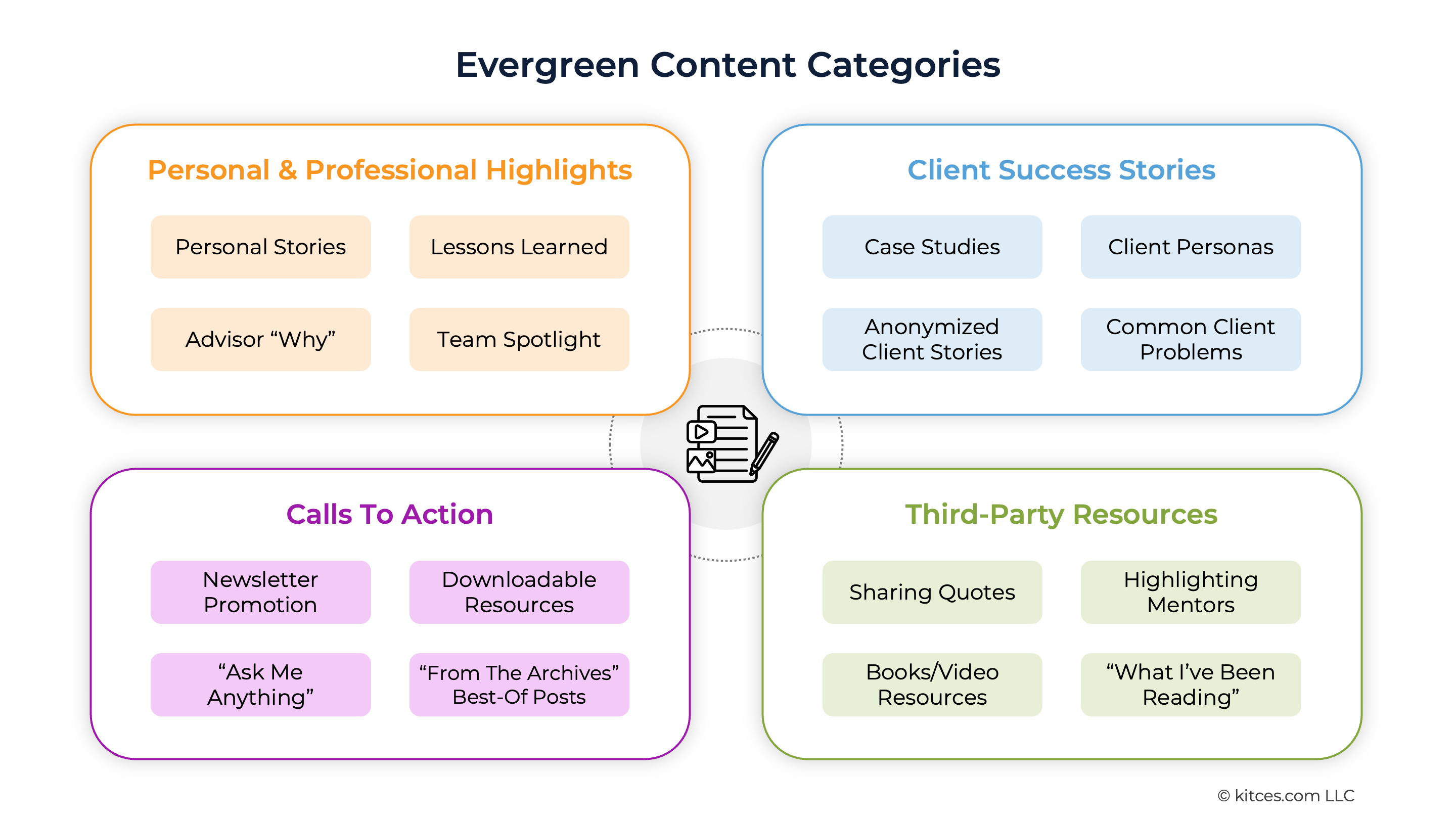
In each of these evergreen ideas, the core criteria is relevance. Some iterations of these ideas may be interesting to the advisor or to their peers – but if the goal is to market with this content, stay focused on what would be comprehensible or applicable to clients and prospects.
Creating Evergreen Marketing – Scalably
Of course, in order to reuse evergreen marketing content, advisors must first create evergreen marketing content. However, if advisors have already been doing content marketing to some degree, they can begin by reviewing their prior posts for content that is 'evergreen' and would still be relevant in the future. They just may surprise themselves with what is still usable.
One important point here – when selecting which content has the potential to be evergreen, consider which metrics are to be used for success. For example, was the goal to get high engagement/views, new followers, or clicks through to another website? Sometimes, these metrics work in tandem, but they are often contradictory – for example, a post may get high engagement, but few clicks onto the website. To balance this, consider giving each post one 'job' by which its performance is ultimately measured – again, either engagement (likes and comments) or conversion (clicks). If conversion is the goal, keep in mind that most social media platforms aim to keep people on their platforms. So not only is it likely that social media platforms will depress the reach of posts with links, but it's also likely that, to get data on conversions, the advisor will need to ensure they track those clicks separately, such as through Google Analytics.

Nerd Note:
Most social media scheduling software can implement what's called an Urchin Tracking Model (UTM) code, which allows advisors to more easily track where traffic to their website came from (what UTM codes call the "source"). UTM codes can also mark the "campaign", so advisors can connect their website traffic data to more specific social media posts with various specific strategies. Readers can go here for a good overview, but the long and short of it is that most social media scheduling software will create these specialized links on the advisor's behalf!
In that vein, once an advisor has their list of 'all-stars' that can be reused, then they can turn to what still needs to be created. For example, do they have posts that are promoting the firm's white papers, but are lacking in client success stories? That can be implemented into their ongoing social media strategies.
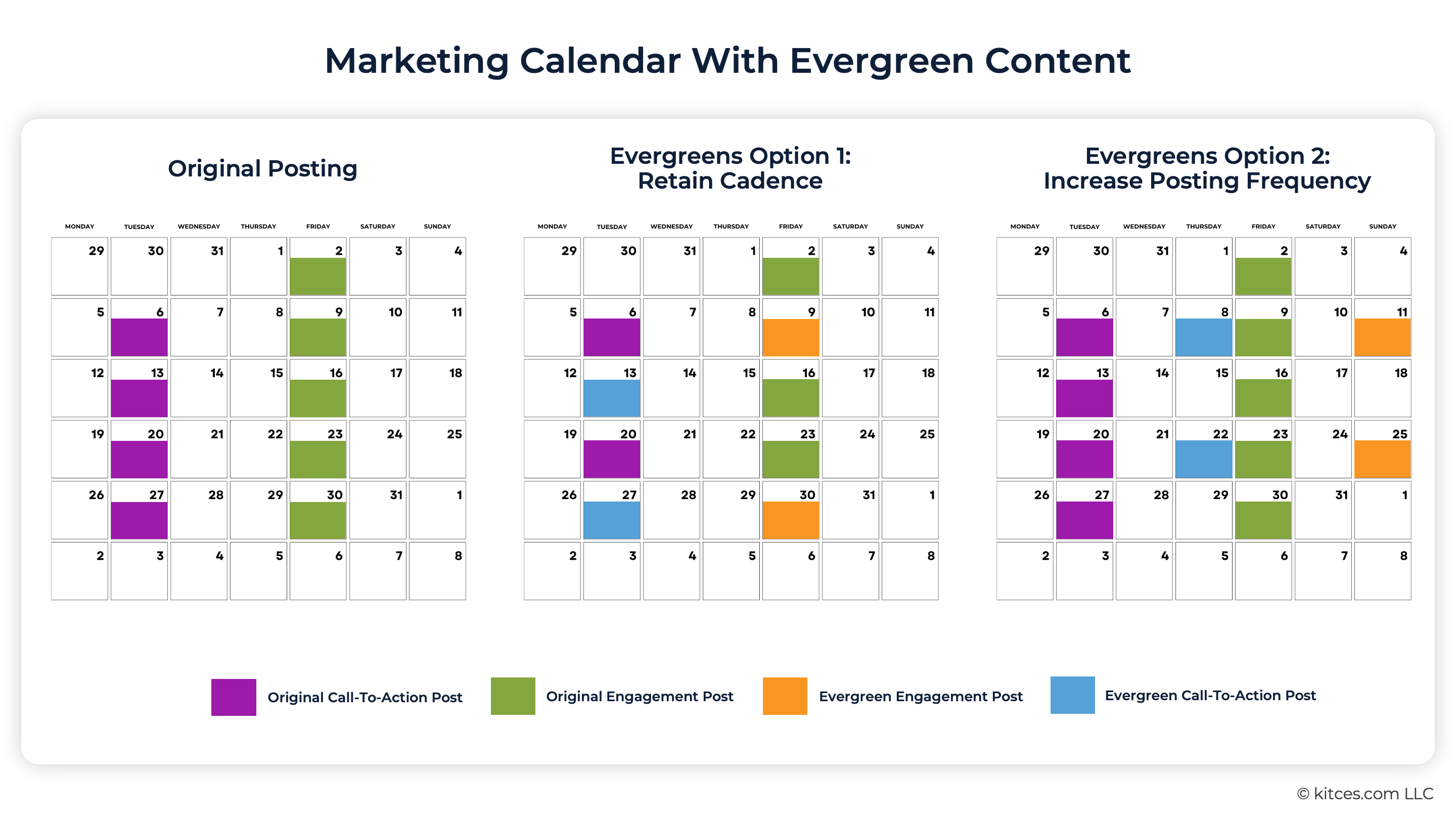
Social media platform algorithms currently reward consistency and activity. Depending on the advisor's current volume, the evergreen content can be used to augment some of the current posting times (reducing their need to create in the short term) or to fill existing gaps in the calendar.
Different platforms reward different frequencies, but while most platforms used to encourage posting multiple times a day and tagging many people, many platforms now rely on algorithms that don't 'just' display the most recent posts. A social media feed may alternate between posts that are minutes old and posts that are weeks old! This is especially true for text-based platforms like LinkedIn or X. If the firm is posting less than once a week, then the evergreen content may be needed to fill existing gaps – without slowing down social media creation (yet). Alternatively, if the firm is posting daily, then there is little need to post more than that (because the platform's algorithm may think that the account is being 'spammy' and may dampen the reach of the content) – so evergreen content can be used to reduce social media creation demands.
Below is an example of what this supplemented calendar may look like, depending on whether the advisor desires a more frequent posting volume or to reduce the original posting cadence.
The good news is that evergreen content can be somewhat 'set it and forget it'. Many social media scheduling software solutions are designed for exactly that, such as MeetEdgar, SocialPilot, SocialBee, and CoSchedule.
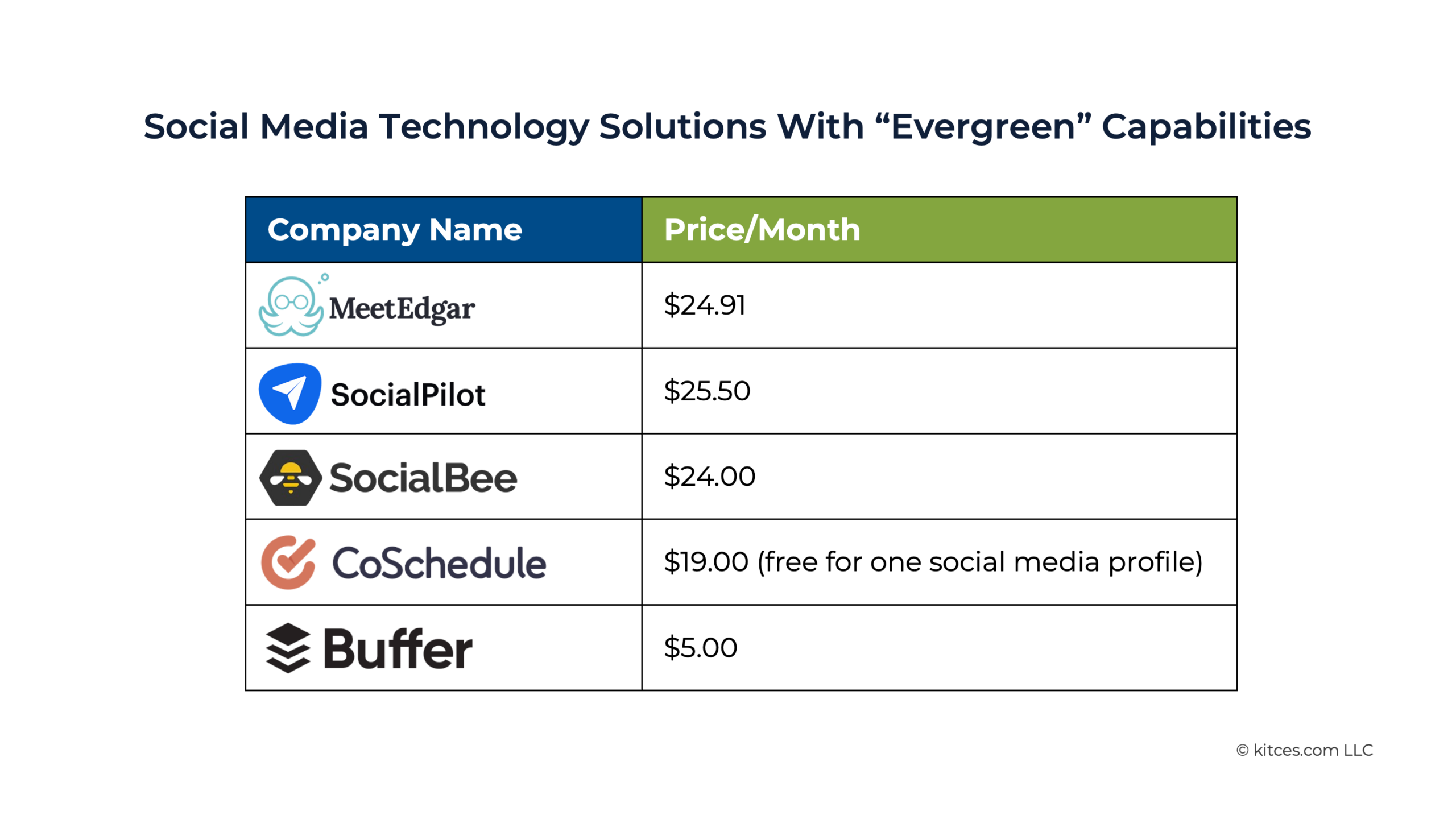
Most of these softwares use categories called campaigns to organize posts. The modifications can range widely on these campaigns, but for the purposes of an evergreen campaign, most of the time, it's a matter of 'just' uploading the evergreen content, then ensuring that the campaign is scheduled to run on an ongoing basis. Most of these campaigns require the user to manually set it to shuffle and repeat on an ongoing basis. However, once the campaign is populated and calibrated, it doesn't have to be touched again. The posts will simply go out on a schedule.
While it may take a bit of time to get this formatted, the maintenance is fairly easily, given that the posts are then automatically distributed.
Utilizing AI (And Other Resources) In Social Media Marketing
AI can certainly be used throughout this process. However, while each step can technically be facilitated by AI, be cautious of using AI on every step. Without careful prompting and guardrails, it can dilute the advisor's individual voice and insights.
ChatGPT, Claude, or a similar 'basic' AI solution may be particularly helpful in reviewing data on past post performance. It can also be useful for ideating on variations of posts that have done well, and reviewing client meeting notes for generalized pain points to be discussed.
It may also be helpful to augment social media marketing with a specialist, such as a copywriter, who can help an advisor crystallize their insights while still ensuring that they keep their voice.
Auditing And Ongoing Maintenance
At least once a year, it pays to audit the firm's evergreen content, which involves both reviewing for recent posts to add and for evergreen posts to be removed. The following questions can act as a guiding light for this process:
Addition-Focused Questions:
- Are there any posts from the last year that performed exceptionally well that can be added to the evergreen list?
- And of those evergreen posts that performed well – what common themes or content styles did particularly well?
Reduction-Focused Questions:
- Are there any posts that are being distributed that are not doing well and can be removed?
- Which former evergreen posts no longer reflect the firm's processes or focus?
- Which issues were once 'evergreen', but are no longer driving the same type of chatter and engagement?
Nerd Note:
Many social media scheduling platforms will provide this analysis. Notably, LinkedIn tries to keep as much data as possible on-platform, so analysis may be limited for that particular platform.
Additionally, as time goes on, the standards for what makes a post 'evergreen' may increase – what was originally great engagement may no longer compete with new content results, and other 'evergreen' issues may eventually become less relevant as the landscape changes. So continually reviewing and refining this list will ensure that the evergreen posts continue to be 'heavy hitters' – evolving as the advisor's tactics and audience do!
At the end of the day, social media is a complex strategy, and creating great social content can be a challenge. However, if advisors can create content designed to work in the long term, it can both alleviate short-term stress (as it's easier to create content in bulk) and yield great dividends as the content is reposted and reused. This can allow the advisor to continually demonstrate the best of their personality and expertise to prospective clients over time!





Leave a Reply