Executive Summary
An important (albeit time-consuming) part of running an RIA is fulfilling the compliance obligations required by the firm's regulator(s). Currently, firms with at least $100M of regulatory Assets Under Management (AUM) or that would be required to register with at least 15 states typically must register with and be overseen by the Securities and Exchange Commission (SEC), while other (smaller) firms are regulated by their home state, plus in most cases any additional state(s) in which they have at least 5 clients. However, the proportion of RIAs meeting the threshold for SEC registration has steadily increased over the years, owing to both the overall growth of the RIA model, and the development of technology allowing RIAs to scale up faster (even as they remain relatively "small" businesses, with even most SEC-registered RIAs employing only a handful of team members and managing 'just' a few hundred million in assets, both of which pale in comparison to the small number of mega-RIAs and asset managers that dominate most of the industry's AUM).
Amid this backdrop, the SEC is considering a pair of changes that would change the regulatory landscape for many RIAs.
First, the SEC has issued a proposed amendment that would change the definition of a "small entity" RIA for purposes of the Regulatory Flexibility Act of 1980 (which is designed to prevent rules and regulations from creating an undue regulatory burden on small businesses) from $25M of AUM to $1B of AUM (while also considering using a revenue- or employee headcount-based threshold in lieu of an AUM-based threshold). A new threshold of $1B of AUM would increase the number of SEC-registered RIAs that qualify as "small entities" from just 3% today up to 75% (though those 75% would still only account for 3% of all RIA-managed assets given the concentration of assets in a few mega-firms!). And so if the proposed amendment is adopted (as appears likely, given fairly broad support expressed during the proposal's comment period), the pace of SEC rulemaking would likely slow down as it would have to more carefully consider and weigh the potential impact of proposed new rules on a drastically increased number of "small entities" it oversees – likely providing a level of future regulatory relief for relatively smaller RIAs who don't have the revenue to support hiring dedicated compliance staff to handle increased regulatory obligations.
A separate (and not yet officially proposed) change that was nevertheless hinted at by Acting SEC Commissioner Mark Uyeda in public comments last year would also increase the regulatory AUM threshold for firms to register with the SEC from the current $100M to perhaps $1B, which would have the result of shifting thousands of currently SEC-registered firms (back) to state registration (likely with many firms needing to register in multiple states given the broader geographic distribution of clients for most firms, especially in the post-COVID virtual-meeting era). While such a change would reduce the number of RIAs under SEC oversight (potentially allowing it to focus on the largest RIAs representing the greatest systemic risk for consumers, and better aligning the number of firms the SEC must oversee with its Congressionally-limited budget), it could also significantly increase the compliance burden on many RIAs that would be forced to grapple with the complexity of multi-state registration, particularly when those states' laws and regulations don't fully line up with each other. Which could cause larger state-registered firms to flock to affiliate with SEC-registered corporate RIA platforms that could take certain compliance obligations off of their plates (or simply render them eligible for Federal rather than state registration), opting to sacrifice some of their independence to remain SEC-registered rather than struggle with increased compliance burdens under state registration.
Ultimately, the key point is that in the 15+ years since the SEC last updated its registration threshold (and nearly 30 years since the "small entity" threshold's last update), there have been enough changes in the RIA landscape – both in terms of average firm size and the number of states in which firms do business in the virtual meeting and niche client marketing era – that it makes sense to rethink how to divide between state and SEC registration. Because ironically, while most RIAs truly are "small" businesses that in aggregate comprise only a small fraction of industry AUM, it's perhaps those firms (with less capacity for handling compliance burdens) that would benefit most from following a single uniform SEC standard rather than a maze of often-conflicting state-level regulations, as well as from slower pace of rulemaking that would likely result from the proposed higher "small entity" AUM threshold. So if the SEC does eventually end up raising its registration threshold, we may expect to see a bigger push for states to further standardize their securities regulations to reduce the compliance burden on state-registered firms – or else see a flood of small- and mid-sized advisory firms affiliate with corporate RIAs to avoid state-level regulation altogether!

The SEC's Two (Prospective) Proposals On Changing RIA Thresholds To $1B Of AUM
Revisiting The $100M AUM Threshold For SEC Registration
In April 2025, SEC Commissioner Mark Uyeda – then serving as Acting Chair of the SEC pending Congressional confirmation of President Trump's nominee, Paul Atkins, as the permanent Chair – delivered remarks to the Annual Conference on Federal and State Securities Cooperation, which was established under Section 19(d) of the Securities Act of 1933 to promote effectiveness and uniformity of securities regulation (while aiming to minimize interference with the business of capital formation). In his remarks, Acting Chair Uyeda raised the question of whether it's time to revisit the current $100M AUM threshold where RIAs switch from state to the SEC for registration and oversight.
The original concept of splitting regulation of RIAs between states and the SEC at a certain AUM threshold came from the National Securities Markets Improvement Act of 1996 (NSMIA), which aimed to delineate the advisory firms that were primarily "local businesses" (that should be overseen by state securities regulators) from the firms with "national presence" (where Federal oversight by the SEC would be more appropriate). Under NSMIA, the initial threshold for transitioning from state to SEC regulation was $25M of AUM.
Later, in 2010, Congress increased the registration threshold from $25M to $100M of AUM under the Dodd-Frank Act. This shift was a reflection of the changes occurring in the advisory firm landscape: with the growth of the RIA model in the 1990s and 2000s, an expanding local client base and the ongoing development of advisor technology that was allowing RIAs to scale up larger than before meant that even a mainly "local" advisory firm could grow well beyond $25M in AUM. And at the same time, the ongoing aftermath of the Bernie Madoff fraud scandal created newfound pressure on the SEC to focus its resources into larger advisory firms where the risks and consequences of major fraud are greater. And more practically, the updated threshold re-allocated the relative split of Federal- versus state-registered RIAs back closer to where it had been when NSMIA was first enacted in 1996, reducing the SEC's proportional burden in overseeing the vast number of still-"small" RIAs that had ‘graduated' to SEC-registered status in the prior decade and a half.
As a result of the Dodd-Frank Act changes, approximately 2,100 RIAs that were deemed ‘mid-sized' advisors (falling between the old $25M and new $100M thresholds) made the shift from SEC to state registration between 2010 and 2012. However, in the years since, the number of SEC-registered firms has grown by 45% from under 11,000 to more than 15,000 RIAs, and the number of $1B+ AUM firms is up 63% from 2,921 RIAs to 4,756.
Which is why Acting Chair Uyeda raised the question of whether the SEC registration threshold should be changed again (under authority granted to the SEC by the Dodd-Frank Act to revisit the threshold periodically). And while he didn't call for any specific new threshold amount, the fact that he explicitly cited the number of $1B+ AUM firms in existence during his remarks at least led commentators to wonder if $1B of AUM is the new threshold the SEC is considering. Officially, however, per Uyeda's remarks, he had not done anything more than "asked the SEC staff conduct such a periodic evaluation on whether the current split between the SEC and the states remains optimal" – and so the industry will need to await the outcome of the SEC's analysis for more certainty on whether, and by how much, the SEC might increase its registration threshold.
SEC Proposes Change To Increase "Small Entity" RIA Definition To $1B Of AUM
While the SEC has yet to officially propose an updated AUM threshold for SEC registration, it did release a proposed rule change earlier this year that would have different implications for SEC-registered RIAs with under $1B of AUM. On January 7th of 2026, the SEC announced a proposed amendment that would change the definition of a "small entity" RIA for purposes of the Regulatory Flexibility Act of 1980 from $25M of AUM to $1B of AUM (and shift a similar definition for a "small entity" investment company from $50M of AUM to $10B of AUM). The proposed change would automatically further adjust these thresholds for inflation every 10 years going forward.
Notably, the SEC's newly proposed $1B AUM threshold change for "small entities" is entirely separate from Acting Chair Uyeda's suggestion of revisiting the SEC registration threshold for RIAs.
The Regulatory Flexibility Act (RFA), and its associated small-entity definition, was designed to prevent rules and regulations imposed by Federal regulatory agencies from creating an undue regulatory burden on small businesses (and thus unwittingly stamping out innovation and new business formation from smaller entities in favor of larger firms with more resources to dedicate to compliance with regulations). Accordingly, under the RFA, agencies like the SEC are "required to determine if a rulemaking is likely to have a ‘significant economic impact on a substantial number of small entities'", and if such an impact is determined, the agency must conduct further analyses during the proposed and final stages of rulemaking to ensure that the rule's consumer protection benefits truly outweigh its otherwise-adverse impact on the small businesses that must comply with it.
For RIAs, the "small entity" definition has applied (since its last update in 1998 to align with NSMIA at the time) to firms with under $25M of AUM. However, the SEC's regulations only apply to – and undergo the required small-entity impact analysis for – RIAs that are registered with the SEC and thus subject to the SEC's purview in the first place. And given that SEC registration itself is typically only triggered at $100M of AUM (unless the firm meets one of the other qualifiers like needing to register in 15 or more states), only a tiny number of under-$25M-AUM RIAs are considered "small entities" for purposes of SEC rulemaking. In fact, the SEC itself now acknowledges that only 3% of today's SEC-registered firms would qualify as "small entities" – which is down from about 20% of firms under the 1998 amendments, and 55% of firms back when the Regulatory Flexibility Act was first passed in 1980. Which means that nearly any new regulation proposed by the SEC will almost by definition be determined to have minimal impact on small entities, if only because almost none of the firms that the small-entity regulations would directly apply to are actually registered with the SEC!
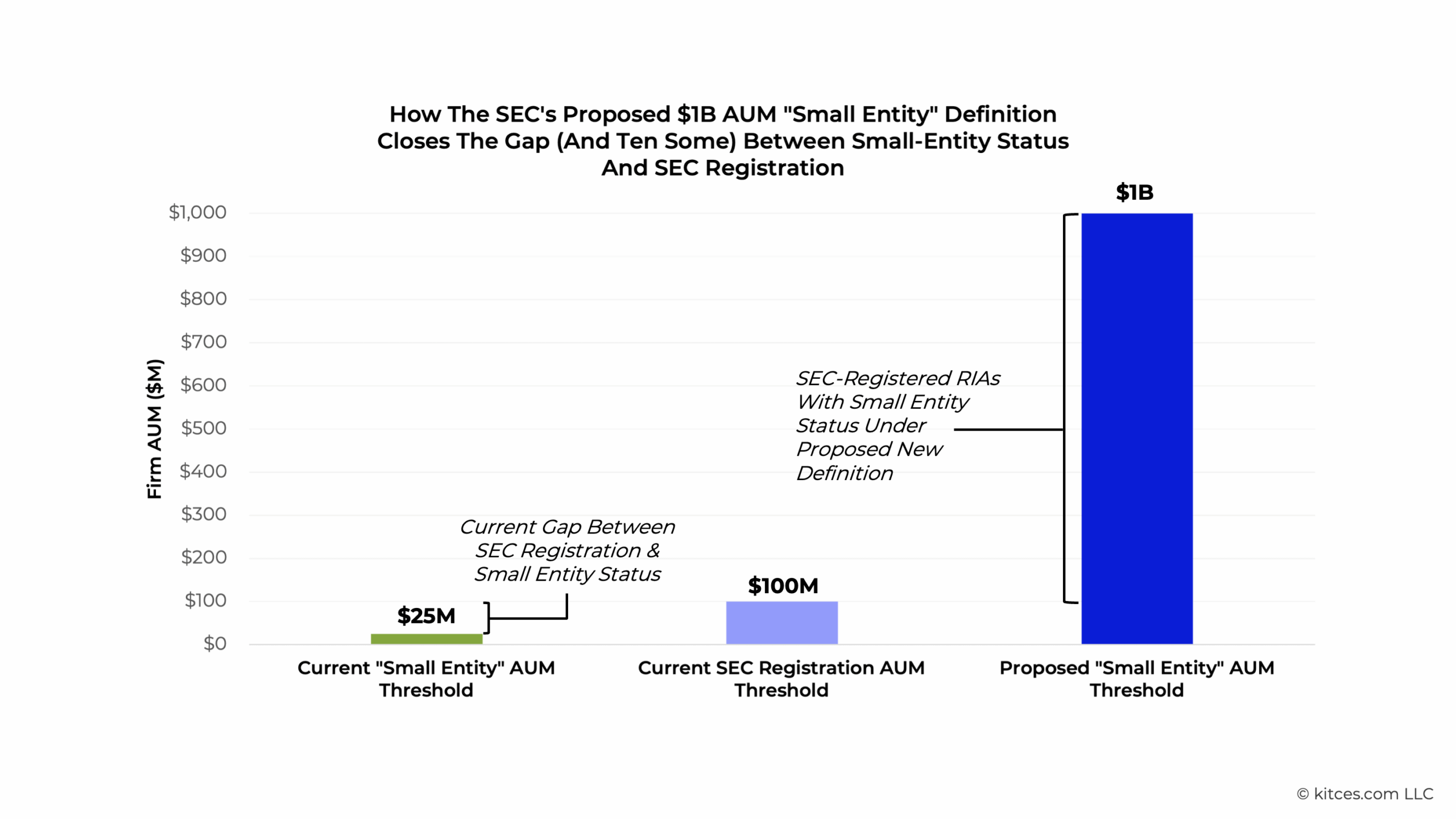
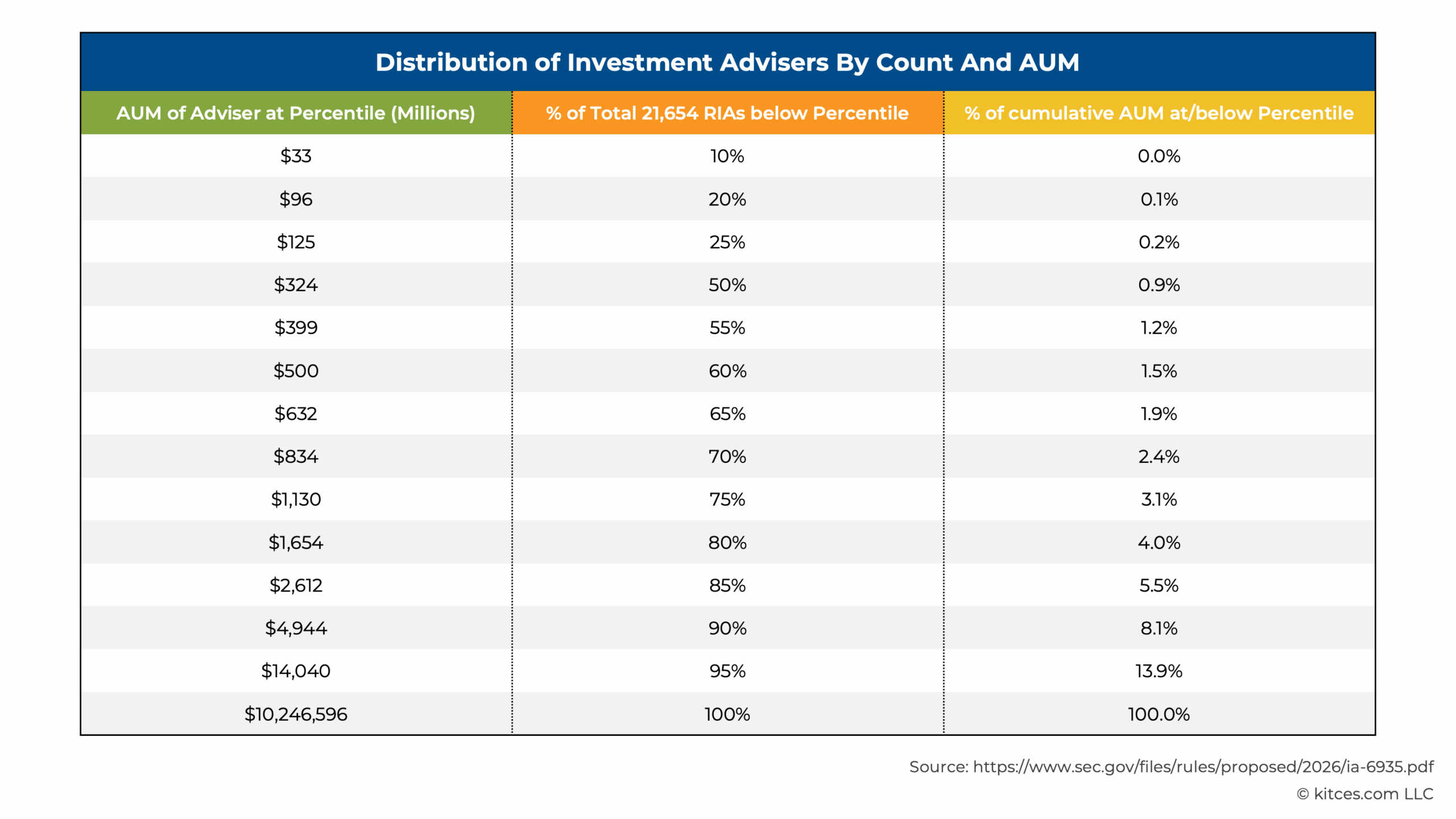
At first glance, the proposed increase of the small entity threshold to $1B of AUM would seem to swing the pendulum almost as far in the other direction, as by the SEC's own numbers approximately 75% of RIAs would be deemed as "small entities" under the proposed new definition. However, the incredible amount of assets concentrated in a small number of mega-RIAs and asset managers is such that, while a $1B AUM small entity threshold would capture 75% of RIA firms, it would still only reflect barely 3% of total regulatory AUM! Which arguably just validates the reality of the advisory firm landscape, which is that that the overwhelming majority of RIAs really are "small entities" in an industry where 97% of assets are concentrated in the top 25% firms (and per the SEC's data, almost 86% of assets are held by just the top 5% of firms!).
Notably, the SEC also stated in its proposed rule that it is considering a revenue- or employee-headcount-based threshold instead of using regulatory AUM, given the reality that a "small" firm's ability to manage compliance requirements is really more a function of the number of team members available to do the work rather than the amount of assets that the firm manages, since firms can have a widely varying number of employees at a given level of AUM depending on their service structure or target clientele (e.g., a wealth management firm working with 1,000 to 2,000 mass affluent clients might have 30+ team members, while a pension consulting firm with a handful of institutional clients might have fewer than 10 team members, given differences in service and pricing models between the two!).
Current State Of Proposals: Public Comment Periods And Awaiting Formal Proposal
As noted earlier, the SEC's proposed amendments to the definition of a "small entity" for purposes of the Regulatory Flexibility Act came out earlier this year (in January), with a public comment period that extended through mid-March. Submitted public comments can be viewed on the SEC's website, with most organizations in support, from the Investment Adviser Association to the Investment Company Institute, the CFP Board (in a coalition with FPA, NAPFA, and XYPN), and even Charles Schwab weighed in positively on the proposal.
On the other hand, some organizations expressed concerns about the proposed amendments, given that the general nature of the Regulatory Flexibility Act is to slow the pace of new regulations due to the additional time and resources needed to analyze and adjust for impact on small entities. Accordingly, the Public Investors Advocate Bar Association (PIABA) raised cautions that a slower pace of regulation on RIAs could present future risks to investors (if regulation fails to keep pace with the industry's ongoing evolution), and SIFMA (representing broker-dealers) objected to the increase out of concern that a slower pace of new compliance burdens on RIAs might further encourage advisors to leave broker-dealers and launch RIAs (which ironically aligns with the SEC's goals to support new business formation, but does so to the detriment of SIFMA broker-dealer members that continue to lose market share to the RIA channel!?).
From here, the SEC will take feedback from comment letters before either withdrawing or – as is more likely given the public comment support – issuing a Final Rule that incorporates feedback (e.g., about whether $1B of AUM is really the correct threshold, and whether an employee-based threshold such as 30 or 50 team members may be more appropriate than a purely-asset-based threshold). A final rule would be likely to come later in 2026.
In the meantime, there has not yet been any word from the SEC about Commissioner Uyeda's comments about potentially increasing the threshold for SEC registration; thus far, it remains at most nothing more than an ‘internal study' that the SEC is conducting, with the industry awaiting confirmation about whether a new rule will be forthcoming.
However, as some public comment letters point out, there is a possibility that the SEC may be choosing to amend the small-entity definition now, so that it can then later use its new $1B AUM small-entity threshold as a basis for moving the SEC registration threshold to align to the new small-entity threshold at $1B of AUM. Stay tuned for further proposals, though notably because there is always pressure on regulators to complete new rulemaking under a current administration (before the presidential election cycle that could result in a subsequent leadership change at the SEC under a new president), the high likelihood is that any potential shifts to the SEC registration threshold will come sometime in 2026 (as SEC Chair Atkins has already indicated he anticipates putting forth several dozen rule proposals this year as part of his regulatory agenda).
Varying Impacts For The SEC's Potential Threshold Changes: A Higher Small Entity Threshold Simplifies Compliance, But A Higher SEC Registration Threshold Adds Complexity?
Higher Small Entity Threshold Slows Down New Regulations (To Hopefully Focus On What Really Matters?)
As the aforementioned public comment letter from PIABA highlights, raising the small entity threshold for the Regulatory Flexibility Act – especially to a level that increases the number of small-entity firms from 3% to approximately 75% of all SEC-registered RIAs – effectively throws a good bit of sand into the gears of new regulations on RIAs. From the consumer advocacy viewpoint of PIABA, this introduces potential risks that the SEC's rulemaking may not keep pace with what ‘needs' to be passed to protect consumers. For RIAs, though, the slightly more optimistic viewpoint is that a reduced pace of new regulation going forward could make it likelier that the SEC will focus its attention on issuing "only" new regulations that really matter for protecting investors (enough to be worth the burden of implementation costs on small firms), rather than regulations that in practice serve mainly to impose higher compliance burdens without actually doing much from a consumer protection standpoint.
Which is particularly salient for many RIAs in light of a number of SEC proposals of recent years under former President Biden and SEC Chair Gary Gensler that would have been especially burdensome. These include a potential "custody rule" proposal that would have expanded the breadth of situations where RIAs are deemed to have custody (and the additional oversight and potential surprise audit burdens that may come along with it), and an anti-money-laundering (AML) proposed rule that would have required RIAs to be more proactive in the information they gather from new clients to facilitate the government's efforts to track illicit activity. In both cases, RIA advocates raised concerns about whether the additional burdens on RIA compliance were really worthwhile – for example, few sub-$1B RIAs directly hold client assets in a way that would have gained any protections under the proposed custody rule, nor are many firms, especially small RIAs, heavily involved with international clients (where anti-money-laundering rules are most focused). And yet in both cases, all RIAs would have been required to create new policies and keep additional records to document compliance with these rules across the firm and all of its clients, even for cases that rarely occur and typically not in the problematic ways that the rules were meant to capture (e.g., small RIAs aren't typically working with lots of international clients who need anti-money-laundering monitoring in the first place). Both of those proposals would have likely have been slowed by an expanded small-entity definition that would have compelled the SEC to more deeply consider the compliance burden impact on 75% of the RIA landscape.
Similarly, in 2022 the SEC also issued a proposed rule on outsourcing which would have required firms to satisfy an SEC-specified set of due diligence questions for any outsourcing providers they use, which potentially could have included not just common outsourcing solutions like TAMPs, but most of the RIA ecosystem's technology and service providers. Yet as critics noted, most RIAs are too small to compel their third party vendors to individually respond to such due diligence requests, and small firms with few team members would have likely found it quite challenging to do the level of prescribed due diligence. Moreover, as noted by SEC Commissioner Hester Pierce, RIAs already have a fiduciary obligation (which includes reasonable due diligence of providers), and clients already have recourse in the event of a fiduciary breach against RIAs that fail to do their due diligence… which meant, as she cautioned, that the proposed rule would have unduly burdened smaller advisors (impliedly without necessarily creating any material lift in real-world consumer protections given the fiduciary framework that already exists).
Notably, changing the threshold of small entities under the Regulatory Flexibility Act wouldn't necessarily change any existing compliance burdens of RIAs that already exist as finalized regulations. Instead, the point is that the SEC would be more compelled to weigh the aggregate cost impact of implementation on small firms against the consumer benefits for any new rulemaking… where a higher threshold (i.e., 75% of all RIAs being deemed as "small entities") would inevitably slow the pace of new regulation beyond what RIAs must already fulfill (and would likely have slowed Chairman Gensler's proposals of 2022-2024 that already struggled to pass because of industry opposition given the compliance burdens they would have created).
New Small Entity Definition Recognizes That Most RIAs Really Aren't THAT Big
Based on the SEC's own data, shifting the "small entity" threshold from $25M to $1B of AUM would move the number of RIAs that are considered "small" from just 3% to nearly 75%. Which has led consumer advocate organizations like PIABA to raise concerns that "a four-thousand percent increase" in the threshold (resulting in a 25x increase in the number of small-entity firms) may be going too far, and that "the SEC's future RFA analyses would therefore be distorted by estimated costs of a proposed rule on almost the entire investment adviser population".
Yet the reality is that compliance obligations aren't fulfilled by assets… they're fulfilled by people. And for most advisory firms, the Chief Compliance Officer hat is typically worn by someone (often a founder/partner, or someone leading the Operations side of the business) with numerous additional duties. Anecdotally, it's rare to see a firm create a single full-time dedicated compliance role before reaching at least 30+ team members.
In point of fact, this is common for small businesses across many domains; it's not until 30-50 employees come onboard that dedicated roles emerge to handle compliance, operations, and other "overhead" roles at scale (which frees up the additional capacity needed to handle additional government regulations). This is why the Family Medical Leave Act's requirements don't begin until private businesses exceed 50 employees, the Affordable Care Act's "applicable large employer" shared responsibility coverage requirements kick in at 50 employees, and mandatory Equal Employment Opportunity reporting for government contractors also start at 50 employees (increased to 100 employees for private businesses not contracting with the government). Simply put, as many different government regulators have recognized over the years, it takes a certain amount of baseline revenue to afford the employee headcount and infrastructure to handle additional regulatory requirements – which is why too much of a regulatory burden risks impairing competition and innovation among businesses that are too small to hire dedicated compliance staff to handle it all.
So how large does an advisory firm need to be to get to 30-50 team members? Drawing on data from industry benchmarking research and benchmarking platforms like AdvisorEconomics, RIAs that are scaling up often run at approximately $350,000 of revenue per employee, which means a 30-person advisory firm would be generating approximately $10.5M of total revenue. Which is quite similar to the definition of "small business" in other contexts; for instance, the Small Business Administration defines a (non-manufacturing) small business as one with revenue under $7.5M, and the IRS puts out "small business" resources for entities with under $10M of revenue.
And with recent Kitces Research data showing a median advisor fee of 1% of AUM, the amount of managed assets it would take to achieve the revenue associated with a 30-person firm (that can support a dedicated compliance role) is $10.5M ÷ 1% = $1.05B of AUM, which is almost exactly in line with the SEC's proposed $1B AUM small entity threshold! (And a 50-person team would be closer to $1.75B of AUM!)
Which suggests that, when viewed through the lens of which advisory firms actually have the resources to handle additional compliance obligations (as opposed to being "small" businesses where the burdens are more often shared or spread across the organization's existing team as best it can), the SEC's proposed threshold of $1B of AUM, capturing 75% of all RIAs, is an accurate reflection of a landscape where the overwhelming majority of RIAs really are small businesses - and if anything, it might still be a little bit too low given that by definition half of advisors bill less than the ‘median' billing rate of 1%!
Raising SEC Registration Threshold Would Increase RIA Compliance Complexity
While the whole nature of the SEC's proposal to increase the "small entity" threshold to $1B of AUM is meant to slow (or at least be more prudent about) the pace of new compliance regulations and associated burdens, the potential increase of the threshold for SEC registration to $1B as hinted at by Commissioner Uyeda would likely have the opposite effect: To increase compliance complexity for mid-sized RIAs as they are shifted from SEC to state registration and oversight.
The reason, simply put, is that not all states have consistent regulations for RIAs doing business in their states, even as many of the larger state-registered RIAs (and increasingly, smaller ones as well) attract clients from multiple states. Which means it's not just that state-registered RIAs can have a different set of compliance obligations in place than SEC-registered firms, it's that an RIA operating in multiple states might not even have one uniform set of rules to follow across all of the states they're registered in! Because while state legislatures and securities regulators generally build on the framework of Federal law and regulations for their own rules governing RIAs, and organizations like the North American Securities Administrators Association (NASAA) exist in part to foster more uniformity in state regulations, ultimately each state legislature or securities regulator sets the rules in their state based on what they believe best protects their state's citizens… and consequently, as experienced compliance attorneys often note, not all states have consistency with other states' rules at top of mind when they write their own rules.
For instance, many states require that an RIA's advisory agreements mandate that any disputes be resolved in their state (under so-called "Choice of Law" provisions). Similarly, some (but not all) states require that any advisor-client disputes be resolved in a court of law rather than through mediation or arbitration. Which means firms that operate in multiple states might need to create multiple versions of their advisory agreements according to each state's particular rules – both for where any advisor-client disputes must be resolved on a state by state basis, and also for which methods of resolution are permitted.
Another state-inconsistency challenge that has emerged more recently is that when it comes to non-AUM fees in particular (e.g., financial planning project fees, hourly fees, subscription fees), states vary in what they consider to be a "reasonable" fee or not. Historically some states even capped hourly fees at what the regulators thought was reasonable (for many years as low as a maximum fee of $150/hour in one case!), and some require firms that charge ongoing financial planning fees to itemize their services provided on each billing statement (while others simply allow "financial planning" to be the line item). Some states don't allow RIAs to charge financial planning fees on top of AUM fees (deeming it a form of double-billing clients for the same service), while still others consider it unreasonable to bundle investment management services into financial planning fees and instead require that the advisor enumerate two different fees for their services! Similarly, states vary in how itemized RIAs' invoices must be (or not) when it comes to enumerating what fees were charged and how they were calculated (especially in situations where both investment management and financial planning are involved).
Of further frustration to advisors in recent years is the fact that not all states have yet adopted the SEC's Marketing Rule allowing the use of client testimonials (nearly six years now after the SEC issued it!). As a result, while an SEC-registered RIA and a state-registered firm might be operating right down the street from each other, only the SEC-registered firm would be permitted to use client testimonials if that state's regulator doesn't yet allow it for state-registered advisors. Similarly, if an advisor operates across multiple states – including some that allow testimonials and others that do not – the process of requesting client testimonials (or avoiding doing so from clients in states that don't allow it) and using them for marketing purposes (or not in states that don't permit it) present very real operational challenges for teams without dedicated compliance or marketing roles. (Although NASAA's recent approval of changes to its Model Rules on advisor advertising to bring them in concurrence with the SEC Marketing Rule may finally start to bring about more consistency between states' rules on testimonial marketing – at least for those that conform to NASAA's Model Rule!)
The end result for many firms has been that, as they grow and began to operate in multiple states, reaching $100M of AUM was a beacon for regulatory simplification: Grow to $100M, and the multi-state compliance challenges largely disappear in favor of one uniform SEC standard. And in practice, once a firm starts to exceed the 5-client "de minimis" within multiple states that would require it to register in each of those states, that firm is often already nearing the $100M of AUM threshold where SEC registration would make it a moot issue. But a potential (much-)higher threshold of $1B of AUM for SEC registration would make it much more common for mid-sized RIAs operating in half a dozen or more states to be required to register in those states, because they're still nowhere near the $1B threshold – and then have to navigate all the inter-state compliance differences that come with six or more state registrations.
How The SEC's Threshold Changes Will Likely Play Out
Small Entity Change Coming Soon And Then… Nothing
Given both SEC Chairman Atkins' self-proclaimed acknowledgement that the "clock is ticking" to get rule changes done in time to be finalized during the current administration (as is common for every SEC chair operating between each election cycle), and the fact that the SEC already issued its preliminary proposal to raise the small entity threshold and received what are largely supportive public comments in favor of the proposal, it seems likely that a Final Rule on the new small entity definition will be released later this year.
And then… there will be not much other action on the issue, as again the whole point of raising the small entity threshold is to force the SEC to give more consideration about the impact of future proposed rules on smaller RIAs (which the Regulatory Flexibility Act will now recognize is… 75%+ of them!). Which means the pace of proposed SEC rules for RIAs will likely be slower going forward, as there will be more discussions and impact analyses about whether a prospective new rule is really important enough from a consumer protection standpoint to be worth the compliance burden (which will certainly be the case sometimes, given the SEC's crucial mandate of consumer protection and the ever-evolving landscape of risks to consumers within the financial system… but again, the bar the SEC must clear will effectively be higher).
In essence, then, the primary driver and outcome of raising the small entity threshold to $1B of AUM is that for advisors considering the long-term implications of becoming or maintaining an RIA (especially relative to other industry channels like FINRA-regulated independent broker-dealers), there will be a relatively lower risk that they might be "compliance'd to death" – at least any more so than they already are. In fact, as SIFMA duly noted in its own public comment letter, one of the ‘risks' of the SEC's proposed increase of the small entity threshold is that it will contribute to "accelerating the trending, explosive growth in the number of independent investment advisers [RIAs]", since it will become that much easier to own and operate an RIA relative to operating in the broker-dealer channel.
Again, though, the small entity threshold change will not have any impact on the rules and regulations that already apply to RIAs; it simply forces the SEC to move more slowly and cautiously when it looks to implement any new regulations going forward. Which makes it more feasible for smaller independent RIAs to remain smaller independent RIAs.

Nerd Note:
In an odd bit of circular logic, one of the interesting side-effects of the SEC increasing the small-entity threshold to $1B of AUM is that it may make it more difficult for the SEC to subsequently increase the SEC-registration threshold to $1B of AUM. Especially if the SEC's economic cost/benefit analysis finds that there really would be an increased burden of RIAs operating across multiple states for all those "mid-sized" firms between $100M and $1B of AUM. On the other hand, if the SEC increases the registration threshold to $1B of AUM, a large swath of those $100M-to-$1B-AUM firms would no longer be subject to SEC regulation (as they're shifted to the states), which would remove them from the scope of needing to be considered under the Regulatory Flexibility Act as small entities because they would no longer be directly impacted by the SEC's rules!
So could the SEC avoid the new constraints of the higher-threshold RFA rules with an SEC registration threshold change that would remove most RFA-small-entities from its purview? Anticipate an interesting rulemaking and public comment period if/when/as the SEC does come forth to propose a higher SEC registration threshold!
Raising The SEC Registration Threshold May Trigger Corporate RIA Consolidation
While the small entity threshold change to $1B of AUM may slow the pace of regulatory change and complexity, especially for small RIAs, raising the threshold for SEC registration to $1B of AUM would add complexity to a sizable number of "mid-sized" RIAs currently operating between the current $100M threshold and the potential new $1B threshold. The reason, simply put, is that being a state-registered RIA operating across multiple states' rules is more challenging than operating under a single SEC standard.
When the SEC last increased the registration threshold from $25M to $100M in 2010, an estimated 2,100 firms had to move from Federal to state registration. But that was in an environment where meeting virtually with clients was almost unheard of, since internet speeds and streaming technology capable of reliably handling video meetings via computer or smartphone were at that point several years away. So in those days, a firm with between $25M and $100M in AUM (which in practice was generally a solo advisor working with a few dozen up to perhaps 150 clients) served a client base that was almost entirely local to that advisor… which meant the shift to state registration likely ‘only' involved registering in a single home state and maybe 1-2 others.
By contrast, firms with hundreds of millions of AUM (from $100M to $1B) are not only more plentiful today than in 2010 (e.g., Commissioner Uyeda estimated last year that there are nearly 9,000 mid-sized RIAs in this range), but also almost certainly have multiple advisors. In today's more digitally connected post-COVID world, this means a much greater likelihood those advisors working in different states from each other (which would require registration in each of those states). And with hundreds of millions of AUM, a firm's client count is more likely in the hundreds or even a few thousand, resulting in far more states where the firm will exceed the de minimis client threshold that triggers state registration. In essence, while the previous SEC registration threshold increase from $25M to $100M mostly impacted firms that were operating in only 1-3 states anyway, a potential increase to $1B would more likely cover firms that are operating in 6-12 (or more) states.
Of course, the SEC's Rule 203A-2(d) does permit "multi-state" investment advisers with registrations in at least 15 states to become SEC registered – regardless of whether they have reached the $100M or if applicable $1B AUM threshold – and so eventually a growing mid-sized RIA under new rules may still be able to register with the SEC without reaching $1B of AUM because they cross over the multi-state threshold instead. And with most states requiring "only" 5 clients to trigger state registration, expanding to 15 states could theoretically occur with fewer than 100 clients. But more realistically the road to 15 state registrations could be much longer given that most RIAs' clients tend not to be so evenly geographically distributed, and meanwhile an RIA would be subject to separate regulations for each state it was registered in (up to 14 at once!) before the less cumbersome SEC registration kicked in. Which means that in a future with a higher SEC registration threshold, some firms may conceivably push to onboard more clients across more states in the hopes that "short-term pain" of multi-state coordination will be offset by the long-term benefits of reaching SEC multi-state registration faster?
Or alternatively, there is also a real potential that a higher SEC registration threshold will lead to a rise in the popularity of various "corporate RIA" models, where otherwise-independent advisors affiliate to a single RIA entity for registration purposes, allowing the combined entity with multiple or dozens of advisors to reach and remain above the SEC threshold by some combination of states and/or AUM while still allowing each advisor to operate as independent contractor (or potentially their own doing-business-as [DBA] sub-entities) with their own client books of business. Such models are already growing in the industry for independent advisors who simply don't want to personally deal with the "Chief Compliance Officer" obligations that come with being their own independent RIA, but a higher SEC threshold could make that approach more appealing to mid-sized RIAs that may be able to handle some of their own compliance obligations – but for whom the cost burden of handling 10+ states' differing compliance obligations is simply too much.
Will States (And NASAA) Adapt To Accommodate A Higher SEC Registration Threshold?
Technological change often has both intended and unintended consequences, and arguably as it pertains to RIAs, one of the biggest unintended consequences of the rise of the internet is that even small, locally-run businesses now often have national (virtual) reach. Which is important, because the entire foundation of the split between state and SEC (Federal) registration of investment advisers was to allow the states to regulate "small, local" businesses, while the SEC focused on complex firms operating with a "national presence".
As indicated by Commissioner Uyeda's statements, the SEC's view remains that it should be focused on the largest and most complex national-presence firms, where arguably the SEC does have better reach and resources for both examinations and enforcement – especially when it comes to the subset of mega firms (e.g., the largest RIAs and investment-adviser-registered asset managers) that may only constitute 5% of all RIAs but hold 86% of consumer assets. From that perspective, the SEC would actually be keeping its jurisdiction relatively broad with a $1B AUM threshold that covers the 25% largest RIAs (which collectively hold nearly 97% of the RIA channel's assets).
Yet that doesn't change the reality that shifting to a $1B SEC registration threshold would mean that nearly 15,000 $100M-to-$1B firms would be ‘relegated' to state regulation (minus those that happen to already exceed the 15-state threshold). Which, with NASAA's annual report indicating that are over 16,000 RIAs that are already state-registered, would amount to nearly doubling the current population of state-registered RIAs. And the "new" mid-sized firms that would be transitioning are disproportionately larger, and thus much more likely to be operating across a larger number of not-fully-uniform states – increasing both the average state-registered firm's compliance burden and the strain on the resources of the state regulators tasked with overseeing them.
Which means, ironically, that while the SEC's intent may be to reduce the degree of compliance complexity impacting small RIAs to support business formation and innovation (as illustrated by the proposed increase in the "small entity" threshold), throwing 75% of RIAs back to state regulation by also increasing the SEC registration threshold would likely have the opposite effect due to the states' lack of regulatory uniformity in an increasingly digital world. And so any proposal from the SEC to lift the registration threshold would likely be met with significant pushback from the industry, because mid-sized RIAs (by the SEC's own small-entity-threshold evaluation) do not have the staff depth to handle significant increases in compliance complexity like suddenly coordinating with a dozen state regulators' differing requirements.
Perhaps a compromise would be to reduce the 15-state threshold required to achieve SEC registration; in point of fact, part of the Dodd-Frank legislation that moved the SEC registration threshold from $25M to $100M of AUM actually reduced the multi-state threshold from 30 states down to 15. Could a subsequent expansion of the SEC registration threshold to $1B of AUM be accompanied by an offsetting reduction in the multi-state threshold, down to 10 or even 5 states, so the states continue to regulate (but only regulate) "mostly local" businesses (where multi-state coordination is less of an issue?).
Otherwise, a potential increase in the SEC registration threshold will put a lot of newfound pressure on states to staff up (with what dollars from their state budgets?) to handle both a 50%+ increase in the number of firms they'd need to oversee (depending on how many mid-sized firms still qualify for SEC registration by virtue of being in 15+ states), and to work harder with and via organizations like NASAA to achieve greater inter-state uniformity… or face the potential that more and more would-be independent mid-sized RIAs throw in the towel and affiliate with the growing number of corporate RIA aggregators simply to be allowed to get back to SEC registration again?