Executive Summary
Planning for an enjoyable retirement is a primary goal of many financial planning clients. For many, this means working full-time well into their 60s before leaving the workforce entirely. However, this 'traditional' view of retirement might not be a fit for every individual, as some might not want to wait until they reach their mid-60s to take significant time away from the workplace – while others might prefer to preserve the financial, psychological, and social benefits that can come from working past 'traditional' retirement age.
With this in mind, financial advisors have the opportunity to create a potential 'aha' moment for their clients by introducing them to alternative retirement paths that could better match their preferences. Further, because these strategies come with their own respective risks and planning opportunities, advisors are also well-positioned to support clients pursuing one of these paths on an ongoing basis.
To start, clients who have amassed significant savings might be able to achieve financial independence, where paid work is no longer required to support their lifestyle expenses. While leaving the workforce before 'traditional' retirement age comes with direct costs (e.g., purchasing health insurance) and risks (e.g., portfolio sustainability over an extended retirement period), it can also present tax planning opportunities (such as Roth conversion and/or capital gains harvesting during lower-income years).
Rather than leave the workforce completely, some individuals might prefer to take extended breaks during the course of their career (e.g., for caretaking, or to travel while they're in good health) while planning to return to their existing job or a similar position at a different company. These "sabbaticals" offer flexibility (in terms of their length and frequency) and require fewer assets than financial independence, but could necessitate working past 'traditional' retirement age (given the inability to save during the sabbatical period, and the risk that the individual won't be able to find a commensurate job when they return to the workforce).
For those who haven't saved enough to achieve 'full' financial independence but who might want to work in a more meaningful and/or less stressful (but lower paying job), "Coast FIRE" could be an attractive alternative path. An individual can take advantage of this path when their retirement savings are projected to grow – without further contributions – into a portfolio large enough to support their anticipated future retirement spending needs. At that point, they 'only' need to earn enough to cover their ongoing expenses while continuing to work.
Finally, under the semi-retirement path, an individual can 'test' retirement by reducing their work hours. In this way, they can see what it's like to have more free hours during the week while still tapping into the financial, social, and psychological benefits that can come from work. A willingness to work at least part-time past 'traditional' retirement age can also be supportive of a client's long-term plan, as it could allow them to delay Social Security benefits and mitigate sequence of return risk.
Ultimately, the key point is that financial advisors are well-positioned to introduce alternative retirement paths to clients who express interest, and to support them on an ongoing basis in navigating the resulting financial planning challenges and opportunities.
 |
And if you want to go deeper on this topic, hear directly from the author on the Financial Advisor Technician podcast . |

Listen To The Financial Advisor Technician Podcast On This Topic




Episode Shownotes And Transcript
Click to expand transcript and show notes↓↓
Shownotes:
- Michael Kitces: LinkedIn
Full Transcript:
Adam: Hello, and welcome back to the "Financial Advisor Technician" podcast. I'm your host, Adam Van Deusen. On today's episode, we're going to discuss how clients often think about their future retirements and how financial advisors have the opportunity to widen their horizons for what's possible.
To start, many clients might come to the table assuming that they're going to follow what might be called the traditional retirement path of working full-time into their 60s before leaving the workforce entirely to enjoy their remaining years. While this path, no doubt, works for many, in reality, there are several different ways to approach retirement that could be a better fit for certain clients. Which offers advisors the opportunity to create a truly transformational experience for clients by introducing them to types of retirement that they might not have considered.
To help us dig deeper into this topic, I'm joined today by the blue shirt himself, Kitces.com Chief Financial Planning Nerd, Michael Kitces, to discuss how the common view of retirement is a relatively recent phenomenon for alternative paths retirees might consider, how advisors can introduce these strategies to clients, and how they can add further value by helping clients execute a chosen path. So welcome, Michael, and thanks for joining us here on the "Financial Advisor Technician Podcast."
Michael: My pleasure, Adam. I'm glad I was able to make the cut and make it onto the podcast. I'm super excited.
Adam: Of course. So now, today, is actually a bit of a special episode of "Financial Advisor Technician" because I'm actually the author of the "Nerd's Eye View" article underlying this discussion. So, with that in mind, I'm actually going to turn the microphone over to Michael to get our conversation started.
The "Traditional" View Of Retirement And Its Origins [1:56]
Michael: So everyone's literally envisioning us turning a microphone around. The truth is we're virtual and a digital organization. So envision it in your heads. So, Adam, as we then, I guess, kick off to this topic, just as you said, we're here to talk about different alternative paths to retirement, or I even think of these, just different mental models around what could retirement be, what's possible. But let's start with the traditional view. If we're going to contrast alternatives to the traditional, let's make sure we're same page on the traditional. How would you frame traditional retirements that we're going to contrast in a few minutes?
Adam: What you might call this sort of default path…I think of a lot of individuals in their working years, they see the light at the end of the tunnel being sometime in their mid-60s. They're working full time up until that point, and then, all of a sudden, they're going to leave the workforce permanently and then enjoy their, what you might call the golden years, doing leisure and other activities. So I would say that would seem to be the sort of common expectation for a lot of people. Is that what you found in your experience, Michael?
Michael: Yeah. I just think of this as every commercial since forever, right? Retirement is your golden years where you finally finished all the work and you get the walks on the beach where with the lighthouse in the distance, the Adirondack chairs, I guess literally the traditional view of retirement is basically what a lot of us put on our websites as financial advisors of this is what it's supposed to build up to, right?
Adam: I was going to say for any listeners out there, you can virtually raise your hands right now if you have the piggybacking couple on the beach on your website, as Michael said.
Michael: Yes, yes.
Why 'Traditional' Retirement Might Not Be The Best Fit For Every Client [3:44]
Michael: I feel like, ideally, the whole point is you're supposed to enjoy 30 golden years of retirement. I said that depressingly. 30 golden years of retirement that you saved for successfully. So talk to us, why alternatives or what alternatives? Because that, ideally, sounds like a pretty good thing.
Adam: Yeah. No doubt, it's worked for a lot of people who have had enjoyable retirements. I'm sure a lot of our listeners have followed clients through their pre-retirement into their retirement years seeing the fruit of all their savings being enjoyed. But there are a couple of angles where people might have different preferences. So, to think for one, you think about your lifespan, right? Maybe an individual is going to live until 80, 85 beyond, so you have a 20-year retirement.
But there's the concept of what's called healthspan, the idea that you probably have fewer healthier years to enjoy your retirement, let's say, if you're trying to do more adventurous things, whether it's physical activities, extensive travel, things like that. Those might be fewer years than your full lifespan. Some individuals might want to pull that earlier. When you're in your 40s or 50s, let's say, you might be in better physical shape. That could be the time to take on some of these activities that otherwise you might be putting off until your mid-60s or later when you don't quite know what your health is going to be like.
Michael: So this is essentially the model of the only thing better than 30 golden years of retirement is 40 golden years of retirement, so you should try to retire earlier.
Adam: Yes, exactly. So that's one option, is actually retiring earlier, though, as we'll discuss, it's possible to take shorter, perhaps, retirement-like periods throughout your career, moving some of that retirement time up a little bit. Similarly, the traditional view of retirement is this working full-time up to the point of retirement and then leaving the workforce completely, which I'm sure as a lot of advisors have experience with clients, is that's a real shock to the system from having your schedule worked out for 40 hours a week, knowing what you're doing to, all of a sudden, to having all of that time back on your plate. So, with that in mind, some folks also might enjoy their work, and instead of this sudden shift, might prefer a more gradual approach. Maybe they cut down their hours, and, perhaps, work for longer than their mid-60s.
Alternative Retirement Path #1: Financial Independence [6:04]
Michael: So then, I guess, break these down a little bit further. I guess, just like, what are my alternative paths? I'm going to envision having a conversation with a client about them at some point. What are my alternatives exactly? It sounds like the first is some version of if retirement sounds awesome, early retirement sounds better.
Adam: Right. So if an individual is originally planning on, let's say, retiring at age 65, it's very possible, depending on their financial circumstances, how much assets they've saved or guaranteed income streams they have coming in, their lifestyle expenses, that it's very possible that they could afford to retire much earlier at 60, 55, before.
A lot of you have probably heard about the FIRE community, the Financial Independence Retire Early community. Some of those folks are looking to retire in their 40s or even before. But I think the key point here is it's not just a matter, though, of retiring early in terms of that FIRE acronym. It's the financial independence element.
So it could come to a point where the advisor can confidently say to their client, "Hey, you've reached the point you have sufficient retirement savings that even if you left the workforce today, your assets would be able to support you through what would expect to be the remainder of your life."
So it does introduce the possibility of following through on that. But I think there's also sort of the side benefit of having that optionality and sort of having that in an individual's back pocket to know that they don't need to keep pushing the pedal to the metal, as it is, until they reach their mid-60s or beyond.
Michael: So, I guess, just the re-anchoring for the client is let's get away from, we're going to work until our early 60s, and then I'll do the math and tell you what you can afford to live on in retirement. It's no, no, no, let's figure out what it takes for you to live in retirement. And whenever we can get to that financial independence number, congratulations, you've hit your number, you're done. Let's move on.
Adam: Right. Right. And then the client can sort of decide from there. Maybe they've been telling you all through the years this, "I enjoy my job, but it's really grinding me down. I'd really like to have a few extra years." Maybe they're very concerned about that healthspan issue. Maybe they know something about their own medical conditions or family members that they've experienced that maybe makes them want to pull up some of the activities that they want to do in retirement earlier and want to see if that's actually financially feasible for them to do.
Michael: I feel like from the advisor end, well, yeah, the whole point is here like, "Tell me when you want to retire, when you want to live on and all of do the math and figure out how much you need to save and how to invest the dollars to get there." It feels very natural for us.
But I can think of a couple of client situations over the years where the reality was, they were just so wired into I'm going to be working until 62 or 65, or whatever number that they were anchored to that it was actually a really significant conversation to say, "Well, you do realize if you wanted to save a little bit more and do some things differently, you could make that number... You could make that age a different age." That's actually a variable we can solve for because they were so anchored to traditional retirement path. "My dad retired 65, I'm going to retire at 65." It was an impactful conversation to say, "No, you actually get to choose and control that." It could be a different age if you can get to financial independence earlier.
Adam: Yeah. And I think that's sort of going to be a common theme across some of these different alternative paths that we discussed, is that we'll get into some of the technical things that advisors can do to support clients. But a really good opportunity here is just opening the client's eyes to these alternative possibilities, because, as you said, many of them might have just been focused, hey, I'm just assuming I'm going to retire at 65 and leave the workforce right then. So just introducing these concepts could be quite revelatory for different clients.
Alternative Retirement Path #2: Sabbaticals [10:05]
Michael: So then, what else is in my bucket of options? It's like retire early, financial independence... Sorry. FIRE is one. So what are my other choices if we're going down this path?
Adam: Yeah. So when you're thinking of that financial independence, of course, the one side of it is it's going to require assets. One of the reasons a lot of people end up retiring in their mid-60s is that it takes that long to accumulate sufficient assets to support them throughout the rest of their retirement. So it might be very feasible for some individuals who had high incomes, for example, maybe they received a large windfall, but for others, they might actually need to wait till 65.
Now, that said, though, some people, again, might want to enjoy retirement-like periods earlier in their career, so they could take what you might call a sabbatical. So, perhaps, during their career, maybe every 5 years or whatever they choose, they take 6 months off or 9 months off or maybe even a year off to pursue an interest. Maybe they have extended travel that they want to do, maybe a hobby, skills development that they want to do that they want to get away from work full time to pursue. So it's kind of the things that you might expect someone to do in a post-65 retirement, but very possible to bring that earlier in their careers.
Michael: So I feel like this is one that we balk at sometimes as advisors, because as I'm hearing you describe it, I'm already thinking the…but you might slow your career progression. And if you have a year where you're not saving, do you know what that compounds to after 30 years of having not saved for the year? Or you may have to draw down the portfolio when you're 35, taking your sabbatical.
Do you know what the future value of that is at a 7% compound and growth rate for when you would have been age 65? This feels like one that we often pause or balk at a little bit as advisors, because it in the spirit of we're trying to get to financial independence, this is like a financial independence setback. I understand, yes, sabbaticals people may enjoy for literally the thing you get to do on the sabbatical, but it feels like it tears at me to say, but you're literally setting your financial independence goals back potentially materially.
Adam: Yeah. And that's a good point, in that in all of these strategies are going to have tradeoffs. So we talked about financial independence that you're retiring earlier, so more years that the portfolio needs to support you and less overall lifetime income coming in. As you mentioned here on sabbaticals, it's a period where no income is coming in. You're not going to be able to save, but you're still going to have lifestyle costs to fund.
So the tradeoff here is maybe that ends up that the individual works an extra year or whatever it is down the line, or introducing that possibility. You don't know what the future necessarily holds. But that might be worth it, I think, for many individuals to...we talked about the healthspan issue, if they can sort of guarantee that they'll have a certain experience by doing it today, that tradeoff might be worth it for them.
Michael: I see. "Hey, you're saving well enough that you could retire at 60, but would you like to take a sabbatical now in your 30s with your young kids to do a cool thing and you'll work until 61? How does that sound?" That's maybe appealing for a lot of people, if you frame it that way. You'll work a little longer, but you can do a cool thing now with your kids, your family, whatever situation you wanted to enjoy that sabbatical today.
Adam: Yeah. And there are other tradeoffs as well, for example, whether you can get your employer to agree to the sabbatical now, as you're usually not going to be paid. But some employers might agree to let you take that time off and come back to your position. Others might not. In which case, then you're considering are you willing to leave the job. And then what do you think the prospects are of finding a similar job when you finish the sabbatical? So definitely some career conversations to be had there.
Michael: I guess, some of that just depends on how long the sabbatical is. There's 1-month sabbaticals, there's 3 months sabbaticals. There's people who take a 1 or 2-year sabbaticals. Those are pretty materially different in how much it actually shows up for your job or your long-term savings.
Adam: Yeah. A lot of flexibility and options in terms of the length and how often you take them.
Alternative Retirement Path #3: "Coast FIRE" [14:26]
Michael: So then, what else is in my list here? We have my FIRE, Financial Independence Retire Early version. We have our sabbaticals. Do you want to actually work a little bit longer but pull up some of the fun, do some golden years things now instead of waiting for your golden years? So what else is in my, I guess, proverbial quiver as an advisor?
Adam: Yeah. So there might be a different group of people who have been pretty good at saving over time. They haven't quite reached the full financial independence level. They have a lot of savings so that with the expected future returns of the savings, as they're expected to compound over time, that that would actually be enough to support their retirement goals without adding additional savings.
So, at that point, such an individual will still need to earn enough income to support their ongoing lifestyle costs pre-full retirement, but they don't necessarily need to save more, which means that they could potentially take a job that doesn't earn quite as much or a position within their current company. This is a concept that some call "Coast FIRE. " Coast, again, the Financial Independence Retire Early.
So the idea here is let's say an individual has been working at a very hard-charging 60-hour-a-week job and they've always had their eye on doing something else, maybe a different field or they want to get into teaching, whatever it is. This is potentially that opportunity if the advisor is able to identify that, hey, the saving retirement savings that you've built up, that's expected to be able to support you when you retire 5, 10, 15 years down the line, that you actually have this optionality that you can stand to earn less, and, perhaps, do something that you enjoy more.
Michael: It's an interesting framing. I think this isn't the same thing as semi-retirement, or is it? I'm dialing back and I'm working part time, but I'm not fully retired yet.
Adam: Yeah. This one potentially could be an hours thing. I like to think of this as a little bit more of where do you want your career to be in terms of what you're actually doing and the position you're in for your remaining working years. So this is the ability to downshift to something, maybe it's still 40 hours a week, but a totally different field, a different position within your current industry, something like that.
Michael: So I'm not necessarily limiting my hours in some semi-retirement sort of cruising on-ramp. I'm just picking a full-time job that maybe pays less and I enjoy more. So I'm doing that tradeoff because I figured out, look, the kids are out of the house. We live on $80,000 a year. As long as I can cover $80,000 a year, I don't need to earn more than that because I don't need to save more because I've got a half million dollars or whatever. Is I got enough in the portfolio that if we just don't touch it and it compounds for another 10 or 15 years, there should be enough in there to cover retirement on top of Social Security. I just need a job that pays enough to literally cover our bills while the portfolio compounds.
Adam: Yeah, that's right. So, right. The idea is, hey, I'm willing to work till 65. I'm interested in that. It's just, there's a different view of what I'd like to experience on the path there.
Alternative Retirement Path #4: Semi-Retirement [17:37]
Michael: And so, then, what's my last option? I think we said there were 4 alternative paths we get to think about here.
Adam: Yeah. And you sort of mentioned it in the previous section, but the idea here is sort of a semi-retirement. So this is, I don't want to do the full-on one week I'm in the office for 40 hours, the next week I'm gone. Maybe the idea here is that, hey, maybe I want to reduce my hours. I want to get additional leisure time during my week, but I'm not ready to leave the workforce, because, again, of course, there's lots of benefits from being at work, whether it's the sense of purpose or meaning that comes from it. A lot of people have their social networks in the workplace. And, of course, the ability to continue to earn income can be attractive.
So here maybe you're at the point where you decide to dial back the hours. So maybe we go from working 40 hours a week to 20 hours a week, potentially with the option, if folks are interested to continue past traditional retirement age. So maybe instead of working full time to 65 and then leaving, we're dialing it back to 20 hours a week at 60, 61, 62, and following the path to see how long it feels fulfilling, both financially and personally.
Michael: This just reminds me, I had a client a long time ago, Sheila, who kind of wanted to retire, couldn't quite make the math work yet, really didn't like her work and wanted to get out. And we got into this conversation of, well, "Sheila, what would you do if you did retire?" I just I always like to ask. I find there's clients who are retiring from something, clients who are retiring to something…clients retiring to tends to go better.
And her retiring to thing was, she had a hobby of making window treatments. That was her thing. She had a gift…her house was lovely. She would do this for some friends who said, you should go to craft spares and sell these. You have a real gift for it. And that was her thing as we sat down and said, "Sheila, is that actually a thing? Can you take these to craft fairs and sell them?" She's like, "Yeah, I wouldn't I wouldn't make that much. I'd probably make something." "Well, how much are we talking about?" She was like, "I don't know, $15,000, $20,000 a year if I did a bunch of this."
And then we started plugging it into her planning software analysis. It's like, "Sheila, if you really want to do this for 5 or 10 years, it's 20 grand a year you're not taking from your portfolio. That's a couple hundred thousand dollars over 10 years with growth. That's enough. You could stop now." She was 60. "We don't have to keep doing this for another 3 or 4 years," that she was trying to save aggressively and do other things. "You could just stop now. As long as you promised to give the window treatment thing a real go and make some dollars at it, you could transition today into window treatments, semi-retirement." And she did. She pulled the trigger almost immediately.
Adam: Yeah. And that's actually, I think, also a really good example of how these strategies aren't necessarily in isolation. From the example that you gave, for example, someone could combine sort of the Coast FIRE idea…I don't need to earn as much, so I can go into a different field. Perhaps, with sort of a semi-retirement, I'm not just going to go into a different field, but also be able to reduce my hours as well. So these strategies can be combined together.
Supporting Clients Considering Alternative Retirement Paths As An Advisor [20:56]
Michael: So what's our role as advisors in navigating this or setting this up for clients? How do we do this with clients?
Adam: Yeah. I really see two sides of this. So what is sort of the qualitative side in terms of identifying clients who might be interested in an alternative path and introducing it to them. Perhaps, some of our listeners right now are thinking in their heads, yeah, I've thought of a client who said this. Maybe they said I'm on this hard-charging job. I have this dream job I want to do that I just don't...but it pays less. Maybe that's a candidate for Coast FIRE.
Again, maybe you have a client who's 60, 61, who just seems like they want a little more time in their day. Maybe that's an opportunity for semi-retirement. So, an opportunity both for current clients, as well as whether it's mixing it into a regular client review meeting or when meeting with new clients using what might be called a "magic wand" question of opening it up to them and saying, "Hey, if you're... What would retirement look like to you if there were no boundaries or money wasn't an issue?" And that might unearth ideas of saying, hey, I'd like to retire earlier. That could be a financial independence candidate. It would be, hey, I really want to get some of these benefits of retirement earlier in my career. Maybe that's a candidate for sabbatical.
So over natural course of conversations or even as a conversation starter, I think there's room to discover what clients might be interested. Of course, then, when you're turning it to introducing these concepts to them, I think, in general, it's important for advisors to avoid jargon, but particularly so here, very few clients are going to have heard of Coast FIRE before. So I think there's sort of more plain language that could be used.
So let's look at that Coast FIRE example. It says, hey, you've saved enough that you actually don't need to save any more in your retirement accounts to meet your retirement lifestyle goals. That means you only need to earn enough to cover your ongoing expenses. Or financial independence is, perhaps, the more simple one. It says, hey, you've saved enough. You could quit working today and meet all your lifestyle goals. So I think introducing it in plain language is an important piece of this as well.
Michael: The Coast FIRE one, to me, gets interesting, I just find, for, again, relative to call traditional retirement or financial independence, the only thing better than saving and being on track to retire at 65 is saving more and being able to retire at 62. There's this natural, if the advisor has run the projections and I'm on track to retire when I wanted to, any additional savings just pulls that forward a couple of years and moves it up in normally in a good way.
And so, to me, it's an interesting contrast from the Coast FIRE end to say, no, no, what if we actually didn't try to pull up retirement from 65 to 62? We're going to leave it at 65. But if you want to hold it at 65, we can just let the portfolio compound and you should have enough. Is there a different job you would take if I told you don't need to earn enough to save, you just need to earn enough to cover your expenses?
Adam: Yeah, exactly. And the other side of this is sort of what you might call the technical or planning side of this. So a client says, "Wow, this strategy is of interest to me." The issue is they'd have to have sort of the financial wherewithal to actually be able to execute it. So a really large role for advisors here. We've talked about some of the tradeoffs, for example, if you're taking sabbaticals earlier, that might be drawing down some of your assets, which could mean working later.
Semi-retirement, or actually sabbaticals as well. You're thinking about, hey, am I going to be able to continue my job for as long as I expect to or for sabbaticals regaining my job? In a world of A.I. and disruption that's being talked about, not necessarily a guarantee that your current position is going to be there for the long run. Some things like financial independence and Coast FIRE as well. You're making a lot of assumptions in there about future rates of return, inflation rates, consistent client spending. So there's a lot of elements here, both to model and to stress test to ensure the clients, I think, have a full perspective of, not just the opportunity set available to them, but the potential risks and tradeoffs that are involved with it as well.
Michael: So we get to do scenario planning in our financial planning software. Yay.
Adam: I know that gets you excited, Michael.
Michael: Well, I'm very happy to get to do scenario A, B, C, D, and E in my planning software. That's always good news.
Adam: And I should say, on the opposite side of the technical coin, some of these strategies offer very interesting planning possibilities, particularly when it comes to tax planning. So if we're thinking about an individual who pulls their retirement earlier, let's say from 65 to 60, that's going to introduce some more relatively lower income years where strategies like Roth conversions, capital gains harvesting could be executed, even to someone who's doing...
Michael: Maximize my premium assistance tax credits if I'm buying insurance on the exchange. Yup.
Adam: Yes. Again, that health insurance is a good point in terms of one of the risks here. If you're leaving early and buying insurance on the exchange, income management becomes very important. Though, it's also available, let's say, to someone taking a sabbatical has a very low income here, could be an opportunity for some of these tax strategies as well.
Michael: So we have to align your sabbatical to the calendar year so we can optimize your Roth conversions. We do love that.
Adam: Always the planner, right?
Michael: Always the planner.
One Key Takeaway For Advisors [26:13]
Michael: So, Adam, as we come to the end here, I guess, we've covered a lot of stuff. So, I guess, there are key takeaway or theme that you would have folks kind of bearing in mind as we as we wrap up?
Adam: Yeah. I think one of the big things is that advisors might find a lot of their clients sort of following this traditional or default path to retirement, assuming they're going to have to work full time in their current career all the way to their mid-60s in order to have this period of full retirement afterwards.
So I think there's a lot of value for advisors in introducing these concepts to clients. It could really open their eyes and create what could be a real transformational moment for them in terms of seeing possibilities that could affect as much as 10, 15 years of their lives that they might not have considered before.
And then it also provides advisors an opportunity, a significant way to add value for their clients, both in modeling the possibilities and stress-testing some of the different strategies. But over time, if the clients do choose to follow that path, monitoring and executing the plan, which, again, can involve the tax planning strategies and other elements that clients could really get a lot of value out of.
Michael: Well, some of my favorite client meetings over the years I can think of are ones where we talked about some new possibility about how their plan can go that they hadn't even been considering or thought of. And then, suddenly, we're doing the math and looking at the planning software. It's like this would actually work. We could do this. And suddenly, everything changes on their life trajectory.
So I'll admit, there's a piece of this that very much calls out to me of showing clients just other models or mental frameworks of how retirement could go, and just don't underestimate that they just really might not have thought about that as another way to do it and might get really excited about it or not. And then we'll just say, hey, we can keep going on the traditional retirement path.
Adam: Yeah. And I think another point for the advisors is that I think there's been research in terms of what drives client referrals. And one of those is creating these sort of major "aha" moments in the client. So that's quite a talking point at the next neighborhood barbecue when someone says, "Oh, I was able to switch jobs" or "I'm taking a yearlong sabbatical" it might get some curious people saying, "Well, who helped you do that?"
Michael: Yeah. "You take a sabbatical? How did you do that?" "Oh, let me introduce you to my advisor. Love to."
Adam: Terrific. Well, thank you so much for joining us today on the "Financial Advisor Technician Podcast," Michael, and for leading our conversation.
Michael: Absolutely. Thank you.
Adam: And for our listeners, if you'd like to dig deeper into the different types of retirement, you can go to kitces.com/FAT4. F-A-T, the number 4, to read our full-length article on this topic. And as a reminder, Kitces premier members can earn CE credit for taking quizzes on our technical content and also have access to our regular CE-eligible webinars, recordings of which can be found in the Members section.
If you're interested in becoming a premier member, we'll put a link in the episode description. Also, if you're enjoying the "Financial Advisor Technician" podcast, please subscribe so you never miss an episode and leave us a rating or review on your favorite podcast platform to help others discover the show. So thanks again for listening, and we'll see you next week on the "Financial Advisor Technician Podcast."
Today, the archetypical view of retirement in America is to work full-time into one's 60s before leaving the workforce completely – a period of relaxation after several decades of uninterrupted work. Many working-age professionals (including those who might be nearing their 60s and are wondering when they might be able to retire) might assume that this is the only path available, which has significant implications for how they save during their working years and approach their careers more generally.
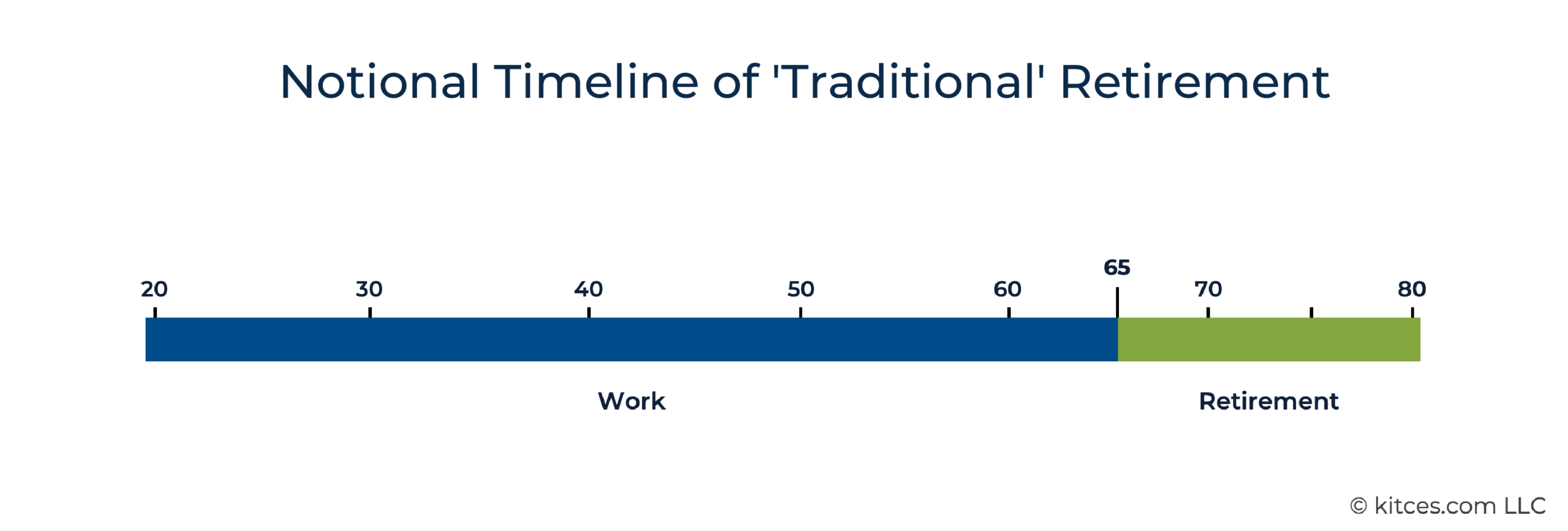
However, this 'traditional' view of retirement is in reality a relatively recent phenomenon and may not match the underlying goals of many individuals, who might instead prefer to enjoy the freedom of retirement at a younger age (at least temporarily), or to reap the financial and social rewards of work well into their 60s and perhaps beyond. Financial advisors have an opportunity to create a truly transformational moment for prospects and clients in this position by introducing them to alternative approaches to retirement and how financial planning can support them if they choose to go down one of these paths.
Why The 'Traditional' Retirement Path Might Not Be For Everyone
While the 'traditional' retirement path of working full-time into one's 60s before leaving the workforce entirely might seem like the 'default' option today, this view of retirement is largely a 20th century phenomenon driven in part by corporate and government decision-making. It might not necessarily be a 'fit' for many individuals who would prefer to organize their working lives in a different way.
The Emergence Of Full-Time Retirement
Today, retirement date is commonly thought of as a choice – even if, in reality, many individuals are forced to leave the workforce sooner than they'd like due to health issues or other limitations. Historically, though, individuals typically worked (often in physically demanding jobs) until they were no longer able to do so. For instance, as of the late 19th century, at a time when white collar jobs were much less prevalent, approximately 75% of men over age 65 were still working.
This created a 'problem' for employers, though, as workers' productivity declined over time alongside their physical capabilities. One solution to this issue was to offer company pensions, which enabled older workers to depart by supporting them financially – and helped attract and retain younger workers as well. As of 1919, approximately 15% of wage and salary employees were covered under a private sector pension, a figure that would peak at about 50% of private sector workers in the early 1980s.
While private-sector pensions started gaining traction in the early 20th century, they still weren't universal. This led, in part, to the Federal government initiating its own form of retirement support through the introduction of the Social Security system in 1935, which established age 65 as the 'normal' retirement age (taking the lead from many state, private, and railroad pension systems which were designed as such).
With Social Security and possibly a private-sector pension available, workers were better insulated against destitution when they left the workforce. However, it would take initiatives from the construction and financial sectors to transform the concept of retirement to a time of well-earned leisure and enjoyment.
The Advertised Promise Of The "Golden Years"
As more individuals left the workforce while they still had the physical capacity for leisure activities, the opportunity emerged to transform retirement from merely a time of convalescence to a period to be enjoyed. Which lead to the creation of the concept of one's "golden years", spurred on by companies and industries that saw an opportunity to serve (and profit from) this emerging group of post-work Americans.
For instance, the developer Del Webb introduced the concept of the 'retirement community' through its Sun City project in Arizona, which opened in 1960. Sun City offered the promise of warm weather, relatively affordable and low-maintenance housing, recreation, and community to those who might have otherwise remained in their long-time homes or moved in with children or other family – offering workers an image of a lifestyle to retire 'to' rather than just retiring 'from' work.
Financial firms also saw opportunity as the modern concept of retirement gained momentum, with Merrill Lynch running its famous "What Everyone Ought To Know…About This Stock And Bond Business" ad starting in 1948 to introduce the concept of stock and bond trading to a wider audience (who might want to invest their own money to have more resources to enjoy during their newly conceived retirements).
Financial firms received a further boost with the Federal government's introduction of the 401(k) plan in 1978, as the growth of defined contribution retirement plans (which offer greater cost certainty for employers) and the decline of defined benefit pension plans meant that more individuals would need to invest for their own respective retirements. Today, only about 14% of private-sector workers have access to a defined benefit pension, while 70% have access to defined contribution plans. Retirement discourse is now ubiquitous, from commentary on how much individuals might 'need' to save to retire, to advice on decumulation strategies to help retirees enjoy their savings.
Why Alternative Retirement Paths Might Be Attractive
Given that the 'traditional' view of retirement didn't emerge 'organically' but instead was at least in part driven by deliberate private and public-sector campaigns, it would stand to reason that many individuals might prefer to follow a different retirement 'path' according to their own wishes.
Due to the increase in white-collar work (that doesn't have the same physical demands of certain blue-collar jobs) over time, many workers can continue to be productive in their jobs well into their 60s and beyond. Which might be attractive to those who want to access the potential financial benefits (e.g., continuing to earn a salary and delaying tapping into retirement assets), psychological benefits (e.g., the sense of meaning and purpose that can come from working), and social benefits (e.g., the built-in social network that can come from a job) that can be accessed by continuing to work past 'traditional' retirement age.
Alternatively, some workers might not want to wait until they reach 'traditional' retirement age to take significant time away from the workplace. For instance, an individual who wants to take an extended, physically demanding hiking trip might prefer to do so at a time when they know they have sufficient stamina to do so successfully (e.g., in their 40s or 50s), rather than waiting until their 60s when such a trip might not be feasible.
Also, while Social Security continues to serve as a baseline source of 'guaranteed' income, the decline in defined benefit pension coverage and increased prevalence of defined contribution plans has created a tradeoff: Though there is the possibility of greater income upside in retirement (for those who are able to save a high percentage of income and achieve strong investment returns), there's also a greater risk of a savings shortfall (e.g., due to sequence of return risk) that could create income volatility. Which means that, on the one hand, more workers today might have the financial means to fully leave the workforce (well) before 'traditional' retirement age than in the past, while on the other hand, some individuals may need to work longer to shore up their financial situations before retiring fully – leading to greater variation in retirement-readiness among workers.
Since many individuals might not realize that an 'alternative' retirement path is possible, financial advisors are well-positioned to introduce their clients to these concepts and, if applicable, offer planning recommendations (including ongoing plan reviews and stress tests) to help them successfully follow through on one of these paths.
Four Alternative Retirement Paths
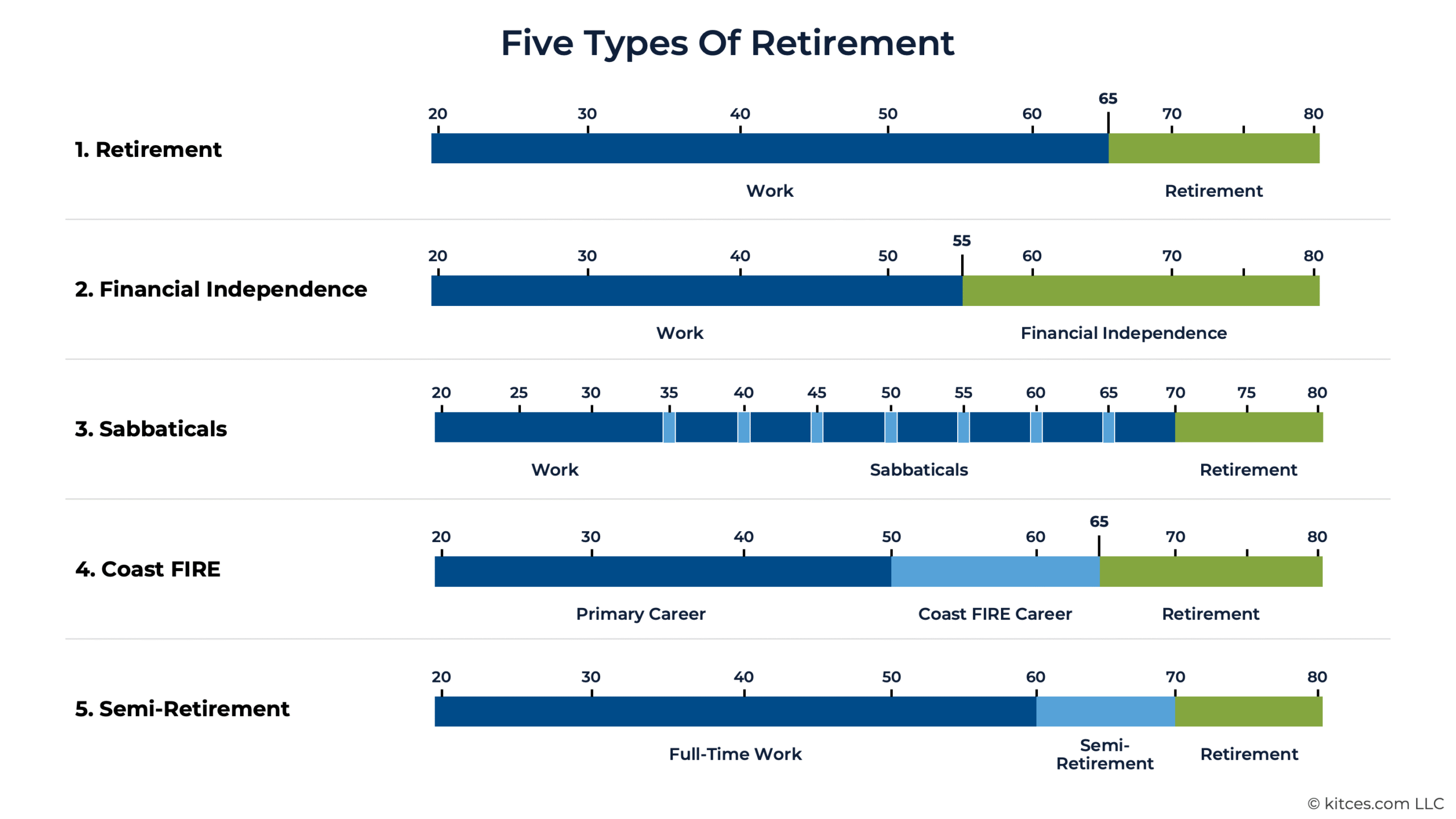
Starting from a baseline of the 'traditional' retirement path of working full-time until approximately one's mid-60s before leaving the workforce completely, there are several potential adjustments that could be made. Here, we will discuss four potential alternative retirement paths: financial independence, sabbaticals, "Coast FIRE" and semi-retirement.
Financial Independence
While the traditional retirement model assumes that workers will need to continue working well into their 60s to build sufficient assets to meet their lifestyle goals in retirement, individuals who are able to amass sufficient assets at an earlier age (due to high income, a high savings rate, a significant financial windfall, or some combination thereof) can achieve a level of "financial independence" that gives them the option to leave the workforce whenever they would like. In the Financial Independence model of retirement, then, individuals seek to build their savings as quickly as possible until they reach the point where they can decide to retire – or not – whenever they choose.
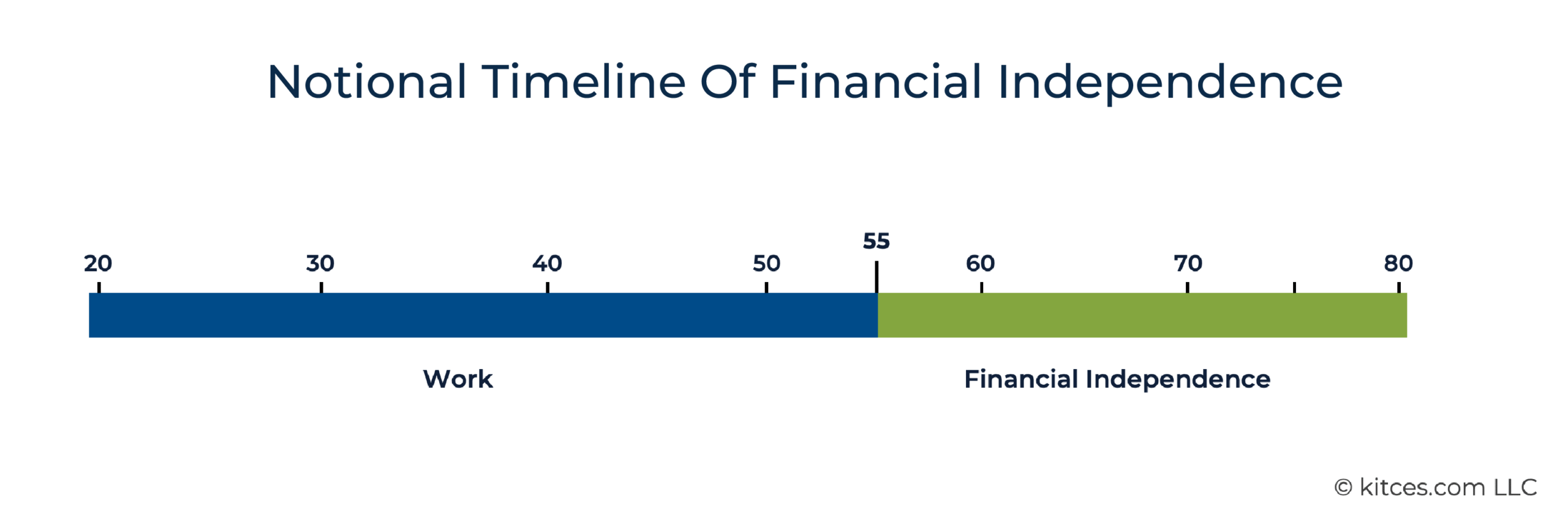
Notably, the ability to reach financial independence is a function of both assets accumulated and an individual's current (and expected future) expenses, as relatively higher lifestyle expenses would require more savings. Additionally, workers who derive a sense of purpose and meaning from their jobs will also want to give special consideration to how they might fulfill these needs outside of an employment setting.
That said, while achieving financial independence is often framed in terms of fully leaving the workforce (much) earlier than 'traditional' retirement age, its benefits are broader in the optionality it can provide. For instance, an individual who has achieved financial independence could choose to work fewer hours each week, giving them time to enjoy hobbies or physically demanding activities while they are mentally sharp or in strong physical shape.
From an advisor's perspective, lengthening the period of retirement can create risks to portfolio sustainability, perhaps calling for reduced safe withdrawal rates and/or flexible retirement income approaches (e.g., 'ratcheting' rules that allow for spending increases if portfolio performance is strong, or a 'guardrails' approach that can allow for a higher initial safe withdrawal rate with potential for upward or downward revisions to the size of annual withdrawals in certain years if the size of the portfolio hits certain 'guardrails').
Clients who think they might want to leave the workforce early might also consider strategically contributing to various savings vehicles. For example, having assets in taxable brokerage accounts could offer greater flexibility (and tax efficiency, given that there will be some basis on assets in the account) for funding lifestyle expenses in early retirement than a traditional IRA (particularly if the client plans to retire before age 59 1/2 when IRA withdrawals become penalty-free). Another option would be to strategically withdraw from an IRA via a series of substantially equal payments.
For many, finding (and paying for) alternative sources of health insurance is one of the most significant barriers to early retirement. Because many employers subsidize employee health insurance coverage, some clients might not realize the full cost that they would have to pay for similar coverage on their own (which could represent a major budget line item until they reach Medicare eligibility age at 65). Given the challenge (and cost) of getting individually issued health insurance policies (and the time limitations of eligibility for coverage under COBRA), many of those in this situation will end up getting policies using the marketplaces established by the Affordable Care Act (ACA). While premiums for these policies will likely be higher than those the employee paid through their employer, even those who have amassed significant assets could be eligible for a premium tax credit that can greatly subsidize this cost – as eligibility for this credit is not based on wealth, but rather on remaining below the Modified Adjusted Gross Income [MAGI] threshold of 400% of the Federal poverty level.
At the same time, leaving the workforce before reaching 'traditional' retirement age could create low-income years that may present ideal conditions for certain tax planning strategies (e.g., Roth conversions or capital gains harvesting).
Example 1: Jessica is single and plans to retire at age 55 with $2 million in a taxable brokerage account (funded in part after her company experienced a liquidity event) and a $2 million traditional IRA. She plans to cover her $75,000/year living expenses by selling off shares from her brokerage account. In her first year of retirement, her advisor expects this to generate $10,000 of long-term capital gains (since the account received a major cash infusion relatively recently). With this in mind, Jessica could decide to sell additional appreciated shares (and immediately buy them back, given the 'wash rule' doesn't apply to sales of assets with capital gains), generating up to $39,450 in long-term capital gains. This would allow her to reach the 2026 threshold for the 0% capital gains tax bracket of $49,450, while also converting $16,100 (her standard deduction) from her traditional IRA to a Roth IRA tax-free.
Sabbaticals
Given that many workers only receive a few weeks (or less) of paid time off from their employer each year, taking extended time off (e.g., for a major trip or to pursue a hobby or other interest full-time) can seem difficult. Uncertainty about one's future health condition or the time-sensitive nature of certain activities (e.g., travel with an aging parent) may make the prospect of waiting until 'traditional' retirement for such pursuits unappealing.
With this in mind, certain clients might be interested in taking one or more unpaid "sabbaticals" during their career (that could last anywhere from one month to multiple years) to enjoy or 'practice' the retirement lifestyle before they permanently leave the workforce. Sabbaticals can be financially feasible for a wide range of clients (especially compared to a more permanent early retirement) given their limited duration, and furthermore can give an individual more choice over when and how to spend their non-working time throughout their life.
In the Sabbatical model, then, individuals take one or more extended blocks of time off during their working years, returning to work once the sabbatical is done. Which results in a tradeoff where instead of bunching all of their nonworking years at the end of their life, the individual 'cashes in' some of that time earlier in their life when they're hopefully young and healthy enough to better enjoy it (though they ultimately may end up waiting until later in life to retire permanently as a result).
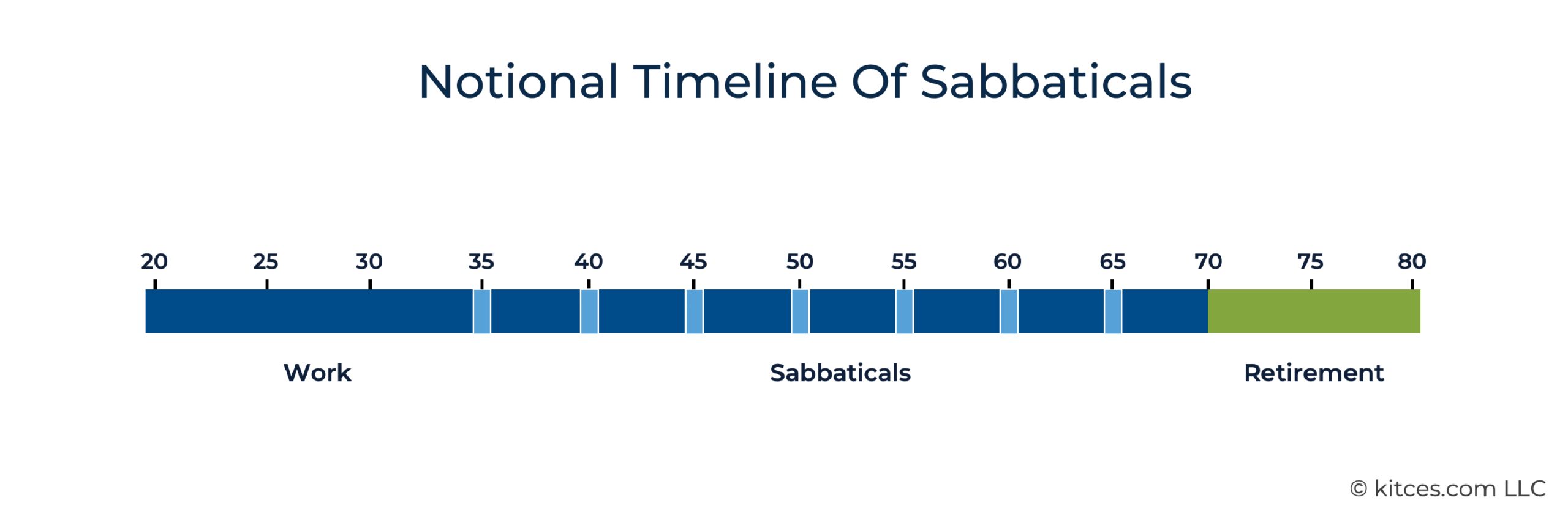
While the immediate financial implication of taking a sabbatical involves generating sufficient cash flow to support spending during the sabbatical period (when income from work is no longer coming in), an even more impactful, longer-term consideration is how taking the sabbatical will affect an individual's employment. In an ideal world, the individual's employer would be amenable to the extended time off (whether on a paid or unpaid basis) and allow the employee to return to their position after the sabbatical is over – though the employee might still consider how the sabbatical will affect prospects for advancement within the company. That said, most employers do not offer sabbaticals, leaving the individual facing the prospect of temporarily leaving the workforce and needing to start a new job when the sabbatical concludes. Practically speaking, many individuals take sabbaticals when they are between jobs – either intentionally (e.g., switching employers or career fields, or just taking a pause between roles) or unintentionally (e.g., after being laid off).

Nerd Note:
While some individuals might take relatively shorter-term (i.e., 1-3 month) sabbaticals over the course of their career to pursue leisure pursuits such as travel, others might take longer amounts of time away (e.g., one or more years) to care for children or an aging parent. Given the length of time away from work, this latter group will face the financial risks of taking a sabbatical even more sharply, including the challenge of finding a job commensurate with their skills and interests after the time off, covering their expenses while unemployed, and making up for lost savings and career advancement opportunities. That said, given that there might only be one chance to take this time (e.g., a child is only a toddler once), the value of this time away from work may outweigh the financial risks. Financial advisors have a unique opportunity to support their clients in navigating this decision by analyzing and modeling the potential effect of taking this time off relative to other financial goals.
With these factors in mind, advance planning becomes crucial, in terms of identifying whether a client's current employer is amenable to the sabbatical as well as planning for liquidity needs during the time away from work (e.g., raising cash in advance to avoid drawing down the portfolio during a downturn). In addition, given that the client likely won't be able to contribute to retirement accounts during the sabbatical period, an advisor could show how the sabbatical may result in an additional savings need once they return to work and/or adjustments to a future retirement date. Nonetheless, given that an extended sabbatical could create at least one relatively low-income year, certain tax planning opportunities (e.g., Roth conversions or capital gains harvesting, discussed above) may emerge during this period.
Looking at insurance coverages, if the individual is ineligible to continue coverage under their current employer's plan (or if doing so is cost-prohibitive), the individual might need to obtain health insurance via the public exchange, where they might be eligible for a premium tax credit. Also, while disability insurance could be particularly valuable for those taking sabbaticals (given that they will be relying more on income earned in their later working years compared to an individual who achieves financial independence), these policies typically don't cover periods of unemployment – though Social Security may still provide partial coverage.
Perhaps more impactful than those shorter-term adjustments, however, will be the extent to which the client can easily re-enter the workforce, and whether they can do so at a similar wage to their pre-sabbatical role. Advisors can encourage their clients to seek out real-world data points from their networks that can then inform the long-term modeling and planning that the advisor engages in on the client's behalf – for example, a reasonable 'worst,' 'mid,' and 'best' case scenario.
Nerd Note:
Advancements in Artificial Intelligence (AI) technology have led some observers to question whether the headcount in certain career fields might be reduced (or even eliminated) in the future – though it's also possible that AI use could lead to the creation of certain new jobs or fields . While this could impact all workers (no matter their intended retirement age), those who take sabbaticals (at least temporarily reducing their ability to save for retirement) could find themselves in the unfortunate position of both being without a job (if they find it hard to reenter their field after the sabbatical) and with less savings than they might have had otherwise. Faced with an uncertain future, individuals interested in this path might 'over-save' in advance of the sabbatical as a form of insurance against future job disruption (AI-related or otherwise).
"Coast FIRE"
In recent years, the Financial Independence, Retire Early (FIRE) movement has come into the public consciousness, often through tales of individuals who have left the workforce in their 30s or 40s. While the most extreme examples of this movement might grab headlines, in reality there are different 'flavors' of FIRE, several of which don't actually involve leaving the workforce.
For instance, an individual has 'reached' "Coast FIRE" when their accumulated retirement savings are projected to grow – without further contributions – into a portfolio large enough to support their anticipated future retirement spending needs. At that point, they 'only' need to earn enough to cover their ongoing expenses while continuing to work. Any additional saving only further strengthens their financial position, reduces risk, and provides additional flexibility.
In the Coast FIRE model, individuals have the option to pursue a new job (or perhaps begin a new career) that is more meaningful and/or less stressful but doesn't pay as much as their current job, as long as they earn enough to cover their living expenses until they fully retire.
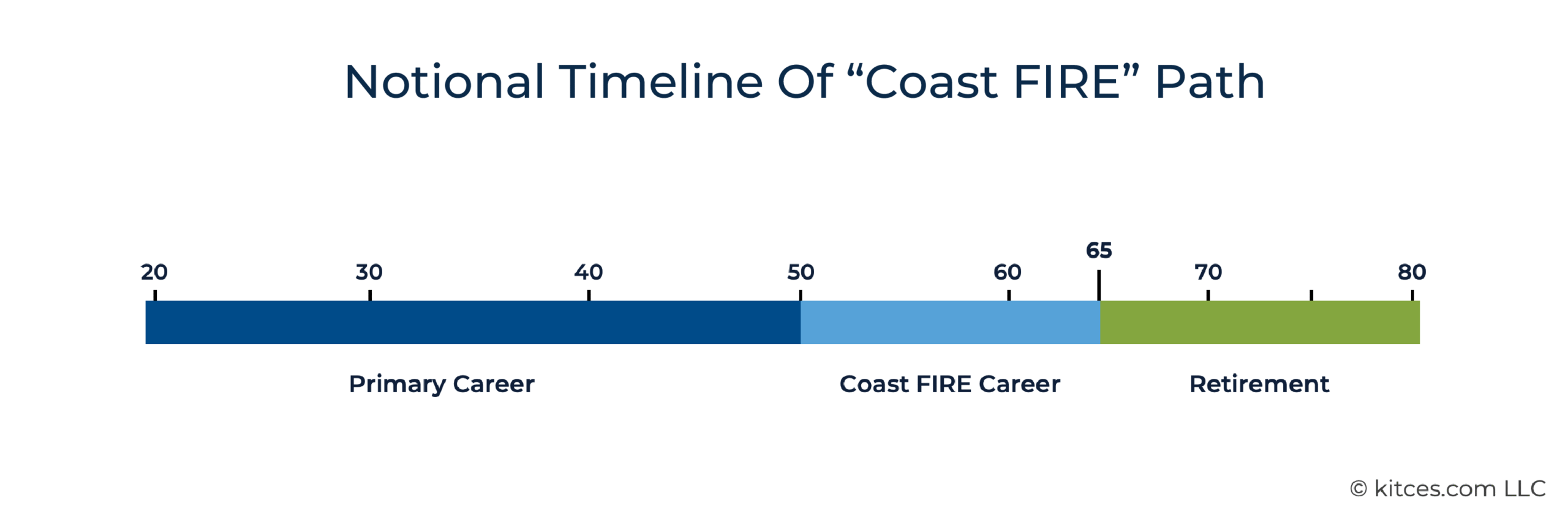
Compared to early retirement, individuals can pursue the Coast FIRE path with fewer assets earmarked for retirement, as they will continue to have earned income to support lifestyle expenses during their remaining working years. They can also benefit from continued employer-subsidized health insurance, as well as the social benefits that can come from continuing to work.
From an advisor's perspective, because a client on this path will be either reducing or stopping their retirement savings, stress testing and regularly monitoring their situation becomes important. For example, an advisor might model higher-than-expected inflation (which could affect the client's ability to meet their lifestyle needs while working and/or in retirement), lower-than-expected rates of return (which could dampen the growth of the client's retirement savings), or a period of (involuntary) unemployment to show the effect on the client's plan. Nonetheless, these risks can be mitigated to a certain extent if the client is able to be flexible in their spending and/or has the ability to find a higher-paying position (that could allow for additional retirement savings) if need be.
Nerd Note:
While pursuing an alternative retirement path can add an element of risk to a client's financial plan, the choice to do so is reversible in many cases. For instance, an individual pursuing Coast FIRE may be able to transition back to a higher-paying position if inflation or markets turn against them, while a client who decides to retire early after achieving financial independence could go back to work (at least part time) to bolster their financial position. A mitigating factor to the risks involved in pursuing an alternative retirement path is an individual's ability (and willingness) to increase their income if necessary – suggesting that clients could benefit from conversations with a career coach to both identify jobs they might enjoy more [particularly in the case of those interested in Coast FIRE] and to explore potential contingencies if additional income is needed.
Semi-Retirement
One of the challenges of 'traditional' retirement is its suddenness: after working 40-hour (or more) workweeks for 40+ years, a new retiree will wake up one Monday without having to go to work. This shock to the system can leave some retirees disoriented and struggling to structure their newfound free time. Which is why many financial advisors encourage clients to visualize what they want their life to look like in retirement before actually leaving the workforce. Going beyond mental exercises, some individuals might want to 'test out' retirement to see what having more time during the week might feel like (without completely leaving the workforce).
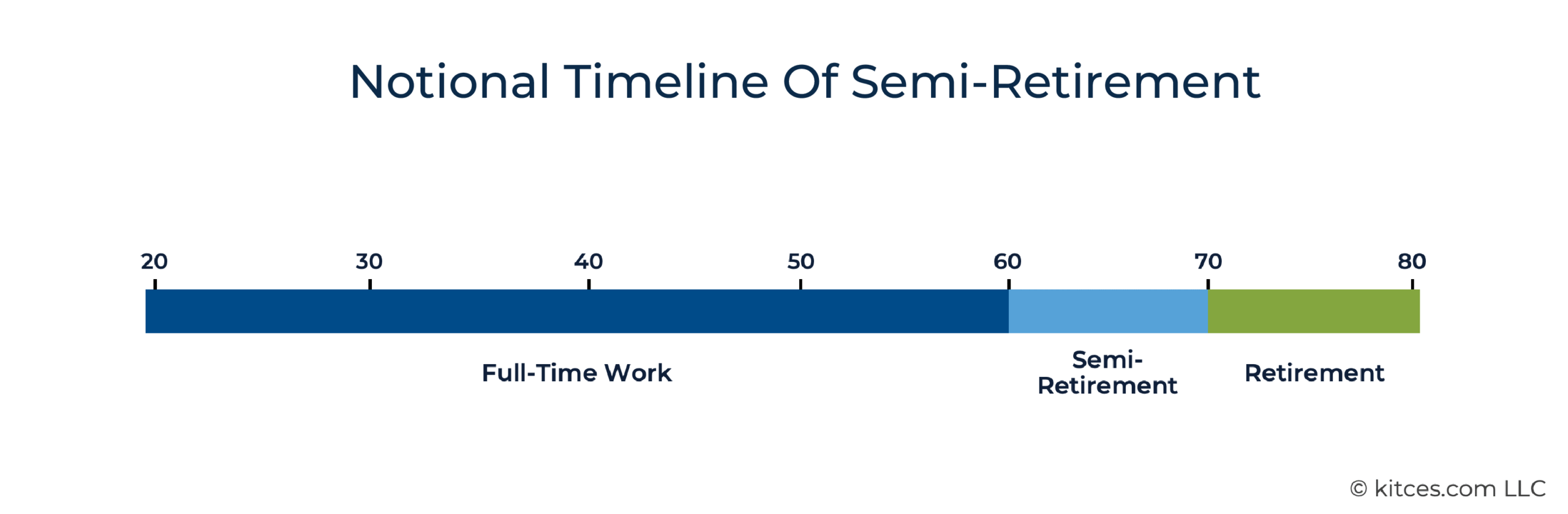
In the Semi-Retirement model, individuals significantly reduce the number of hours they work each week (e.g., from 40 to 20). Many individuals who pursue this path might find that this provides an enjoyable, 'best-of-both-worlds' balance: maintaining professional and social ties (and continuing to earn income) while having more time for leisure activities (while they're in better physical health) compared to remaining in a full-time position or leaving the workforce entirely.
Semi-retirement could begin in advance of a target 'full' retirement age (to 'test' out what full retirement would be like), but many individuals might choose to continue in semi-retirement well beyond 'traditional' retirement age given the above benefits.
From an advisor's perspective, a first step when working with a client interested in semi-retirement is to determine the extent to which they need to continue earning money (whether to support ongoing living expenses and/or add to their retirement savings) to determine how much of an income 'haircut' they can afford to take. Also, given that these older individuals could be more susceptible to health conditions that force them to take time away from work (or leave the workforce entirely) and face the prospect of being laid off (and the challenge of finding a commensurate position elsewhere), stress-testing the client's plan for an unexpected income reduction is an important exercise to help a client decide whether they're willing to take this path. In addition, if a client will no longer have access to health insurance due to their reduced hours, this will likely result in an added cost (though, given their reduced income, the client might be eligible for a premium tax credit if they purchase an ACA plan).
While semi-retirement can come with risks, it also has the potential to strengthen a client's financial plan as well if they are interested in working (at least part-time) past age 65. For instance, doing so could allow them to delay claiming Social Security benefits (to increase the size of their lifetime monthly benefit) while also mitigating sequence of return risk (by having some earned income to support lifestyle expenses), and possibly creating some additional flexibility around full retirement start date.
Nerd Note:
Notably, a client might choose to transition from one alternative retirement path to another. For instance, a client who takes several sabbaticals and enjoys the extended time off (and who has the financial assets to do so) might eventually achieve financial independence and retire early. Another client might decide to Coast FIRE and then transition to semi-retirement as they approach (and perhaps move beyond) 'traditional' retirement age.
How Financial Advisors Can Help Clients Pursue Alternative Retirement Strategies
While certain clients might be interested in pursuing an alternative retirement path, many might not have considered these possibilities in the first place. Which, at a high level, means that financial advisors have an opportunity to create a truly transformational moment for their clients by opening their eyes to retirement possibilities that could change the course of their remaining working years and retirements. In addition, if a particular client does show interest in an alternative path, advisors are also well-positioned to show the client whether they're equipped to follow through on it (or what actions they might need to take in the coming years to do so) and support them in actually executing the strategy.
Identifying Clients Who Might Be Interested In An Alternative Retirement Path
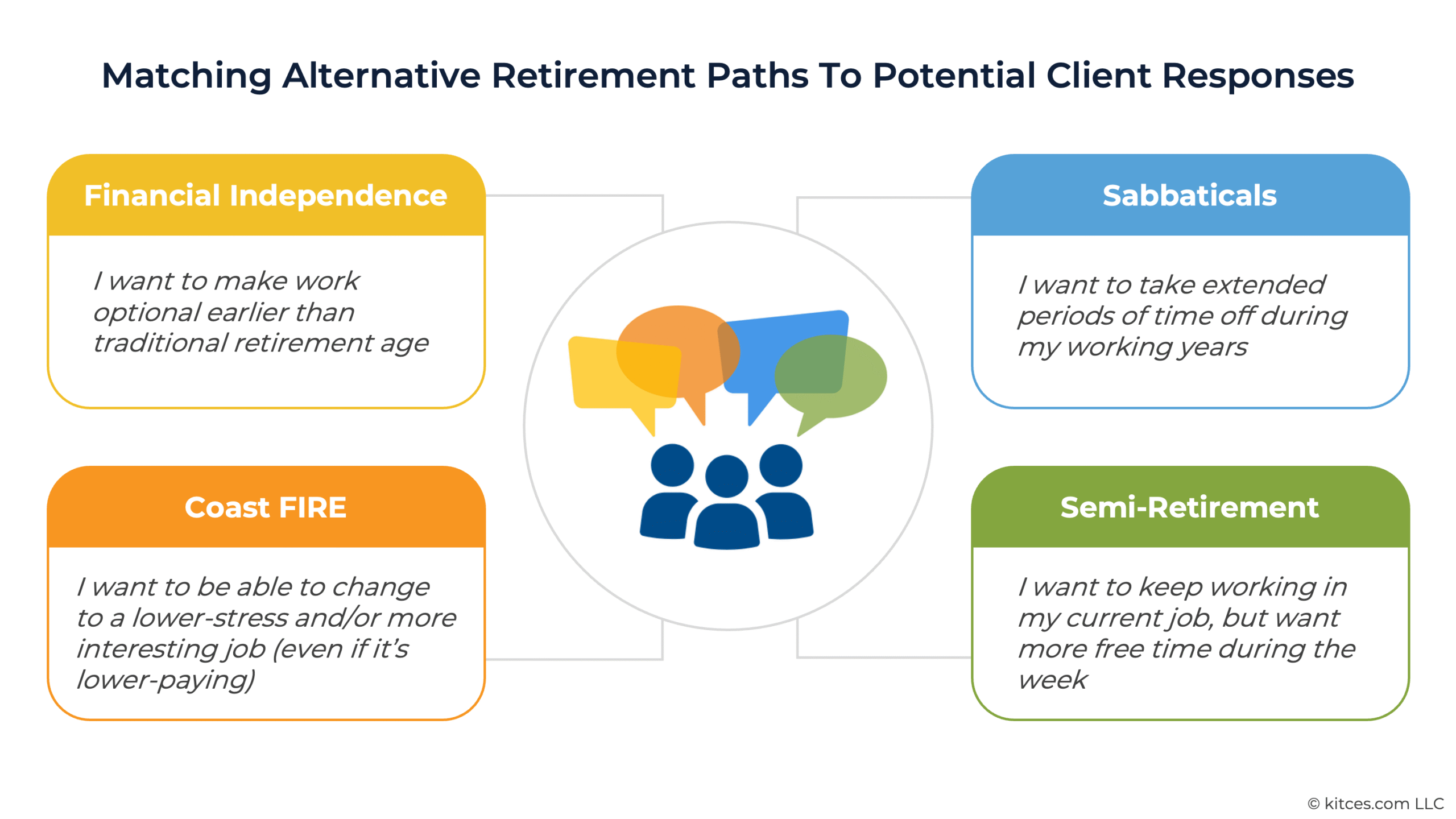
Identifying clients who might be a good fit for an alternative retirement path is both a matter of a client's interest in a particular model and the financial feasibility of doing so. Thinking about current clients, an advisor might consider who has expressed goals that align with alternative retirement paths (even if the client might not have known that a particular path was an option).
Example 2: During annual review meetings, Juan's client Amanda, age 55, always mentions how she's stressed in her current job as a consultant (even though it pays $250,000 per year) and how she'd like to have a position that requires less travel. Notably, she's also talked about how much she'd like to work for a local non-profit that helps individuals start new businesses. Even though the non-profit job is expected to only pay $100,000 per year (at least to start), Juan determines that Amanda's current retirement savings is expected to grow to a sufficient extent that it, alongside her Social Security benefits, will support her income needs in retirement and, because the non-profit salary would be expected to cover her current annual living expenses, that Amanda could pursue the non-profit job if she wishes.
When meeting with new clients (or as a thought exercise during review meetings with current clients), one way to see if a client might be interested in an alternative retirement path is to ask "magic wand" questions that encourage them to expand their horizons of what might be possible. For instance, an advisor might ask a client "Let's pretend for a moment that you own a magic wand. With it, you can have your ideal path for the remainder of your career and retirement. What does that look like for you?". For example, a 60-year-old client who notes that they enjoy their job and would like to remain connected to it for many years to come but would like to work part time to have more time for hobbies could be a good candidate for a semi-retirement approach.
Communicating Alternative Retirement Paths To Clients
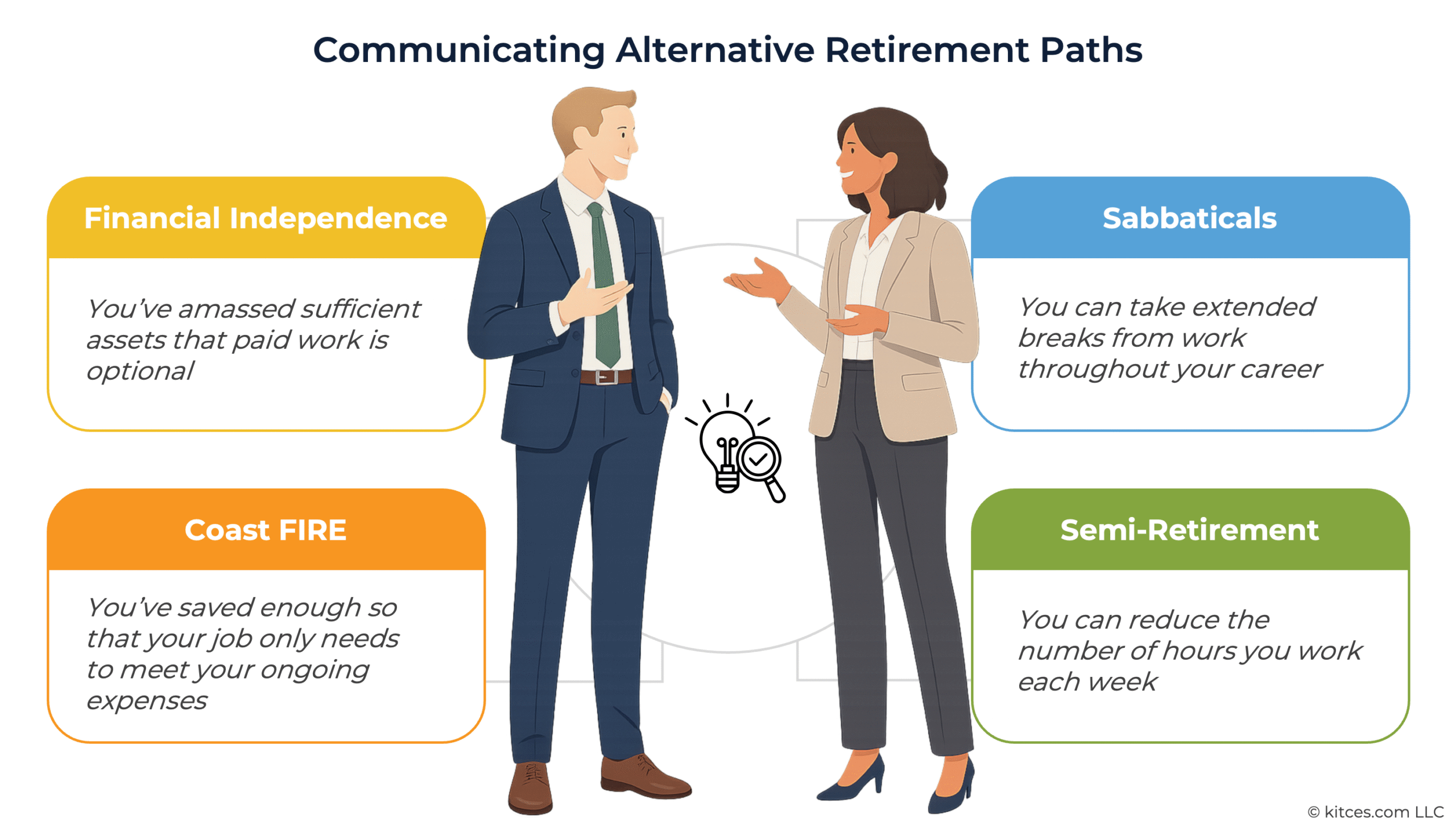
While clients are likely familiar with the terms financial independence, sabbaticals, and semi-retirement (though Coast FIRE is much less likely to be known), they might not know exactly how these strategies translate into a financial planning context. With this in mind, explaining them at a high level and without jargon can give the client an introduction to the concepts (and offer an opportunity to elicit feedback) before going deeper into what they would entail.
Nerd Note:
The alternative retirement path conversation could look different depending on whether an advisor is working with a single client or a client couple, as each member of a couple might have different preferences or goals. Some of these could be complimentary (e.g., if one spouse might want to "Coast FIRE" and take a lower-paying job, having a spouse who plans to continue working full-time can reduce the risks of reducing or stopping their retirement savings), though it would be valuable for clients to consider how relationship dynamics might be impacted.
Ultimately, although fully leaving the workforce at 'traditional' retirement age might be the default path for many individuals, financial advisors have an opportunity to create a true 'aha' moment for their clients by introducing them to alternative strategies. To the extent that this results in happier, more fulfilled clients, doing so may also be an effective way to encourage client retention (and boost referrals) over time!