Executive Summary
For most of our history, the domain of the financial advisor has been helping clients to invest their savings in publicly traded stocks and bonds that create opportunities for long-term growth, in order to achieve clients' retirement and other savings goals. While the particular vehicles have changed over time – from individual securities, to mutual funds, to exchange-traded funds – the underlying continuity has been that all of these issuers are registered with and are subject to the reporting standards of the Securities and Exchange Commission (SEC), which mandates detailed and extensive disclosures about the issuer, its business, and the securities being offered. More recently, as companies are staying private longer and issuing more private equity and debt, private investments and funds have proliferated, and more and more advisory firms are now exploring whether to add allocations of private funds into their client portfolios. However, without the rigorous disclosures required of issuers because of SEC registration and reporting, it is significantly harder for advisors to conduct due diligence on private funds, which present investment and legal risks not typical for most public investments.
In this guest post, Rich Chen, founder of Brightstar Law Group, explores the practical due diligence considerations that advisors must navigate when considering a private fund investment, with a particular focus on what to look for in governing documents and the operational systems of the private fund.
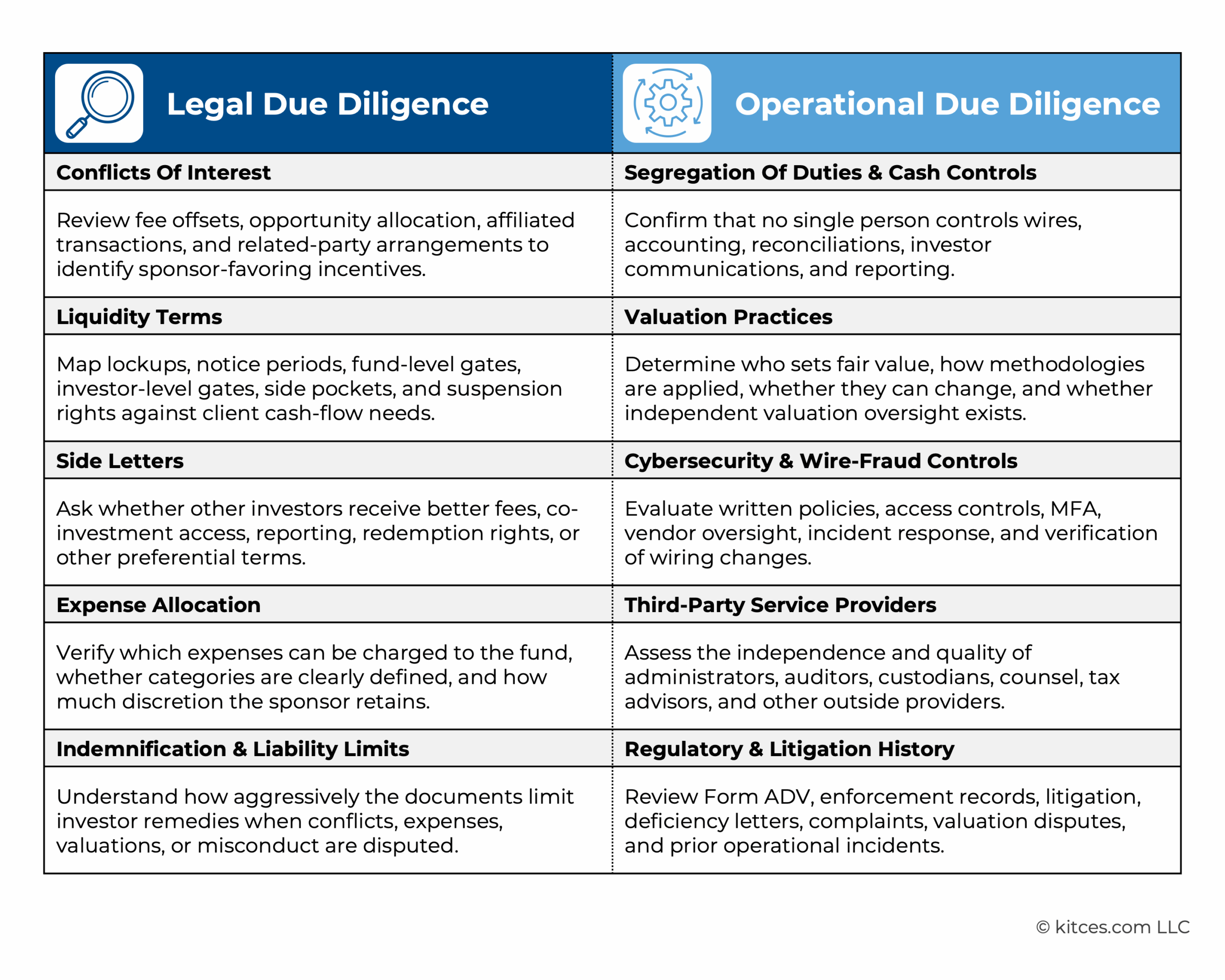
The starting point in due diligence is to recognize that what is stated in legal governing documents can differ quite significantly from a private fund's marketing materials, as the latter is written to attract investors to the fund by focusing on the opportunities, while the former is written to minimize the risks for the fund sponsor (and thus more clearly articulates the rights of investors who put dollars into the fund). Accordingly, a detailed review of governing documents can highlight conflicts of interest (e.g., between the fund sponsor and affiliated parties), reveal restrictions on an investor's ability to exit the fund investment (which can often be significant), identify red-flags regarding indemnification provisions, and detail how expenses will be allocated between investors and fund management. In addition, due diligence of governing documents provides an opportunity to ask about “side letters” to determine if other investors might have preferential or different rights or return opportunities.
Beyond due diligence of legal documents, it's also important to evaluate a private fund's operational systems, and how effectively they are built to protect investors. For instance, does the private fund segregate key functions, ensure dual authorizations for disbursements, use an outside custodian or separate accounting firm, and conduct annual audits? These measures can significantly mitigate risks of fraud or misappropriation by the manager or its personnel. Similarly, advisors can inquire about the firm's cybersecurity and client data protections, engage in background checks of the fund sponsor's history (to ensure no prior legal issues or enforcement actions!), and determine how the firm values its assets (especially in cases where it calculates carried interest or other management fees based on those valuations).
Ultimately, Chen provides a due diligence checklist to help support the process, though notably it's not enough to just 'mechanically' complete a checklist; instead, the SEC expects to see advisors showing contemporaneous documentation that they were thoughtful in their questions and evaluation of the answers provided, to demonstrate robustness of the process itself – for which advisors may even wish to engage outside providers to support in due diligence (especially if their internal resources are limited). The growth of companies in the private markets represents a significant opportunity for clients to invest, but those who are accustomed to the natural protections the SEC has built into public markets need to be cognizant that there are unique risks of private equity and debt funds that, at the least, require a substantive proactive due diligence process from financial advisors (with the SEC increasingly applying enforcement actions against advisory firms that “just” relied on the marketing materials and representations of the private fund sponsor alone).

Private fund investments have migrated from the exclusive domain of large institutions and endowments into the mainstream of RIA client portfolios. Private equity, hedge funds, private credit, venture capital, and real estate vehicles now appear across the wealth management landscape. Furthermore, the structural expansion of the private fund investor base appears likely to accelerate. The Trump Administration's push to open 401(k) plans and individual retirement accounts to private market investments would bring millions more retirement savers into contact with illiquid, complex structures… that carry risks fundamentally different from the mutual funds and ETFs they have traditionally held.
While that expansion creates significant new opportunities for clients, it also carries real regulatory consequences and litigation risk. The SEC has been explicit that the fiduciary duty imposed by the Investment Advisers Act of 1940 requires RIAs to conduct a reasonable and independent investigation before recommending a private fund investment. In January 2022, the Division of Examinations issued a Risk Alert specifically focused on investment advisers that recommend, sponsor, or manage private funds, identifying widespread deficiencies in due diligence practices. The Risk Alert confirmed that advisers were being examined against a standard demanding substantive, documented analysis, and that failure to meet it has resulted in deficiency findings, referrals to the Division of Enforcement, and outright enforcement actions. Which means for RIAs recommending private funds, inadequate diligence is not merely a compliance gap; it is now an enforcement risk.
The discussion that follows addresses how RIAs should approach legal and operational due diligence on private fund recommendations, focusing on the fiduciary framework governing the obligations, SEC expectations, and the legal document review and operational review that satisfy these demands. Advisers who utilize the tools herein to conduct effective legal and operational due diligence when recommending private fund investments can significantly reduce their regulatory and legal risk exposure.
Applying The Fiduciary Standard To Conducting Due Diligence On Private Funds
The Investment Advisers Act of 1940 imposes a fiduciary duty on RIAs, a standard rooted in the Supreme Court's recognition in SEC v. Capital Gains Research Bureau, Inc. that the adviser-client relationship is one of trust and confidence demanding undivided loyalty. In 2019, the SEC issued its Commission Interpretation Regarding Standard of Conduct for Investment Advisers (the "Commission Interpretation"), which frames the fiduciary obligation as two distinct but related duties: a duty of loyalty, and a duty of care. Both apply fully and continuously when an RIA recommends a private fund investment, but our analysis will focus predominantly on the duty of care.
Fiduciary Duty Of Care For Private Fund Diligence
The duty of care, as articulated in the Commission Interpretation, requires an adviser to provide investment advice in the best interest of the client based on the client's individual circumstances. Critically, it requires the adviser to have a reasonable basis to believe that any recommendation is suitable. That basis cannot be derived from generalized assumptions. It requires an understanding of the investment itself.
In the context of private fund recommendations, the duty of care carries particular weight. The Commission Interpretation makes clear that the obligation to investigate is independent of, and cannot be discharged by, the marketing presentations, pitch books, due diligence and disclosure materials, and other representations provided by the private fund (or its issuer, sponsor, or promoter seeking the investment), which the SEC has recognized are promotional documents drafted to describe, and not to constrain, sponsor authority.
In an action brought against Hennessee Group LLC, the SEC charged an investment advisory firm and its principal with recommending that clients invest in a hedge fund without conducting due diligence they represented they would undertake and failing to conduct a reasonable investigation into red flags about a hedge fund, which resulted in substantial client losses when the underlying fund was revealed to be a fraud.
This reflects a foundational principle: the interests of the sponsor and the interests of the investor are not identical, and the adviser has the task of deciphering where those divergent interests could create undue risk for the investor – especially since private funds operate outside the public disclosure framework of the Securities Act of 1933 and the Securities Exchange Act of 1934. As a result, their assets are frequently illiquid and difficult to value independently, and because sponsor-controlled reporting creates inherent information asymmetries, a reasonable investigation should extend into the fund's governing documents, operational infrastructure, valuation methodology, conflicts of interest, and the legal rights actually available to investors.
Where the adviser lacks the expertise to conduct that review independently, there are third parties such as law firms (including Brightstar Law Group and Investment Law Group) and operational due diligence specialists (like IQ-EQ and Kroll) who can step in to support the advisor's efforts to understand the risks involved.
In the absence of effective due diligence, the SEC's January 2022 Risk Alert on Examinations of Private Fund Advisers highlights the emerging regulatory concerns (as reflected in findings from examinations across a range of RIAs): recommending private fund investments without sufficient due diligence on the funds themselves; failing to adequately evaluate suitability for specific clients; making material misstatements or omissions in disclosures; and failing to identify, disclose, or appropriately manage conflicts of interest.
A critical feature of the SEC's fiduciary framework is that it focuses on the quality of the adviser's process, not solely on investment outcomes. Regulators evaluating compliance with the duty of care are primarily concerned with whether the adviser followed a disciplined, documented framework when making the recommendation, and not whether the investment ultimately performed well. Which means that even where performance is good, the SEC may still take action if the RIA does not have a disciplined fiduciary process. This is especially important given that performance may appear strong for years before structural or operational weaknesses surface (that, ideally, effective due diligence should have revealed).
A documented diligence framework also materially strengthens the adviser's position if disputes with clients arise later. Many complaints involving private funds emerge only after liquidity problems, valuation declines, or redemption suspensions occur, at which point clients ask whether the adviser understood the risks before recommending the investment. A documented record demonstrating analysis of legal terms, operational controls, valuation procedures, and conflicts of interest, including contemporaneous documentation of the diligence process, provides a substantially stronger defense than an informal recollection of conversations with sponsors and familiarity with the manager's reputation or other informal assessments.
Fiduciary Monitoring For (Closed-End Illiquid) Private Funds
Beyond upfront due diligence obligations, the SEC's January 2022 Risk Alert on Private Funds also highlighted failures in monitoring of existing holdings, and made clear that deficiency findings in this area are routinely considered for referral to the Division of Enforcement.
The Commission Interpretation's account monitoring obligation reinforces that where the advisor has a continuing advisory relationship with the client, fiduciary diligence cannot be treated as a one-time exercise completed at onboarding. A fund that appeared sound at the time of investment may later experience operational changes, key personnel departures, litigation, cybersecurity incidents, valuation concerns, or regulatory scrutiny that materially alter its risk profile. The duty of care continues as long as the adviser maintains an ongoing advisory relationship with the client.
RIAs should therefore implement structured periodic review procedures for private fund holdings, including updated diligence questionnaires, annual review of audited financial statements, monitoring of SEC filings and litigation developments, assessment of changes in key service providers, and reassessment of fund conditions in light of any material operational changes.
A common misconception among advisers is that the closed-end structure of many private funds eliminates or reduces the obligation to conduct ongoing monitoring. The reasoning offered is intuitive but incorrect: because the investor cannot redeem, there is nothing actionable the adviser can do if conditions deteriorate, and therefore no continuing diligence obligation arises.
That reasoning conflates the investor's contractual liquidity rights with the adviser's independent fiduciary duties. The inability to exit does not suspend the duty of care - it intensifies the importance of monitoring. An adviser who identifies material deterioration in a fund's operational controls, valuation practices, or legal posture may have obligations to inform the client, to reassess the suitability of continued holding, to escalate concerns directly to fund management or an investor advisory committee where one exists, and to document the analysis and any steps taken.
In some circumstances, secondary market options, transfer rights, or co-investor collective action mechanisms may provide partial remedies that the adviser has an obligation to evaluate. Moreover, ongoing monitoring of closed-end vehicles informs future allocation decisions across the adviser's broader private fund program – as well as within clients' respective portfolios.
Simply put, the fiduciary standard does not provide a safe harbor once capital is committed and redemption is unavailable.
The sections that follow address the two components of the diligence process most commonly underdeveloped in RIA practice: legal due diligence focused on governing documents, and operational due diligence focused on the infrastructure and controls supporting fund operations.
Understanding Due Diligence On Private Funds' Governing (Legal) Documents
Effective due diligence begins with the governing documents of the private fund, which spell out the legal constraints on the fund and potential legal recourses the investor may have if things go awry. This is important because the legally binding documents governing the investment often differ substantially from the sponsor's marketing materials.
Pitch books and due diligence questionnaires are designed to present the strategy attractively. Governing documents are drafted primarily to protect the sponsor and define investor rights in legally enforceable terms. The gap between those two sets of documents is often where the most significant risks reside.
As a result, even though governing documents are lengthy and are written in sometimes hypertechnical legalese, they nonetheless cannot be ignored.
Surfacing Conflicts Of Interest From The Fine-Print Disclosures
Conflicts of interest represent one of the biggest risks where governing documents often reveal risks not fully captured in marketing discussions. Private fund sponsors frequently manage multiple vehicles, maintain affiliated businesses, allocate investment opportunities across strategies, and enter into transactions involving related parties.
Several categories of conflict warrant particular scrutiny. First, sponsor compensation from portfolio companies is a recurring and consequential conflict. Sponsors managing private equity, private credit, or real estate funds frequently receive transaction fees, monitoring fees, consulting fees, acquisition fees, and advisory fees directly from the portfolio companies or projects in which the fund invests. Where those fees are not fully offset against management fees charged to the fund, the sponsor is economically incentivized to pursue transactions and structures that generate additional layers of fee income for themselves, rather than those that maximize investor returns. Advisors should review whether the governing documents require fee offsets, how those offsets are calculated, and whether any cap or limitation applies to the fees a sponsor may collect from portfolio companies without crediting investors.
Second, sponsors that manage multiple funds with similar or overlapping investment mandates present a significant conflict in how to allocate such opportunities. When the same sponsor is simultaneously deploying capital across two or more funds pursuing comparable strategies (whether successive vintage funds, a flagship fund and a co-investment vehicle, or parallel structures targeting different investor bases) the sponsor controls which investment opportunities are allocated to which fund. Governing documents often grant the sponsor broad discretion over these allocation decisions, subject only to general equitable allocation language that may be difficult for investors to enforce. The conflict is sharpest when the economics differ across funds: the sponsor may have stronger incentives to favor a fund in which it holds a larger carried interest stake, a fund whose performance metrics are more in need of support, or a fund where a key investor has informal influence over investment selection. Advisors should review whether allocation policies are clearly defined in the governing documents, whether an independent advisory committee or investor oversight mechanism exists with authority over allocation disputes, and whether the sponsor's cross-fund economics create identifiable incentives to favor one vehicle over another.
Third, related party and affiliated transaction conflicts deserve careful attention. Sponsors may enter transactions between the fund and affiliated entities, including, among other things, using affiliated brokers for trade execution, retaining affiliated property managers for real estate assets, engaging affiliated lenders for credit facilities, or employing affiliated service providers for administration or consulting. Each of these arrangements creates a structural conflict because the sponsor and its related parties profit on both sides of the transaction. Governing documents frequently authorize these transactions with only general disclosure requirements and investor consent mechanisms that may be difficult to invoke as a practical matter. Advisors should identify what affiliated transactions are explicitly authorized, whether independent oversight or approval procedures apply, and whether the terms of affiliated transactions are required to be on arm's-length terms with independent verification.
The practical challenge advisors face when evaluating conflicts is that governing documents are frequently drafted to authorize the very conduct that creates the conflict, subject to general disclosure obligations that may be satisfied by a single paragraph in the private placement memorandum. Investor advisory committees, where they exist, typically provide only a partial avenue for management of such conflicts and are often comprised of investors representing their own interests, which may be different from other investors. Advisors should evaluate not only whether conflicts are disclosed in the offering documents, but whether the governance structure provides any realistic mechanism for investors to constrain sponsor conduct when conflicts arise.
Separating Illiquid From Very Illiquid: Gates, Side Pockets, And Suspension Rights
When it comes to open-ended funds like hedge funds that permit periodic liquidity, liquidity restrictions also deserve close scrutiny, because they often create the greatest disconnect between investor expectations and actual contractual rights. Especially given that in practice, their most restrictive features often activate precisely when investors most need or want access to their capital.
The governing documents of many private funds contain multiple, layered mechanisms that can independently or collectively eliminate meaningful liquidity for extended periods, and advisors must understand each of them independently, rather than accepting a general description of the fund's "redemption terms".
The first layer of liquidity restriction involves initial lockup periods and redemption notice requirements. Many private funds impose lockups ranging from one to several years during which investors have no contractual right to redeem, regardless of circumstances. Following the lockup, notice periods of ninety to one hundred eighty days or longer may further delay actual receipt of capital after a redemption request is submitted. For clients with potential near-term capital needs, the combined effect of a lockup and notice period may mean that capital invested in a private fund is effectively unavailable for a substantially longer period than the stated lockup alone suggests.
The second and third layers of liquidity restriction, fund-level gates and investor-level gates, are particularly important because they are commonly misunderstood and can dramatically narrow redemption rights even for investors who have served their lockup and submitted timely notice.
A fund-level gate limits aggregate redemptions across all investors in any given period, commonly expressed as a percentage of net asset value, such as twenty-five percent per quarter. When aggregate redemption requests exceed that threshold, all redemptions are prorated, meaning an investor who requested full redemption may receive only a fraction of the requested amount in each redemption period, with the remainder deferred to subsequent periods at the discretion of the sponsor.
Example 1. Jeremy and Lawrence each hold a sizable 20% stake in ABC private fund (so that, together, they own 40% of the total fund), and ABC's governing documents impose a fund-level gate capping aggregate redemptions at 25% of net asset value per quarter.
As a result, if Jeremy and Lawrence both submitted requests to fully liquidate, their combined 40% redemption request would exceed the 25% quarterly gate and be prorated, so that only 25% / 40% = 62.5% of each investor's request is satisfied this quarter.
Given the fund-level gate, Jeremy and Lawrence would each have 62.5% of their requested redemption satisfied, meaning 20% x 62.5% = 12.5% of the total fund attributable to each investor is liquidated, with the remaining 7.5% stake of each person still held within the fund.
Notably, when Jeremy and Lawrence each receive 12.5% of their liquidation request, the total is 12.5% + 12.5% = 25% of the fund, matching its fund-level gate. Because they each requested an identical liquidation (20% total), the 25% total fund-level gate was effectively split between them, at 25% / 2 = 12.5% each.
An investor-level gate limits the amount any single investor may redeem in a given period, regardless of whether the fund-level gate has been triggered. For instance, the private fund might also prevent any one investor from redeeming more than 10% of that investor's own holdings in a single quarter.
Example 2. Continuing the prior example, assume that ABC private fund also had a 10% investor-level gate.
As a result of this constraint, Jeremy and Lawrence would not even be able to liquidate 12.5% of their 20% stakes after the fund-level gate; instead, the additional investor-level gate means each would be constrained to redeeming only 10% of their own investment in the quarter. Because each holds a 20% stake, 10% of that holding equals 10% x 20% = 2% of the total fund per investor, or 4% of total fund assets between the two of them.
Notably, in this scenario, even if no other investors pursued redemptions, Jeremy and Lawrence would fall well short of the 25% fund-level gate, because the investor-level gate constrains them to combined liquidations of only 4% of the total fund in the quarter, dramatically stretching out how long it may take for them (and other investors) to fully liquidate their holdings.
A fund where both gate types are present may effectively prevent an investor from achieving full redemption for many quarters even under normal market conditions. The 2008 financial crisis demonstrated how dramatically these provisions can restrict liquidity: numerous hedge funds simultaneously triggered fund-level gates as redemption requests exceeded thresholds, while sponsors in some cases suspended redemptions entirely under separate suspension authority embedded in the governing documents. Investors who believed they maintained periodic liquidity discovered that the contractual framework heavily favored the sponsor's ability to preserve fund stability over investor access to capital.
Beyond gates, advisors should also scrutinize side pocket authority and suspension rights. Side pockets allow sponsors to segregate illiquid or hard-to-value assets from the main portfolio, placing them in a separate account from which investors generally cannot redeem until the assets are realized or otherwise resolved at the sponsor's discretion. Suspension rights provide the sponsor with authority to halt all redemptions entirely during periods the sponsor determines to involve market disruption, valuation uncertainty, or other defined conditions, which is a standard that may be quite broad in practice.
The cumulative effect of lockups, notice requirements, fund-level gates, investor-level gates, side pocket authority, and suspension rights means that an investor's actual liquidity may be substantially more restricted than a surface-level review of the fund's redemption policy would suggest. Recently, liquidity concerns emerged within certain real estate and private credit vehicles as rising interest rates and redemption pressure created mismatches between investor withdrawal demands and the illiquid nature of underlying assets, thus illustrating why advisors must evaluate these terms realistically rather than relying on assumptions formed during favorable market conditions.
Advisors should map each layer of contractual liquidity restriction against the client's overall portfolio construction and near-term capital requirements. That analysis must be performed explicitly and documented before the recommendation is made. The existence of layered liquidity restrictions is itself a material risk that must be affirmatively identified and assessed during the diligence process.
How Side Letters Can Give Some Clients Inferior Investor Rights Or Returns
Side letters introduce additional complexity because they create materially different rights among investors participating in the same fund. Advisors whose clients do not hold side letter rights may find that their clients are invested on substantially less favorable terms than other participants… without being aware of that disparity.
The challenge for many RIAs is that side letters are negotiated privately and are not always disclosed broadly to other investors. A client investing through the advisor may participate in the same fund as an institutional investor while receiving materially fewer rights. The governing documents may contain a most-favored-nation provision entitling certain investors to receive equivalent rights granted to others, but the scope of those provisions varies considerably, exceptions are common, and the administrative burden of invoking them often falls on the investor rather than the sponsor.
The rights commonly negotiated in side letters include reduced management fees, reduced or eliminated carried interest, preferential access to co-investment opportunities, enhanced reporting and portfolio transparency, and regulatory accommodations for specific investor types. An institutional investor holding enhanced redemption rights may be able to exit a deteriorating fund at full or near-full net asset value precisely at the moment when a gate is triggered for standard investors who remain locked in while the portfolio continues declining.
Advisors should therefore inquire whether side letters exist, which categories of rights have been granted to other investors, whether most-favored-nation provisions are available to their clients and what exceptions apply, and whether any preferential rights granted to other investors could materially affect the client's relative position within the fund, particularly during stressed market conditions when the disparity between side letter holders and standard investors is likely to be most consequential.
Scrutinizing Expense Allocations Between Sponsors And Investors
Expense allocation provisions present another area where governing documents frequently contain broader sponsor authority than investors expect, and where the gap between marketing descriptions and actual contractual terms can be most pronounced. Many investors assume that the sponsor bears ordinary operational costs of running the private fund, while investors primarily pay management fees and carried interest. In practice, governing documents often permit a wide range of expenses to be charged directly to the fund and thereby borne by investors, reducing net returns without a corresponding adjustment to stated fee economics.
Expenses that governing documents may authorize charging to the fund often include broken deal costs, regulatory compliance expenses, litigation expenses and related legal fees, consultant and advisory fees, travel and entertainment costs, technology and systems expenses, organizational costs, third-party due diligence expenses, placement agent fees, insurance premiums covering the sponsor and its principals, and various forms of overhead that might reasonably be expected to be borne by the sponsor at the management fee level. Many governing documents provide only broad or vague standards for what qualifies as a fund expense, granting the sponsor substantial discretion without meaningful investor recourse.
Expense allocation disputes have become increasingly common within the private fund industry, and the SEC has brought multiple enforcement actions involving undisclosed or improperly allocated expenses. These cases reflect a consistent regulatory concern: that sponsors use broad expense allocation authority to shift costs to investors in ways that were not meaningfully disclosed (and that investors could not have anticipated from a review of marketing materials).
The SEC's enforcement action involving Blackstone provides a well-known example. According to the SEC, Blackstone failed to adequately disclose certain fee arrangements, and accelerated monitoring fees collected from portfolio companies following early terminations of monitoring agreements. This enforcement action reinforced the SEC's view that investors must receive clear and accurate disclosure regarding how sponsors are compensated and what expenses may affect net investor returns, and that advisory fees and fund-level expenses must be evaluated together rather than in isolation.
RIAs reviewing private funds should therefore compare expense provisions carefully across the private placement memorandum and governing agreements, like the limited partnership agreement or operating agreement. Advisors should assess whether categories of eligible fund expenses are clearly defined, whether the sponsor's discretion is subject to meaningful limitation, whether affiliated-party expenses are addressed with arm's-length requirements, and whether any caps or allocation methodologies constrain the sponsor's ability to shift costs to investors. Where expense provisions are unusually broad or vague, that breadth should be specifically evaluated and documented as part of the diligence record.
Evaluating Indemnification Provisions To Ensure Clients Have Recourse
Indemnification provisions and limitations of liability also require attention alongside the substantive risk categories described above. Most private fund agreements significantly restrict investor remedies, and provide broad protections to the sponsor and affiliated parties. Some agreements indemnify sponsors except in cases involving gross negligence, willful misconduct, or bad faith, standards that are difficult to establish in litigation. Others contain provisions even more favorable to the sponsor.
Advisors should understand how these provisions interact with the substantive risks identified during diligence: where a sponsor holds broad valuation authority, broad expense allocation discretion, and broad indemnification protection simultaneously, the investor's practical ability to seek recourse for misuse of any of those authorities may be severely limited.
The existence of broad indemnification language does not automatically make a fund inappropriate. Such provisions are common within private markets, but advisors should understand how aggressively the provisions are drafted, whether carve-outs for common risk scenarios are meaningful, and whether clients understand the practical limitations on recovery rights before committing capital.
In short, effective legal diligence requires more than confirming that offering documents exist. Advisors must actively review how those documents disclose and handle conflicts, liquidity terms, side letter, expense allocations, and indemnification obligations, among other issues, in order to understand the legal risks associated with such investments.
Understanding Operational Due Diligence Of Private Funds
Operational due diligence addresses risks that investment analysis alone cannot detect. Private fund structures, with their limited transparency and sponsor-controlled reporting, make those risks particularly difficult to identify without a disciplined review of how the sponsor actually operates.
The Madoff scandal remains the clearest historical example of operational failures hiding beneath apparently strong investment performance. Many feeder funds focused heavily on consistent returns, while failing to scrutinize the operational structure supporting the strategy. Red flags later identified included the absence of an independent custodian, concentration of operational authority, lack of meaningful third-party oversight, and limited transparency regarding trading operations - none of which were visible from performance reports alone.
Segregation Of Operational Duties To Ensure Reasonable Cash Controls
One of the first operational areas advisors should evaluate involves segregation of duties and cash controls. Weak cash controls create some of the most significant risks within private fund operations, because they increase the likelihood of fraud, unauthorized transfers, reconciliation failures, and operational mistakes.
Smaller private fund managers are often particularly vulnerable because operational responsibilities may be concentrated among a limited number of individuals. In some organizations, the same person may control wire transfers, maintain accounting records, approve reconciliations, communicate with investors, and oversee reporting functions.
That concentration of authority substantially increases operational risk. Effective operational structures separate responsibilities among different individuals or independent third parties so that no single person controls all stages of a transaction or reporting process. Otherwise, if a sole individual with too much control engages in fraudulent behavior, there is no one else internally who would even be able to witness enough to catch it.
RIAs conducting operational diligence should ask how cash movements are approved, whether dual authorization procedures exist, how reconciliations are performed, and whether independent administrators or custodians provide oversight.
The SEC's enforcement action against Onix Capital LLC illustrates the importance of these issues and how they can create risk for fund investors. According to the SEC, the advisor and its principal misappropriated investor assets and fabricated details about the principal's background and credentials, while operating without meaningful independent oversight. The organization lacked sufficient segregation of duties, independent fund administration, and external controls capable of detecting misconduct earlier.
Operational scale is another important consideration. A sponsor managing substantial assets with minimal staffing or infrastructure may present operational vulnerabilities even if investment performance appears strong. For example, a manager overseeing several hundred million dollars with only a handful of employees and limited compliance or operations personnel may lack sufficient infrastructure to support responsible growth.
What's The 'Real' Valuation Of An Illiquid Private Fund?
Valuation methodology and practices represent another critical area of operational diligence. Unlike publicly traded securities, where market prices provide an objective and independent measure of value, private fund assets are frequently illiquid, thinly traded, or entirely absent from observable markets. As a result, valuations are often determined by the sponsor itself, or by a valuation committee controlled or significantly influenced by the sponsor, using methodologies defined in the governing documents that may afford substantial discretion.
The conflict is structural and direct: many private fund sponsors charge management fees calculated as a percentage of net asset value or assets under management, and earn carried interest based on the fund's reported performance, sometimes relative to a preferred return hurdle. Where the sponsor controls or significantly influences the valuation of the assets upon which those fees and performance allocations are based, the sponsor has a financial incentive to maintain or inflate reported values. That incentive does not require intentional misconduct - it operates as a structural pressure that can influence judgment in valuation decisions even when methodologies are applied in apparent good faith.
Advisors conducting legal diligence should examine governing documents carefully and ask sponsors about their valuation procedures to understand who holds valuation authority and how they operate. Many fund agreements authorize the sponsor or a sponsor-controlled committee to determine fair value using methodologies selected at the sponsor's discretion, subject only to general standards of reasonableness that are difficult to enforce in practice. Advisors should assess whether independent third-party valuation agents are required, whether they are used in practice, and whether their role is advisory or binding. The involvement of a reputable, genuinely independent valuation firm is a meaningful structural safeguard; the mere recitation of independence standards in the offering documents without operational independence may not be.
Advisors should also evaluate the consistency and transparency of the valuation methodology employed. Governing documents that permit the sponsor to shift among valuation methodologies (e.g., between income and market approaches) at its discretion create conditions under which reported values may not be comparable across periods or across similar assets within the same portfolio. Changes in methodology that coincide with periods of market stress or portfolio deterioration warrant particular scrutiny. Similarly, advisors should assess whether audited financial statements reflect independent confirmation of reported values, whether audit opinions include qualifications or “emphasis of matter” paragraphs relating to valuation, and whether the timing of audited statements allows for meaningful investor monitoring.
The SEC has identified valuation practices as a recurring area of concern in private fund examinations. Enforcement actions have involved sponsors that used valuations to inflate reported performance metrics, delay recognition of losses, or maintain reported net asset values inconsistent with the underlying condition of portfolio assets. Where management fees are calculated on reported net asset value and carried interest is triggered by performance measured against that same value, the economic incentive to support valuations above their realizable levels can be significant. RIAs must therefore evaluate valuation methodology not merely as a technical operational matter but as a central dimension of the conflict of interest analysis, understanding whether the legal framework governing valuations provides investors with genuine independent oversight – or merely the appearance of it.
How (Cyber)Secure Is Your Private Fund's Client Data And Asset Holdings?
Cybersecurity has also become an increasingly important operational diligence topic. Private fund sponsors can maintain highly sensitive information including subscription documents, tax records, banking instructions, investor account data, and personal identifying information. A significant cybersecurity failure can therefore expose investors to financial loss, privacy violations, identity theft, reputational harm, and wire fraud risks.
Cyber incidents involving financial firms have increased dramatically in recent years, and the SEC's cybersecurity enforcement initiatives and amendments to Regulation S-P reinforce that advisors and financial firms must maintain robust safeguards protecting client information.
RIAs evaluating private fund sponsors should consider whether the sponsor maintains written cybersecurity policies, employee access controls, incident response procedures, vendor management practices, multifactor authentication requirements, and business continuity plans. Advisors should also evaluate how the sponsor manages wire transfer instructions and investor communications, as social engineering attacks targeting private fund investors have become increasingly sophisticated. Practical questions matter: Does the sponsor require verbal verification for changes to wiring instructions? Are investor portals secured appropriately? Does the organization conduct employee cybersecurity training?
Third-party service providers represent another critical operational diligence area because much of a private fund's operational integrity depends upon the quality and independence of external firms supporting the structure.
Key service providers generally include fund administrators, auditors, custodians, outside counsel, compliance consultants, tax advisors, and cybersecurity vendors. Experienced and independent service providers can significantly strengthen operational oversight. Conversely, weak, inexperienced, or affiliated providers may increase operational risk.
Fund administrators are particularly important because they often perform independent accounting, investor allocation calculations, subscription processing, and reconciliation functions. A reputable independent administrator can provide a valuable layer of oversight separating operational reporting from the sponsor itself.
Auditors also play an important role: advisors should evaluate whether the fund uses a reputable accounting firm experienced with private funds, and whether audited financial statements are delivered consistently and timely. The absence of a reputable independent auditor warrants heightened scrutiny. The Madoff scandal is instructive. Madoff utilized a tiny accounting firm lacking the resources and credibility typically associated with auditing billions of dollars in assets.
Advisors should evaluate custodial arrangements with similar care. Independent custodians reduce the risk that sponsors can manipulate account statements or conceal asset activity. Operational diligence should examine where assets are held, who controls custody, and whether third-party verification exists. Affiliated service provider relationships (i.e., where the sponsor uses related entities for administration, brokerage, valuation, or consulting) require particular attention because they may undermine operational independence.
Frequent changes in auditors, administrators, or legal counsel may signal operational concerns worth investigating and should prompt specific inquiry regarding the reasons for those transitions.
Business continuity and disaster recovery planning also deserve attention. Private fund sponsors should maintain plans addressing operational disruptions, cybersecurity events, natural disasters, technology failures, and personnel interruptions. Advisors should consider whether critical functions can continue during emergencies and whether investor records are protected appropriately.
Key person risk also warrants careful evaluation, as many private funds depend heavily on one or a small number of individuals whose investment judgment, relationships, or operational oversight are central to the fund's success. The departure, incapacity, or death of such a person can materially impair the fund's strategy and operations. Advisors should assess the depth of the sponsor's bench, succession planning, and the extent to which critical functions are concentrated in a single individual.
Background Checks For Private Funds: Regulatory And Litigation History
Operational diligence should also include review of the sponsor's regulatory history, litigation exposure, and prior operational incidents through Form ADV filings, public enforcement records, litigation disclosures, bankruptcy filings, and disciplinary history involving key principals.
Advisors should ask direct questions regarding prior SEC examinations, deficiency letters, cybersecurity incidents, operational failures, valuation disputes, investor complaints, and pending litigation.
The objective is not to disqualify any sponsor that has experienced regulatory scrutiny. Many sophisticated firms receive deficiency comments or become involved in litigation during the normal course of business. Rather, the goal is to understand the nature of those issues, how the sponsor responded, and whether patterns exist suggesting broader operational weaknesses. Conversely, diligence is also important because the absence of disclosed enforcement history does not mean no concerns exist.
A Checklist For Conducting Private Fund Due Diligence
For RIAs recommending private fund investments, the stakes have never been higher. The fiduciary obligations imposed by the Investment Advisers Act of 1940 – as interpreted by the SEC, reinforced through enforcement actions, and scrutinized in examinations – require more than familiarity with a manager's track record or confidence in a sponsor's reputation. They require a disciplined, independent, and documented investigation conducted before the recommendation is made and maintained as long as the advisory relationship continues. Advisers who fail to meet that standard face meaningful exposure: examination deficiencies, enforcement referrals, and civil liability in client disputes that emerge only after liquidity problems, valuation declines, or operational failures surface. The question regulators and plaintiffs will ask is not whether the investment ultimately performed. It is whether the adviser understood what the client was buying before recommending it, and whether that understanding can be demonstrated through contemporaneous records with clear documentation.
Click to download the Private Fund Due Diligence Checklist
In practice, firms benefit from developing standardized legal diligence checklists addressing the key categories above as well as others not discussed in this article. Those checklists should not function as purely checklist exercises, though; due diligence conducted mechanically, without genuine engagement with how legal terms and operational controls function in practice, will not satisfy the fiduciary standard.
In other words, while standardized questionnaires are useful, effective diligence often requires thoughtful follow-up and contextual analysis – a sponsor may technically maintain cybersecurity policies that are outdated, generic, or poorly implemented, or maintain formal segregation of duties on paper while operational authority is effectively concentrated in practice. Site visits, virtual operational meetings, and direct conversations with operational staff can provide insights unavailable through written materials alone, all meant to support a thoughtful analysis of how the legal and operational structure of the private fund affects the client's actual investment experience.
Documentation plays a critical role throughout. Advisors should maintain records reflecting what documents were reviewed, what material risks were identified, how concerns were evaluated, and how the recommendation was determined to be appropriate for the client. This documentation becomes especially important because many private fund disputes arise years after the original recommendation. A well-documented diligence file demonstrates that the advisor engaged in a disciplined fiduciary process rather than relying on sponsor reputation or informal assumptions.
A practical challenge for many RIAs is balancing thorough diligence against limited internal resources to conduct their due diligence in the first place. Still, that challenge does not eliminate fiduciary obligations; instead, it highlights the importance of implementing structured, repeatable processes appropriate to the firm's size. Advisors may utilize standardized questionnaires, outside consultants, compliance professionals, or specialized operational diligence providers when internal capacity is constrained.
Similarly, law firms experienced in private fund structures can provide meaningful support in reviewing and interpreting governing documents, identifying non-standard or aggressive provisions, assessing the practical scope of investor rights and remedies, and evaluating the legal enforceability of the protections on which investors are relying. Specialized operational due diligence firms can assess fund administrator quality, custodial arrangements, cybersecurity controls, regulatory history, and organizational infrastructure with a depth and experience that most RIA compliance departments cannot replicate internally. Delegation of specific diligence components to qualified professionals is appropriate and, in many cases, necessary. Yet it does not transfer the adviser's ultimate fiduciary responsibility. The adviser must ensure the investigation was performed, understand its conclusions, and integrate those conclusions into the recommendation process.
As private market investing continues expanding within the wealth management industry, RIAs should expect increasing scrutiny regarding how private funds are evaluated before recommendations are made. Regulators increasingly expect advisors to understand the actual legal terms governing the investment rather than relying on performance metrics or sponsor marketing. Legal diligence is not separate from fiduciary diligence. Rather, conducting due diligence is a central part of understanding what clients are actually buying, what risks they are assuming, and how the investment may behave when markets become stressed. Those that do not will find, when market stress or operational failure eventually surfaces, that informal assessments and undocumented processes provide no meaningful defense.