Executive Summary
The rapid advance of AI-enabled financial planning software has led many advisory firms to wonder whether they still need to hire entry-level planners. With tools now able to turn a client's spreadsheets and PDFs into a detailed financial plan in a matter of minutes, handing off the work traditionally given to new planners can look like an easy decision, particularly for a profession that already struggles to find talent. Yet there are several reasons to believe that firms that pull back from hiring new planners may end up worse off.
In this guest post, Daniel Yerger, founder and owner of the RIA MY Wealth Planners, explores why firms should continue to invest in developing entry-level planners amidst the rise of AI, from the risks of relying on technology over talent, to the tasks and career path that make doing so worthwhile.
Part of the challenge is what Yerger calls the 'Christmas Tree Problem': financial planning has very few 'real' entry-level planning jobs, which leaves the market for associate planners with more than three years of experience undersupplied (and drives compensation higher than many firms can sustain). Outsourcing entry-level tasks to AI agents can seem like a natural solution, though Kitces Research on Advisor Productivity has found that as firms adopt more technology, they do not reduce their reliance on human capital, and instead tend to do more for existing clients – often without adjusting fees.
Technology (like Quicken, TurboTax, and robo-advisors) has also been predicted to replace financial planners before, yet demand for human-centric advice has continued to grow. Going all-in on technology (in lieu of prioritizing the development of human capital) comes with challenges of its own, as firms that rely on off-the-shelf tools will struggle to differentiate themselves, and financial planning firms are not inherently well-positioned to compete in the technology business.
With that said, even well-established firms have struggled with talent retention, reinforcing the importance of having a structured career path and a clear link between advancement and compensation. Firms may naturally question whether the benefits of hiring and developing talent outweigh the costs, particularly when that capital could otherwise be allocated to adopting new tech. However, many AI platforms are presently subsidized by investor capital – which means that today's affordable scale could prove temporary.
With routine tasks such as data entry quickly disappearing, Yerger suggests eight tasks that can add value while still developing new planners (such as validating AI-generated meeting notes, auditing client touchpoints, and servicing smaller client relationships), along with a sample 10-year career track from Planning Analyst to Lead Planner, with defined requirements for promotion at each step.
Ultimately, the key point is that while technology can take over many of the tasks that entry-level planners have traditionally performed, the firms best positioned to succeed will be those that combine the best of technology and human capital. Firms that take the time to develop their entry-level planners may find themselves with a lasting advantage over those that don't!

It was a warm afternoon not that long ago when I found myself sitting in an executive conference room with a fintech company. As part of a client advisory committee, we'd discussed various features and facets of their existing platform, offering feedback and suggestions on tweaks to make to the product. It was a good discussion with good people, but something had come up earlier in the conversation: nothing they'd done as of late or that we expected to come out soon came with a "wow" factor. By contrast, recent announcements from other fintech products had caused a sparkle in the eye of more than one person at the table; the proverbial 'shiny object'.
It was then that the next staff member took control of the projector in the room and brought up a new financial planning tool they were working on. The tool was already available to the public, albeit in a limited form that most people in the room hadn't adopted because many incumbent financial planning products went 'deeper', and frankly the switching costs simply didn't warrant moving to a new tool. The fintech company, however, was keen to share version 2.0 with us. In the next minute, we watched in stunned silence as the tool took a collection of sample client spreadsheets and PDF documents, and constructed a highly detailed financial plan, complete with scenarios that had been stress-tested against variables that had been provided to it in a natural language prompt. Cash flow planning, Roth conversions, Monte Carlo projections, retirement income guardrails, education funding, you name it – all of this was modeled by the new product.
While we spent the next 15 minutes asking questions and trying to poke holes in the tool's functionality, it was clear: this was more than a "wow." It was an iPhone moment in financial planning technology. In an instant, I watched as decades of progress in the development of new financial planning talent all but evaporated. Who, now, would ever hire an eager-but-green financial planner when the technology to create an entire financial plan within minutes would soon be available to every seasoned financial planning professional? What would come of this profession if it fell into the temptation to magnify its existing talent shortage problem by hiring fewer new entrants?
The 'Christmas Tree Problem' In New Planner Hiring
In December 2022, at the FPA Annual Conference held in Seattle, I gave a presentation: "Opening the Door: Welcoming Students and Career Changers to a Financial Planning Career." The aim of the presentation was to highlight the vast opportunities available to the firms and financial planners in attendance for bringing on financial planning talent. It was, as I observed, a strange phenomenon that you could talk to firm owners and students at the same event and hear the same two sentences in the same room: "Where is the next generation of financial planning talent?", and "Where are all the financial planning jobs?"
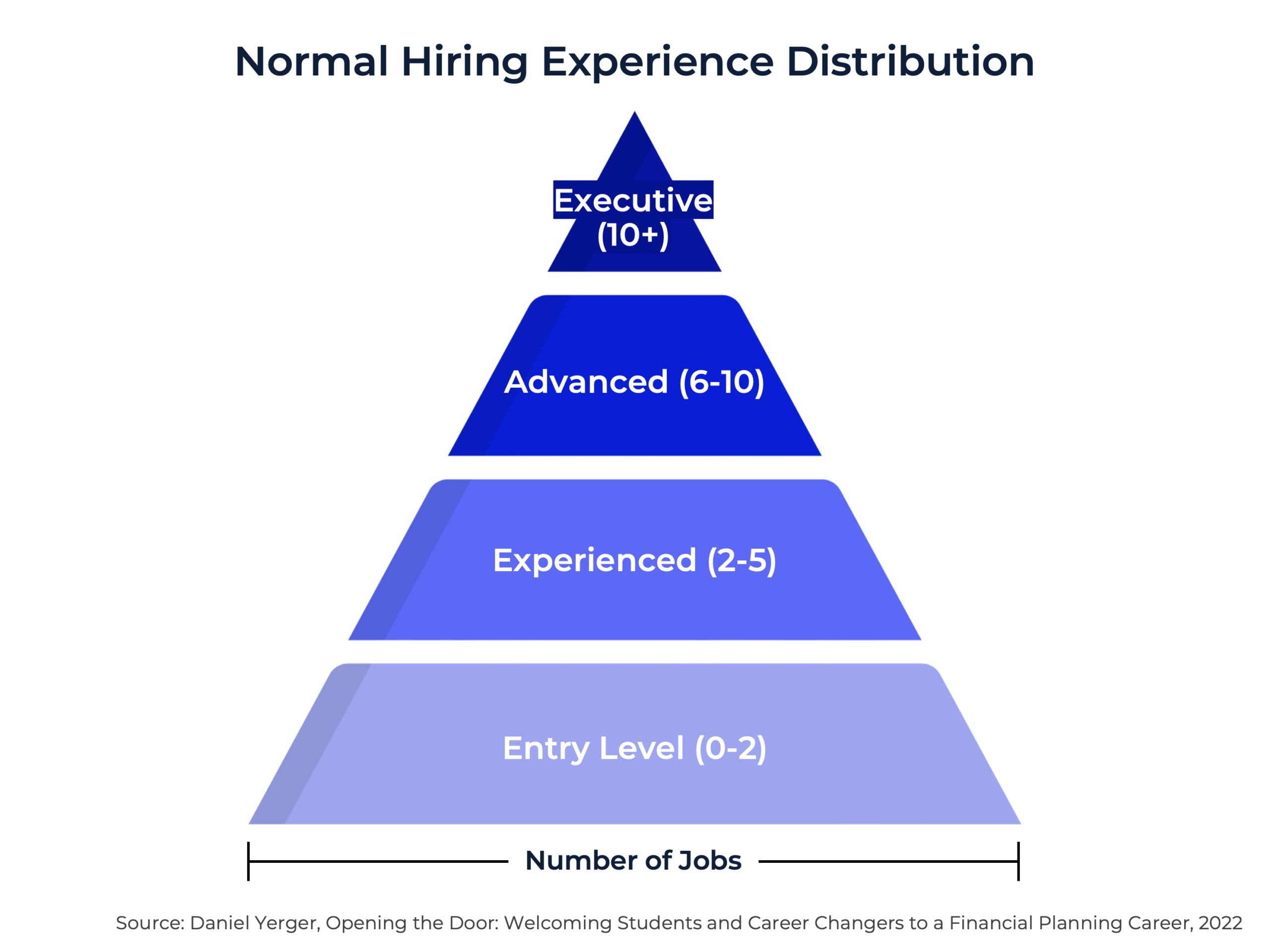
I identified the problem as being what I've come to call 'The Christmas Tree Problem'. While most industries enjoy a pyramidal talent and job distribution (with most opportunities being entry-level or low-level, and a progressively tapering pool of talent and opportunities as you move up the career ladder), financial planning had one that looked more like a Christmas Tree. In particular, we have almost no 'real' entry-level financial planning jobs, but we have an overabundance of call center, office admin, and sales jobs; the proverbial 'boxes of coal' surrounding the otherwise rare 'trunk' of high-quality financial planning opportunities.
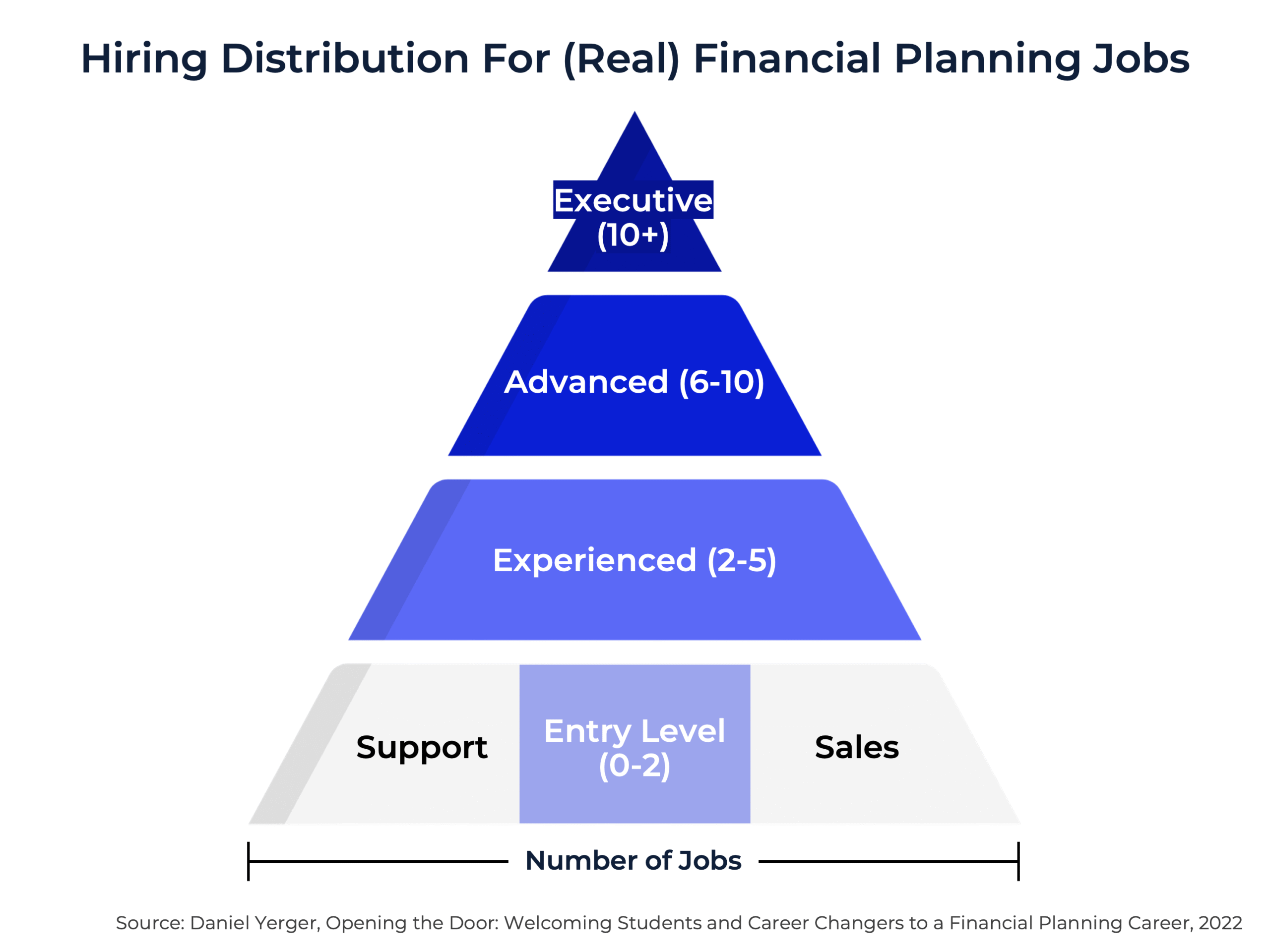
Note that despite their characterization as 'boxes of coal', I pass no judgment on sales or support roles – I highlight them as distinct from financial planning roles because both job seekers and the firms offering the positions distinguish them as such. While hundreds of jobs in call centers (on-site or remote) and a virtually limitless number of job offers were waiting for those who wanted to try their hand at eat-what-you-kill 100% commission positions, the career changers and financial planning students that I spoke with regularly weren't looking for those opportunities; instead, they wanted a job where they could do real financial planning from day one. And in turn, many of the firms offering those call center or sales opportunities often held up financial planning as 'the next step' in one's career path, where those who first toughed it out in sales or showed their merit on the support team could later get promoted into a financial planning role.
My observation of the data in the marketplace in 2022 was that there was 1 entry-level financial planning job for every 20 support jobs. And if you include the virtually limitless appetite of some firms to hire anyone who will try into a sales job, you could reasonably infer that the ratio of entry-level non-planning jobs to planning jobs was easily in the hundreds-to-one ratio. In other words, financial planning jobs were ultra-competitive opportunities that were fought for not only by people without any experience, but also by those who had been pulled into the support or sales roles first and now wanted to obtain a lateral promotion into a financial planning opportunity.
However, this narrow talent pipeline for financial planning talent exacerbates a second-order effect. The lack of entry-level financial planners building experience from zero years of experience to two to three years of experience means that the marketplace for associate financial planners (preferably more than three years of experience and their CFP Marks already obtained) is grossly undersupplied. This translates into fierce competition among firms for talent and often drives compensation levels up well above what is otherwise economically reasonable for businesses attempting to maintain a healthy 40%–50% of revenue going to direct expenses. Consequently, while firms had little appetite to train entry-level planners for various reasons, they also found themselves grossly overpaying for what little talent trickled up from the entry-level into the intermediate-experienced tiers of the financial planner career track.
Finding A Solution In Technology
Here we return to the existential risk to entry-level planners that appeared in that executive conference room. As AI-enabled technology begins to percolate through the financial planning ecosystem, financial planning firms are finding themselves with a tempting solution to the Christmas Tree Problem: Simply outsource every possible entry-level task to an AI agent. And why not? Agents don't need much mentorship or guidance; they don't take PTO days or ask for a 401(k) match, nor do they complain or sue for wrongful termination if you ever find yourself with too many of them. And in the event you have a shortage of help, you can always buy another tool or revisit your agent's guiding parameters to squeeze more use out of it. In fact, some major RIAs are reportedly spending as much as $50,000 per year per FTE-equivalent in AI agent FTE-replacements for all sorts of back office and entry-level functions of their enterprise.
The temptation to simply tech-spend away the problems posed by human capital is strong, particularly when one solution can be bought off the shelf while the other requires real time and consideration to obtain – let alone to develop into a serious contributing member of a financial planning firm. Many firms already eschewed hiring entry-level talent or even expanding their team simply because real people generate real complexity in a business, and whether it's a question of time, affordability, or effort, shiny new technology presents a popular solution. Yet, even with the advent of financial planning software that can build in minutes what once took a human being hours, there are deeper risks at play than meet the eye.
A Cure That Risks Becoming Worse Than The Disease
While there's no doubt that the work of financial planning has been greatly aided by dedicated software, rebalancing tools, tax analysis and research platforms, AI notetakers, and the myriad of fintech platforms that offer efficiency, scale, and time saved, none of these tools has actually produced a reduction in work. A trend long identified by studies such as Kitces Research on Advisor Productivity (Volume 2, 2022, and Volume 2, 2024) has shown that as financial planning firms adopt more technology, they do not buy back time or otherwise reduce their reliance on human capital. Instead, the tools allow them to do deeper work for their existing clients, which can lead to an 'arms race' of scope creep in which advisors do more and more for their clients – without necessarily adjusting the fee or the terms of the service agreement.
Consequently, as services provided to clients grow, no amount of technology resolves the mental burden placed upon the ever-more-efficient professionals and staff already within the firm. Even with the most efficient army of AI agents or tools at their disposal, financial planners still spend time meeting with and serving the very real and human clients that planners work for, and in turn, we see a decline across a myriad of metrics: planners who work solo earn less than those with support teams, planners who spend more time on administrative work are less happy than those who spend less, firms with effectively leveraged human capital are the most productive firms while those with higher tech spends show lower margins, on and on. In other words, while it's beneficial that planners are able to reduce their personal administrative burden through more advanced tools, the data thus far is fairly clear that the proliferation of technology does not necessarily generate more revenue or happier planners.
Despite the real efficiencies provided by fintech, there is no evidence that we're any closer to getting away from one singular truth: the exceptional financial planner leverages an exceptional team, not exceptional technology. That's not to say they are Luddites who still do all their work on a yellow pad and keep filing cabinets stuffed with decades of work product, but that they effectively balance the leverage technology can provide while not avoiding the real need to build human-centric systems in their human-service business of financial planning.
Pick Your Battle: A Tech Arms Race, Or A Talent Shortage
There's an old adage: "History doesn't repeat itself, but it does rhyme." The notion that technology will soon replace financial planners altogether is as old as the consumer-sized personal computer.
Early financial tools like Quicken, TurboTax, and even the ever-present Excel were predicted to disrupt the world of financial advice, particularly when paired by consumers with self-service platforms such as discount brokerages and direct-to-consumer insurance policy sales. Yet instead, the profession broadly shifted away from a focus on transactional sales towards advice – and found that demand for such services soared. This was followed by the advent of financial professional-specific tools such as rebalancing software and investment research platforms. "What need would we have for a trading team when I can trade my book with a few clicks of a mouse?" Yet demand for experienced investment managers has increased, not decreased, even with the expansion of passive index-based products causing rapid fee compression within funds. And who would hire an investment manager at all given the existence of robo-advisors, who could not only automate your portfolio – but do so at a fraction of the cost? Once again, the demand increased for human-centric services, while the robos went to serve a segment of the population that was less likely to hire a financial advisor in the first place!
In the present discourse, the particularized nouns of the question are different, but the grammar is the same: "Why would [clients/firms] hire [financial planners] when [AI] can do the work?" Simple: Because the public has always shown a strong preference for financial planners (as both recent Vanguard and Betterment studies have affirmed) and that preference is increasing, not decreasing.
However, as human capital presently carries greater costs than technology in terms of time, development, and compensation, this forces another consideration of second-order thinking: If firms are to differentiate by their human capital (rather than by commoditized technological offerings), what does that decision require of the firm?
A Tech Arms Race You Probably Can't Win
As highlighted thus far, the easier, short-term solution is to lean into technology. Adopt the AI notetaker, vet AI-enabled financial planning software, and spin up an army of agents to take away as much rote and routine busy-work as possible. Yet while technology may enable firms to stave off the need to hire more human support for a while, there are several problems embedded in this approach that eventually emerge.
First, firms relying entirely on off-the-shelf solutions will struggle to differentiate themselves. This is not to say that the solution is to run out and start vibe-coding some unique intellectual property to stand out, but to highlight that the vast majority of financial planning firms are in the professional services business, not the technology development business. Consequently, firms looking to go all-in on technology may find themselves operating more akin to a tech startup than a financial planning services business – and in doing so may ultimately remove the elements that led founders or firm leaders to launch or join the firm in the first place!
Secondly, financial planning firms are not inherently competitive in the tech landscape. While having a clear understanding of the business of financial planning might appear to be a competitive advantage, all but a few of the fastest-growing fintech-based consumer services companies of the past decade are run by industry outsiders. Robinhood was founded by two math technologists, backed by venture capital, who'd never actually worked as financial advisors or served retail clients; Betterment was founded by a consultant and a securities attorney, backed by venture capital; and even the AI-direct-to-consumer businesses closest to financial planners today (e.g., Range) were founded by venture capital investors or built up out of private-equity bundled acquisitions. In other words, the evidence suggests not that fintech platforms are best grown by financial planners, but rather by those with deep access to investor capital. Their trajectory often follows a common pattern: build a flashy but functional fintech product for consumers, spend massive amounts of investor capital on marketing to get subscribers, and then look to recapitalize by pursuing an IPO or otherwise getting acquired by a larger financial institution at a terrific multiple. A potentially profitable path, to be sure – but not one that's necessarily aligned with the client-centric fiduciary financial planner mindset.
Tech firms thrive on a high volume of scalable no-to-low-touch services. They do this by offering services at scale whereby the acquisition of any new client or customer does not materially increase the costs of the firm, resulting in a business model of low cost-per-unit-of-delivery but also low revenue-per-unit-of-delivery. As such, any tech-focused financial planning firm is likely to see a reduction in interpersonal and client touchpoints (compared to their 'traditional' counterparts), as well as a ballooning client roster as it attempts to achieve profitability through onboarding as many asynchronous and impersonal client relationships as possible.
This also means that any financial planning firm attempting to offer its services at scale must carefully balance its price and service offering; many firms have tried (and failed) to offer low-cost and low-touch services before. Charles Schwab's Intelligent Portfolios Premium, which tried to blend a low investment minimum with a low monthly fee model, is one such example – that was ultimately withdrawn in favor of Schwab's expansion into regional wealth management offices targeting clients with up to $5 million in assets with a 55 basis point fee. In other words, even one of the largest and most well-capitalized scale-efficient firms in the wealth management business had to throw in the towel on offering financial planning at scale, signaling how difficult it is to really do so while maintaining profitability.
A Talent Shortage You Can Solve
So, this leaves the talent shortage, which is not without its own challenges. Even well-established and reputable firms such as Yeske Buie (which has a dedicated financial planning residency program) have found a long-term retention rate as low as 1 in 12 hires. This means that choosing to go the route of developing new talent in the industry is not merely a one-time activity, but must be part of a systematic program that the firm engages in consistently over time, taking into account both the present and future needs of the firm. The costs of retention and attrition must also be considered.
Yet, the Christmas Tree Problem highlights that demand for intermediate and advanced talent is enormous. Firms can better position themselves to retain newly developed talent by offering a clear career path from start to finish within the firm, and also by demonstrating a clear relationship between advancement and compensation that makes attrition-for-pay less of a risk factor.
Of course, there remains a simple question at the heart of the matter: does absorbing the cost of developing new talent offset the efficiencies and potential economies of scale that technology brings?
Well, it depends, but perhaps the most obvious consideration for the time being is the very real risk of tech-cost expansion. At present, many AI-based platforms are built on the underlying technology of larger AI firms such as OpenAI and Anthropic, of which one has reported losses since inception and the other has posted just two profitable quarters. This suggests that much of the technology powering the infrastructure of the latest and greatest fintech – to which many firms turn in order to expand their scale – is presently being subsidized by investor capital, as these firms continue to compete for necessary market share before increasing the cost of tokens to more effectively break even. In other words, the relatively affordable scale of AI-enabled technology may be a temporary mirage before the real costs of such platforms kick in and drive technology costs higher. The result? Firms that opt to rely upon technology over human capital may find that they are simply operating on subsidized tokens which lend them borrowed time and scale, both resources outside of their control. It's not impossible that an AI-version of Moore's Law will drive token costs down in the future as efficiencies develop, but is that a risk financial planners are willing to bet their firms on?
How Can Entry-Level Planners Add Value In The Age Of AI?
Let it be stated plainly: You should hire and retain talent both now and in future because it is a business necessity for any financial planning practice that aims to grow, rather than simply because it might feel like doing good in the world. For that to be the case, developing talent must make business sense both in the present and the future.
The primary problem that financial planning firms will face in short order is that most of the routine 'paying your dues' tasks may be quickly evaporating. Fast-developing technology threatens to deprive (or perhaps liberate) entry-level employees from the basic but time-consuming developmental tasks that don't require much more than foundational technical knowledge, such as initial financial plan data entry or document review. Historically, because entry-level employees' time has been so much cheaper than that of senior financial planners, firms have been able to effectively leverage this economic arbitrage.
Going forward, what tasks will entry-level planner-track employees be able to perform that will add value to the firm while providing good developmental opportunities? Here are eight tasks that a developing financial planner can perform that fulfill both functions:
- AI Validation: While AI notetakers and financial planning tools are steadily improving in quality, there is still likely to be a necessary validation step between what the AI produces and what makes it into the client records and deliverables. Getting developing financial planners involved in client meetings and responsible for validating the AI-generated follow-up content by reviewing notes, editing emails, and ensuring tasks are accurately assigned and documented can be another measure that firms can leverage to save valuable senior planner time.
- License-Required Tasks: Many new financial planners obtain their Series license(s) early in their time with the firm. With these licenses newly in hand, they can be relied upon to execute simple or small-scale trades to build their competency in handling client funds, answer some client inquiries, draft detailed responses to complex specific financial planning questions for clients, and represent their firm in the community through networking or social events. Even those without a business development mandate can help the firm build its brand exposure within the community while also strengthening future business development skills by networking early in their career, when it's not a business necessity that they do so.
- Development of Educational Content: Many financial planning firms find themselves reinventing the wheel over time as they are asked to provide educational webinars or seminars, teaching existing clients about complex topics, or even providing a foundational education to clients' children or family members. Given that developing financial planners are often recent graduates or active participants in CFP Professional educational credentialing programs, they often possess an abundance of freshly validated technical information that can easily be converted into educational presentations and marketing material. This provides the firm with resources that can be used with its clients and prospects, and developing planners benefit from the mentorship that occurs as senior planners review the content for accuracy and provide feedback.
- Redeveloping Existing Training Material. Some firms will already have established training material and systems for their employees. However, as technology continues to bridge the knowledge and skills gap between new financial planners and experienced financial planners, it may be necessary to redevelop the initial onboarding and training curriculum of the firm for future team members to reflect this evolution. Particular emphasis may be given to client service, behavioral finance and financial psychology skills.
 Touchpoints Audit. In his bestselling book, "Unreasonable Hospitality," Will Guidara describes a 'touchpoint audit' that the team in his award-winning restaurant underwent. In the course of doing so, they soon realized that customers experienced as many as 120 experiential touchpoints from the time they first considered booking a reservation, to the time they left the restaurant after an incredible meal. New team members are invaluable for their insight into what the experience of the firm is from an outsider's perspective because they have not already developed a familiarity with the firm's process and systems. Thus, they can help identify the assorted touchpoints that firms can focus on enhancing to make for a better end-to-end client experience.
- Delivering Enhanced Touchpoints: Hand-in-hand with the prior point, entry-level employees can take responsibility for improving the deliverables uncovered during the touchpoints audit. For example, a firm with a geographic client niche might discover that sending more personalized referral appreciation gifts (or even hand-delivering such gifts) can elevate an otherwise routine "thank you" to one that strengthens the advisor-client relationship.
- Deep Research & Validation: While technology provides tools to more quickly develop financial plans and generate deliverable insights, there are some financial decisions that are simply so complex or otherwise so significant that AI and technology alone cannot be relied upon. These deep research topics may involve seeking precedent for specific tax or financial matters, performing due diligence on investment opportunities, or screening insurance products for "gotchas" that may become points of contention with relatively less-informed clients in the future. These tasks are time-consuming but important, and provide an opportunity for new financial planners to both deepen their technical knowledge while still providing the time-cost savings leverage they presently provide through the development of financial plans.
- Serving Tertiary Client Relationships: Many firms have a core clientele of anywhere from 30–100 primary client relationships per financial planner, along with a larger number of secondary or tertiary clients. These might be the young adult children of older and more affluent clients, the employees of a company with a SIMPLE or SEP IRA plan, or the otherwise small and de minimis accounts that the firm accumulated earlier in its growth and has since outgrown. New financial planners can gain ample experience by servicing these small accounts and client relationships, potentially supporting multi-generational planning relationships within client families – and thus 'growing up with' younger clients as they develop their own careers and eventually turn into fuller financial planning relationships.

These are only a handful of examples. The key is that work given to entry-level planners should have real stakes (which helps with cultivating an 'ownership mentality' and building confidence), but should also be developmentally appropriate and occur under the oversight of more senior planners.
From Entry-Level To Senior Financial Planner: Mapping Out A Career Path
If a new financial planner is on your team long enough, they will hopefully mature into an associate planner, a service advisor, and later a senior or lead financial planner. The judgment, skills, and discernment that senior financial planners bring to their firms comes from having had ample exposure to a vast panoply of financial planning cases, problems, and solutions (in other words, 'getting the reps in'). Firms that invest in exposing a newer financial planner to thousands of hours of their 'style' of service delivery will be rewarded with a future roster of seasoned financial planners who can implement the specific and valuable services that the firm delivers to its clientele, rather than having to redevelop and polish out the bad habits developed at other firms or otherwise filling in knowledge gaps for specialty areas not otherwise addressed by an experienced new hire's prior firms.
However, the path from brand new to advanced planner can be one that some firms have a hard time mapping out. Offered as an example, here is a sample career track for developing an entry-level planner into a senior planner over the course of a ten-year term.
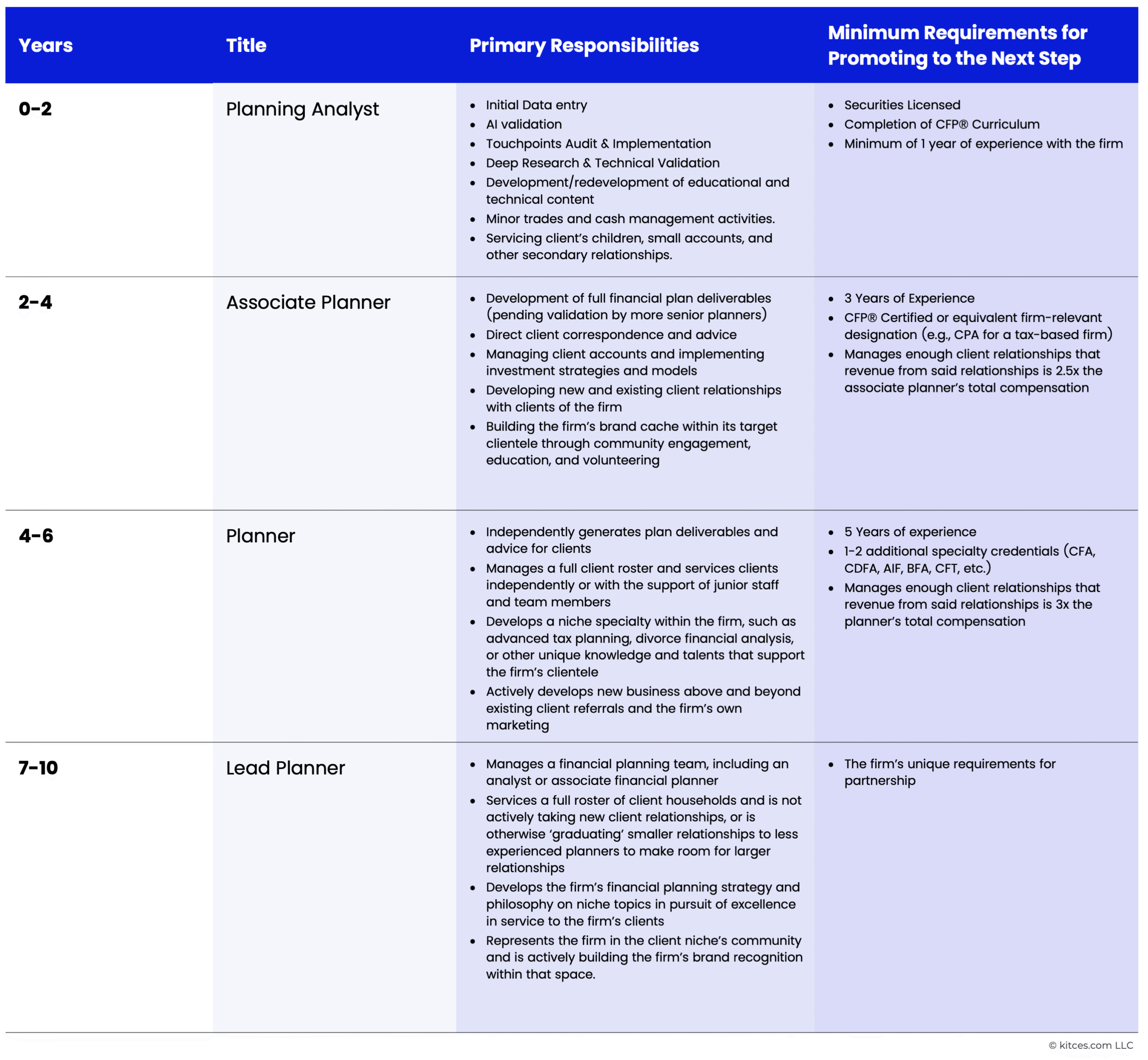
For those firms looking to develop new financial planners along a continuum like this, it is essential that new financial planners are mentored at every step of the path. Those planning analyst roles for entry level talent should emphasize the acquisition of technical knowledge and basic client communication skills. These are fostered through the routine plan development tasks that planners are already familiar with, and are complemented by data gathering from clients, presentation of educational material, and supporting the active and more complex projects of the firm.
As newer planners mature into associate and service planner roles, shifting the burden of their day-to-day work away from plan development support activities and into client advising and managing roles becomes critical. Licensed planners can build their skills by advising the lower-tier clients of the firm, family members of more substantial client relationships, or handling initial prospect screening and onboarding. It's also a valuable time for these planners to get involved in the advocacy and community work that many senior planners and partners later use in business development. By introducing these responsibilities before they are measured by their accomplishment of more tangible deliverables, these early-career planners are given an opportunity to learn in a relatively safe and low-impact environment, where mistakes or errors are unlikely to affect full client relationships or major financial action items.
Ultimately, talent development will continue to pay dividends to the firms that invest in doing it well. The firms that are best positioned to succeed in an increasingly competitive landscape will be those who successfully combine the best of technology and human capital, to unleash the maximum potential of both!