Executive Summary
One of the most pressing questions for individuals nearing retirement is how much they will be able to withdraw from their portfolio each year without exhausting their retirement savings. But the problem is that almost all the variables involved in making that calculation, from market returns to life expectancy to the client's spending needs, are uncertain. This conundrum has spawned an entire field of research into Safe Withdrawal Rates (SWRs), seeking methods to thread the needle between over- and under-withdrawing the portfolio that are also flexible enough to adapt to clients' life circumstances – all while being simple enough to explain and apply in practice.
Several types of withdrawal strategies have arisen out of this research, each with its own benefits and drawbacks. Some 'fixed' SWR strategies, like the "4% Rule" developed by Bill Bengen, are relatively simple to apply – but because they're premised on having the client's portfolio survive the worst-case market return scenario, the vast majority of the time they'll result in the client having significant unspent (and unenjoyed) portfolio assets at the end of their lives. Other 'dynamic' withdrawal strategies, like the Guyton-Klinger guardrail method, can more precisely match portfolio withdrawals to market conditions (and often allow for higher total withdrawals), but the withdrawals under these strategies can vary significantly from year to year, leading to uncertainty and anxiety for some clients who use them.
One strategy that can serve as a happy medium between fixed and dynamic withdrawals borrows from the IRS's method of calculating Required Minimum Distributions (RMDs) from retirement accounts. Under the RMD method, the client's total portfolio value as of the end of the previous year is divided by a factor based on the client's remaining life expectancy (provided by IRS tables for RMD calculations). As a result, each year the client withdraws only a certain percentage of their portfolio, preventing over-withdrawals – but because the withdrawal percentage increases each year incrementally, there's a lower likelihood of leaving significant funds behind. And because the IRS publishes RMD tables for all ages (since, for example, a child who inherits an IRA may be subject to RMDs), the RMD method can be applied regardless of when the client decides to retire.
Furthermore, the RMD approach can be modified to reduce the volatility of annual withdrawals (e.g., if market movements cause a temporary drop or spike in the portfolio's value at year-end). Under this modified approach, the annual withdrawal is calculated based not just on the previous year-end portfolio balance, but on the average of the past three years. This helps smooth out year-to-year variations in annual withdrawals and can help keep clients from focusing too much on market conditions that could affect their 'paycheck' the next year.
The key point is that because the IRS has already done the work of calculating withdrawal tables meant to gradually deplete a portfolio throughout retirement, the RMD method presents a relatively easy-to-understand strategy that doesn't require special software or decision trees to implement. And with a few simple modifications – e.g., using the three-year average portfolio value to reduce withdrawal volatility and carving out specific amounts to set aside for legacy and other goals – advisors can help their clients customize the RMD method to meet their own needs and ultimately reduce the uncertainty around drawing down their portfolio in retirement!

The question of how much a person can withdraw from their portfolio each year in retirement without fully depleting over their lifetime has been widely studied.
Our purpose here is to describe a safe withdrawal rate (SWR) approach that addresses some of the shortcomings of existing techniques.
A desirable SWR system should:
- Be reasonably easy to apply
- Be safe – i.e., always leave money in the portfolio and last the full extent of an individual's lifespan
- Have acceptable levels of yearly variations in withdrawal amounts
- Gradually deplete the portfolio (but not to zero) over a retirement lifespan
- Be applicable at any retirement age
- Be flexible enough to accommodate either conservative or robust withdrawals, depending on the needs and circumstances of the retiree
That's a tall order! We're faced with an impossible task: predicting a client's lifespan, anticipating the fluctuations of markets and inflation rates, and planning for unknown future changes in our clients' needs. Yet we seek to improve on conventional approaches to this challenge.
Current SWR Systems
Considerable research and discussion have been devoted to identifying an effective SWR. Among them are Bengen's 4% rule, Guyton-Klinger's guardrails, Kitces' ratcheting SWR, Morningstar's research on SWRs, and the RMD method.
These strategies generally fall into two categories:
FIXED: real (inflation-adjusted) SWRs, such as Bengen's, in which a specific percent of the portfolio is withdrawn in the first year of retirement, and in each following year, last year's withdrawal amount – adjusted for inflation – is withdrawn. This yields a consistent annual real withdrawal.
DYNAMIC: Withdraw a calculated amount, which varies from year to year, to prevent too rapid a depletion of the portfolio, as well as allowing higher withdrawals when the portfolio value increases. Examples include the guardrail, RMD, and other proprietary methods, including commercially available software.
There are advantages and disadvantages to each approach. Fixed type withdrawals, such as the 4% rule, are generally safe over the long term, but can leave a considerable portfolio size at the end of the individual's lifetime; funds that could have been used and enjoyed.
Dynamic strategies can allow larger withdrawals but vary from year to year based on market movements (and their subsequent impact on portfolio size). That volatility may not be acceptable to some clients.
The RMD Approach
To better understand the features of the RMD SWR method, let's examine it in more detail.
Legally required RMD withdrawals from IRAs and qualified plans are based on tables provided in IRS Publication 590b.
To calculate an individual's RMD, the total value of their account as of December 31st of the preceding year is divided by the corresponding divisor in the IRS table based on the individual's age. E.g., if the IRA value was $100,000 on December 31st of 2024 and the person's age is 73, Table III indicates a divisor of 26.5; the required RMD is $ 100,000 ÷ 26.5 = $3,774.
For an RMD-style retirement withdrawal, that same divisor is applied to the person's entire portfolio value. For example, if the portfolio is $1,000,000, the RMD SWR, using the same divisor of 26.5, is $37,736. The retirement withdrawals we describe are voluntary, unlike required annual RMDs from IRAs.
The RMD SWR is an effective method because the portfolio is never fully depleted – only a percentage of the portfolio is withdrawn each year – but is designed to draw down the portfolio over the retirement span. It has been shown to provide among the highest lifetime distributions of the withdrawal methods now in use .
This system also provides a degree of safety, as it tends to help prevent sequence-of-return risk. If investment returns are low or negative in the first several years of retirement, the portfolio – which is already being depleted by withdrawals – runs the risk of being reduced to a point of no recovery, even when the markets themselves recover. In contrast to a fixed withdrawal rate, the divisors provided by the RMD tables offer lower initial withdrawal percentages, which increase each year. These lower initial withdrawals help prevent over-withdrawals from the portfolio when market losses simultaneously reduce its value.
Note that this technique does not apply an inflation adjustment, as is common in some 'fixed' approaches. However, the percentage of the portfolio to be withdrawn increases each year, as noted above (see Fig. 3). When paired with established principles of portfolio construction, this method gives a client's funds the best prospect of lasting throughout their lifetime.
Modified RMD: Utilizing Rolling Three-Year Averages To Reduce Volatility
The annual withdrawal using the RMD and other 'flexible' withdrawal methods is directly tethered to recent market returns. This leads to variability in withdrawals due to market fluctuations. The resulting cash flow volatility is undesirable because the yearly 'paycheck' can vary considerably, making planning for upcoming expenditures unpredictable.
This volatility has an intangible but significant consequence: a retiree will reasonably tend to associate recent negative market news with an anticipated reduction in their annual paycheck! Advisors would likely not wish their clients to be anxiously tracking the markets because of their direct effect on next year's withdrawal. A system to reduce withdrawal variability based on the RMD SWR would enhance the utility of this approach.
In our modified RMD approach, the average of the last three years of portfolio values is used to calculate the withdrawal, rather than the value on a single (arbitrary) day. The total portfolio value at a certain point, say December 31st, of each of the last three years is added together and divided by 3. This provides a rolling three-year (RTY) average value. This average value is divided by the appropriate divisor in the RMD table, which yields the following year's withdrawal amount.
Example 1: Ana, age 65 in 2025, is ready to make her first annual retirement withdrawal. Her portfolio values as of 12/31 of the past three years are as follows:
2024: $1,000,000
2023: $900,901
2022: $866,251
The rolling three-year average is $922,384. The divisor in the RMD Table I for age 65 is 22.9.
$922,384 ÷ 22.9 =$40,279, the withdrawal for 2025.
A rolling three-year average represents the value over a period, rather than a single point in time. Imagine if the market experienced a steep decline in the few months before the date selected to calculate the RMD-style withdrawal. The amount to be withdrawn would be significantly reduced, resulting in a lower paycheck for an entire year, even if the market had been higher for many months before and may soon rebound. The rolling average 'smooths out' the volatility of the figure used to calculate the withdrawal; it moderates abrupt changes in both directions.
Fig. 1 shows the results of using both the 'standard' RMD withdrawal method (based on the portfolio value on one selected day) and our rolling three-year average modification. RMD Table I provides the divisors in both methods. In this illustration, Bob, age 62, retires in 1996 with a portfolio of $1,173,045. We used historical investment results for a 60/40 portfolio (annually rebalanced), with 60% in equities (S&P 500) and 40% in U.S. bond aggregate. All figures are in nominal dollars.
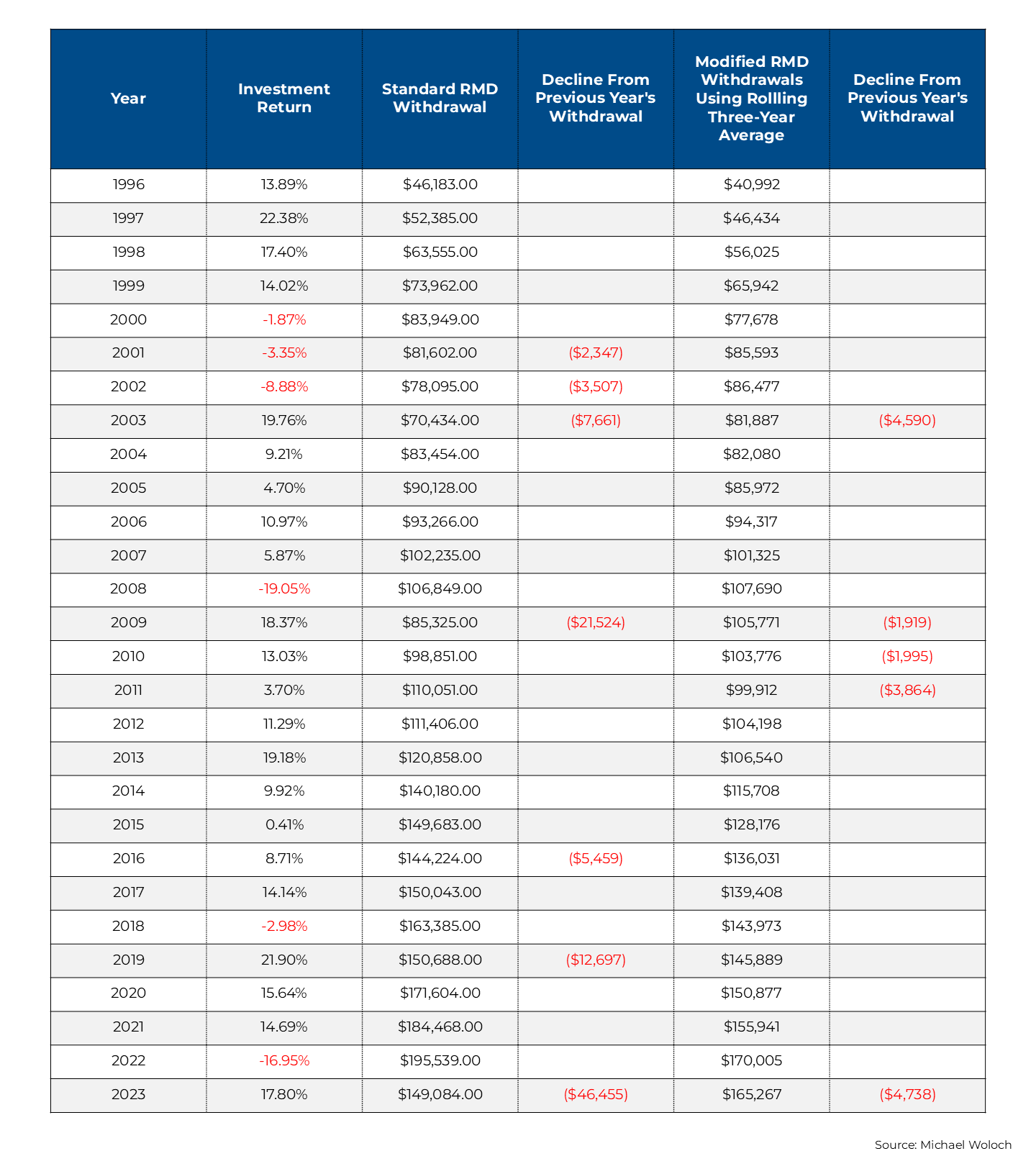
Fig. 1
Some observations from Fig. 1:
- In market downturns, the 'standard RMD' withdrawals tend to be reduced significantly more than with the modified method using the rolling three-year (RTY) average.
- In 2000–2002 (the 'dot-com crash') the RMD withdrawal dropped by $13,515 over 3 years; with RTY, the decline was $4,590.
- During the great financial crisis of 2008–2010, the RMD withdrawal declined by $21,524 in one year, compared with $7,778 over 3 years with RTY.
- During the 2015-2016 selloff, RMD withdrawals declined by $5,459, while RTY withdrawals remained unchanged.
- In 2019, the RMD withdrawal dropped by $12,697, with no decline with RTY.
- In 2023, following the COVID-19 decline, the RMD withdrawal declined by $46,455, and RTY by only $4,738. (Note that in an individual's later years, the reductions are more exaggerated during market declines because the tables call for significantly larger withdrawal percentages at that stage).
As we know from the seminal work of Kahneman and Tversky in behavioral finance, the pain of financial loss is significantly greater than the pleasure of gain. In years of market declines, advisors using this modified RMD approach may want to point out to clients that although the markets declined in the past year, their paycheck remained stable, or declined much less than the markets!
Using the modified RMD method doesn't significantly change the total amount withdrawn over time; it only changes the volatility of those withdrawals.
Given the relative stability of withdrawals in this approach, clients should not be concerned that recent market declines will significantly affect their annual withdrawal. Using the rolling three-year average in this manner should similarly help reduce volatility when using the 'guardrail' and other 'flexible' SWR approaches.
Accurate SWRs At Any Age
Traditionally, SWR strategies are based on a retirement age of 65. But what is the appropriate SWR for those who retire 5, 10, or more years before or after that age? An SWR that was calculated for age 65 but applied to age 75 would likely be far too conservative, and the reverse is true for an early retiree. The modified RMD strategy described here provides guidance on an appropriate SWR at any age.
The three tables we discuss are provided by the IRS to calculate legally required RMD distributions from IRAs and qualified plans. Here, we are using them for an entirely different purpose – as a tool that provides the numbers that we will use to calculate SWRs. The tables contain the numbers, called divisors (identified as "Life Expectancy" or "Distribution Period"), that can be used to determine withdrawals. These withdrawals will gradually deplete the portfolio over time.
Two of the three tables can be used by a retiree at any age. Table III begins at age 72. Using these tables thoughtfully will allow us to calculate an appropriate SWR each year, regardless of an individual's retirement age. As we will see, they also allow advisors to customize a withdrawal rate based on individual client needs and preferences.
Looking Under The Hood Of The RMD Tables
To use the IRS tables to calculate the appropriate SWR, we must first understand what the tables are communicating. The divisors in each table represent the average remaining lifespan for an individual of any age. E.g., a divisor of 20 corresponds to the number of years statistically considered to remain in that individual's expected life. Therefore, the withdrawal would be 1/20 of the IRA – or in our case – the portfolio. Fig. 2 shows a comparison of the divisors among the three tables, with the percent withdrawal indicated by each divisor.
Since Table I is intended by the IRS for an individual with an inherited IRA, the divisors are designed to (mostly) deplete that IRA by the beneficiary's late 80s (for a retiree age 65). This is what makes withdrawals using this table more 'robust' than the other two tables, and the advisor should be aware of that time horizon. Many studies have shown that both wealthy and educated individuals generally live significantly longer than average.
Table III is intended for individuals who are unmarried or married to a spouse up to 10 years younger. In the case of a couple with a younger spouse, the funds need to last longer. As a result, the divisors create distribution amounts that (mostly) deplete the funds in the retiree's late nineties (for a retiree of 65), providing for a considerably more conservative yearly distribution than Table I.
Table II is similar to Table III but is designed for situations in which the spouse is more than 10 years younger than the retiree. Therefore, the divisors in Table II are somewhat larger than in Table III (resulting in a lower withdrawal). Table II (Fig. 6) applies if the retiree has a spouse or partner who is 11 years younger. This table should also be used for single individuals prior to age 72 who wish to have conservative withdrawals. E.g., if the (single) retiree is age 70, the (phantom) 'spouse' age would be 59. The two ages are located along the top row and left column of the table, and the number where they intersect gives us our divisor – in this case, 29.9. This is the number by which the portfolio's rolling three-year average is divided to yield the actual withdrawal. We will soon show specific examples.
The annual distributions in Table II will be smaller than those in Table III, making Table II slightly more conservative. Note that this table can also be used to provide a distribution amount for (actual) couples or partners with age differences greater than 10 years, with the SWR decreasing as the separation in years increases. The larger the age discrepancy, the lower (more conservative) the withdrawals will be, since the portfolio will likely need to last longer.
To illustrate the different results yielded by the three tables, Fig. 2 assumes a portfolio of 1,000,000; age 73; (and for Table II – a 'spouse' of age 62). The percent of the portfolio withdrawn is also indicated.
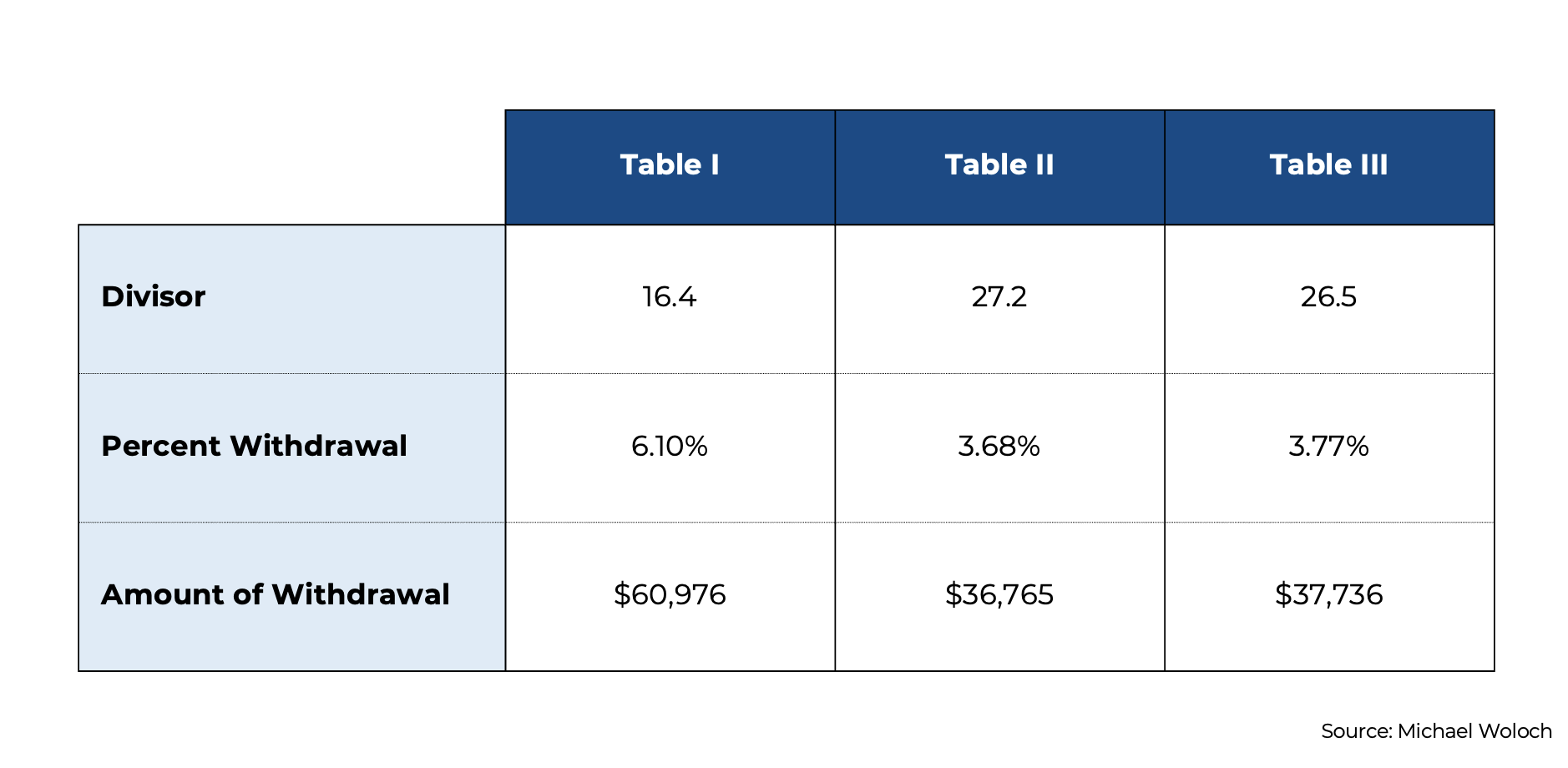
Fig. 2
Note the substantially higher withdrawal using Table I (for the same age).
Table II withdrawals are slightly more conservative (smaller) than Table III (assuming an eleven-year age difference).
Fig. 3 shows the approximate withdrawal percentage by age, referencing the three tables. This gives a sense of how this system compares with other SWR approaches. As expected, earlier retirement results in a lower percentage withdrawal, while later-in-life retirement results in a higher one. The withdrawal percentage increases each year throughout retirement. (For Table II, assume an eleven-year age difference, as discussed above).
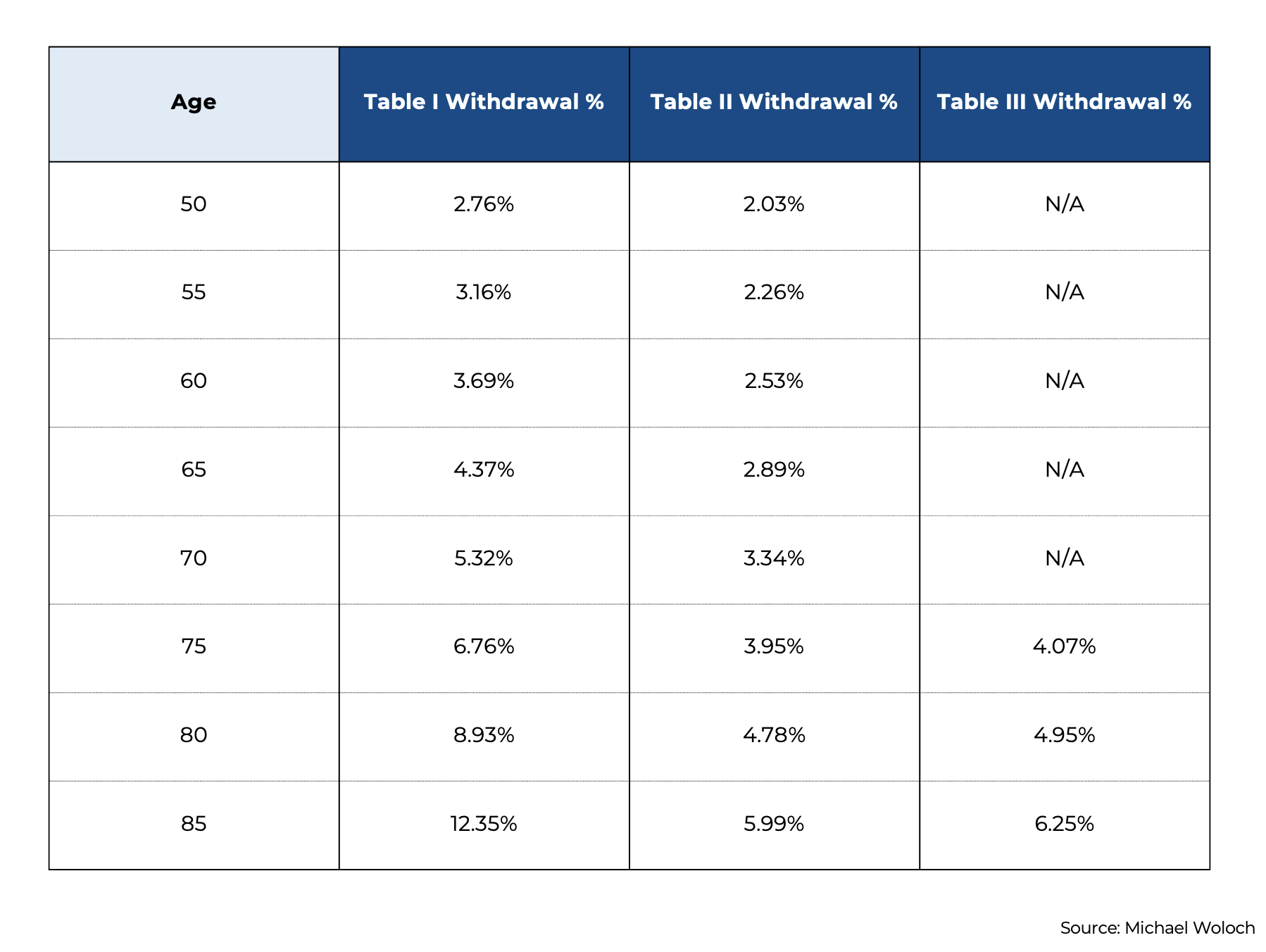
Fig. 3
To summarize the use of these tables in our modified RMD method:
- Table I: Retirees of any age can use this for robust (larger) yearly withdrawals, keeping in mind that the portfolio will nearly deplete in the individual's late 80's – for a retiree age 65.
- Table II: Can be used at any age. Provides the most conservative (smaller) yearly withdrawals. A portfolio (for a retiree aged 65) is nearly depleted in their late 90's.
- Table III: Can be used beginning at age 72. Conservative withdrawals. Portfolio depletion in their late 90's (for a retiree aged 72).
Sources of income outside the portfolio will affect the decision on the SWR method to select. Those sources include social security, part-time work, rental income, annuities, inheritance, trust fund income, royalties, and deferred compensation. If the client's revenue is substantial, the advisor may consider selecting a table that provides for lower/conservative SWRs. This would allow the portfolio to grow, and more funds will likely be available in the future if those income streams diminish.
Case Study: Early Retirement, Larger Withdrawals
Bill and Melinda, ages 55 and 53, have an investment portfolio with a rolling three-year average value of $3,000,000. As relatively early retirees, they want to travel and enjoy life to the fullest. After detailed discussions with her clients, Lori, their advisor, understands they anticipate an average life expectancy and would like robust withdrawals that will last through their anticipated retirement years. Lori selects Table I because it will provide relatively larger withdrawals that will last through her clients' life expectancy.
In Table I (see Fig. 4), age 55 corresponds to a divisor (life expectancy) of 31.6: $3,000,000 ÷ 31.6= $94,937 for her clients' first year withdrawal.
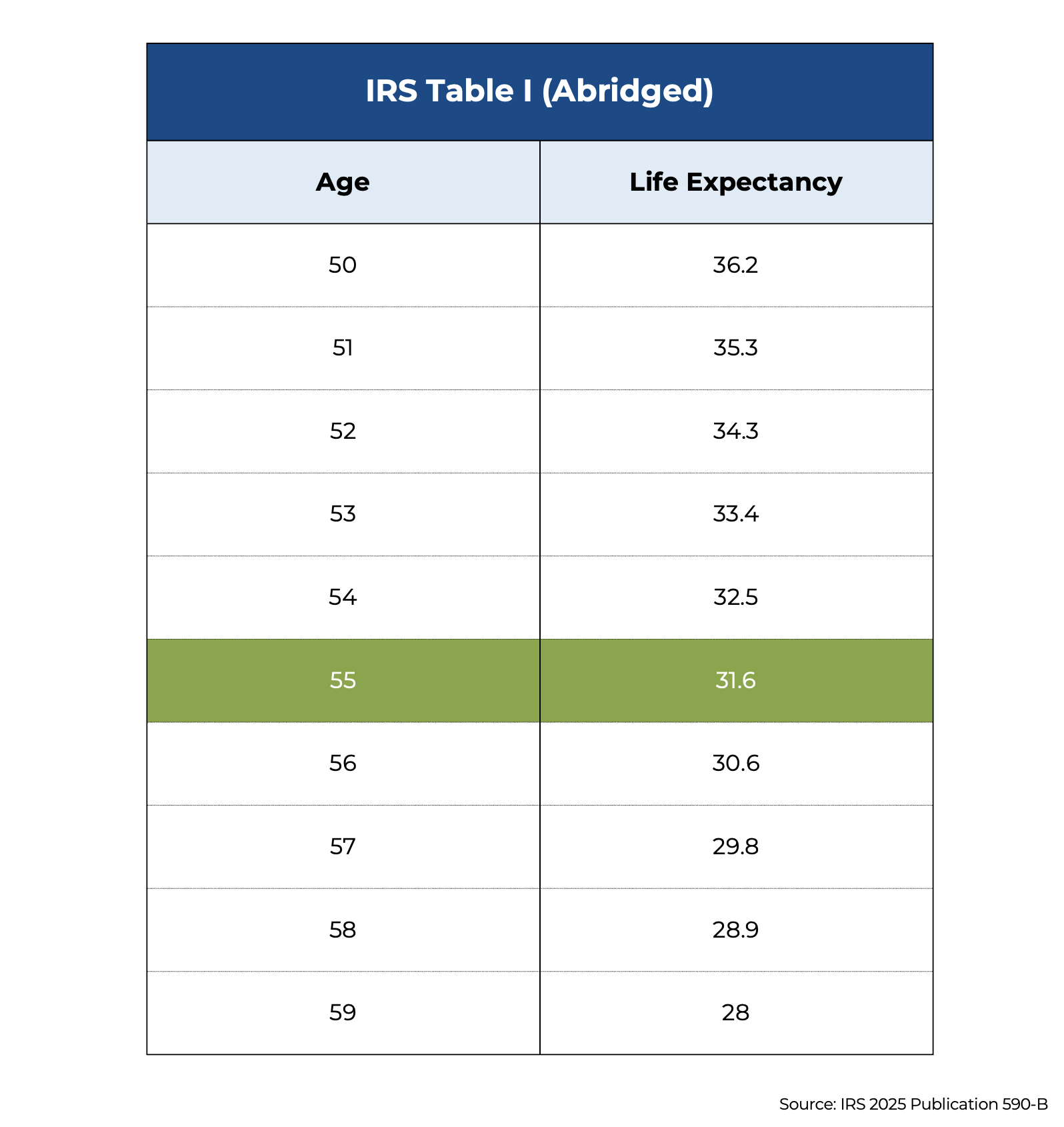
Fig.4
Case Study: Later Retirement; More Conservative Withdrawals
Randi and Glenn, ages 73 and 64, are in excellent health and want to fund their retirement into their late 90s. Steven, their financial planner, selects Table III (Fig. 5), which assumes a partner who is less than 10 years younger, to meet his clients' preferences. He calculates their portfolio rolling three-year average to be $2,000,000. Using the divisor for age 73, which is 26.5, he calculates their first-year withdrawal:
$2,000,000 ÷ 26.5 = $75,472.
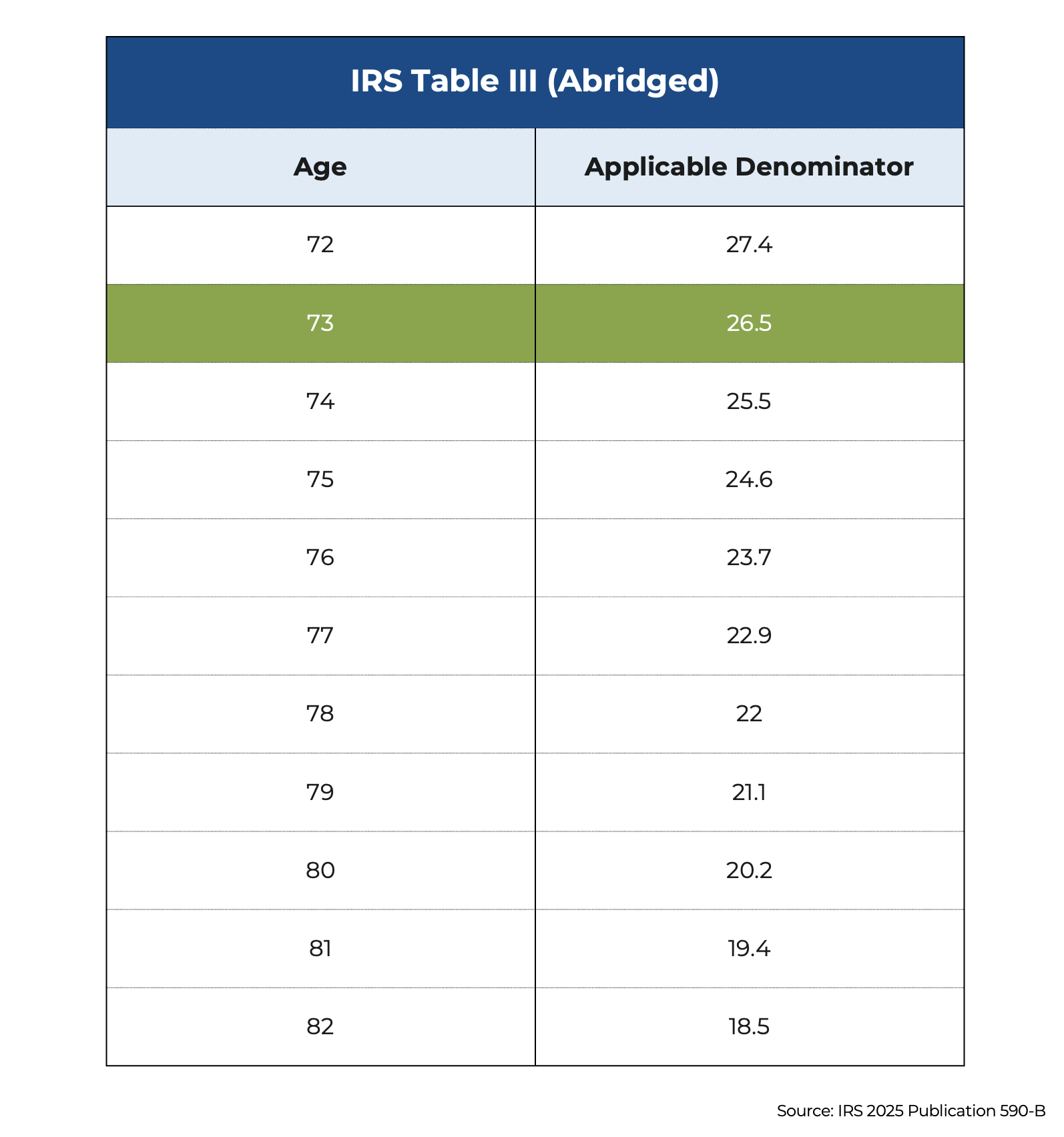
Fig. 5
Case study: Single; Conservative Withdrawals
Debbie, age 68, is single and about to retire. The rolling 3-year average of her portfolio is currently $3,000,000. She wants to plan for a long life, which calls for a more conservative approach to withdrawals.
Table I would produce withdrawals that would be too aggressive; Table III does not include her age, so Table II will be used. Although the table was designed for couples with more than a 10-year age difference to produce conservative withdrawals, Debbie should use this table:
On the left column of Table II (see Fig.6) is her age: 68. In the top row, she uses age 57 (11 years younger) for a 'phantom' partner. The left column and top row intersect at the divisor (life expectancy) of 31.8
Since her portfolio's rolling 3-year average is $3,000,000:
$3,000,000 ÷ 31.8 = $94,340, her first withdrawal.
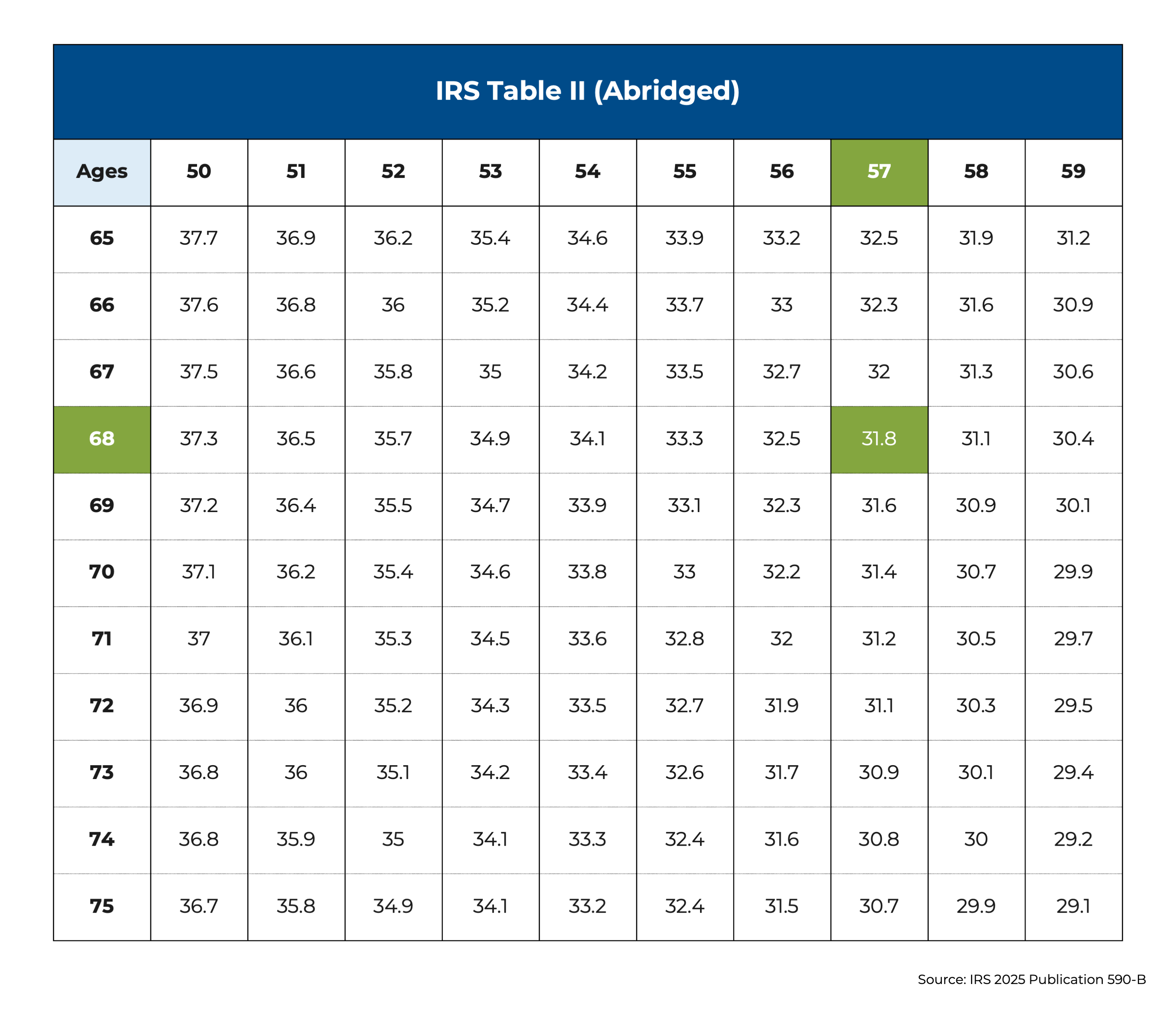
Fig. 6
Legacy Giving And Special Goals: Carve-Outs
While these methods can help identify an appropriate SWR in a vacuum, in reality, there are other concerns that could affect the choice of a SWR method. One is that those who wish to leave funds to beneficiaries may select a conservative SWR, which is more likely to result in substantial funds remaining after a person's lifetime. This is more prevalent with the 'fixed' SWR methods.
There have been opinions expressed that lifetime giving may be a better choice over delaying that gift until after their lifetime, given that the donor gets the satisfaction of seeing those funds put to the desired use, and the recipient will likely receive that gift when they are most needed, rather than at what could be a more advanced age. Nevertheless, those who choose to leave a financial legacy have options.
One way to fulfill this decision without resorting to choosing a possibly too-conservative withdrawal rate is to establish the amount of that legacy, segregate that amount from the retirement portfolio, and invest it separately (and possibly differently). In other words, create a carve-out. This way, the donor proactively decides what to set aside to give, rather than being conservative with their portfolio withdrawals to "leave more behind".
Another common issue is that some new retirees want to achieve specific goals, often within the first few years of retirement. Among these is extensive (and expensive) travel. What if the cost of these plans exceeds the anticipated withdrawal? This is another case where a carve-out could be helpful. The amount needed to fulfill these goals is set aside from the portfolio (and invested as cash/near cash).
Before carving out a certain amount, it would be beneficial to 'stress-test' the remaining portfolio. The first-year anticipated withdrawal is estimated and assessed against the annual spending needs. If there were a shortfall, the amount of any carve-out could then be reduced accordingly, as in this example:
Case Study: Legacy Carve-Out
Jon, a successful entrepreneur, is 48, has a portfolio with a rolling three-year average of $8,000,000, and is now ready to retire. He is comfortable with a portfolio that will last an average lifespan. He would like to withdraw $196,000 a year in the first year of retirement, and his financial planner, Teri, designed an appropriate investment portfolio.
He also told Teri that he wants to leave a $1,000,000 legacy to his favorite charity. Teri uses Table I to determine that his first-year withdrawal from what is now a $7,000,000 portfolio would be $183,727 – below his desired amount. She then suggests that, to withdraw his desired amount, the 'legacy carve-out' amount could be changed to $500,000, or Jon can accept the lower withdrawal amount to preserve his legacy intentions.
Summing Up
We've described modifications to the RMD SWR approach, designed to introduce improvements and overcome some of the existing limitations:
- Using the rolling three-year portfolio average to reduce volatility in year-to-year withdrawals.
- Providing the ability for retirees of any age to find an appropriate SWR
- Allowing the advisor to personalize the individual's SWR – from 'robust' to conservative, based on an individual's time horizon, risk tolerance, and other personal factors.
- Using 'carve-outs' to set aside funds for legacy giving and/or special goals.
Ultimately, any withdrawal approach requires monitoring and reassessment over time. Our lives and needs evolve, and so do markets, inflation, and the economy. Assumptions regarding individual longevity can also change over time. As a result, the rate of spending and withdrawal amounts may well need to be adjusted to accommodate these changes, and advisors and individuals should reassess these factors at regular intervals.