Executive Summary
When clients search for a new advisor, they often look for signals of competence and trust. In the world of AI-powered tools and search engines, clients can easily find nearly-endless options for advisors, but determining whom to trust – even enough to schedule an introductory call – is a tall order. Many clients opt to ask friends for a recommendation, but nearly everyone looks to the general public as well – that is to say, to client reviews. And since the 'modernized' SEC Marketing Rule became effective in 2021, advisors can now use testimonials from current clients and other related parties, provided that the advisor gives appropriate disclosures. That said, implementing reviews as an advisory firm can add an extra layer of complexity and compliance work, leaving many advisors to wonder if the proverbial 'juice' is worth the squeeze.
In this article, Whit Lanier, co-founder of Amplify Reviews (an RIA review-verification and publishing platform), and Kent Keister, founder of Reliant Compliance (an RIA compliance firm), discuss how advisors can implement client reviews in a sustainable, balanced manner. According to Amplify Reviews' own 2026 State of Testimonial Marketing report, 79% of top RIAs still aren't actively using testimonials or online reviews in their marketing, in part due to compliance complications or concerns. Yet at the same time, prospective clients increasingly rely on online reviews and other tools to evaluate their providers (and Google gives an outright search boost to highly-rated businesses). The challenge, then, is finding an approach that maximizes the marketing benefits of online reviews while remaining compliant with SEC requirements.
For most firms, receiving reviews is generally not a compliance issue; the greater challenge is soliciting reviews while remaining in compliance. For example, advisors must have a reasonable basis to demonstrate that third-party rating systems allow favorable and unfavorable feedback equally, without being designed to produce a predetermined result. An advisory firm must ask all clients for feedback, not just satisfied ones, and document the process by which they opted to ask for these reviews.
Of course, advisors are also balancing clients' own preferences and practicality. For example, while positive Google Reviews can strengthen a firm's visibility, many clients may not be comfortable publicly admitting that they have a financial advisor (or an advisor with a high minimum, for example) – and it isn't possible to post an anonymous Google review. As such, firm owners may solicit anonymous testimonials through third-party software, which can be displayed on their site. Through this approach, advisors sacrifice some Google search return visibility, but may gain an increased number of client reviews.
In short, relying exclusively on either Google or a third-party channel inevitably means sacrificing some combination of marketing reach, client participation, and compliance flexibility. As such, advisors may benefit from a two-pronged strategy that combines both Google Reviews and anonymous testimonials, allowing advisors to yield the benefits of both channels while maintaining flexibility to accommodate client preferences. Each firm's exact approach will vary based on client temperament as well as the team's own capacity. For example, one firm may send clients a single review request offering a choice between leaving a Google review and submitting a testimonial for the firm's website. A different firm can first collect website testimonials, then invite all respondents to post on Google (regardless of their rating). A third firm may opt to conduct several campaigns several months apart. While the exact approach may vary, the key is to have a transparent, consistent, and unbiased process.
Ultimately, the key point is that building a strong online reputation doesn't require advisors to choose between maximizing marketing impact and maintaining compliance comfort, especially for advisors that can combine the broad visibility of Google reviews with more anonymized third-party options. All of this can contribute to helping prospective clients gain a fuller picture of whom to hire – and increase their trust in the advisor, all before they even reach out!
 |
And if you want to go deeper on this topic, hear directly from the author on the Financial Advisor Technician podcast. |
Authors:


Listen To The Financial Advisor Technician Podcast On This Topic




Episode Shownotes And Transcript
Click to expand transcript and show notes↓↓
Title: Creating A (Compliant) Testimonial And Google Review Strategy
Shownotes:
- Whit Lanier: LinkedIn | Amplify Reviews
- Kent Keister: LinkedIn | Reliant Compliance
Full Transcript:
Adam: Hello, and welcome back to the "Financial Advisor Technician" podcast. I'm your host, Adam Van Deusen. On today's episode, we're going to discuss how advisors can effectively gather and publish online reviews without running afoul of compliance concerns. Given that individuals use online reviews to research everything from hotels to shampoos, it makes sense that prospective clients might want to look up a prospective advisor to find out what current clients have to say about them, and that an advisor would want to tout receiving strong ratings. However, advisors were previously barred from soliciting testimonials or marketing third-party reviews under the auspices that it could constitute misleading advertising. Nonetheless, the adoption of the SEC's recent marketing rule opened new doors for SEC-regulated investment advisers by providing clarity and guidance on the compliant use of testimonials, endorsements, and third-party ratings.
So to help us dig deeper into this topic, I'm joined today by Whit Lanier, the CEO of Amplify Reviews, and Kent Keister, the founder of Reliant Compliance, to discuss why online reviews can be helpful for financial advisors, how advisors can stay compliant when collecting reviews, and strategies advisors can use to generate more reviews in more places and attract more prospects in the process. So welcome, Whit and Kent, to the "Financial Advisor Technician" podcast.
Whit: Thank you, Adam.
Kent: Yes, thanks for having us.
Why Online Reviews Can Be Valuable For Financial Advisors [1:40]
Adam: Terrific. So to start, Whit, perhaps you could spend just a minute or two explaining, based on your experience, why online reviews can be particularly helpful for financial advisors.
Whit: You already acknowledged the fact that the SEC updated the marketing rule, and that deadline was back in November of '22. And the word that often gets used is it was the modernization of the marketing rule. The easiest thing for most of us as consumers to understand is that we rely on online reviews to make just about any sort of purchasing decision or major decision that we have. And the reasons that we like them elsewhere in our life are really the same reasons that it would be great for an advisor. The broad category in terms that you hear, obviously, are social proof, which is a powerful influence for us as humans.
But specifically in the context of advisors, we look at some data. And one of the things is you will hear from a number of different studies that trust is either the number one criterion when selecting an advisor, or one of the top ones, and that outranks things like credentials or historical performance. So I think that's really important for people to keep in mind. As they're selecting an advisor, most consumers are not strictly looking for the absolute best performance, but rather someone who they feel like they can connect with and they can trust. But if you pair that stat with the other one about consumers in general, 91% of consumers say that they trust online reviews more than any messaging a brand can provide about themselves. And so if I'm a prospective client trying to pick a financial advisor and figure out how I can know whether or not I can trust them, arguably online reviews are the single most effective thing to convey that.
The Differences Between Testimonials, Endorsements, And Third-Party Ratings [3:31]
Adam: I think that's helpful background. Now, as we dig in, I think, to some of the compliance issues here, I think it might be helpful to do maybe some quick definitions. We've been talking about online reviews so far, but I know that can sort of break down into different types. I think you have testimonials, endorsements, third-party ratings. Perhaps you could give us some quick definitions of these just to help our listeners understand what you're saying for each.
Whit: So testimonials and endorsements are very clearly defined in the marketing rule. And really what distinguishes those two buckets is the relationship between the person providing an opinion and the advisor. Testimonials are very narrowly defined as basically an opinion shared by a current client about an advisor. And then endorsements are anyone other than a current client who is sharing an opinion about an advisor. Now, there's one more hurdle for those two terms to be accurate and relevant. And that is that the advisor must use that opinion in what the rule defines as an advertisement. So if you take a quote from a current client and put it forth in what the regulation defines as an advertisement, that's a testimonial. If you take one from, say, a center of influence or a family member or a former client and put that forth in an advertisement, that's an endorsement. I actually am going to kick it over to Kent for third-party ratings, which is the third term we're defining.
Kent: I always like to preface a lot of this. And I think any of the lawyers that are listening will appreciate this. A lot of the definitions start with, "It depends," because there's so much ambiguity around some of these things, even if they're well-defined. It's about the applicability. And I think that's why we're both excited to write a piece like this because advisors have a lot of questions around this, and they're all very good questions because there is so much ambiguity. So Whit was correct on the testimonial part and the applicability of those.
Third-party ratings are a little trickier on the applicability, but essentially they have defined it as any other type of rating system, which also falls under awards. But anyone that's in the business of giving ratings can give ratings or feedback about the advisors in the form of reviews or ratings. Again, they have to be in the business of that. And that's kind of their primary focus. And they're kind of assumed to already be an advertisement because a lot of those things are very public or can be adopted in advertising to be public.
So the easiest example we can say is Google reviews. And that's what we focus a lot on because that's something a lot of advisors have been clamoring to use well before they were allowed to in this current modernization. But then also there's a lot of awards that fall under this as well. We don't go into that as much, but that's where, again, advisors could use them sparingly in certain parts, so it just kind of depended. But those got lumped together kind of in this one. But, yeah, so what's funny is all three can kind of overlap. And we try to address that in the article as well, that you can have a third-party rating like a Google review. Someone can leave a rating that they end up being a client, and you use that review on your advertising, put it on your website if you're an advisor, and that becomes a testimonial. So lots of interconnectivity for all of this.
What Changed With The “Modernized” SEC Marketing Rule [6:52]
Adam: Very interesting. So I think that's helpful for folks to think about, and we're going to discuss, I think, all three today, and particularly sort of in the third-party ratings world. Now, as you said before, this is sort of a modernized situation, the SEC marketing rule was modernized. So, let's focus in on this third-party ratings idea, so the Google reviews or similar. So what changed with regard to that for advisors with the modernized marketing rule?
Whit: I think before this iteration of the marketing rule, before the modernized marketing rule, the underlying assumption is that the only way an advisor could get something that we would broadly define as an endorsement was if they paid someone to say something nice about them, because I think the previous regulations were written before online reviews were a thing. And so all of the regulations were really in the weeds about you have to disclose who you paid, how you paid, exactly what your relationship was, and really left out the concept of somebody participating in an unpaid, sharing publicly their perspective, because that has basically become a thing. So what the modernized rule did was provided guidance for the first time about, "Okay, we know these are now a thing that matter to consumers. And we have eased up on our stance that this is not a valid aspect for consumers to use when they are considering which advisor they would want to hire." So it's maybe less what has changed than that, for the first time, they introduced guidance saying, "Okay, you can use this in advertisements as long as you do it in accordance with these guidelines and regulations."
Adam: And I will note, we've mentioned a couple of times here, the corresponding piece to today's podcast, if you'd like to check that out, a terrific post on the "Nerd's Eye View" blog, you can go to kitces.com/FAT14 to go directly to that article.
Where A Curious Advisor Might Start When It Comes To Online Reviews [9:00]
Adam: So from our discussion so far, I'm a listener out there, an advisor. I say, "Okay, Whit, I hear your stats on how helpful online reviews can be. This discussion that, ‘Hey, there's a little more room for this now than there previously had been.’ I'm thinking of getting started with it." So perhaps you could start out with, what's a first step if an advisor wants to start cultivating more online reviews in a compliant way? Where might an advisor start?
Whit: I think folks should start with a policy. So before you take any action to try and solicit reviews, you should take a moment to think about what your policy and what your approach is going to be.
And then our sort of best practices around that. I think if you want to earn trust, one of the best things you can do is be transparent, which in the case of customers who work with us, they almost all publish their testimonial policy on their website so that if somebody is visiting the website and seeing testimonials that are on their website, they can understand where they came from and what their rules are about what gets published and under what circumstances.
And then the other one is be sort of equal opportunity. Now, there's a number of perspectives about the regulation, and in terms of saying you can't just pick good reviews, you can't ask in a way that you would only get good responses. But I think the easiest way to do that is to give everyone in your defined audience an equal opportunity to leave a review. Now, we can get more into the weeds of that, and I think we will. But that's the three that I would say for getting started. Have a policy, be transparent, and try to be equal opportunity in terms of letting people write those reviews.
Adam: Yeah, I think that last point is an interesting one, because, as an advisor, you probably have some top clients who've been with you for a long time who are making a lot of referrals, people you know would leave a very positive review if you asked. And maybe there are some other clients who are have not had the best time who might not. So you'd be tempted to only ask the first ones or the people who give you five stars on your internal client survey. So it sounds like, from what you're saying is an invitation to submit a testimonial or to leave an online review that's going to have to go out to the full client base. Is that correct?
Whit: Yes, I think that is by far both the easiest way to do this in a way that is compliant and to the spirit of being transparent.
Best Practices For Framing The ‘Ask’ For Client Reviews [11:38]
Adam: Now, the next step then, I guess, is actually having the clients leave a review. So logging into their account, writing, giving a rating, writing a review down. Are there things that advisors can do to help sort of ease that burden on the clients and encourage more of them to actually leave a review?
Whit: Well, yeah, there's a couple of very simple things. Our best practice is to make that sort of a two-step process. The first one is whatever existing communication an advisor or a firm has established, whether that's a newsletter or just regular emails from one of the firm leaders or each individual advisor to their clients, you tee up the idea that we are going to give you an opportunity to write a review and you do that in a separate communication than the actual ask.
This accomplishes two things. One, it gives them a little bit of time to think about whether or not they want to participate. And if they do want to participate, it gives them a moment to formulate what they would have to say about the advisor. And while you obviously cannot say, "We hope you will write us a five-star review," you can say, "If you want to participate, it's great if you use language just like you're talking to a friend or colleague and talk about what your experience has been or what the experience of working with the advisor has been like for you."
And then when you do a separate dedicated ask where the only content in that follow-up ask is here is the ask for a review if you want to participate. I think that has two benefits. Number one, we've established they already knew it was coming. And number two, there's no noise for that ask to get lost in. It is an important enough ask that, in most cases, it's a dedicated email where that's the entirety of it. And it's really back to that principle of transparency. "Here's what we're doing. Here's why we're doing it. If you want to participate, great. If you don't, that's fine, too."
Adam: Yeah, I mean, I guess the next step is the client actually has to write the review. So if it's Google, do they have to be logged in, have a Google account, write it out, a little bit of a time investment, some friction in there? Is there anything that advisors can do to reduce that friction for the clients?
Whit: In our experience, there are actually two stumbling blocks that might reduce the yield of reviews you could get if you are only offering Google reviews. The first one is you have to have a Google account. Now, that doesn't necessarily mean you have to have a Gmail address, but you have to have a Google account. Now, from the research I did, there's evidence that about three out of four people in the world have a Google account. So plenty of them, but certainly not all of them.
And then the second one is with what the user experience is like in leaving a review. By default, Google says, "We're going to share your full name and account. We're going to associate both of those with this review." And I think the topic of money and wealth is a private one in a lot of people's minds. And so I think I used the phrase, in the piece we wrote, that many people think it's either a breach of privacy or a breach of modesty if they're going to attach their name to a review that could be perceived as, "I have enough money to have a financial advisor. Let me tell you what I think." So it is those two things. It's the requirement of an account and it is the lack of a clear option to preserve some element of anonymity that can cause some people to hesitate or be unwilling or unable to write a review if you're only doing Google.
Adam: Yeah, that makes a lot of sense. So what can be done for these that might encourage folks to actually go forward? Are there ways to be a little more anonymized? Anything along those lines?
Whit: So our view is there are two broad approaches, both of which are popular with advisors. One is an effort to collect testimonials and display them on a firm's own website, sort of self-publish those. And the other is to go straight to Google and have have the reviews go directly on there. There are advantages to both. The very succinct idea is that Google favors Google content. So if somebody is searching on Google and a business that would meet that search term has a lot of Google reviews, Google is going to give preferential treatment to those reviews. However, we just established that you might not get as many reviews as you otherwise could if the only way you're doing that is by asking for Google reviews.
So one option is to first offer your clients an opportunity to write a review in a way that you intend to publish on your own [website] and that doesn't require the creation of an account. That separates the idea of verifying that it's an actual client from displaying that client's name online. So you can make sure only clients are given the opportunity to write a review. You can even verify their identity in the review collection process, but then let them say how they want their name displayed alongside the review when it is published on your website. So if we think of website testimonials and Google reviews as the two primary destinations, we see three tactics that I think can be used really well.
One is you start with the testimonials that are only going to be on the website where we feel like you can more easily remove those two points of friction of needing an account and preserving anonymity if preferred. That's the easiest one, the least friction. You do a campaign that is just for your website.
Then, if you want to, after you have done that, you could wait 6 or 12 months and run a separate campaign, again, giving the opportunity to everyone to just write a review on Google. That's a sort of very clean, easy-to-understand separation of those things. Now, the concern there is make sure you're not asking too often because you can fatigue your clients. And most advisors that I talk to are actually very sensitive to that concern.
Another option is in one ask, whether that's in one email or in a landing page that you can steer clients through, you can let them choose where they would like to write a review. And this works well because some people just sort of are Google people. They like to write Google reviews. They like to read Google reviews. And so they quickly understand, "If Google is one of the options, that's what I'm going to do, because that's what I'm familiar with. And that's what I like." If the other option is write a testimonial for our website, they'll choose that because for whatever reason, either they aren't big Google fans or they have the hesitations that we had talked about, that's just a more appealing option to them.
Adam: Yeah, and I was actually just going to ask Kent, in your experience working with compliance and RIA's, where have you seen firms maybe have pitfalls or potential mistakes when it comes to soliciting and collecting and publishing the testimonials or working with Google reviews?
Kent: When I talk to anybody about marketing anything, I start with what is the story you're trying to tell? Because that's where everything makes the most sense to me. What are you trying to accomplish? So before you solicit anything, you have to understand what are you trying to get? And I think not only what are you trying to get, but in what way would you use the information you have?
So to Whit's original point, when we first started talking about definitions, some people say it'd be really nice to have some good testimonials for the business. And it's like, well, you have testimonials for marketing, or do you just want to collect feedback from your clients? Because I think soliciting information is what you start with and then you figure out, are you letting the information tell the story, or are you trying to come up with a story and then backfill your way into how you got that information? And I think that's really important from a compliance perspective, kind of like which comes first, the cart of the horse, because that's what is going to dictate a lot of the disclosures that are required and a lot of where the hang ups can be as we move forward.
So maybe it's a little outdated, but I think a lot of times some advisors get too excited, like, "Hey, I want to use Google reviews." And what you guys brought up before is, yeah, you get some extreme voices that might be the only ones that chime in first, and then that feels like it backfired. So what I typically like to start with again is, do you want information about how you're servicing your clients, like asking people, how do you do? So you look at it from the customer service standpoint first and go, "Hey, do we want to know what our clients think about us?" Not that we're going to show the world yet. We just want to know how are we going to get that information. So is that us asking their opinion? Is it us asking to just their opinion or to leave a review? And I think that's where Whit had a nice spot talking about, what's the next step or what do you feel comfortable doing or what do you feel comfortable disclosing, especially when you're dealing with an RIA that deals a lot with ultra-high-net-worth clients. They barely want to refer their own friends because they don't even want their friends to know that they're a client of a big wealth manager. You have different caveats in that regard or at least willingness to share.
So I always try to start with do you want information about your business from your clients? And a lot of times they come unsolicited. You might just get an email. I got an email today about one of my employees that said, "Hey, we worked with so and so and we had a great experience. They did an awesome job for us." And I didn't have to worry about collecting anything. I just got it. So I thought, "Hey, that'd be a nice thing for me to put on our website." I'm at least going to send it to the person they talked about to say, "Hey, great job." And I think if you start in that context, you're almost always going to be compliant with a lot of this stuff because all the hard work's already been done for you before you even start worrying about, "Oh, I want to put stuff on my website." Well, that's the end result of the information you get. I'm not saying you shouldn't start there. I'm saying that's not usually the place I recommend to start. Because in advertising in general, people get too caught up with the details as opposed to the story they're trying to tell or what they're trying to do.
Adam: Yeah, I think that's a really good point, because you could just do an internal client survey. So it sounds like if you're looking to understand what the clients feel, an internal client survey that you're not planning to publish any of it as a testimonial is good knowledge. Are your clients satisfied? You're sort of getting a preview of what some of them might say, actually, if they were going to write a public Google review. And then maybe that knowledge, maybe you're doing adjustments, or maybe a lot of the feedback has been very good and then you take the next step of considering, "Hey, do we want to do a push for testimonials that we'll publish on the website or to encourage folks to leave reviews on Google or otherwise?"
So I think for both of you, it sounds like that's a real key point here is, before running out and getting excited about soliciting reviews and things like that is to really think about the firm's goals and to understand what kind of information you want and what kind of information that you're seeking from the clients.
Key Takeaways For Advisors [23:01]
Adam: As we come to the end of our time here, we've covered a lot of ground today. Perhaps each of you could give us sort of one short key takeaway you think our advisor listeners should get from this conversation.
Whit: I think Kent gets a lot more open-ended questions from his clients. And I'm realizing maybe I am in the situation of when all you have is a hammer, everything looks like a nail. I think by the time people are having a conversation with me, they are already of the mindset that they want to see if they can, in a compliant way, generate some form of online review that will create social proof for the benefit of their advisors.
And so our simplifying rule for people to get started is if you only present this to current clients and you make it your policy, you will never compensate for the collection of a testimonial and you will not invite them from people who have known conflicts of interest, that drastically simplifies the...Kent alluded to a 500-page regulation, that cuts out a whole lot of those pages. Current clients, never compensated, no conflicts of interest. That's both what simplifies the program and, I argue, that is what consumers would want to see anyway. They care the most about what your actual clients say. And that basically tees up what your disclosure is going to be. They're not going to care if that is a paid-for opinion and they're going to care a lot less if they know that there is a material conflict of interest. So that is what I would offer up as the simplifying provision. If you're trying to get started, it simplifies the regulatory part of your approach and the tactical part of your approach.
Adam: Very good. How about you, Kent?
Kent: I would like advisors to really understand, it is a choose-your-own-adventure. There are times where it's good to know the guidelines. But if you start, like I had mentioned earlier, with what is the story you're trying to tell, what are you trying to accomplish, where you're trying to get your information from, you might go through a whole decision-making tree and then you get to the point where you go, "Hey, we really would like to emphasize those Google reviews as best we can." Maybe we have some testimonials we like. We have a handful of those that are okay that we can hand out the prospects. But from an online presence, how do we make it known publicly what we know privately?
So I think it's important to know, where you're at and where you're trying to go, just like with any kind of project. But I think the biggest thing I would tell advisors overall with this is there are a lot of great people in the industry that can help you at whatever level you're at, which is great. And it's not scary. Compliance people are trying to help. There's a lot of great marketing people like Whit that can help you. And it's great that there are marketing people that know the compliance side. And it's nice that there can be these kinds of cross-collaborations where we can do these kind of things. But it's not scary. And I think if it sounds right for your business, great. If you're a business that says, "Hey, we have grown great under just word-of-mouth referrals and we never want to use that crazy internet and the Google reviews," fine. Great. But if you're on the fence about it, at least talk to a marketing person, talk to a compliance person. It's not as scary as you think.
Adam: Terrific. Well, thank you so much, Whit and Kent, for joining us today here on the "Financial Advisor Technician" podcast.
Whit: Thank you, Adam. Appreciate the opportunity.
Kent: Yeah, thanks so much.
The SEC Marketing Rule And The (Historical) Problem With Reviews
Whether relying on word of mouth, written testimonials, or simple star ratings systems, consumers of products and services commonly incorporate the opinions of others into their decision-making process, from choosing a restaurant for dinner, to which autobody shop to have their cars serviced at. Historically, however, financial advisors were barred from soliciting testimonials or marketing third-party reviews, on the grounds that it could constitute "misleading" advertising given that one client's happiness with their investment results may not be representative of the performance future clients could expect.
The Modernization Of The Rule
This treatment finally changed in 2021 when the SEC 'modernized' marketing rule took effect, recognizing both the expansion of services that financial advisors provide (i.e., a positive 'review' on the advisor is rarely a statement about investment returns anymore), and the sheer proliferation of online review sites for a wide range of products and services (from Yelp to Angie's List) that made it clear consumers preferred to have access to this information when choosing a professional.
The updated SEC Marketing Rule opened new doors for (SEC-regulated) investment advisers by providing clarity and guidance on the compliant use of testimonials, endorsements, and third-party ratings. With a few reasonable disclosure requirements, advisors could now join essentially every other industry in leveraging social proof as part of their marketing and advertising strategy. While not all state-regulated advisory organizations have yet approved the use of testimonials, those who have tend to closely follow the guidance in the SEC Marketing Rule – which will be our focus in this article.
Setting The Stage: Testimonial Terminology Under The SEC Marketing Rule
In order to understand how the SEC Marketing Rule changed the landscape for testimonials, endorsements, and online reviews, it's first important to clarify exactly what those terms mean from a regulatory compliance perspective.
Testimonials And Endorsements
The first terminology distinction that advisors should understand when it comes to the SEC Marketing Rule is that of "testimonials" and "endorsements". In the simplest terms, "testimonials" come from current clients, and "endorsements" come from anyone else. These terms are defined in the context of advertising, meaning a firm must consider these perspectives to be a part of an "advertisement" (as defined by the Marketing Rule) for the definitions and associated regulations to be applicable.
Both terms refer to opinions shared about a specific advisor or firm, but the exact output format is not strictly specified, since written text or a video or audio clip could all be categorized as either an endorsement or a testimonial. So, the biggest distinction between these two terms is the relationship between the person providing the opinion and the advisor/firm being described.
From the regulatory perspective, the distinction is important because of the adviser's obligation not to engage in misleading advertising, including and especially in the context of sharing opinions from third parties about the advisor's services. Simply put, prospective consumers should be able to clearly understand whether a review they see is from someone who has actually been a client of the advisor (i.e., a testimonial), or is simply someone who is offering a (paid) endorsement but hasn't ever engaged the advisor's services themselves.
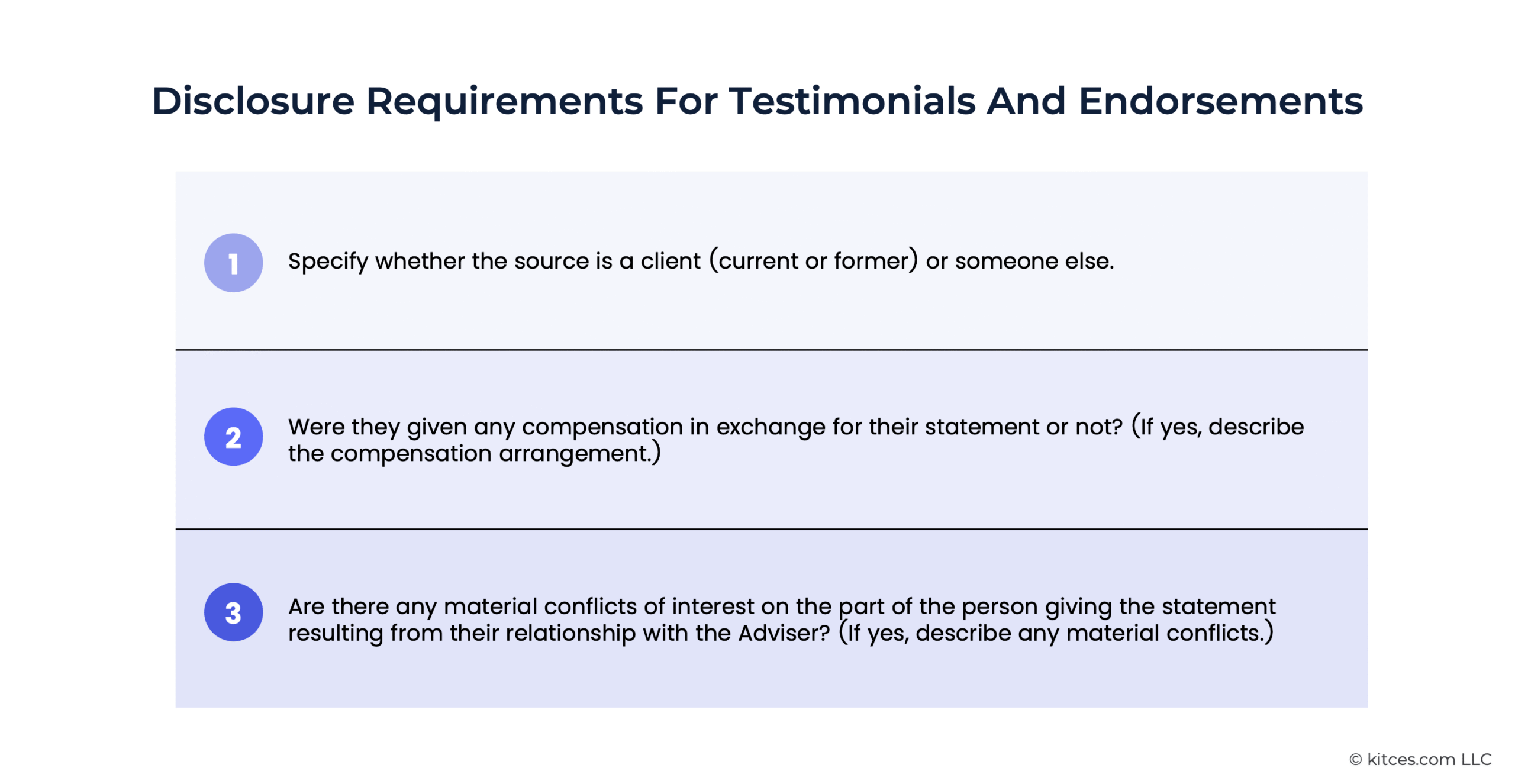
From the SEC Marketing Rule perspective, the following disclosure requirements apply to testimonials and endorsements:
- Specify whether the source is a client (current or former) or someone else
- Were they given any compensation in exchange for their statement or not?
- If yes, a description of the compensation arrangement
- A brief statement of any material conflicts of interest on the part of the person giving the statement resulting from their relationship with the adviser.
- A description of any of the material conflicts above
Online Reviews
The second term we will focus on is "online reviews," which is not specifically defined in the SEC Marketing Rule, but should be clarified for the purposes of this conversation. This term generally describes a specific format: a rating from one to five stars paired with a text "review" or opinion shared. This format has become immensely popular online because the aggregated ratings (e.g., "4.7 out of 5 stars") provide for a rapid initial evaluation of overall opinion, and the content of the reviews enables consumers to explore more detailed feedback provided by each individual reviewer.
Furthermore, when a website presents feedback in this format (an overall average rating, and a feed of individual reviews which comprise that rating) it is implied (or explicitly stated) that the opinions shared represent an unfiltered feed of all opinions collected. Put differently, when consumers see a rating and review feed, they expect that the opinions shown have not been filtered to only show the positive feedback. Which again is important given the adviser's obligation not to engage in misleading advertising (e.g., by 'cherry-picking' only the best reviews).
Within the context of advisor marketing efforts, online reviews are one possible format for collecting and displaying opinions which may or may not wind up qualifying as testimonials and/or endorsements. If a firm wishes to collect and display testimonials as part of their marketing efforts, they are not required to do so in the format of online ratings – other formats (such as standalone quotes without ratings, or client video or audio testimonials) are also permissible. However, this article will make the case that this format is fully aligned with the SEC Marketing Rule and is also arguably the most valuable and trustworthy format in the eyes of prospective clients.
Third-Party Ratings And Testimonials
The term "third-party ratings (TPRs)" is another term specifically defined in the SEC Marketing Rule. Rule 206(4)-1(e)(18) defines it as:
"Third-party rating" means a rating or ranking of an investment adviser provided by a person who is not a related person of the adviser, and such person provides such ratings or rankings in the ordinary course of its business.
Google reviews are the most relevant example in this category, as it is estimated that 63% of all online reviews are Google reviews. In this example, Google is the third party. Google can create a Google Business Profile (GBP) for any business, and any GBP is equipped to collect and display reviews pertaining to that business. While any internet user could leave a Google review, Google does publish its "acceptable use policy." If a review clearly violates that policy (e.g., the reviewer has never actually engaged the services of that business and is leaving a specious review), the review might never be published, or the business owner may report the review for a violation of the policy and request that the review be taken down. Good-faith reviews that are negative or mixed in nature, however, are not violations of this policy and cannot be removed at the simple request of the business owner.
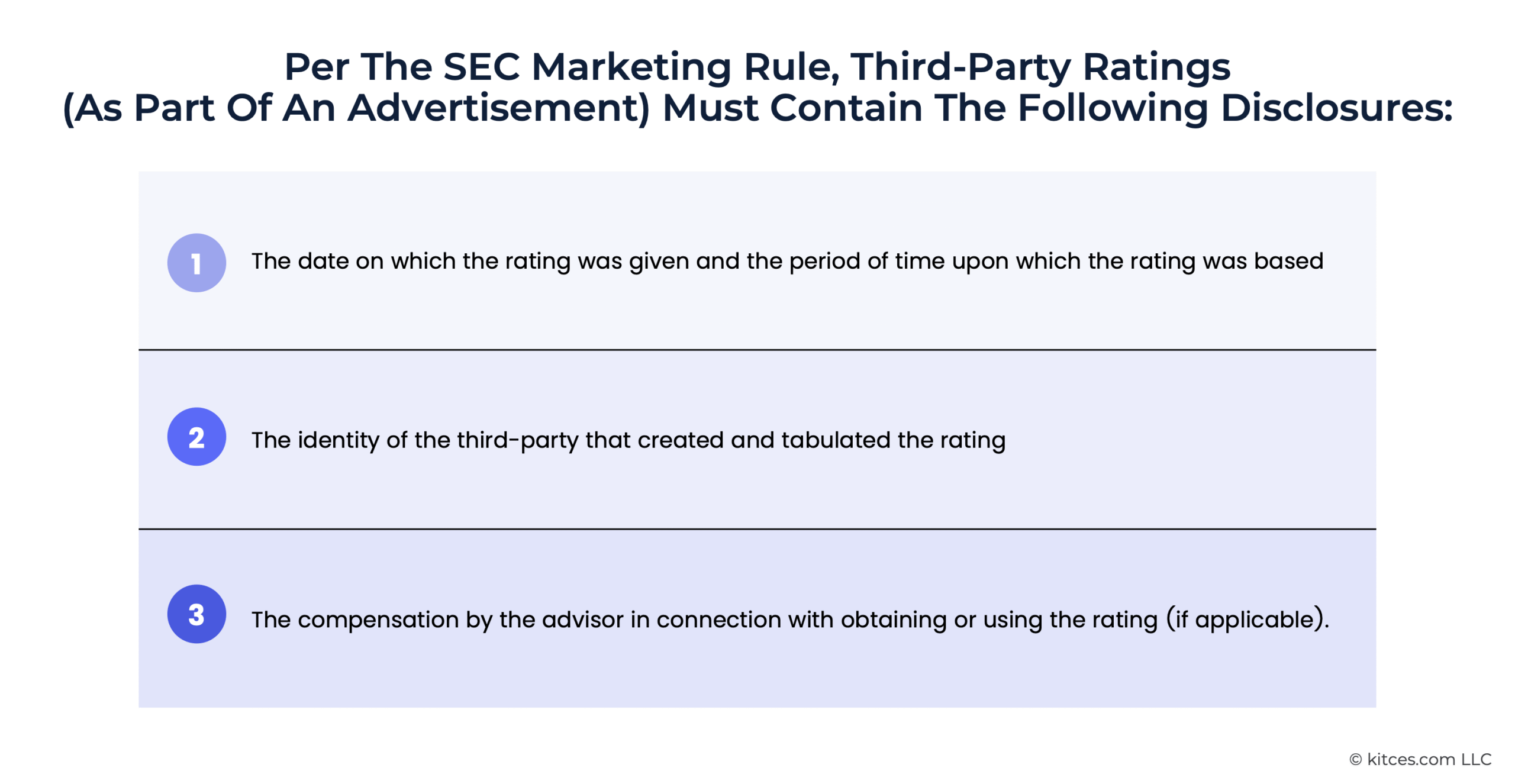
From the perspective of the SEC Marketing Rule, in order to use third-party ratings as part of an advertisement (e.g., on an adviser's own website, over which they have control), they must contain the following disclosures:
- The date on which the rating was given and the period of time upon which the rating was based
- The identity of the third-party that created and tabulated the rating
- If applicable, the compensation by the advisor in connection with obtaining or using the rating.
Further, to use third-party ratings compliantly, advisors need to consider the following:
- Is the party providing the rating related to the advisor?
- Does the party provide rating services as part of its regular business?
- Does the advisor have a reasonable belief that the third-party rating system:
- is structured to make it just as easy for participants to leave unfavorable reviews as it is to leave favorable ones?
- is not designed to produce a fixed result?
In contrast to third-party ratings, testimonials are generally collected and displayed by the firm/advisor being evaluated. We also know that the most common, highly visible place for a firm to share their testimonials is on their website. So, to a consumer, testimonials can appear very similar to third-party ratings and can come across as an equally valid form of 'online reviews.'

Nerd Note:
Businesses can solicit feedback from their clients at any time through a number of methods. An adviser's solicitation of feedback from their clients, in and of itself, is not considered "advertising" and, as such, does not trigger the Marketing Rule. However, if an adviser chooses to use this feedback to market or promote their business, that act is then considered advertising, and the Marketing Rule applies. So, when an adviser uses a client's rating or feedback from a third-party rating on its website, it would be considered a testimonial. Under the Marketing Rule, advisers can't put their thumbs on the scale of third-party ratings; however, they can be selective about which testimonials are used in advertising.
Collecting and sharing 'closed-loop reviews' online is a common practice for some industries like healthcare systems and luxury retailers. In this context, 'closed loop' means that feedback only comes from current clients, and is both solicited by and returned to the firm. Sometimes those businesses have already-established processes for collecting customer/patient feedback (e.g., healthcare), which makes collecting testimonial-style data an easy extension of that existing program. In other cases, the businesses act as their own direct-to-consumer distribution channels (e.g., luxury brands), in which case the most logical place to show customer reviews is on the brand's own website.
However, whenever consumers find testimonials on a business's own website (vs. on a third-party site), they may bring more skepticism about the objectivity of those reviews. In an effort to counteract that skepticism, a business can provide transparency into their processes and policies for collecting and displaying testimonials. At a high level, the business can try to explicitly answer the unasked questions, "Where did these reviews come from?" and "Why should I trust them?" In doing so, the business can clarify who may leave a review (e.g., only clients) and what review content would be deemed unsuitable for publishing (e.g., performance claims or profanity). This transparency is a critical component to making the reviews trustworthy, and arguably the primary goal of a testimonial program is to build trust.
A sensible testimonial policy can also protect the business from some especially unsavory (if rare) outcomes. Within the financial advisory industry, most of these policies specify that a review cannot be published if it contains offensive language, personally identifiable information, or any content specifically prohibited by the SEC's Marketing Rule for any type of advertising (like a client sharing a claim about their individual investment performance). If a firm is transparent with their policy and adheres to their own guidelines, they can insulate themselves from some of the most jarring possible outcomes (e.g., a client who leaves a negative review with offensive language can't be excluded for being a negative review, but might be reasonably omitted because of the offensive language).
This additional structure usually goes a long way towards reassuring compliance officers, and it's why many firms prefer to start their testimonial program with a closed loop collection approach.
Nerd Note:
Many firms face issues during regulatory exams due to the lack of proper disclosures on testimonials. The SEC has made it clear that a standard disclosure, such as "Testimonials provided by clients may not reflect the experiences of all clients," will not be sufficient. Firms should use their collection methodology as the basis for forming solid disclosures, as those disclosures should be specific to each firm's process. For example, imagine a firm's approach is to review their entire client roster once per year, exclude any clients with material conflicts of interest, and then send an invitation to write a testimonial to the remainder of the list without any incentive provided. When that firm wants to provide disclosures for those collected testimonials, it's easy to articulate that ALL testimonials are from current clients, and are uncompensated and free from material conflicts of interest.
'Getting Involved With' Google Reviews Increases Compliance Complexity
Google Reviews are one of the most common ways that advisors wade into third-party rating systems (though we'd argue they shouldn't be the only way – more on that later). And as previously stated, Google can create a Google Business Profile (GBP) for any business – whether the business wants it or not. And once a GBP exists, any internet user can leave a review for that business. In general, there are no compliance requirements that stem from simply having a GBP or receiving unsolicited online reviews on that profile. No part of the SEC Marketing Rule is even triggered if a firm plays no role in asking for reviews and if the firm otherwise ignores the reviews once they've been received.
Nerd Note:
As a best practice, firms who want nothing to do with Google Reviews should add a brief disclosure on their GBP saying that they do not solicit any reviews nor do they monitor any feedback given on that platform.
If a firm wants to request that their clients leave a Google review, they need to be clear on their approach and policy from a compliance standpoint. Here, the regulation provides specific language requiring that a firm must have a reasonable basis "for believing that any questionnaire or survey used in the preparation of the third-party rating is structured to make it equally easy for a participant to provide favorable and unfavorable responses, and is not designed or prepared to produce any predetermined result." In other words, neither the 'survey' itself nor the outreach approach deployed by the firm should sway the response of the respondent.
A salient example of what would NOT fly is what is called "review gating" and it is still occasionally encountered in non-regulated industries. This approach will first present a customer with a short non-public survey asking, "How did we do?" If the customer chooses a 4- or 5-star rating, that customer will then be asked to leave a review on a site like Google. If, however, they leave a 3-star or lower rating, there will be no follow-up ask. This approach is a clear example of a structure designed to produce a skewed result. Another common form of review manipulation occurs when firms go out of their way to solicit positive reviews in order to suppress or drown out negative ones.
Instead, if firms want to request Google Reviews, they should ensure they're asking all clients broadly and not targeting any specific groups (such as their favorite clients or ones they know will provide good reviews) and follow appropriate record-keeping practices to document those outreach efforts. A good way to do this would be for firms to add a link to their GBP on their website and in their email signatures, which will reach a large audience and not otherwise bias the collection of reviews in a way that could be deemed misleading advertising or 'cherry-picking' of which clients are invited to leave reviews.
Once marketers understand those compliance fundamentals, they can explore their most impactful options for engaging with Google reviews. If a firm deploys a fair and compliant outreach approach for requesting reviews, they will almost certainly generate new reviews on their Google Business Profile. If firms then want to use any of those Google reviews in their own marketing – either by using one or more flattering reviews, or by showing the overall average rating and number of reviews – then those become testimonials or the utilization of third-party ratings, and additional compliance requirements are triggered.
Specifically, once a firm incorporates a testimonial in its marketing, it must show "clear and prominent" disclosures (client or non-client, compensated or not, and any conflicts of interest). Many advisors choose to display the contents of clients' Google reviews as testimonials on their own websites, where disclosure requirements can be easily accommodated.
Compliance aside, the presentation of reviews only on a Google Business Profile is sub-optimal from a marketing perspective as well. Since any internet user can leave a Google review on any GBP, a feed of reviews on a firm's GBP may contain perspectives from both clients and non-clients – and Google provides no verified way for a prospective client to know which is which. If all the reviews are glowing, there are no marketing concerns, but if a non-client, former client, or competitor writes something disparaging in a Google review, the prospective client has no simple way to filter reviews by reviewer type.
Getting Into Reviews: Why And How To Start
Despite the requirements for showing client reviews in a compliant manner, they can function as a powerful form of social proof that ultimately drives new business – making the endeavor worthwhile from the advisor's perspective.
Why Online Reviews Enhance Advisor Credibility
For any type of business, if a prospect arrives on the business website and sees five flattering quotes from customers, that prospect may find some reassurance that there are at least five people who have something nice to say about the business. They are unlikely, however, to believe that those five quotes represent a valid sample of opinion from the entire customer base of that business.
On the contrary, a critical mass of online reviews posted to a third-party rating site can imply that prospects are seeing a valid sample of opinions from a representative cross-section of customers. Because this format so effectively encapsulates the feedback that prospective customers seek, search engines have for years ascribed significant authority to third-party ratings sites and have therefore rewarded those businesses with stronger online reputations.
And now that AI tools are capturing a larger share of the function of connecting prospective buyers with products and businesses, those tools also lean heavily upon online reviews as an indication of trust and competence. As such, advisors who want to increase their Answer Engine Optimization (AEO) relevance and visibility would be well-served by focusing on online reviews.
After years of helping advisors to collect and display client feedback, we offer up the following generalizations which will apply to the remainder of the article:
- The primary goal of collecting and displaying testimonials is to build trust with prospective clients;
- Transparency makes trust easier to build;
- Prospective clients are more interested in the perspectives of current clients (testimonials) than they are in the perspectives of non-clients (endorsements); and
- If an advisor/firm pays for a testimonial (and correctly discloses that fact), it significantly diminishes the credibility of that testimonial.
Given the above observations, it's understandable why so many firms wishing to take advantage of the power of social proof in their marketing have chosen to pursue the format of online reviews. Both third-party ratings and testimonials have strengths and drawbacks, which is why the ultimate strategy is to pursue both channels. Let's explore…
No Single Online Review Channel Checks All Of The Boxes
Let's consider separately the single-tactic options to only pursue Google reviews or to only pursue testimonials on a firm's own website.
Despite the rapid rise of AI hyperscalers (ChatGPT, Perplexity, Claude), Google is still king when it comes to helping humans find things online. Google's share of the search engine market has hovered around 90% for over 20 years. While data suggests that approximately 16% of consumers now start their searches with an AI tool (rather than a search engine), the majority of search traffic still flows through Google's algorithm. And because Google has now integrated Gemini into the search experience, they're likely to maintain their dominant position regardless of users' AI preferences. It's not surprising that Google's own reviews carry a lot of weight in their search algorithm.
Obstacles May Prevent Some Clients from Writing a Google Review
The most thorough and transparent way to implement a testimonial program is to ensure that every client has a legitimate opportunity to share their perspective by leaving a review. And given the influence described above, why wouldn't advisors want to go 'all-in' on Google reviews?
There are two facets of the review-leaving flow which might weed out clients who might otherwise be willing to share their perspective: lack of a Google account, and the inclusion of the reviewer's name and identity. (Notably, these factors constitute more of an issue with client comfort than a compliance concern.)
Lack Of A Google Account
First, to leave a Google review a user must have a Google account. That doesn't necessarily mean they need a Gmail address, but they must have a Google account or be willing to create one. Yes, Gmail is tremendously popular, claiming up to a 75% share of the email market, but that still leaves 25% of people who might not have a Google account.
It's true that Google accounts are free, but if a client receives a "Write a review" request and willingly clicks through only to encounter a page that says "Sign in - Use your Google account," they are going to pause and recalibrate. The best case is that they understand exactly what's going on, and are willing to invest another few minutes to create an account so that they can leave a review. In the worst case, they are either confused by the user experience, or they are opposed to creating an account – leading to an abandonment of the testimonial request.
Showing Full Name
Even if clients do have a Google account, the default form for capturing a review shows the reviewer's full name and informs users "Posts may appear publicly with your profile name, picture, or link to your profile." For many people, the topic of wealth is a private one. The idea of telling the world that you use a wealth manager can be perceived as either a breach of privacy or a breach of modesty. Technically, Google offers an option for a user to change how their name is displayed, but that option is not visible in the default "leave a review" user flow.
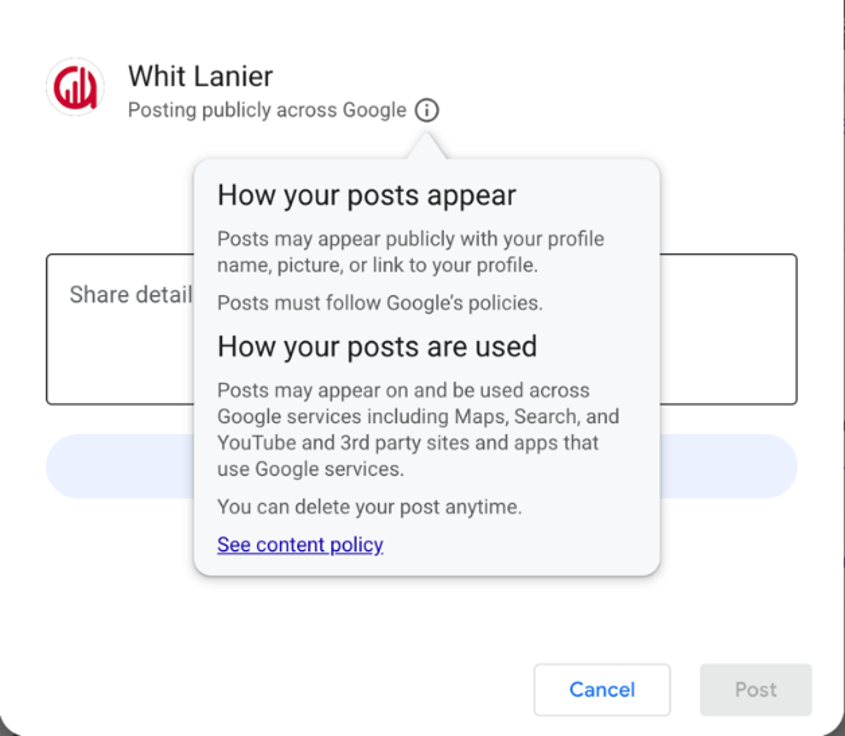
Internal data from an Amplify Reviews case study support the idea that these two friction points (requiring an account and showing a user's full name) do indeed inhibit the reviews 'yield' that firms could otherwise get. In the case of one firm that had already been requesting Google reviews, adding a new option for clients to write a review without publishing their full name and without creating an account resulted in the collection of 50% more reviews than their previous Google-only request efforts!
Testimonials On A Firm's Website Miss Out On Some Local Search Love
Another option for getting online reviews is for a firm to collect feedback from their own clients and display those reviews directly on their own website (and in their other marketing efforts) as testimonials. This approach avoids the sampling bias described above and keeps all the compliance requirements directly under the control of the firm.
The simplest approach is to invite 100% of clients to write a review through this closed-loop process (without requiring the creation of a user account, and while allowing the reviewer to separate the confirmation of their identity from choosing their "display name" to preserve some anonymity if preferred). The firm still retains/has visibility into the relevant information for each review, which is useful when it comes time to craft and present the "clear and prominent" disclosures.
When the firm goes to implement these testimonials in the format of online reviews on their own website, their web team will want to add the appropriate schema markup to the reviews. (Schema markup is a behind-the-scenes labeling system that tells Google 'this text is a review' rather than just 'this is text.' Many review management platforms and content management systems make it easy to include this markup by default, but it's also very manageable for a DIY web user.) This means if a prospect is entering a search term specifically about "client reviews" the search tools can return this testimonial content in their search results and AI overviews, just like third-party reviews.
However, as we mentioned above, Google has a powerful and self-reinforcing ecosystem. A Google search for "top rated financial advisor near me" will give preferential treatment to the advisor with Google reviews over the advisor with comparable testimonials. The testimonials-only advisor can still expect to outperform the zero-reviews advisors.
Despite these nuances, if a firm's marketing department and compliance department can agree on an approach to enable the firm to use either third-party ratings like Google or reviews/testimonials on their own website, they will be able to outperform the majority of firms that still haven't gotten started with any form of testimonials/reviews. In fact, Amplify Reviews' 2026 State of Testimonial Marketing report shows that 79% of top RIAs are still not actively employing testimonials or online reviews as part of their marketing strategy.
A Two-Pronged Review Strategy Can Maximize Marketing Impact And Simplify Compliance
There are many ways that advisors can magnify the impact of reviews collected on their behalf, including strategic extensions of a single 'ask' campaign.
More Reviews In More Places
If Marketing wants Google reviews and Compliance is on board, the option to leave a Google review can be presented to all clients, who can then self-select into doing so (or not). Having reviews directly on Google is beneficial in all dimensions of Google search (local, maps, web, and AI). With the reviewer's consent, these reviews can also be added as testimonials and displayed on a firm's own website – either by themselves, or alongside testimonials from other sources – with all required disclosures accommodated.
In the pursuit of building a strong online reputation, this rule has always been true: "More reviews in more places = more impact." Generally speaking, one's online authority increases as a function of both the number of 'proof points', as well as the number of websites on which they appear. This axiom has long been true for SEO efforts, and remains true with the newer focus on AI visibility. By having unique reviews on both a firm's own website and on the firm's Google Business Profile, the power of the 'social proof signal' is magnified both for humans doing research on that firm, and also for any technology crawling those pages for 'training' about that firm.
The exponential rise in recent years of AI chatbots has drawn into question whether Google will be 'king' forever, but a diversified two-pronged strategy will ensure that there are authority and trust signals for your firm regardless of how the technology of 'getting found' evolves. Below are four specific ways that firms can get started.
Three Ways To A Two-Pronged Approach
Option One: Recipient's Choice Between Platforms
When firms send their outreach to request reviews from their clients, the request can contain two clear calls to action – one for a closed loop testimonial, and the other for a Google review. These calls-to-action can be presented in a dedicated outreach email, and they can live on a landing page which can be accessed from a few different sources (e.g. newsletter template, in-office QR code).
By clearly providing both options with a little context, this approach allows the client to choose between leaving a testimonial which will live on the firm's website, or clicking straight through to a Google Business Profile to leave a review there. One initial outreach effort using this approach can populate a meaningful number of reviews in both places and really help get the firm 'on the map' (literally and metaphorically) regarding online reviews.
Option Two: Follow-On Ask
This tactic makes sense for a firm that prefers to maintain as much ownership of their reviews as possible, while still establishing a presence on Google. In this approach, clients initially receive a dedicated request to write a testimonial which will be displayed on the firm's website. If a client completes this request via a web form, a 'thank you' landing page can be displayed and can contain a follow-on ask for all reviewers: "Would you also write us a Google review?" This ask cannot, of course, be dependent on the rating in the initial review – if enabled, the follow-on ask must be shown to all reviewers.
Some subset of reviewers are willing to take the additional one or two minutes to click through to the firm's Google Business Profile and either copy/paste the review they already wrote, or compose a new one. This approach yields a higher percentage of testimonials, but will manage to also generate a footprint of Google reviews in the same outreach effort.
Option Three: Discrete Campaigns At Different Times
A firm may initially make a transparent 'ask' of all clients, requesting that they write a testimonial which will be displayed on the firm's website. Then, in three to six months, the firm can run a separate campaign to all clients asking only for Google reviews. Again, from a compliance perspective, there can be no preferential treatment for one request over the other.
The firm can then decide if they want to add any of the Google reviews onto their own website as testimonials, or keep the two streams separate and only leverage their self-collected testimonials within the firm's marketing efforts. This approach gives firms a little more control over where the 'next batch' of social proof will come from, but needs to be carefully planned to avoid making review requests too frequently.
Plan For The Big Picture, But Start Wherever You Can
Readers should hopefully now have a clear view of the marketing impact and compliance considerations for each of these types of social proof. As testimonial marketing adoption continues to grow among financial advisors, growth-conscious firms should make sure that an online review plan is part of their marketing strategy for the upcoming year. Even if marketers face compliance or capacity constraints which would prevent them from diving into a two-pronged strategy in depth, it's worthwhile to find at least one tactic they can get started with immediately.