
Executive Summary
Financial advisors will sometimes encounter a client who does not follow through on financial planning recommendations, even when the recommendations were developed collaboratively and seemed to resonate in the moment. In that situation, the advisor might assume that the problem was that the plan was too long, too complex, or too abstract, and that the solution is to simplify it and make it more actionable. But the primary cause of the inaction might not actually be a lack of understanding on the client's part. Rather, the plan may be speaking only to one part of the client's mind.
In this guest post, Scott Frank, CFA, CFP, RLP, founder of Stone Steps Financial and a lead trainer at the Kinder Institute of Life Planning, discusses how client motivation can be shaped at the start of the planning relationship and why creating an atmosphere where prospects and clients feel safe enough to explore and communicate their deepest motivations is an important part of that process.
In his 2006 book "The Happiness Hypothesis", psychologist Jonathan Haidt distinguishes between the "Rider" – the conscious, deliberate mind – and the "Elephant" – the unconscious system that stores memory and emotion, runs habit and avoidance, and carries every money story the client absorbed before they were old enough to question any of it. Because common financial planning approaches, such as gathering and analyzing data and presenting recommendations, are largely directed at the Rider, the Elephant is often left out of the conversation. Which creates a gap between the client's understanding of the plan and their motivation to act on it.
With this in mind, George Kinder's life planning approach – the EVOKE framework – begins with Exploration, where the advisor doesn't focus on gathering or assessing client data. During this stage, the advisor is mindful about resisting the urge to go too deep on any one subject. Instead, the meeting is designed to create enough space and safety for prospects to reveal not only immediate financial concerns, but also other issues that might be on their mind, including the deeper motivations behind their financial goals.
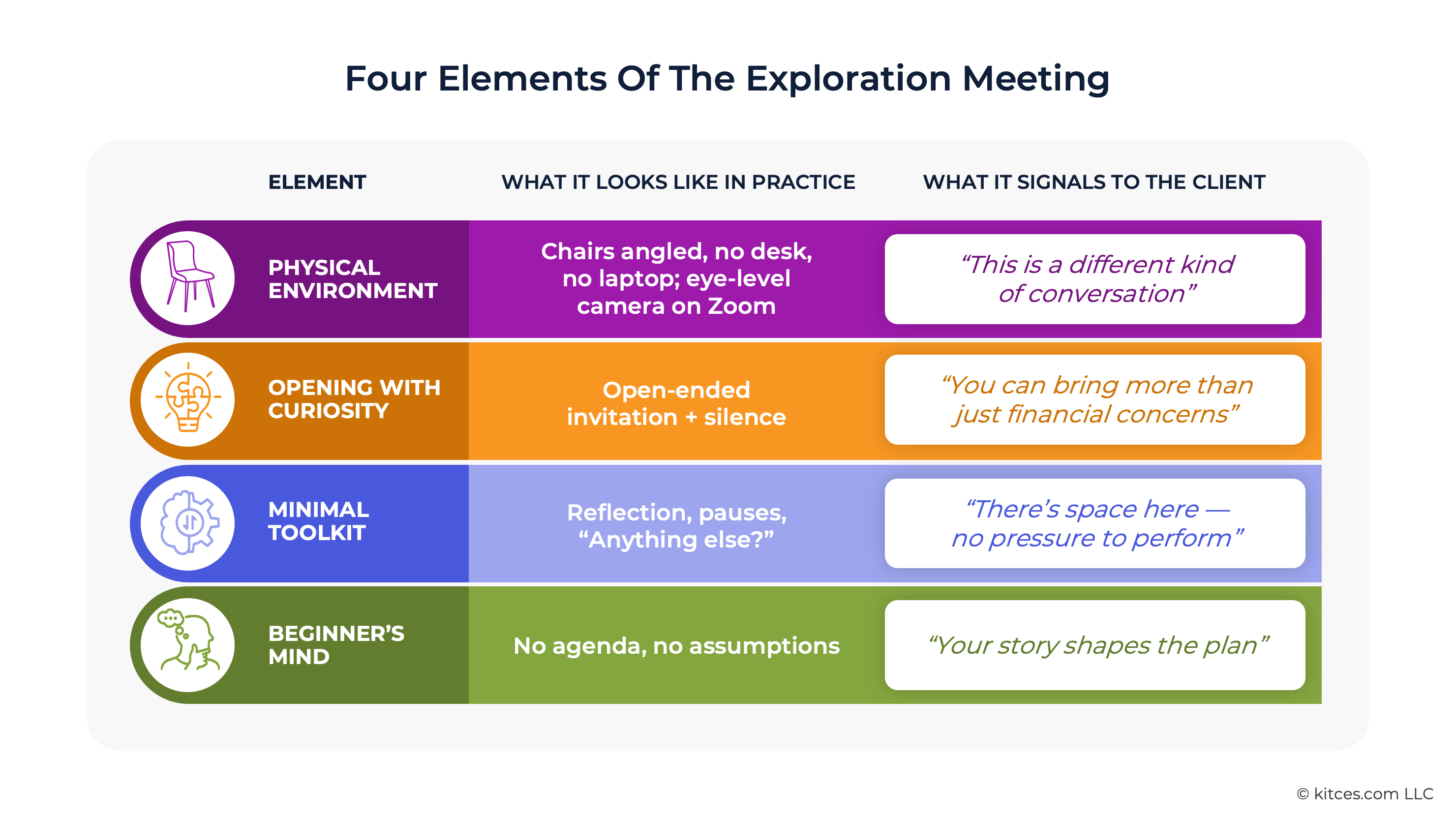
Four structural elements define the Exploration meeting: 1) the physical environment, 2) an opening grounded in two genuine questions, 3) a minimal toolkit built around presence and the discipline of asking "Anything else?", and 4) a no-judgment orientation throughout. The meeting closes with reflection along with a clearer sense of what working together would look like, grounded in what the prospect has just brought into the room. In this way, an advisor can better understand not only the immediate financial pain points that may have led the prospective client to reach out, but also the deeper hopes, fears, and motivations that can shape a more meaningful and effective planning relationship.
Ultimately, the key point is that when clients fail to implement financial planning recommendations, the issue is not necessarily a lack of understanding but may instead reflect a lack of (unconscious) motivation to act. By creating space early in the relationship for clients to explore all of their concerns – including their immediate pain points and their deeper hopes and worries – advisors can improve the likelihood that the recommendations developed later will feel personally meaningful, and, therefore, more likely to be acted on with energy and intention!

Every advisor has seen some version of this client.
The meeting went well. The plan was thorough – technically precise, clearly organized, built on everything the client said they wanted. They nodded through the recommendations. They said thank you. They left.
Three months later, nothing has moved.
The profession's standard diagnosis is that the plan was too long, too complex, or too abstract. The response, then, is to simplify it – shorten it, prioritize a smaller handful of action items, and make it more actionable.
But that diagnosis may be incomplete. In a 2019 survey of 138 financial advisors providing plans for a fee, researcher Russ Alan Prince found that, on average, only 30% of clients had implemented at least 20% of their plan's recommendations within six months. Nearly one in five had done nothing at all.
A shorter plan addressed to the wrong system will be ignored more efficiently.
The Implementation Gap Is Architectural, Not Motivational
The explanation for why clients so often fail to implement doesn't come from financial planning's own literature. It comes from cognitive neuroscience – a field that the profession has been slow to absorb, even though it offers a useful framework for understanding what happens in client meetings.
The Conscious–Unconscious Processing Gap
In 2024, researchers at Caltech published a study in Neuron quantifying the processing-speed gap between the conscious and unconscious mind. The conscious mind – the system addressed in virtually every client meeting – processes approximately 10 bits of information per second. Yet the unconscious system that more powerfully shapes behavior processes approximately 1 billion bits per second. The gap is one hundred million to one.
 Financial planning has largely been built for the 10-bit system. In his 2006 book "The Happiness Hypothesis", psychologist Jonathan Haidt calls it the Rider: the conscious, deliberate mind, fully capable of reviewing a plan, nodding at the logic, and agreeing that yes, the estate documents really do need to be updated this year. The Elephant is everything else – the system that stores memory and emotion, runs habit and avoidance, and carries every money story the client absorbed before they were old enough to question any of it.
And while the Rider can say yes to a plan, the Elephant decides whether anything actually happens.
Why Simplifying The Plan Doesn't Improve Follow-Through
Standard financial planning is largely designed for the Rider. The discovery questionnaire, the risk tolerance assessment, the goal-ranking exercise – these are all conscious-mind instruments. They extract information the Rider holds and build a plan the Rider can follow.
Which would be reasonable if the Rider were the system in charge of execution. But it isn't. Improving the plan doesn't solve the problem. A more actionable plan addressed to the wrong system may still be ignored – just more efficiently. The client who nodded in the meeting wasn't failing. The plan was built for the wrong system.
This is not a motivational problem. Clients aren't failing to implement because they lack commitment, didn't understand the recommendations, or received a plan that was too long. They are failing because the system that governs behavior was not engaged in the process of building the plan. That's an architectural problem. And it requires an architectural fix.
The Exploration Meeting Is The Architectural Fix
 George Kinder began developing the life planning approach, referred to as the EVOKE framework, in the early 1990s. He co-founded the Nazrudin Project in 1994 for the life planning community and established the Kinder Institute of Life Planning in 2003. The neuroscience that now helps explain why his method works – Haidt's Rider/Elephant framework, Kahneman's dual-process model in "Thinking, Fast and Slow", and the 2024 Caltech study published in Neuron – arrived years, and in some cases decades, after Kinder had already built something that worked. He developed the method empirically through practice with clients. The science caught up later.
The first phase of Kinder's EVOKE® framework is Exploration – and the name carries its own instruction. The advisor is not gathering or assessing. They are exploring.  In my practice, this happens in the prospect meeting: it's when I have the first substantive conversation with someone considering working with me. No intake form precedes it. No preparation is required. The client arrives as they are, carrying whatever they carry. That is exactly the point.
The plan that follows belongs to the client. The client who authors the plan is the one who follows it.
The Marble Inventory – What Clients Carry Into The Meeting
Louis Vollebregt, a lead trainer at the Kinder Institute, introduced me to the following way of thinking about what clients carry into a meeting. I have never found a better frame for it.
Every prospective client walks in with a pocket full of marbles – each one representing something in their life that matters to them. Some are financial. Some are about life – a career they're quietly wondering about, a relationship they're navigating, a transition they can feel approaching. And some are hidden treasures, which we'll return to later. The mix is different for every person. The goal of the Exploration meeting is not to sort the marbles. It's to create enough space, safety, and unhurried time for the prospect to bring out all of them.
Prospects usually begin with the marbles that are easiest to articulate – the familiar concerns the Rider has already organized into a coherent story. Often, those financial marbles are the first to come out, because the Rider is in charge of the presentation. Prospective clients may even have been rehearsing the retirement question on the drive over.
Here's where many advisors make a critical mistake: they ask a deepening question too quickly. It's a natural reflex – the prospect mentions one concern, and the advisor leans in with a follow-up question to learn more. But that move can subtly direct the conversation before the prospect has finished revealing what they came in carrying. It signals that this is now the topic to focus on.
The Elephant reads that signal immediately. The question no longer feels like neutral curiosity. Instead, it signals that the advisor – not the prospect – is now steering the meeting. And it's that signal that collapses the space. The Elephant, which came carrying far more than the marbles the prospect first presented, quietly puts the rest back in its pocket.
Instead, advisors can simply receive the marble. Reflect it back without evaluation, analysis, or the beginning of a recommendation. Then hold the space. When the initial, more familiar financial marbles have been received and not redirected, something shifts. The Rider relaxes. The prospective client feels heard.
And once the Rider has been heard, the Elephant begins to participate more fully. Additional marbles begin to surface: the life questions, the unnamed worries, the things the prospect didn't know they were going to say until the room was safe enough to say them.
This is the Elephant entering the conversation – not because the advisor asked the right question, but because the space became safe enough for more of the prospect's internal world to emerge. Clients are far more likely to follow the plans they help craft than the ones handed to them.
How Hidden Treasures Create Plans That Clients Actually Follow
Every client carries something they have rarely, if ever, said aloud – not to their advisor, often not even to their partner. A long-deferred dream. A fear that has never been named. A longing so folded into the ordinary business of life that the person had almost stopped noticing it was there.
These are what the Kinder Institute calls hidden treasures. They are the last marbles to surface. They emerge after the client's more familiar, easier-to-articulate concerns have come out, and after the client has experienced enough safety to let the Elephant speak for itself. They don't appear in the first ten minutes. They appear only when the room has proven it can hold them.
And when they do appear, they tend to reveal what matters most. Hidden treasures can express, sometimes more clearly than anything else in the meeting, the life the client actually wants, fears, or feels called toward. For that reason, they often become the point of the conversation – and the emotional center of a plan the client is genuinely willing to act on.
Here's the implementation mechanism stated plainly: people don't move on logic alone. They move on emotion. A plan organized around tactics – increasing the contribution rate, updating the beneficiary forms, rebalancing the portfolio – asks the Rider to act. The Rider may agree in the meeting and forget by Thursday. But a plan organized around who the client actually is – around the dream they finally said aloud, the version of their life they have been quietly working toward – belongs to the Elephant. And the Elephant does not forget what it cares about.
Polyvagal theory – a framework developed by Stephen Porges that explains how the nervous system responds to cues of safety and threat – helps explain why this works at a neurological level. Porges's research suggests that safety is a physiological precondition for genuine self-disclosure – not a soft concept, but a structural one. The ventral vagal state, the body's social engagement system, is the state in which authentic communication and self-reflection are most fully accessible. When a client doesn't feel safe, the Elephant guards. And when the client does feel safe, it opens.
 Carl Rogers's research on unconditional positive regard points to a similar mechanism from a different direction: being seen without judgment activates capacities that are difficult to access otherwise. This is the neuroscience of what Kinder built intuitively. He didn't have these frameworks when he developed the method. The practice preceded the science. But they describe the same kind of room.
How To Run The Exploration Meeting
The Exploration meeting can happen in person or on Zoom. In either setting, presence matters before any discussion of money begins. The prospective client needs to feel that another human being is genuinely here, genuinely curious, and genuinely ready to receive whatever they bring. Much of that is communicated nonverbally through eye contact before it is communicated through language.
I open every Exploration meeting with new prospects the same way:
Thank you for coming in. I look forward to chatting with you and learning about what is essential for you to live a great life. After all, money is just a tool. Is there anything urgent, and what brings you in today?
The two questions are asked as one. The first honors whatever concern the Rider carried in. The second opens the door to everything else. Then I stop talking. What follows is not a questionnaire. It is an invitation.
Four Elements That Make The Meeting Work
In practice, the Exploration meeting is shaped by a handful of structural choices that work together from the first moment to the last. Each one is simple on its own, but when used together, they create the conditions that allow the conversation to move beyond the prospective client's surface-level concerns and into a fuller picture of what really matters most.
The physical environment. In person, that means chairs at an angle, no desk between advisor and prospect, and no laptop open. On Zoom, it means a camera at eye level, a clean and undistracting background, and no second screen visible. In either setting, the physical arrangement communicates something the Elephant reads before a word is spoken: this is a different kind of conversation.
An opening grounded in genuine curiosity. This isn't the moment to start asking questions about goals or prompting a discussion about financial concerns. It's when the advisor can demonstrate an authentic interest in the prospect's life, then leave a short stretch of silence so the prospect has room to begin. The silence is not an awkward gap to be managed. It is the first moment of real invitation.
A minimal toolkit. These simple instruments include presence, brief reflection of what's heard without evaluation, long pauses held without rushing to fill them, and "Anything else?" asked genuinely, repeatedly, after intentional silence. That is the whole toolkit. Advisors who have spent years being the most knowledgeable person in the room may find this discipline difficult at first. The work is staying out of the way.
Beginner's mind, maintained from first word to last. I think of this element as a blank canvas. My job is to listen while the prospective client begins to sketch the picture of their life. What takes shape on that canvas – not what I have pre-drawn, and not what I expect to see – becomes the foundation for everything that follows. An advisor who arrives with an agenda, however well-intentioned, has already started sketching.
The Discipline Of Not Deepening Too Soon
There is a moment in nearly every Exploration meeting when the advisor's natural reflex becomes the enemy of the work. The prospect says something that stands out – something important, emotionally charged, or clearly worth exploring further. And the instinct, developed across years of discovery meetings, is to lean in, ask more, and find out what's underneath. Don't. Not yet. In this moment, it's often more useful to pause, because the prospect may still be in the process of revealing what else they brought into the room.
That's why it can help to eliminate 'I', 'me', and 'mine' from the meeting as much as possible. Every time an advisor says "I think you should…" or "In my experience…" or "That reminds me of…", the conversation pivots from the prospect's frame to the advisor's. The Elephant notices that shift immediately. It is not interested in the advisor's experience; it's calibrating whether this room is safe enough to bring something real forward. The moment the advisor steps into the center, that calibration changes. This is not a discipline of coldness. Warmth can remain fully present without making the advisor the subject of the conversation. The objective is to reflect back what's heard without interpreting it, pause for three full seconds after a prospect finishes a thought, and then ask: "Anything else?"
Three seconds of silence after a prospective client speaks feels, to many advisors, like an eternity. To the prospect, it can feel like permission.
The same discipline applies to the deepening question. When a prospect says something that catches the advisor's attention – something important, emotionally charged, or that invites curiosity and exploration – the reflex is to lean in and ask. But doing this too quickly can direct the conversation before the prospect has finished revealing what they're carrying. A deepening question signals which marble the advisor finds most interesting. The Elephant hears that signal and will keep all the other marbles in the pocket. Presence and silence leave room for more to emerge. A probe narrows the conversation, closing the bag around one thing.
The Close: Reflection And Kinder's Three Questions
The last ten minutes of the Exploration meeting serve two purposes. First, they bring closure to the exploratory work that has unfolded in the room, helping the prospect see and feel what has emerged. Second, they support the prospect in deciding whether to move forward and engage the advisor. By this point, something meaningful has already happened: the prospect feels heard, perhaps more fully than they expected when they first arrived. But they didn't come only to explore – they also came to decide whether to hire the advisor. The close needs to honor both purposes.
It begins with a reflection – a genuine account of what emerged in the room that goes beyond financial concerns: where the prospect is today, the things that carried energy, the marbles that surfaced late. This reflection makes it clear to the prospect that all of it was being heard – not just the financially relevant parts.
From there, I introduce George Kinder's Three Questions as a way for the prospect to begin prioritizing their own marbles. I walk them through all three verbally: the first removes the money constraint and asks how they would live if financial security were guaranteed; the second shortens the horizon to five to ten years and asks what rises to the surface when time becomes finite; and the third removes everything — time, plans, the future itself — and asks, in the past tense, what was missed, who the prospect didn't get to be, and what they didn't get to do. I don't ask them to answer in the room. I ask them to feel the questions and to write out the answers in their own time. We follow up by email, and they bring their handwritten responses to our first meeting as clients.
The Three Questions are introduced here, at the close of the Exploration meeting, before discussing fees and next steps – not after. This is intentional. The questions are not a sales tool. They complete the meeting's work by helping prospective clients begin to prioritize what surfaced in the room. That prioritization is what makes the conversation about working together land differently than it would if it came first. The prospect has just experienced a kind of listening that most financial meetings never make room for. When the advisor then explains how they work and what it costs, the prospect is not simply evaluating a service. They are deciding whether to continue something that has already begun.
Only then do I walk them through the practical details of working together: what our next few meetings look like, who they will work with, what our fees are, and what the next steps are if they decide to move forward. In my own practice, clients who arrive at their plan through this process tend to implement at rates I had stopped expecting from more conventional approaches. The difference is not the plan. It is what the plan was built on.
The implementation gap is not a mystery. It is a mismatch – between the system the plan was built for and the system that determines whether anything actually happens. The Exploration meeting is the structural fix. When a client arrives at their plan through this process, the recommendations are no longer something the advisor persuaded them to accept. They reflect something the client already knows they want at the level where behavior is actually shaped.
You don't need to fix the plan. You need to fix what the plan is built on.





Leave a Reply