
Executive Summary
Financial advisors often begin new client relationships with a long checklist of logistical onboarding tasks – transferring accounts, gathering data, completing paperwork, and integrating information into the firm's CRM. Yet focusing exclusively on these operational details risks overlooking a more important foundation: understanding what truly matters to the client. A clear picture of a client's goals and motivations serves as a kind of 'North Star' for planning decisions, helping ensure that technical recommendations align with the client's broader vision for their life. Which is why discovery meetings play such an important role early in the relationship. They help advisors build trust, clarify priorities, and signal that financial planning is about more than numbers – it is also about helping clients build lives that feel meaningful and fulfilling.
However, helping clients articulate meaningful goals is often more difficult than it first appears. Many clients feel uncomfortable discussing their finances openly, especially with someone they have only recently met. At the same time, clients often struggle to connect specific financial goals with the deeper values driving them. A client who says they want to buy a boat, for example, may actually be expressing a desire for family connection, relaxation, or a sense of accomplishment. Without exploring those underlying motivations, advisors may end up planning around surface-level objectives that fail to capture what truly matters.
In this article, Senior Financial Planning Nerd Sydney Squires describes how the CLEAR Framework can provide advisors with a structured approach to bring more depth to discovery conversations. The process begins by Capturing the Goal, clarifying the client's objective in practical terms such as timing, scale, and expectations. Advisors then Learn the Client's Current Approach, exploring what steps – if any – the client has already taken toward the goal. Next, advisors Examine Emotions, asking how the client feels about their progress and what achieving the goal would mean to them personally. After gathering this information, the advisor Acknowledges and Confirms their understanding by summarizing what they have heard and allowing the client to refine or correct it. Finally, the advisor invites the client to Reveal Additional Context by sharing any remaining details or considerations that might influence the goal. Taken together, these steps move the conversation from surface-level facts to a deeper understanding of motivations, assumptions, and emotional significance.
Ultimately, the key point is that effective discovery meetings are not just about collecting a list of goals, but about understanding what those goals represent. By asking thoughtful follow-up questions, listening carefully for emotional cues, and creating space for clients to reflect on their values and experiences, advisors can uncover the deeper meaning behind financial objectives. Frameworks like CLEAR provide helpful structure, but their real value lies in supporting curiosity, empathy, and deeper listening throughout the conversation. And when advisors move beyond simple goal capture to explore the deeper motivations shaping those goals, they are better positioned to craft recommendations that resonate personally with clients – improving engagement and follow-through while helping ensure that the resulting financial plans truly support the lives their clients want to lead!

Onboarding a new client can be an exciting – and busy – period for both the client and the advisory team. Plenty of practical tasks come with the process: paperwork, data entry, organizing financial accounts, fully integrating the client in the CRM, setting expectations about the relationship… and more. It can be easy to become wholly absorbed in the logistical to-do list… yet, while these tasks are all important, they are incomplete without clear goals to guide the work.
A clear understanding of the client's goals and purpose creates a kind of 'North Star' that can guide many of the decisions that follow. Which is why discovery meetings are such a common part of the beginning of many financial planning relationships. They often take place later in the prospecting process (after an introductory call), or in the early client onboarding process once the client has decided to move forward. And in some cases, when life circumstances change enough, a "rediscovery meeting" may help both the client and advisor reset around a new set of priorities.
When done well, discovery meetings clarify a client's personal and financial goals while also presenting the advisor with a great opportunity to build trust and rapport with their (likely new) client. They can also set the foundation for implementation and action by ensuring that administrative tasks and financial strategies are grounded in an agreed-upon, explicit sense of purpose. Ideally, everyone leaves the discovery meeting energized by that clarity – which can make the follow-up work easier for both parties.
Put another way, discovery meetings give advisors an opportunity to set the tone for the relationship from the start and to signal that financial planning isn't just about tactics, but also about personal fulfillment.
Client Barriers That Challenge The Discovery Meeting Process
While discovery meetings can be exciting, they're also not without their challenges. Human beings struggle to set goals, let alone anticipate what will actually make them happier in the long-term… and there are many barriers that keep clients from articulating what they really want in the first place.

Nerd Note:
Kitces Research on How Financial Planners Actually Do Financial Planning suggests that discovery and plan delivery often take more than one or two meetings. In fact, 59% of advisors reported using more than two meetings in their discovery and delivery process, and 11% reported meeting with new clients more than five times. Which highlights the challenge of getting not just good financial data, but also the behavioral context needed to make the data meaningful!
First, the discovery meeting may be the first time a client is invited to talk openly about finances with anyone other than, perhaps, their spouse. And because the advisor-client relationship is still relatively new, fear of judgement can be a very real thing: many clients feel anxious about discussing the details of their financial lives. While they may genuinely want help, it's nonetheless nerve-racking to ask for it – and to discuss potential financial shortcomings and mistakes!
Second, clients may have a hard time articulating why they want certain things, let alone connecting their goals to their values. For example, a client may say they want to buy a boat. But is the boat really about independence and travel? About family connection and returning to the same lake every year? Or is it tied to a particular milestone that signals a sense of success and security? Buying a boat, in itself, isn't a fully formed goal; it becomes more meaningful only when placed in a broader personal context. And the same applies to many other goals, from travel to familial support.
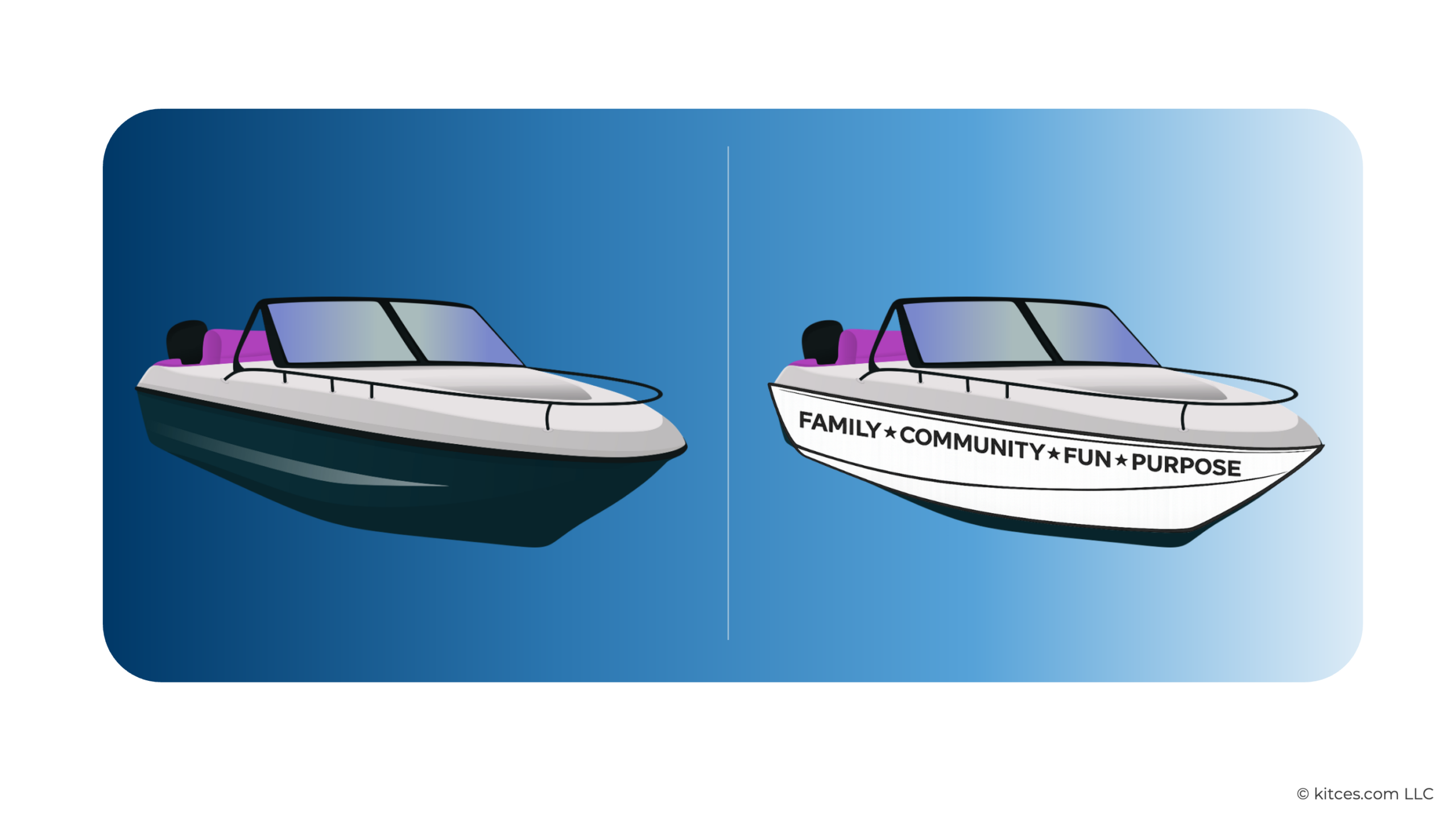
And it doesn't help that, rightly or wrongly, people often assign moral weight to different motivations. Buying the boat for family time may be considered generous or family-centered. Buying a boat because everyone else on the block – or in the C-suite – has one may be seen as shallow or status-driven. Whether either interpretation is actually fair is a different point of discussion. But when one motivation is seen as more socially acceptable than another, clients may be less likely to admit what's really driving the goal. (Remember that fear of judgment mentioned earlier?)
Third, there may be misalignment within a couple – or family – about how to use limited time and financial resources, even when the underlying values are shared. For example, both partners in a client couple may value living in a beautiful, restful space. For one spouse, that may mean remodeling their house. For the other, it may mean buying a vacation home. If the couple's financial situation can't support both, someone will eventually have to yield to the other.
And if one spouse tends to be 'in charge' of the finances – which is common in couples with some degree of role specialization – that person may also feel more comfortable explaining their perspective to the advisor. Which means this tension may not surface until years later, when the renovation is actually underway. Or the less engaged partner may gradually disengage even further.
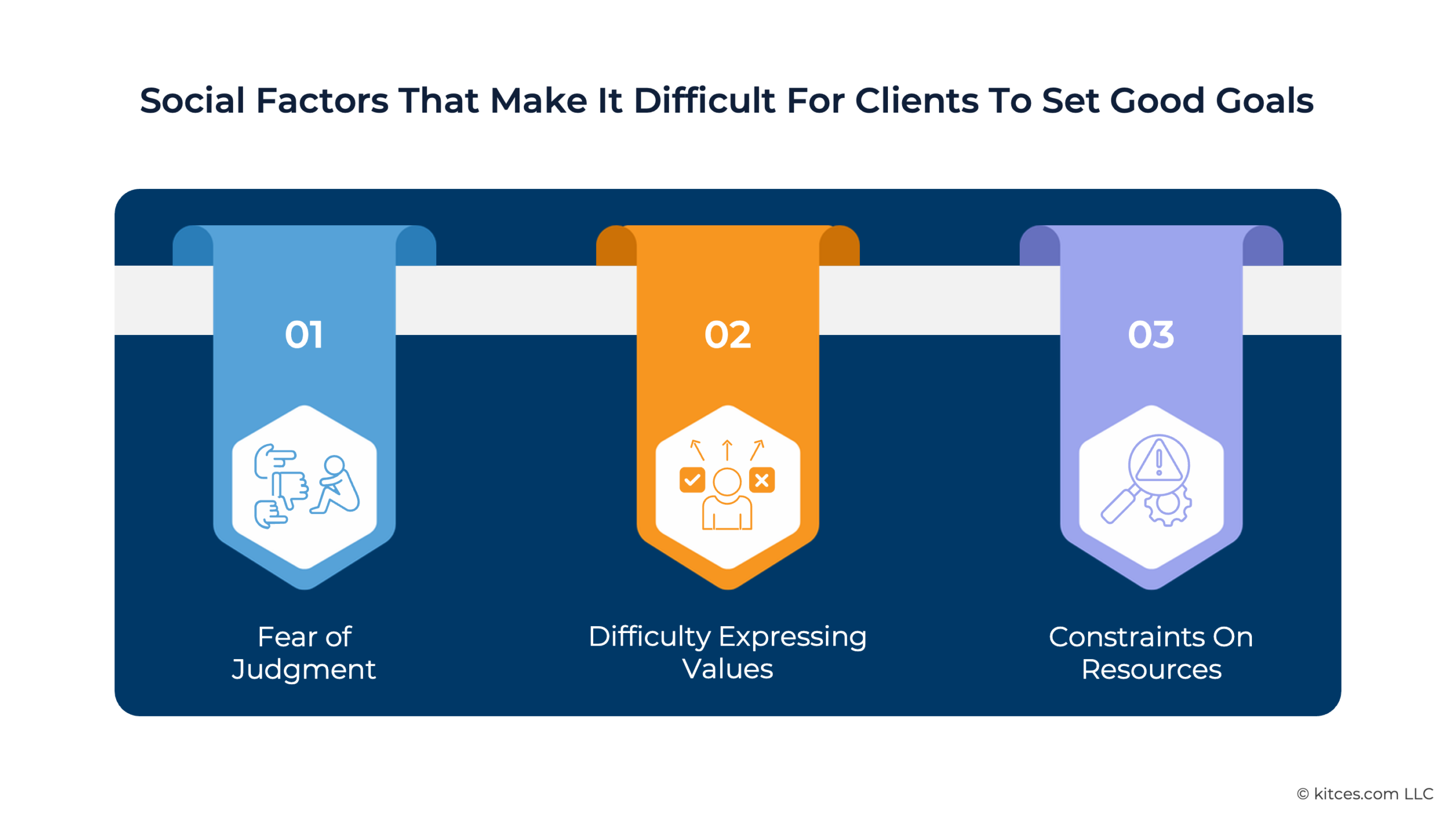
All of this is to say that, while they will bring specific goals to the meeting, clients may have particular goals that actually reflect deeper feelings, values, or desires. And the underlying motivation can be much harder to express, especially in a relationship where trust is still being built.
Psychological Barriers In Discovery Conversations
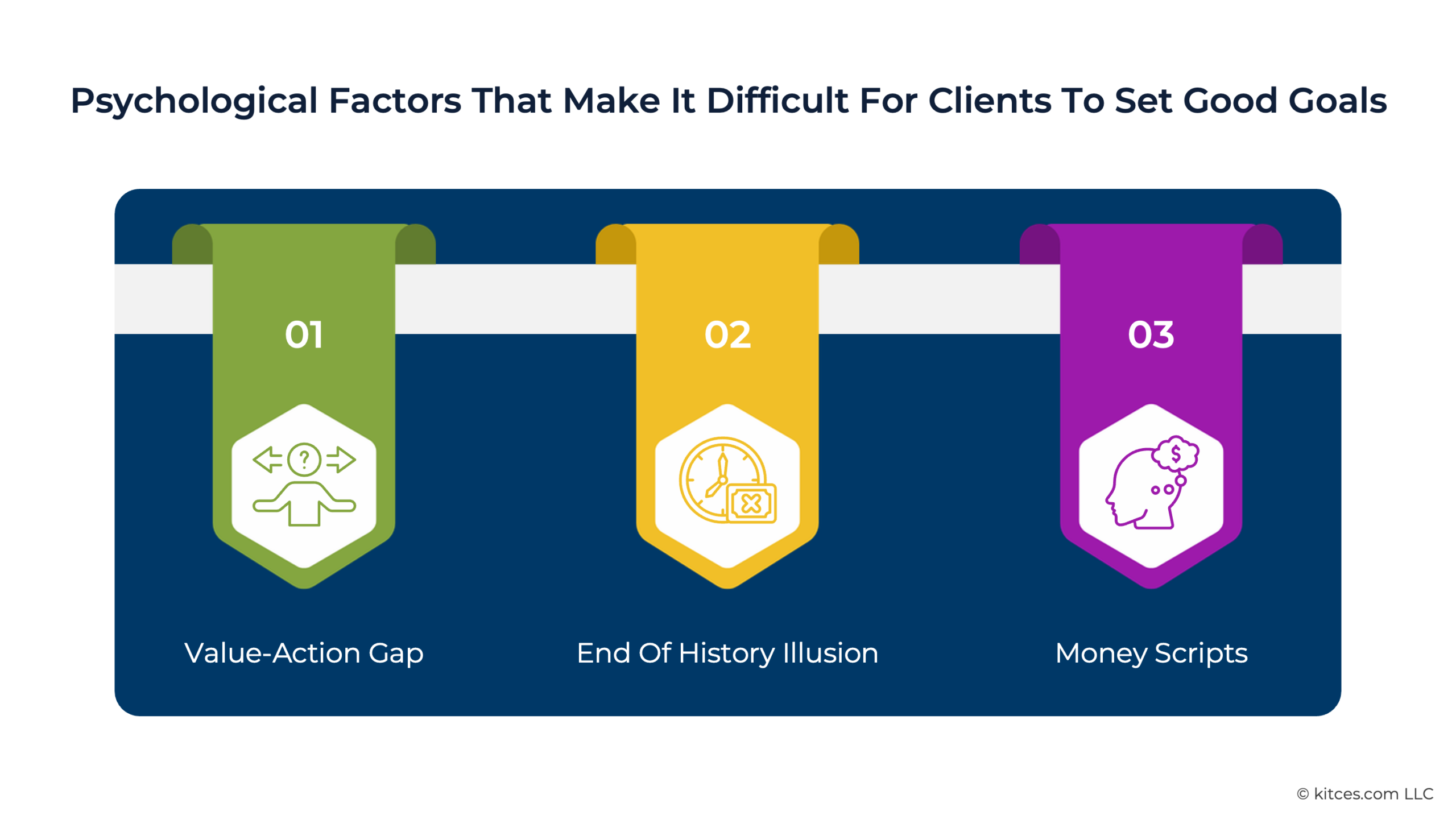
While the factors noted earlier are mostly social, there are psychological patterns that also create their own set of challenges.
The first is the value-action gap: the distance between the goals people say they have and the actions they actually take. For example, a client may say that international travel is a major priority, but they've only ever taken domestic trips. That doesn't mean the client is insincere; a range of factors could explain the gap, from financial constraints to anxiety, logistics, or lack of motivation. But the advisor won't know what's driving the mismatch until they ask.
The second is the end-of-history illusion, which can be summarized as the tendency to believe that the person one is today is largely the same person they'll be in the future. A client may be able to acknowledge that life has changed immensely over the past 20 years, while having a hard time anticipating whether – or how – they'll change over the next 20. Continuing the example above, international travel may be fun and relaxing now, but even if travel remains a priority, the client's preferred destinations and styles of travel are likely to change over time and with age.
The third is money scripts, or the personal stories that shape how a person thinks and feels about money. These stories are often molded in the early years of a person's life, though later life experiences can influence them as well. Sometimes, a client's goals may be less about the goal itself and more about the 'job' they've given money – what spending is meant to represent in their life. Certain purchases, homes, or financial behaviors, for example, may serve as reassurance that they are secure and have 'made it,' regardless of whether that's actually true – or whether the client even enjoys what their money is buying!
Given all the obstacles to clear goal-setting, advisors may wonder what the point is. The reality, of course, is that a client's goals are likely to shift over time as financial values, family dynamics, and personal values evolve. But, to paraphrase Winston Churchill, goal-setting may be the worst form of client discovery – except for all the others. Even when goals change, those that a client raises early in the relationship can still reveal a great deal about what feels emotionally important to them in the moment. They can represent hopes, fears, priorities, and aspirations that matter deeply enough to the client that they're bringing them up early in the process.
Put another way, as poet T. S. Eliot wrote, "It is impossible to say just what I mean!" That may be one of the clearest summaries of both the challenges and opportunities in goal discovery with clients. At the surface level, it can be difficult to tell whether a client is describing a deeply held and well-formed goal, a high-level aspiration, or an underlying money script they haven't yet fully examined. Which is where good follow-up questions come into play.
This is what makes discovery meetings challenging – and valuable. The work isn't just about getting clients to name a few goals; it's about helping uncover what those goals really mean. Without strong follow-up questions, it's hard to distinguish between a deeply felt priority and a vague aspiration, or to understand what's really driving the client's stated objectives. And without that clarity, it becomes difficult to prioritize goals effectively or help co-create a future that feels genuinely fulfilling to the client.
Using The CLEAR Framework To Clarify Client Goals
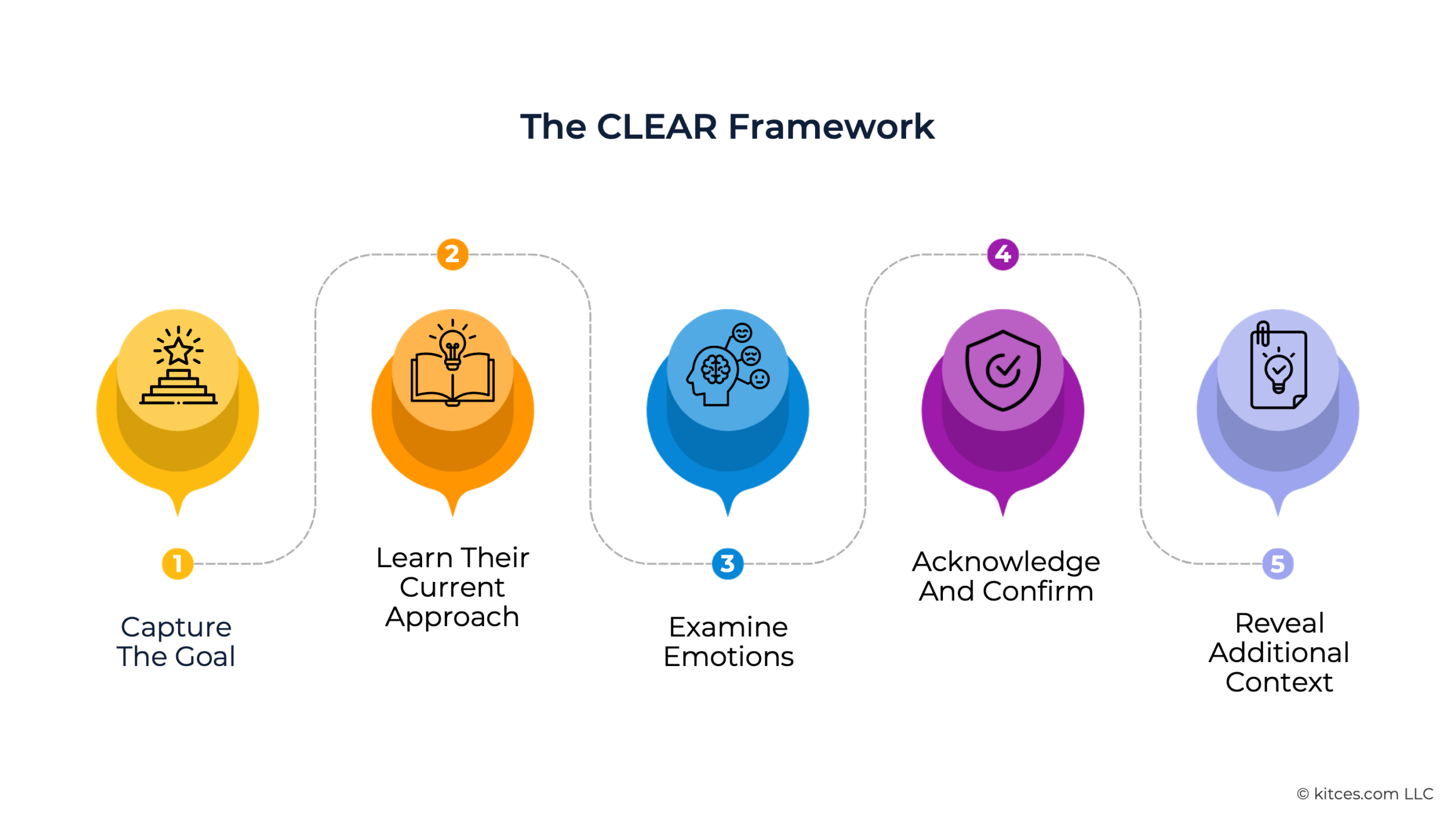
When clients talk about their goals, one challenge for advisors is figuring out what those goals actually mean beneath the surface. To help with that process, the Kitces Training Course on Facilitating A (More) Effective Discovery Meeting Process (developed by Michael Yoder, Jonathan Dursteler, and Apoorva Sehgal) introduced the CLEAR Process: a five-step discussion framework designed to help advisors use follow-up questions and reflective statements to better clarify what matters most to the client.
The five steps of the CLEAR Process are:
- Capture The Goal
- Learn Their Current Approach
- Examine Emotions
- Acknowledge And Confirm
- Reveal Additional Context
Each step is discussed in more detail below, but the broader aim is to gather as many details from the client as possible – not just about what they want, but also why it matters to them. Which can make the CLEAR Process especially useful for big-picture, big-emotion goals – without being too overwhelming for the client. It begins with the first step: Capture The Goal.
Capture The Goal
The first step of the CLEAR Process, Capture The Goal, is all about understanding the goal in practical, concrete terms. Say that an advisor, Alison, is working with a new client, Prue Baker. One of the very first goals Prue identifies is education planning: she wants to help pay for her son Paul's college expenses.
This step is about asking basic logistical questions – what, when, where – to establish the broad shape of the goal. When is Paul expected to begin college? Where? How much is it expected to cost?
Most of these questions are relatively straightforward and logistics-focused. At the same time, the advisor may want to reassure the client that getting exact numbers right away isn't the goal here. Rather, this step is simply about clarifying the client's vision and expectations at a more specific level than broad statements such as "pay for college" or "travel more".
Objective: Capture the general goal
Potential questions to ask:
- Tell me more about what this looks like.
- Can you describe the timeline?
- What do you anticipate this looking like on a practical level?
Learn Their Current Approach
Some goals are practical, grounded, and already underway, while others are more aspirational. Both can be important, but it's important for the advisor to understand which kind of goal is being discussed.
Returning to the example above, suppose Prue already has a funded 529 account set up for her son. That would naturally lead to follow-up questions about how much has been saved, how much more she hopes to contribute, and whether any other support may be available from extended family. For example:
Alison: What has already been done to prepare for your son's college education?
Prue: We've invested $XX,XXX in a 529, which I think would cover about a year of school if he stays in-state. We had hoped to save more, but I had a few tough years where I struggled to find steady work, so I'm only now getting things back on track.
Questions about a client's current approach can be particularly useful because they reveal not only what the client has done so far, but also what the client believes is still missing from the plan.
At the same time, these questions can also reveal when a goal is more aspirational than actionable. And that, in turn, can signal an opportunity to explore the underlying motivations driving that goal more deeply. In some cases, it may even open the door to reframing spending as experiments that help clients 'sample' aspects of a future goal before fully committing to it.
Objective: Understand what the client is currently doing – or not doing – to work toward their goal.
Potential questions to ask:
- What has already been done to prepare for this goal?
- What progress has been made toward this goal so far?
- Have you started preparing for this? If so, what's been done?
Examine Emotions
Up to this point, the advisor's questions have focused largely on logistics. Now, it's time to pivot slightly to how the client feels about their current progress toward the goal.
A question as simple as, "How do you feel about where you stand in relation to this goal?" can be a powerful way to open this part of the discussion. It often brings out pieces of a client's broader financial story. While few clients open up about their entire financial history in a single discovery meeting, this can be an especially useful moment for gathering meaningful context.
It can be helpful to keep questions as neutral as possible, so advisors don't accidentally impose their own assumptions on the conversation. Rather than implying that the client has overfunded or underfunded the goal – unless the client has already framed it that way – the advisor can simply invite the client to reflect on how they feel about their progress.
For example:
Alison: How do you feel about your progress on education funding so far?
Prue: I mean, we know it's not enough to pay for Paul's school outright. We're hoping to at least give him a year or two to get himself organized. It's funny – on the one hand, I want to send him off with more. My goal is to give him the best future possible. On the other hand, I didn't really get any parental support for school, and things worked out for me – though school was much less expensive then. I keep telling myself we're doing our best to set him up, and that every bit counts! Besides, you never know what scholarships he might earn.
In just a few sentences, Prue reveals a range of emotions – nervousness, hope, pride, and even some lingering ambivalence. These emotions signal where future buy-in, motivation, or even resistance may emerge.
The point of examining emotions is to listen for how the client feels about their goal and what those feelings might suggest about its importance, the client's confidence, and their readiness to act. Guilt, excitement, passion, pride, and optimism are all useful clues about how the client relates to their goal – and about how the advisor might best support them moving forward.
Objective: Gain a broader understanding of the client's underlying emotions behind their goal.
Questions to ask:
- How do you feel about your progress toward this goal so far?
- How do you think it will feel to achieve this goal?
- What are you most looking forward to with this goal?
Acknowledge And Confirm
By this stage, the advisor has gathered several key pieces of information – the general goal, the client's current approach, and the client's feelings about any gaps. At this point, the client has covered a lot of emotional and logistical ground, so this can be a good moment to pause and make sure both sides are on the same page.
This is where the advisor can take a more active role:
Alison: Okay, this has been really fantastic. Let me just summarize what I've heard, and please let me know if I've missed anything. You currently have $XX,XXX saved in a 529 account for Paul, with plans for him to attend an in-state school like WKU or U of L. That amount will probably be enough to pay for one year of college, but there are still a lot of unknowns around scholarships and student aid. Does this sound about right?
Prue: Yes, that sounds exactly right. I guess one thing I'd add is that Paul can attend an out-of-state school – I just don't want him to have too much student loan debt.
This a valuable moment to show the client that the advisor has been actively listening. When possible, it can help to reflect back the client's own language, key concerns, or emotions they've expressed. This also reduces the risk of the advisor reading their own emotions or judgments into the conversation. There will be time later to assess whether the goal is quantitatively on track. For now, the more important task is to clarify what 'on track' actually means to the client.
Objective: Reaffirm that the client and advisor are on the same page with the information that has been discussed so far.
Reveal Additional Context
Once the client and advisor have confirmed that they're on the same page, the advisor can close out this part of the conversation with a simple question: "What else?"
This type of question can help surface additional details that may have been omitted earlier in the discussion, from additional family logistics to potential contingencies that could affect the goal. And if the advisor notices some tension – either within a client couple or between the client's stated goal and their current behavior – this can be a good opportunity to invite more context without forcing it.
Objective: Give the client a chance to highlight anything else that may be relevant to the goal.
Questions to ask:
- Are there any other details we should know about this goal before we move on?
- Is there anything else about this topic that I should have asked?
- Are there any other factors that could affect this goal?
Bringing It All Together
Once every step in the CLEAR Process has been completed, the advisor should have a much clearer picture not just of the client's goal, but also of the motivations, concerns, assumptions, and questions shaping it. Which can better prepare the advisor for a better plan presentation meeting or whatever step comes next in the planning journey!
How To Use The CLEAR Process Well
The CLEAR Process is only one part of a broader discovery meeting, and it will be most successful when the overall discovery meeting is structured thoughtfully. In practice, this often begins with setting expectations in advance – especially in the early stages of the advisor-client relationship.
One way advisors can do this is by sharing a simple agenda in advance via email. This can help clients understand what the meeting will cover, what kinds of topics may come up, and what they should expect from the conversation. While discovery meetings vary in length, here is an example of a pre-meeting email that sets expectations for a 60-minute discovery meeting:
Hello [Client Name(s)],
I'm excited to meet with you on [Date] and [Time]. Here is the link to access our meeting: [Link]
These get-to-know-you meetings usually last about an hour. The main objective is to learn more about your goals and what's important to you. We'll talk through your retirement goals, [anything else mentioned in client intake], and any other pressing issues on your mind.
You don't need to bring anything with you – just come prepared to discuss some of your goals and anything you'd like me to know about you. At the end of the meeting, we'll discuss next steps.
Let me know if you have any questions. See you [day of the week]!
[Advisor Name]
While the CLEAR Process is not named explicitly in the agenda, the implicit groundwork is still being laid for a deeper exploration of the client's goals. And when it comes to using the framework well, advisors don't need to follow it rigidly. The suggested follow-up questions and language are meant to provide support, not a script. Over time, most advisors will develop their own rhythm for asking questions and gathering the data and context they need. The CLEAR Process can serve as a useful touchpoint, but it doesn't need to be followed mechanically if the conversation is unfolding naturally.
Advisors can also pay close attention to the client's phrasing or body language, all of which can indicate that there may be more beneath the surface to ask about. Some goals will naturally be more complex or emotionally charged than others, and those may require more time and care.
And just as importantly, it can help not to rush in too quickly to fill the silence after asking questions. Many of these are big questions, and clients may need a moment to think. If all else fails, the advisor can silently count to 20 before rephrasing the question or moving on. As the client responds, the advisor can continue to affirm what they're hearing through simple, reflective rephrasing, follow-up questions, or occasional closed-ended questions that confirm understanding. During this stage of the meeting, the goal is to create enough structure and space for the client to keep talking so the deeper meaning behind the goal has room to emerge.
Following Up After The Discovery Meeting
Discovery meetings are naturally busy meetings, with a lot of personal information uncovered, initial tasks, and multiple threads of discussion emerging all at once. When used, AI meeting notetakers can be especially helpful for capturing key discussion points, action items, and follow-up.
It can help to send a follow-up email within 24 hours. The email can briefly reinforce what the advisor will be doing next and what the client is expected to do in the meantime. And because clients can usually focus on only a few action items at a time, it can also be a good idea to keep the ask limited to what's most important. Many of the topics discussed in the meeting may matter, but not all of them will be equally urgent.
For example, an advisor might follow up with an email like this:
Hello [Client Name(s)],
Thank you again for meeting [yesterday]. It was great to get to know you better and learn more about your goals. As we begin building your financial plan, we'll be integrating the details we discussed into our analysis. At our next meeting, we'll take a closer look at how your goals fit into the broader plan and how everything works together. In particular, we'll focus on [goal 1] and [goal 2], and we'll come prepared with some options for us to discuss.
Before we meet on [date], here is what we need from you:
- [Action Item 1, and why it's needed]
- [Action Item 2, and why it's needed]
Let me know if anything else comes to mind while we are working on this initial version of your financial plan. Otherwise, I'm looking forward to continuing the conversation on [date].
Thank you,
[Advisor Name]
Messaging like this can reassure the client that the advisor understood what mattered most in the meeting – and that those goals are going to be included in the plan. Which can set the groundwork for motivating the client to complete their action items, so that the financial planning process can keep moving forward!
Ultimately, the key point is that a well-run discovery meeting is not just about identifying a client's goals, but about understanding what those goals mean. When advisors go beyond surface-level goal capture and explore a client's underlying motivations, emotions, and assumptions underneath, they are often better positioned to prioritize what matters most and shape more meaningful recommendations that can fuel far more productive meetings – and stronger relationships with clients in the long-term!
Jonathan Dursteler, Curriculum DesigNerd at Kitces.com, consulted on this article.
Want to learn more? The Kitces Training Course on Facilitating A (More) Effecitve Discovery Meeting Process provides 6 hours of in-depth, CE-eligible training on running effective discovery meetings.





Leave a Reply