
Executive Summary
Senior advisors occupy a uniquely high-impact role within advisory firms. Typically responsible for leading client relationships, driving business development, and mentoring team members, they represent both a firm's revenue engine and its client experience core. Yet precisely because senior advisors develop portable skills – particularly prospecting and relationship management – they also have options: move to another firm, negotiate a richer package elsewhere, or launch their own practice. For firm owners, the challenge is not merely recruiting this talent… but also creating an environment and incentives compelling enough to retain their advisors.
In this article, Senior Financial Planning Nerd Sydney Squires discusses the newest Kitces Research on What Actually Contributes To Advisor Wellbeing and how advisory firms can create work environments and compensation structures that increase advisor satisfaction and long-term retention.
There are four primary factors that make a difference for senior advisors: compensation, equity, a team structure that minimizes administrative work, and a solid culture and work/life balance. While firms cannot manufacture a universally 'perfect' senior advisor role, they can focus on the factors that most consistently move the needle for advisors through the lens of the firm's resources and mission.
Regarding compensation, higher income is associated with higher wellbeing (though there are diminishing returns beyond roughly $250,000!). However, beyond base compensation, the compensation structure makes an immense difference. Advisors with at least some variable compensation tend to report higher wellbeing and significantly higher earnings than those on purely fixed salaries. Variable pay reinforces autonomy, aligns incentives with firm growth, and rewards business development skills. The most effective designs strike a balance – providing enough stability to reduce financial anxiety while preserving upside tied to client relationships or firm performance. Even modest variable components can meaningfully enhance both satisfaction and earning potential.
Beyond compensation, equity opportunities have an outsized impact on retention. The mere presence of a credible path to ownership substantially reduces a senior advisor's likelihood of leaving. Advisors without ownership opportunities report lower wellbeing and materially higher anticipated turnover, while those with future equity potential are far more likely to envision a long-term future within the firm. Structurally, firms approach equity in different ways – granting ownership based on client development, allowing buy-ins at fair or discounted valuations, or phasing in partnership over time. Excessive barriers may unintentionally push ambitious advisors to seek ownership elsewhere, including by launching their own firms, but firms that offer a path to equity that is clear, attainable, and aligned with the advisor's worth can ensure long-term retention.
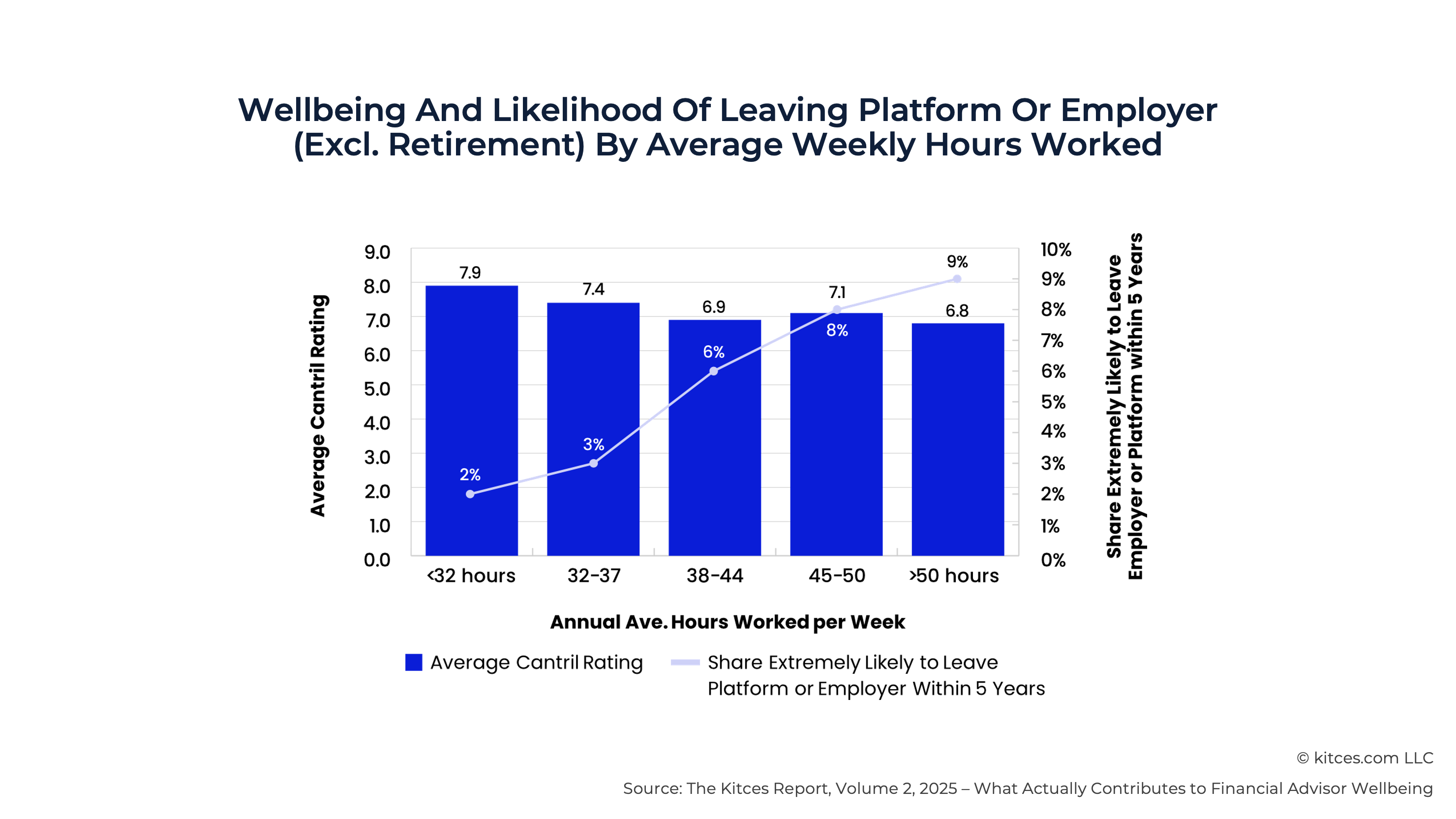
Operational structure and culture further shape the day-to-day experience of senior advisors. Firm size itself is less important than team design. Advisors supported by associate advisors and client service staff – particularly within ensemble structures – report higher wellbeing than unsupported solos. The dividing line often comes down to administrative burden: the more time advisors spend on compliance and paperwork, the lower their satisfaction; the more they can focus on client relationships, strategic planning, and prospecting, the higher their engagement. At the same time, traditional performance metrics such as clients served, revenue per advisor, or hours worked exhibit diminishing returns on advisor wellbeing. Workweeks extending materially beyond roughly 38 hours correlate with increased likelihood of turnover, even if wellbeing scores remain superficially stable. A sustainable workload and authentic firm culture – where mission, compensation, structure, and expectations are aligned – form a cohesive value proposition that attracts advisors who resonate with that model.
Ultimately, senior advisor retention is all about intentional design: variable compensation with stability, a realistic path to equity, strong team support that minimizes administrative drag, and a culture that protects work-life balance. Together, these create an environment where senior advisors can thrive. No firm will appeal to every advisor, but firms that clearly articulate their model and align their structure with their mission are far more likely to attract and retain advisors who see that vision as their own. When senior advisors find the right blend of autonomy, opportunity, and support, they do not merely stay – they build, grow, and contribute at the highest level, strengthening both the firm and the clients it serves!

As the saying goes, good talent is hard to come by, and this is perhaps especially true among advisory firms. There is no fast track to recruiting, training, and retaining advisors – particularly at the senior level, which typically offers greater responsibility and compensation. Advisory firms either spend years developing them internally… or are developing compensation packages to recruit them from other firms. According to a 2024 RIA Benchmarking Study from Schwab, approximately one in three firms recruit from other RIAs when hiring.
In this vein, "senior advisor" can mean many things in the financial services industry. In this article, "senior advisor" refers to non-partner advisors who are primarily responsible for client relationships. They may lead a small advisory team and are likely to have a degree of prospecting responsibilities. Altogether, they typically have 10+ years of experience and earn a median of $260,000 (more on that later). While there are no 'low-stakes' roles at advisory firms, senior advisors are particularly high-impact, both to the servicing of clients and to the economic success of the business itself.
Most senior advisors must prospect, onboard clients, and lead client relationships as a part of their role – they are crucial to client services and business development. Advisors who develop and master these skills have a multitude of options. They can stay and build at their current firm, leverage their skills at another firm, or put their business development skills into practice and open their own firm. The latter decision in particular can create a real cashflow risk for advisors, as they could potentially take a not-insubstantial portion of the firm's clients with them to their new firm (even as conversations abound about who really 'owns' the client relationship). This, in turn, creates risks for a firm's revenue, cash flow, and growth. And even if the senior advisor cannot take clients with them, they at least have the business development skills to start over at another firm – or their own.
Firms respond to this risk in a variety of ways. The first are non-competes or similar contractual restrictions, which can be difficult to enforce… whether due to state law or the reality that a firm has no real mechanism to 'force' a client to remain if they wish to work with their old advisor at a new firm. The second is to ensure that advisors who develop these skills are incentivized to stay and grow as much as possible. For the latter, advisory firms are competing not only against other existing firms but also with the advisor's own business development skills to create a compelling reason to stay and build within a specific firm!
What Actually Makes A Difference In Advisor Satisfaction?
Senior advisor recruitment, training, and retention are all different sides of the same coin: workplace satisfaction. This concept is measured and discussed in Kitces Research on What Actually Contributes To Advisor Wellbeing. In this newly-released survey, advisor survey respondents scored their wellbeing on what's called the Cantril Ladder – for the purposes of this discussion, on a scale of 1–10. A score of 5 or below constituted an "Unwell" advisor, 6–8 was "Typical", and those who rated their lives at a 9 or 10 were categorized as "Thriving".
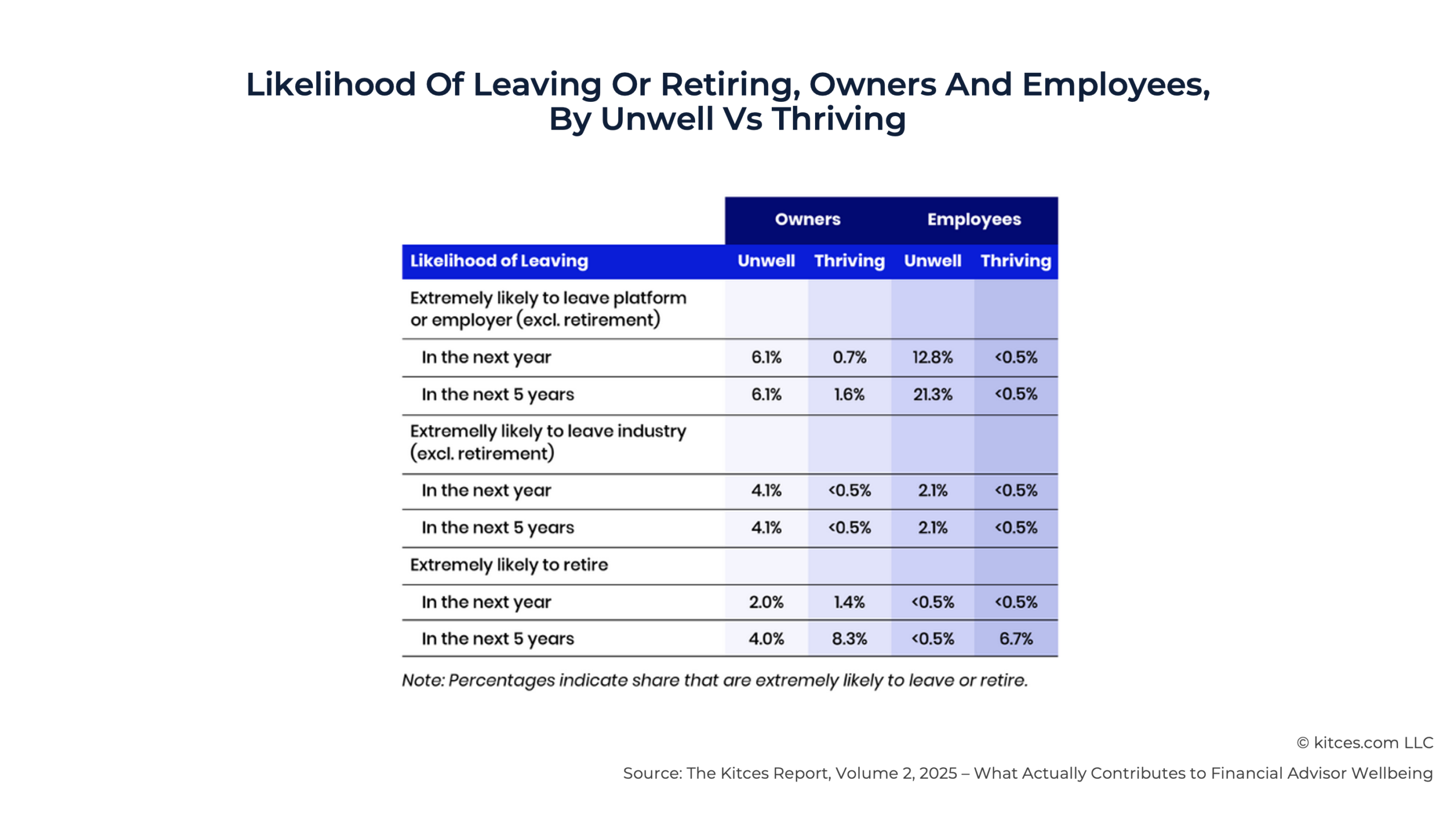
Wellbeing matters for more than 'just' altruistic reasons. The lower a team member's wellbeing, the more likely they are to leave their employer (or profession) for reasons other than retirement. For example, 12.8% of Unwell employees reported they were likely to leave their employer within the next year – compared to less than 0.5% of Thriving advisors. In other words, advisors who are satisfied with their workplace don't want to leave it!
While what matters most to advisor wellbeing will be unique to each individual, the Kitces Wellbeing Research delineated 5 core traits that correlated with a higher overall wellbeing:
- Experience – primarily, years of experience.
- Workplace Fit, which includes satisfaction with the tech stack, working in the desired environment, team support, and having a firm that lives out its mission and values.
- Autonomy, such as having control over schedule and a path to ownership within the firm
- Revenue Per Hour, which is influenced by factors like client affluence, allows advisors to work a sustainable number of hours while maintaining a high income
- Having Enough, such as prioritizing lifestyle over business growth and annual income
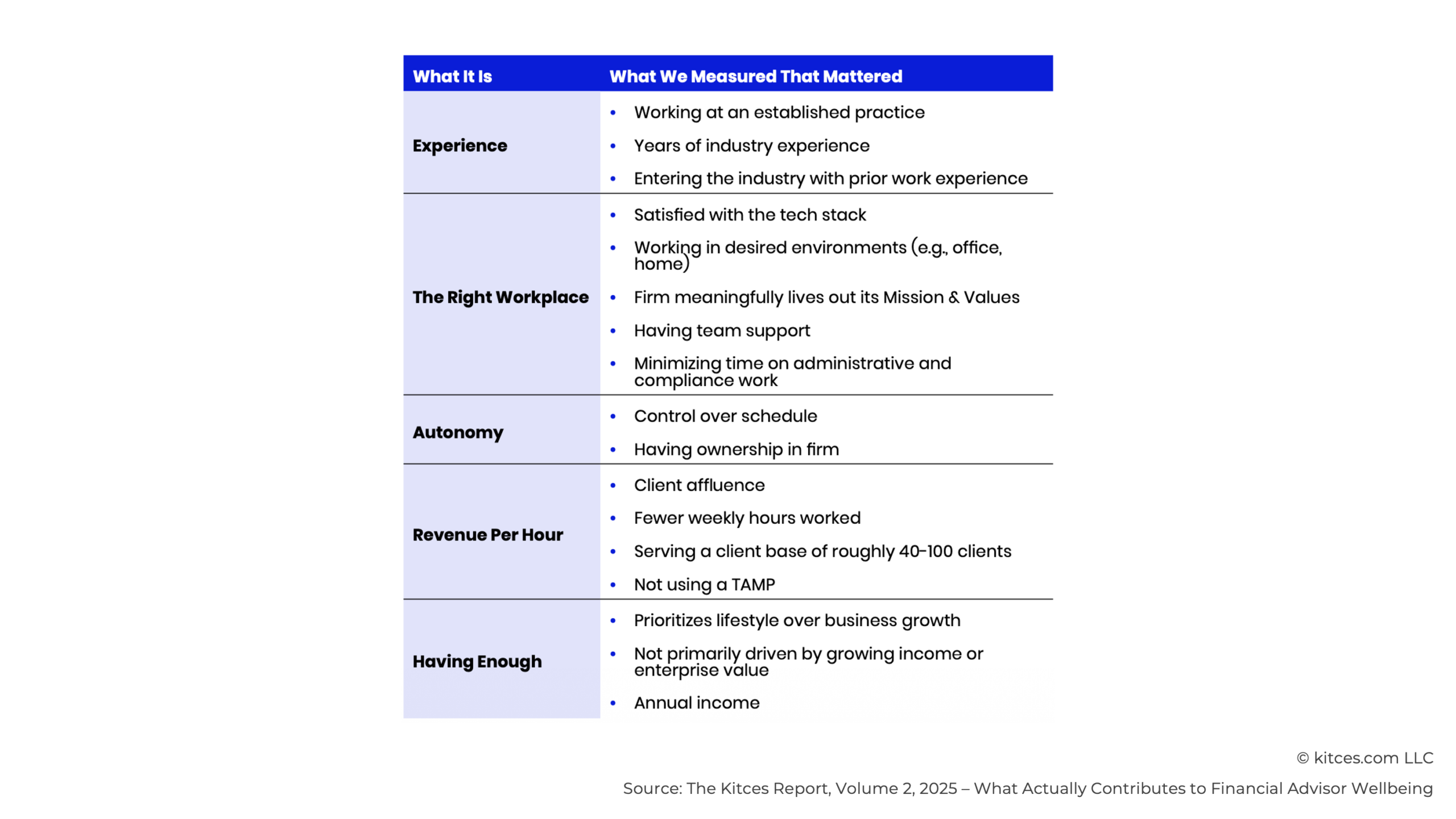
Put another way, firm leaders constructing the ideal workplace to retain senior advisors are balancing structure, opportunities, and team support against process drag and overwork. Yet the data suggest that by and large, firms do fairly well with providing this structure to senior advisors, who are certainly more satisfied than many of their peers. Only 9% of senior advisors are Unwell (scoring 5 or below on the Cantril Ladder), compared to 21% of service advisors and 29% of associate advisors. 45% of senior advisors feel they are effective at their jobs and strongly agree they are in control of their schedules. They also earn more than their advisory peers (while working fewer hours) and have more years of experience. In other words, in many ways, senior advisors are the model for advisory wellbeing!
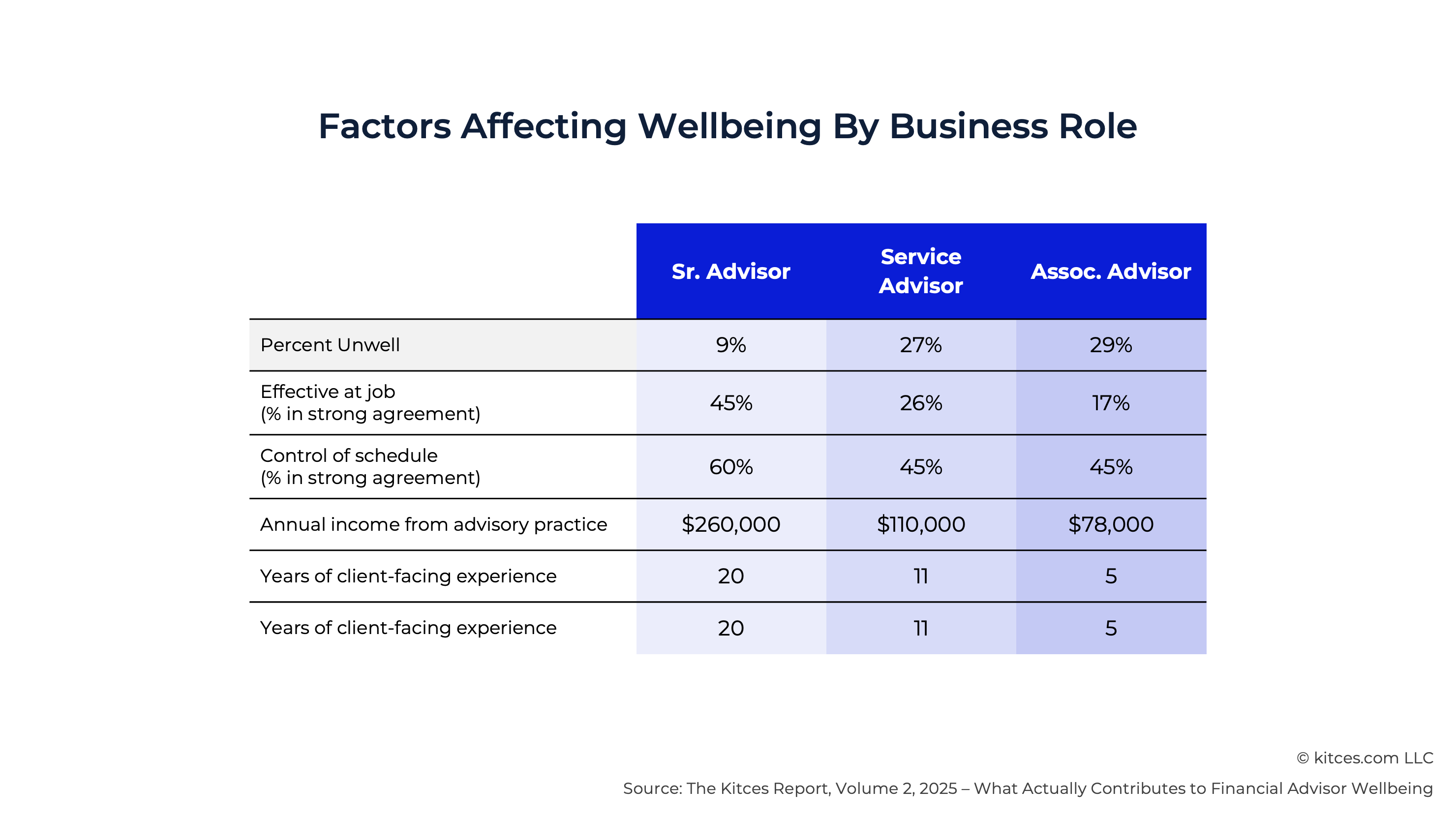
These scores can be interpreted in a few ways. First, yes, advisors who enjoy financial services are more likely not only to stay in the field but also to undertake the considerable work to upskill and become senior advisors. (Career changers also report very high levels of satisfaction, likely because they knew themselves and their inclinations well when selecting their new career field!) Yet perhaps an underrated part of advisor satisfaction is the journey everyone goes through in making a career in advisory services. As time goes on, people gradually specialize, curating the parts of the role and ability that appeal to them… while releasing go of those that don't. This applies to work benefits as well – for some advisors, the tradeoffs of higher compensation are worth the increased demands on time, whereas others value work-life balance above the potential upside of working additional hours.
About Kitces Research
 The Wellbeing Study is one of four original scientific studies – on advisor wellbeing, advisor technology, advisor productivity, and firm marketing – conducted by Kitces Research and shared with Kitces.com readers on a rotating schedule every two years. The most recent Kitces Research study is our look at The Technology That Independent Financial Advisors Actually Use and Like.
Over time, advisors will self-select into the roles that are most fulfilling to them. This means advisory firm leadership cannot design the 'perfect' role for all candidates, as no firm can be everything to everyone. So, the onus becomes determining which elements are going to matter most to senior advisor satisfaction and retention – and which may not move the needle.
The Four Components Of Senior Advisor Satisfaction
While we've seen that many of the factors that lead to advisor satisfaction are deeply personal, for senior advisors specifically, there are four common components that tend to increase satisfaction – and thus, their long-term engagement and retention:
- Variable Compensation
- Opportunities For Equity
- Team Structure To Minimize Admin Work And Maximize Time With Clients
- Work/Life Balance And Firm Culture
We'll discuss each of these components individually.
(Variable) Compensation
When discussing communication, the saying often goes, "It's not just what you say, it's how you say it" – and for senior advisor compensation, that same saying may be, "It's not just what you pay, it's how you pay it".
As a baseline, more compensation is generally associated with higher wellbeing – at least, up to a certain point. The most dramatic increase in wellbeing occurs when advisors earn more than $250K, with average wellbeing rising from 6.7 to 7.47. Notably, employee advisor wellbeing increases by only another 0.03 for senior advisors earning more than $400k, suggesting diminishing returns in compensation after a certain point.
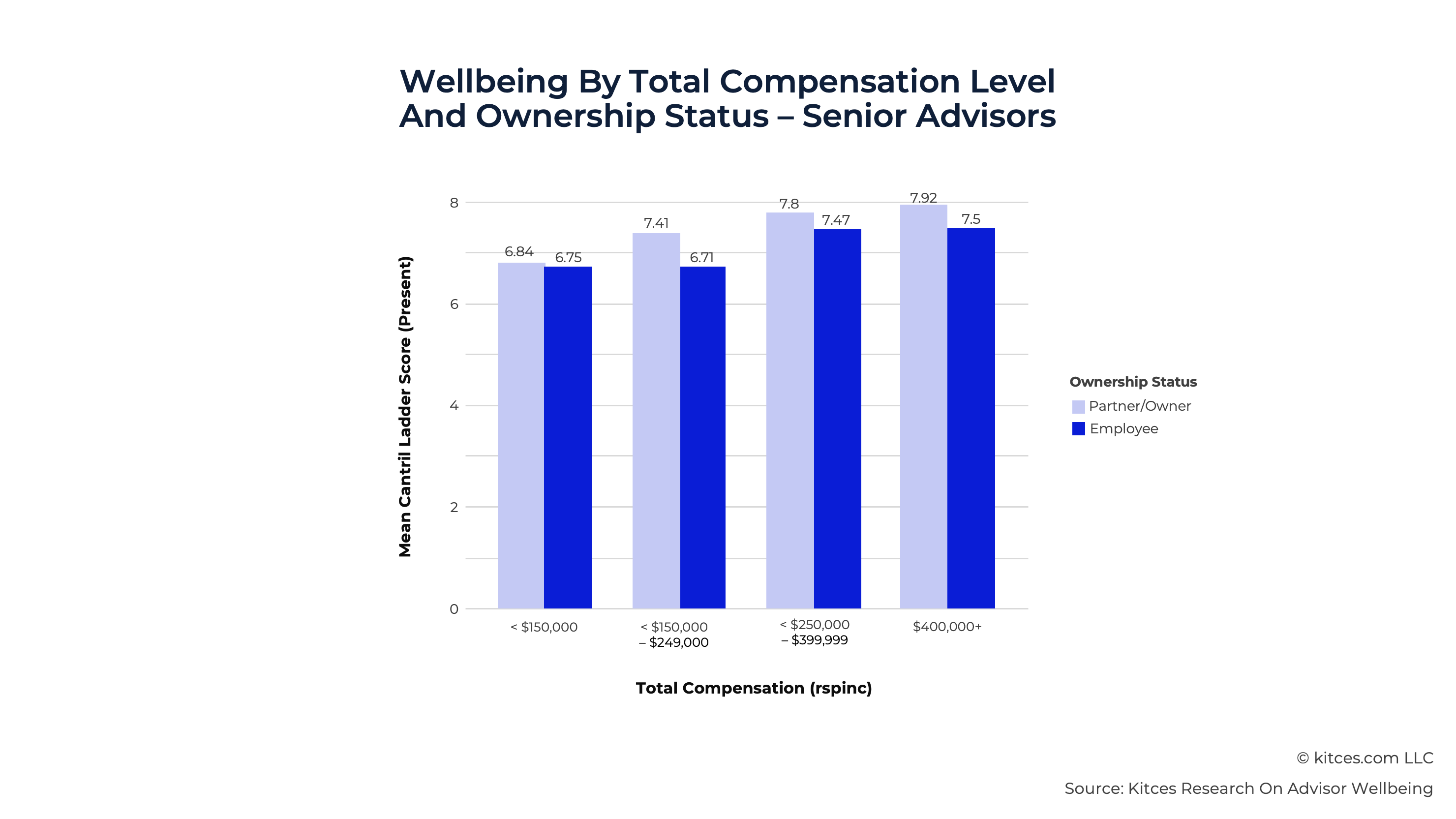
However, there is more to the story than 'just' compensation. Compensation methods, not just compensation amounts, greatly impact an advisor's wellbeing.
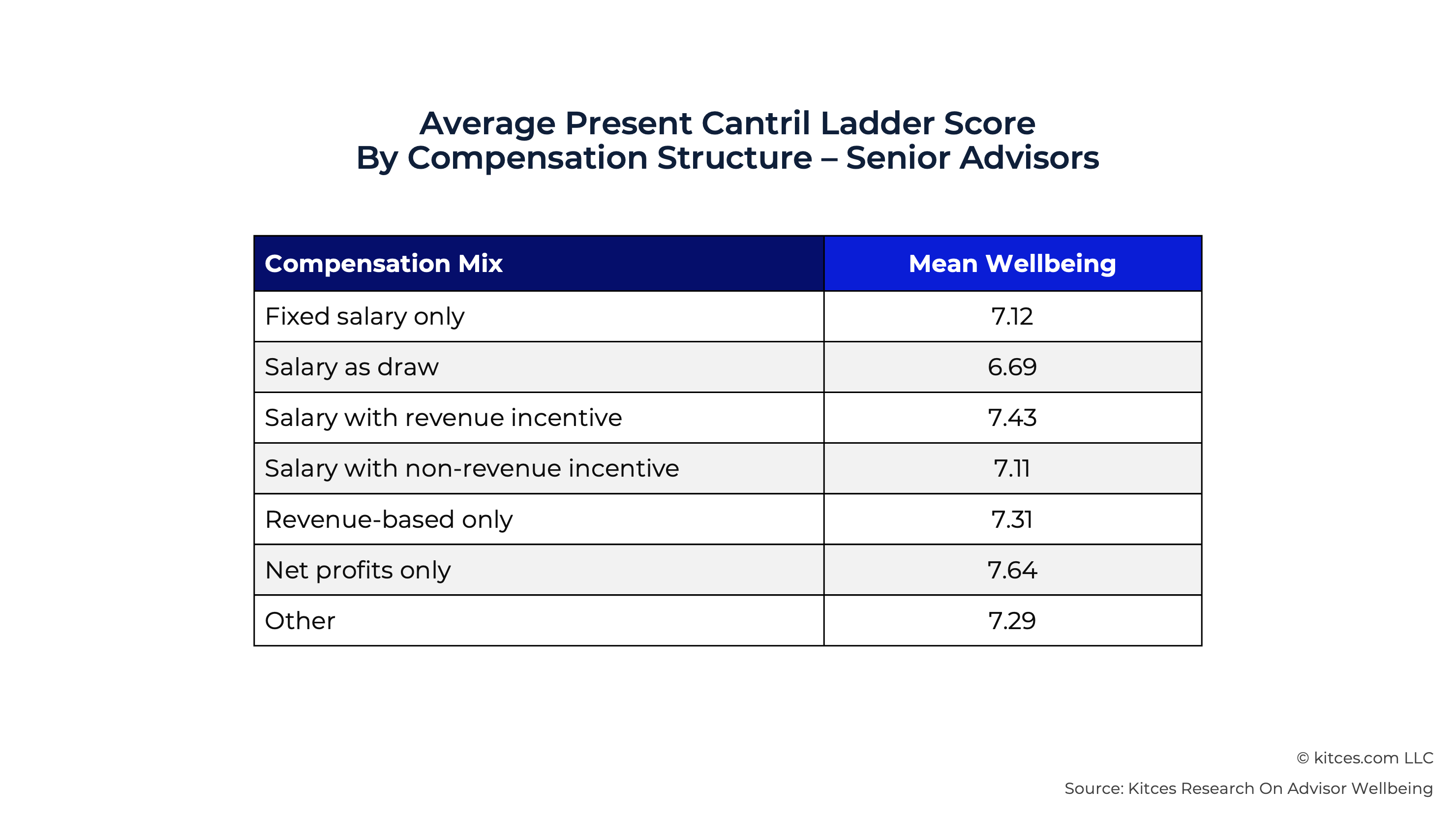
At first glance, compensation via net profits appears to be the clear winner; however, this is only true if the variable compensation ensures the advisor earns above-market rates. If compensation is entirely variable but the advisor earns below median income, then the wellbeing 'boost' from variable compensation is not present, as is shown below. The more junior an advisor is, the lower their well-being will be from variable compensation, because with the possibility of higher compensation comes the parallel risk of lower compensation.
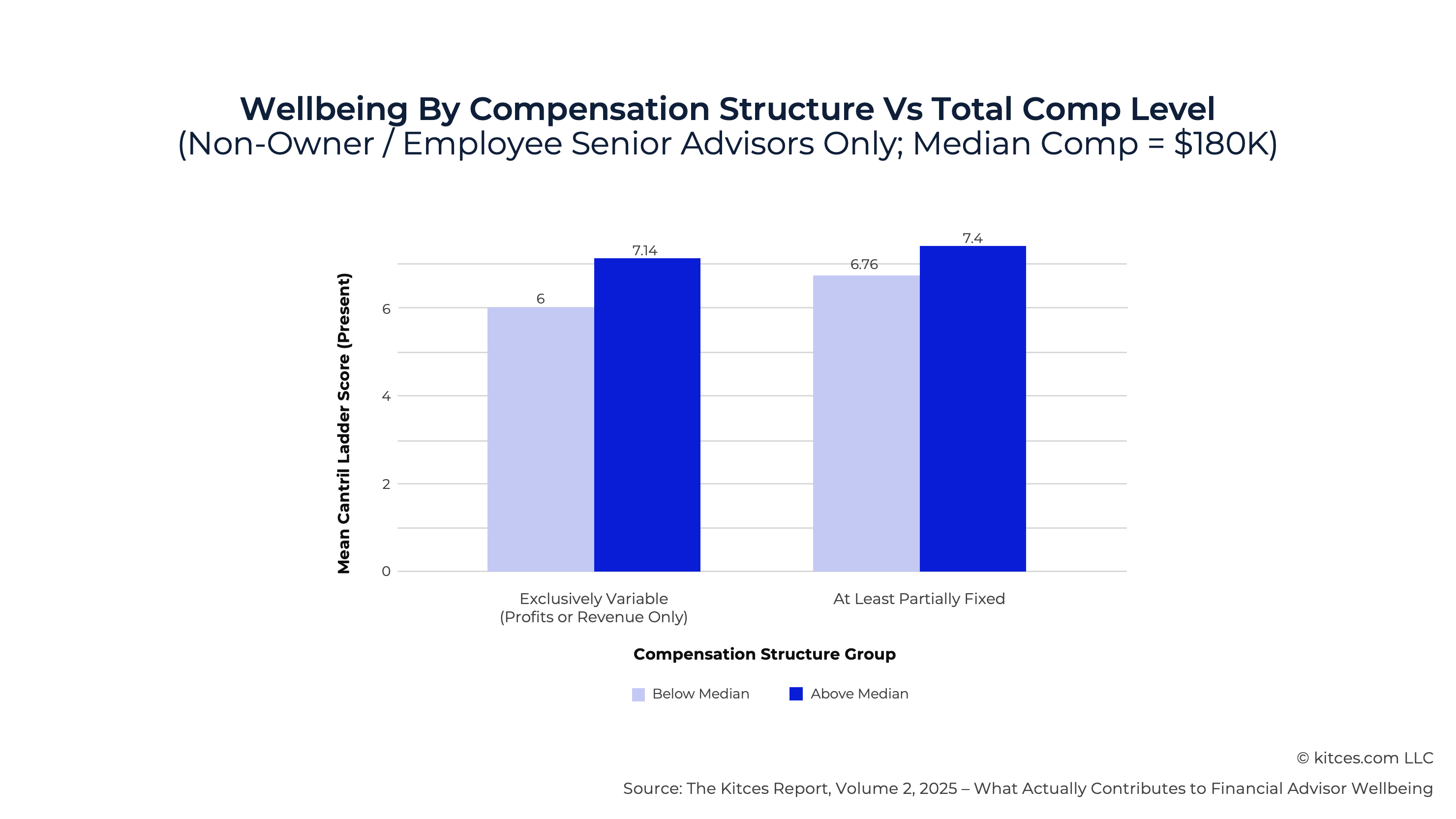
As such, when it comes to variable compensation, advisory firm owners are trying to hit a sweet spot between the advisor's locus of control, motivation, and the potential for undue stress. For example, the advisor who earns solely variable compensation and needs to 'build a book of business' via a phone book will report lower wellbeing and be more likely to leave their job (or profession!). The advisor who has prospecting expectations coupled with a level of stable salary will often report lower stress and higher satisfaction. If an advisory firm wants to remain entirely variable for senior advisor compensation, then ensuring that some of that compensation is tie to broader firm metrics, such as an overall revenue goal, can soften this stress and reaffirm how the advisor fits into the firm's goals at large while still encouraging business-building activities.
That said, advisory firms don't necessarily have to go all-in on variable compensation to increase wellbeing: even some level of variable compensation is enough, according to Kitces Research.
As a part of this dynamic, advisors with at least some variable compensation far outearn their peers. As shown in the graphic below, advisors with mixed compensation earned an average of $75k more than their peers with exclusively fixed salaries.
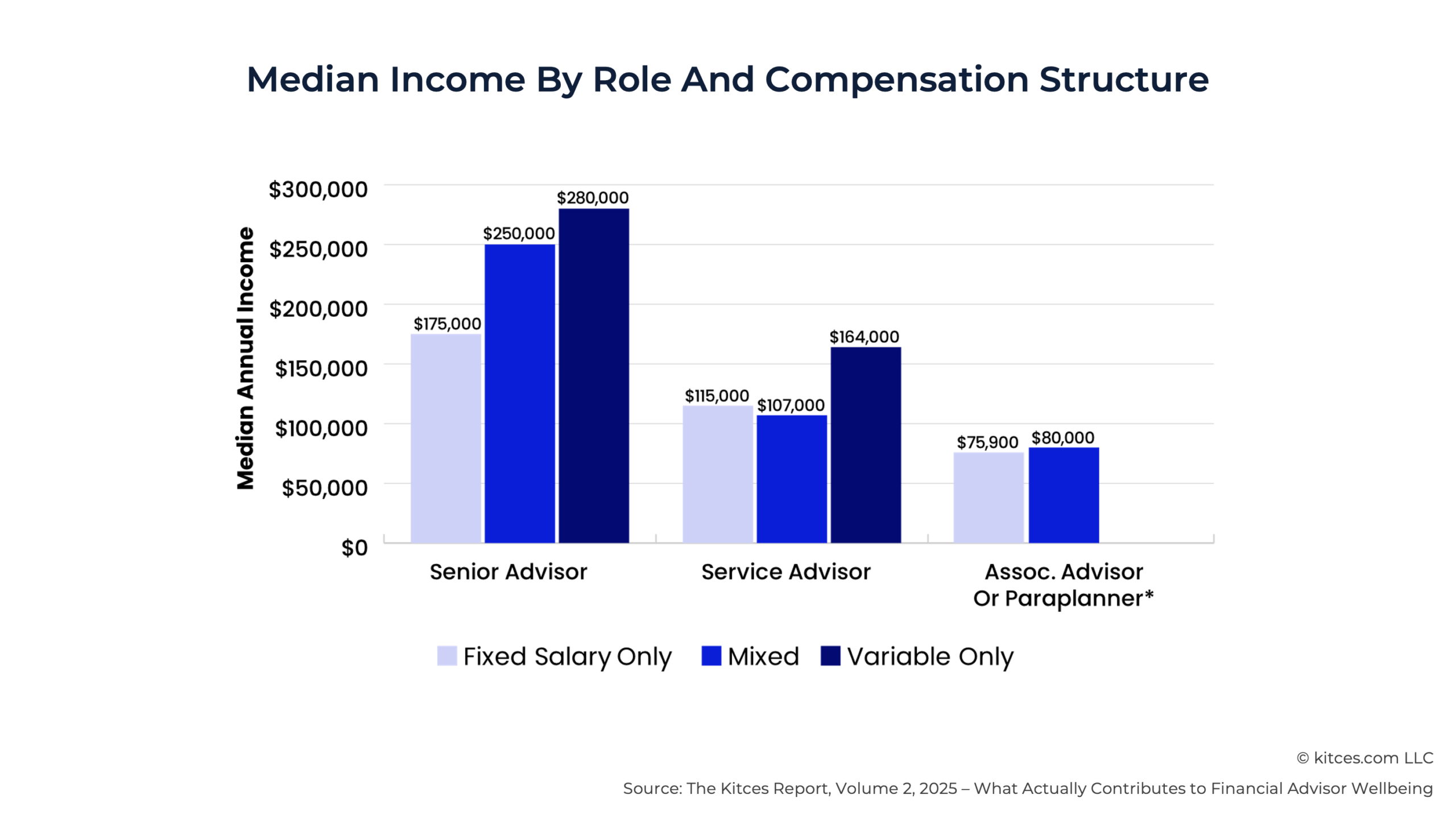
The long and short of it is that, as team members who own client relationships, ensuring that senior advisors have access to at least some variable compensation for their efforts is crucial to their long-term satisfaction – and increasing their earning potential in a scalable way for the firm. After all, if senior advisors' compensation is directly tied to business growth, the incentive to manage more households and responsibilities is much stronger!
Equity Opportunities
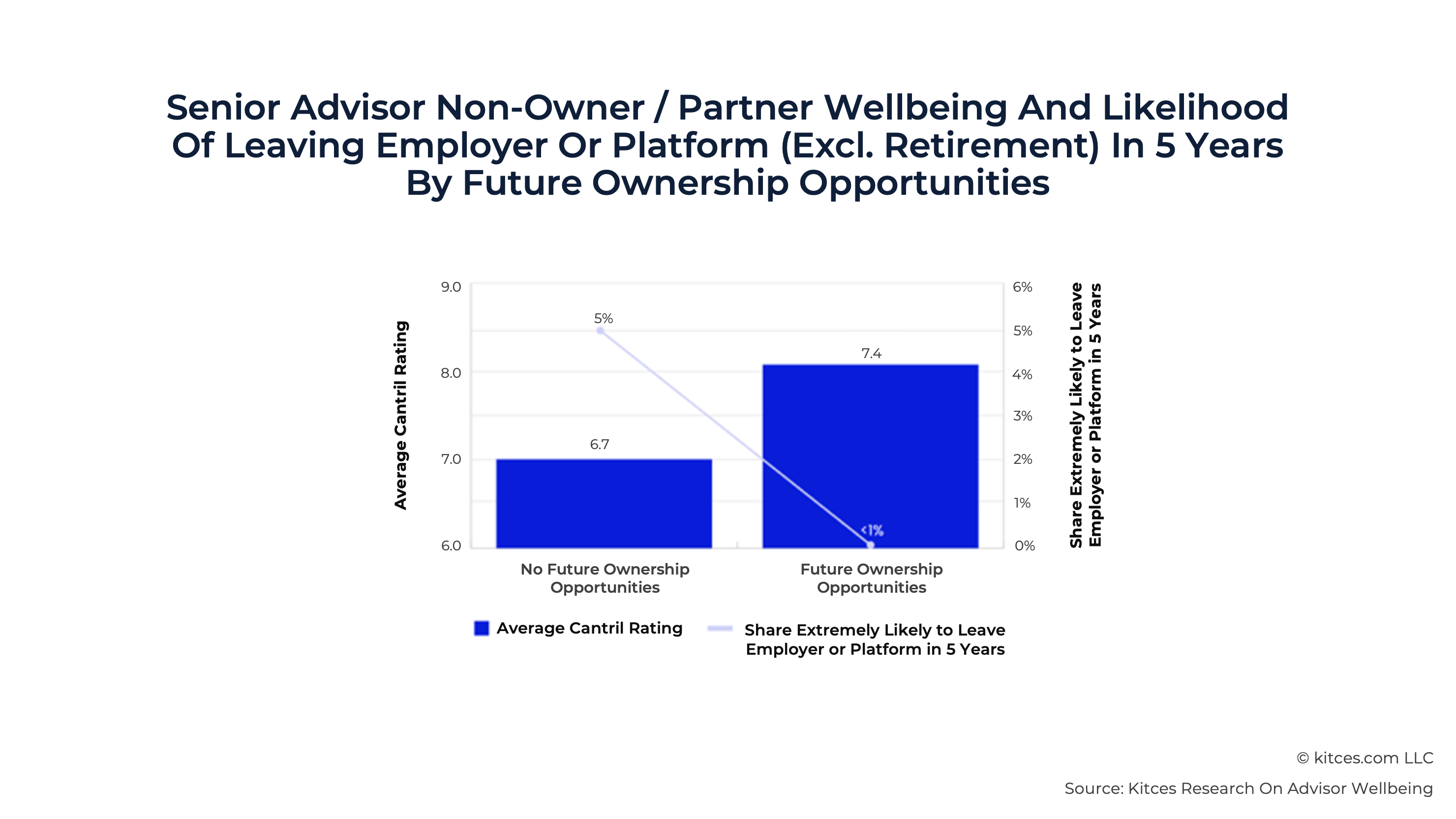
While variable compensation matters significantly to advisor satisfaction, equity perhaps matters more to advisor retention. Even knowing that there is just a potential path to ownership changes how senior advisors consider their future with the firm – and their reported wellbeing. Advisors who have no future ownership opportunities have a lower average wellbeing, and they report a 5% likelihood of leaving their employer within the next 5 years. For advisors with future ownership opportunities, the likelihood of leaving their employer drops below 1%.
Some of this, again, has to do with an advisor's own centrality in the firm's growth. If the advisor is doing business development work, then it stands to reason that they will eventually want something to show for it beyond their compensation.
The bigger question for advisory firm owners is what this looks like structurally. Some firms grant ownership as advisors bring in clients; others allow advisors to purchase their way to equity, either at a discount or full price. The more barriers there are between the advisor and ownership, the less likely it is that advisor employees will pursue it. While some barriers are helpful – owners want to ensure that their partners are committed – if a firm's approach to equity is too stringent, then advisors may seek an opportunity to either buy or build their own equity elsewhere. Ultimately, if firm leadership wants to create a path to ownership that is sustainable and actually attainable – which can help them retain their greatest talent in the long-term.
Team Structure And Minimized Administrative Work
Amidst the many differentials in advisor wellbeing, one factor didn't matter: firm size. This may be a result of some level of self-selection, where those who enjoy large companies seek large firms, and vice versa… but many advisory firm teams have a similar structure: senior advisor, associate advisor, client service associates, and other support staff. And it is this team structure that has a larger impact on advisor wellbeing.
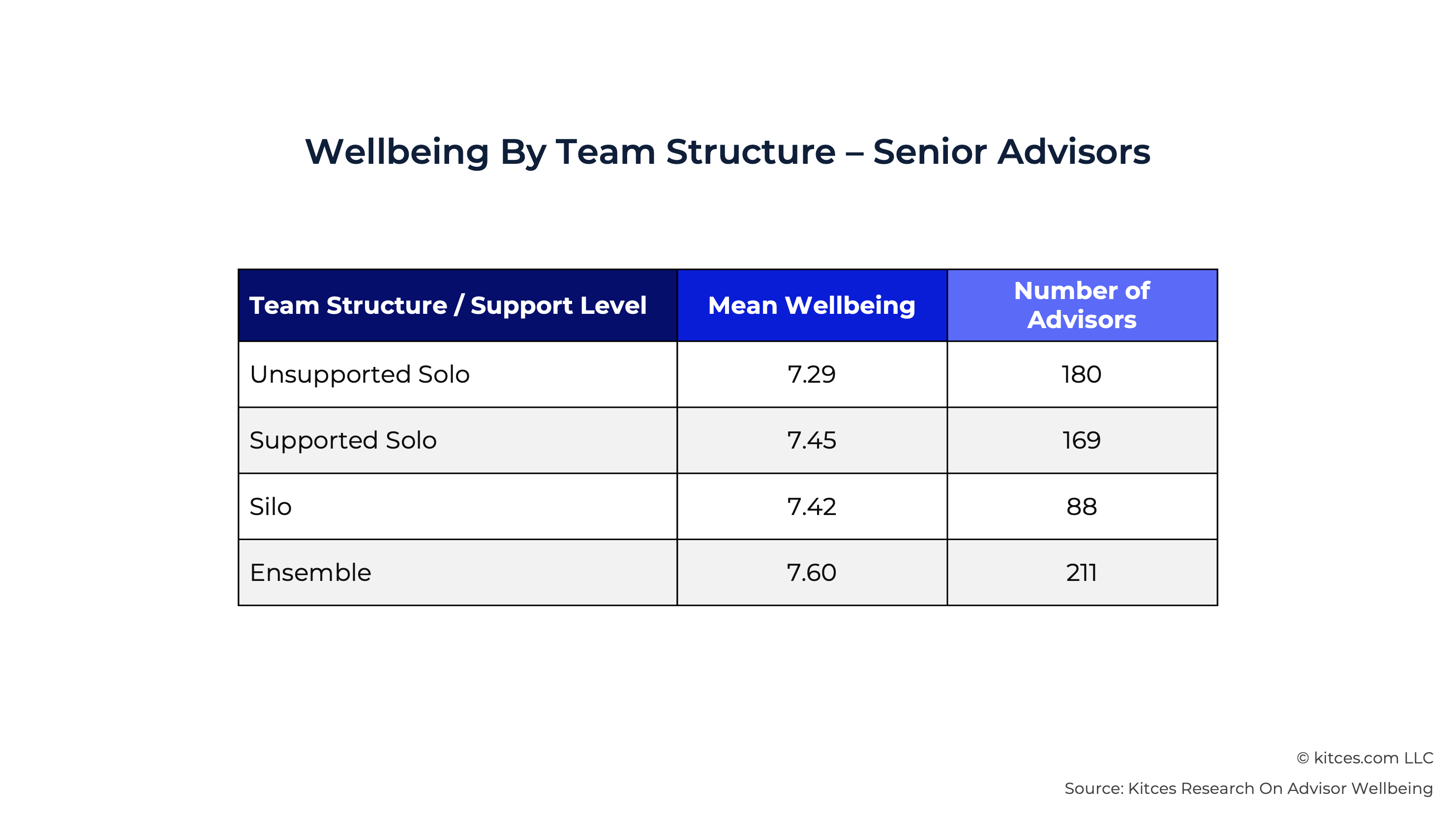
In general, the more support that an advisor has, the higher their reported level of wellbeing. For example, supported solo advisors report higher levels of wellbeing than unsupported solos. Ensemble teams boast the highest average wellbeing for advisors.
Much of this comes down to the work that advisors find satisfying – in general, the more administrative work that advisors do, the lower their reported level of wellbeing. Conversely, the more an advisor is able to delegate administrative and compliance work to focus on servicing clients, meeting with prospects, and strategic planning, the higher their overall levels of wellbeing – and the less likely they are to consider leaving the firm.
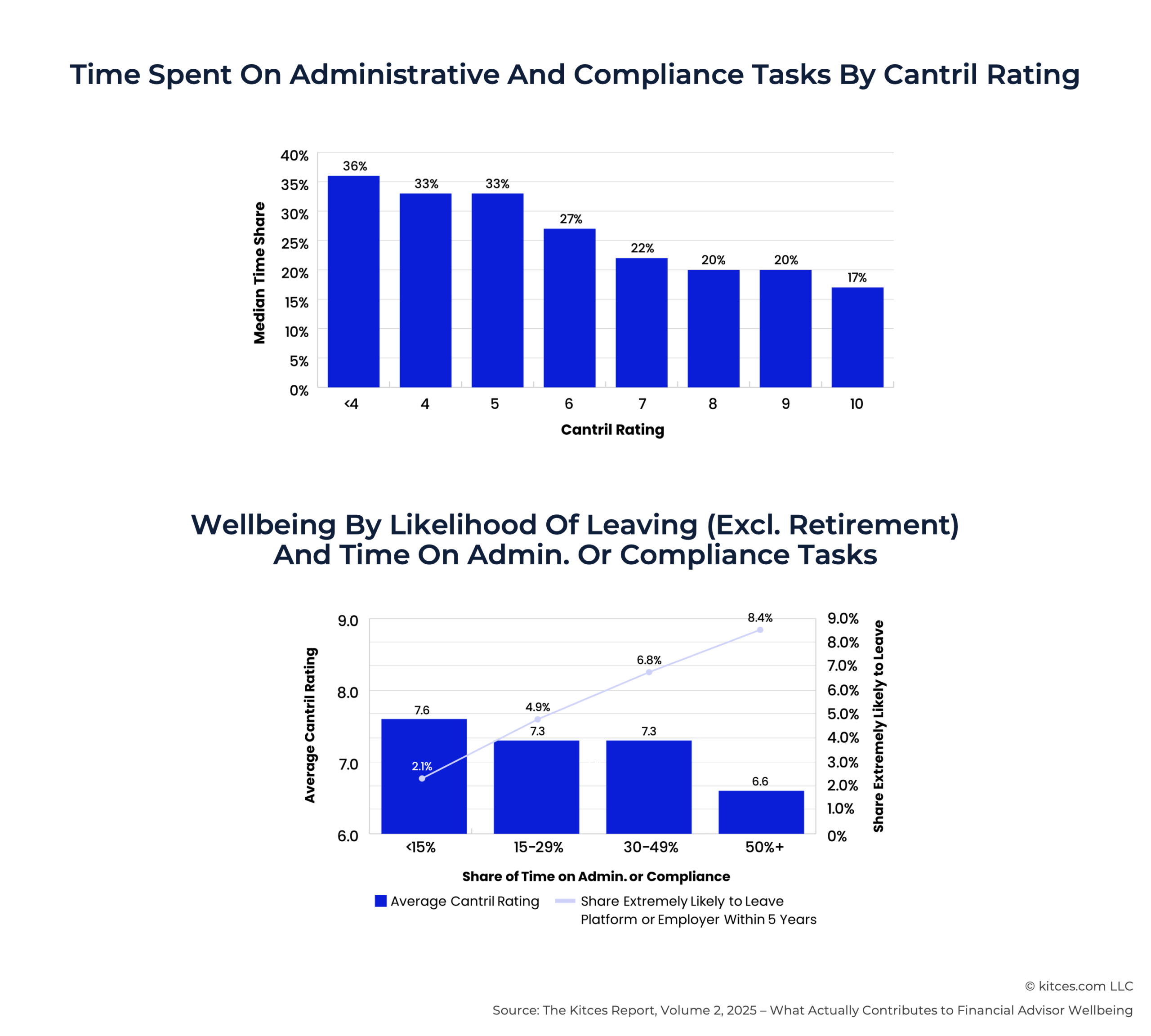
All of this to say, it's challenging to wholly get away from compliance and administrative work – but the more that it can be delegated or automated, the more the advisor can focus on building client relationships. That, in turn, has a very powerful upside for advisor retention!
Work/Life Balance And Firm Culture
One of the central tenets of the value of financial advice is that it's about more than the 'spreadsheet' itself. Rather, it's also about the relationship, finding an advisor who aligns with their values, and other 'intangible' components of working with their advisor. Firm culture is similar for team members. It's often intangible yet essential, although firm culture and a mission on its own can't compensate for bad compensation (and vice versa).
Many of the stats discussed in advisor satisfaction – income, clients per advisor, and revenue per advisor – all of a moment of diminishing returns, where 'too much' of a good thing means that Cantril scores stagnated – or even decreased.
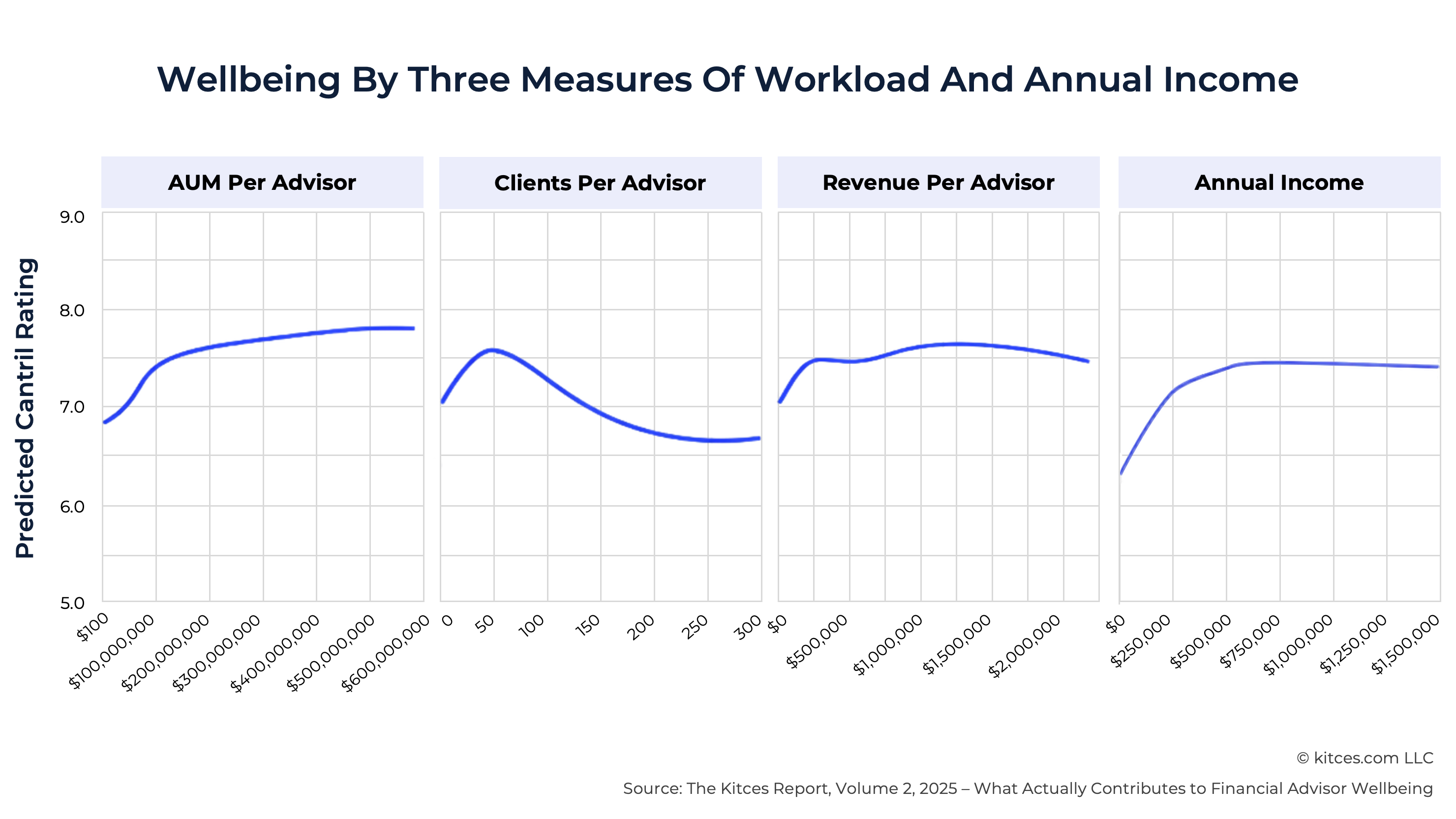
This can be summarized as the law of diminishing returns, or perhaps just, "everything comes at the cost of something else". Even the advisor who focuses on helping as many people as possible will eventually become overwhelmed, or the advisor who wants to run the most efficient firm. Each of these 'healthy' business metrics signals a potential downside!
One of the biggest 'soft' benefits that an advisory firm can offer is a work-life balance. While wellbeing remains relatively stable for advisors working more than 38 hours per week, the percentage of advisors considering leaving their firm increases with each successive hour of average overtime, as is shown below.
Combining Your Firm's Vision With Advisor Compensation
All of these elements – Variable Compensation, Equity, Client Management and Prospecting Opportunities, Minimized Admin Work, Team Structure (Not Firm Size), Work/Life Balance, and the Firm Culture – come together as a single, cohesive value proposition for current and prospective advisors. No element exists truly on its own! This opens the possibility for firms to pick and choose which parts of compensation to truly embrace and leverage as a competitive edge… and which may not fit the firm's overall messaging and culture.
With that said, it's worth examining at least these three elements:
First, is there space to add at least some level of variable compensation? Whether the compensation is based on firm revenues, the client relationships that the advisor manages, or something else, this can be a great way to both increase autonomy and reward the advisor's business-building skills.
Second, does the team's structure and resources enable advisors to maximize their time with clients?
Third, are there 'soft benefits' of a great work/life balance and firm purpose? One of the core highlights of the Kitces Wellbeing Study is that many components will increase wellbeing – but if those workplace traits come at the cost of working too many hours or serving too many clients, an advisor's overall satisfaction will suffer.

Nerd Note:
For better or worse, a history of departing employees can be informative. Reviewing a handful of resignations can help the firm assess whether there is a core part of benefits or compensation that they don't currently offer that their 'good fit' employees ultimately seek.
Be Clear How The Firm Is Different
Finally, advisory firms don't have to be everything to everyone – and that includes senior advisors. Different advisors will seek different types of work/life balance, compensation structures, opportunities for growth, and ongoing support. While the data above provides general trends on what advisors are looking for, it doesn't speak to every advisor. So if the advisory firm has a different take on client load, work/life balance, or benefits at large, it may not signal that a course correction is needed. Instead, it may be a firm's opportunity to signal how they are different to senior advisors – who just may be seeking that firm's type of 'weird'. Some senior advisors may not want the added responsibilities or headache of equity compensation, for example, or may be happy to serve a higher aggregate number of clients! Other advisors may be interested in growing into an equity role but may not want to do prospecting work, even though they have much to offer in other areas.
In general, if a firm's core employee offerings continue to attract qualified advisors who usually stay long-term, then odds are the firm is communicating its core offerings and mission well. If, on the other hand, the firm's job listings and hiring process aren't yielding good-fit advisors, it's worth examining both the hiring process and the core value propositions in the firm's description.
Perhaps the best way to summarize these strategies – and how they increase senior advisor wellbeing – is this: if the firm has an overall objective and mission, that doesn't just impact clients. Rather, if the firm whose core mission permeates their team structure, compensation, and long-term opportunities is more likely to attract and retain the advisors who, after all, joined the firm because they believed in that mission.
Ultimately, the key point is that while each advisor ultimately seeks their own unique opportunities, there are shared traits that will make it easier for firms to attract and retain good talent. And when advisors find the right combination of benefits, firm culture, and opportunities for growth, they are likely to remain in the long term!





Leave a Reply