


Executive Summary
Prospective clients face a complex and high-stakes decision when selecting a financial advisory firm. They're not only seeking credentials to trust, but also an individual they can genuinely trust to solve their specific financial challenges. However, the landscape of financial advice can be dense, and these decisions are high-stakes for prospects – a traditional advisor/client relationship involves nearly all of their life savings and can span years. For the prospect, this poses the challenge of how to determine who to trust, given their lack of understanding of the broader landscape of financial advice. For advisory firms, this poses a challenge of how to stand out to the (right) prospects and communicate their value effectively.
In this article, Sydney Squires, Senior Financial Planning Nerd, discusses how financial advisors can mold their existing marketing and value propositions to fit a prospect's emotional and practical decision-making process. Most decision-making processes are two-part: first, the divergent phase (gathering a wide array of qualified options), then the convergent phase (of narrowing down the list). This process often cycles multiple times as prospects refine their understanding of what they need and who can best provide it.
For prospects, the initial divergent phase involves looking for indicators of general trustworthiness and expertise. This typically includes checking an advisor's professional designations or seeking peer validation of the firm, such as asking for referrals or looking for online reviews. Referrals remain the most influential factor in how prospects find advisors… yet Wealthtender's research shows that 96% of prospects will conduct further online research before reaching out, typically visiting the advisor's website and evaluating credentials, pricing transparency, and communication style.
This highlights the importance of 'supporting tactics' such as SEO, social media, and newsletters – tactics that help reinforce the positive perception initiated by referrals. Even strong referrals can falter if a firm's website is outdated, difficult to navigate, or overly generic. Design, clarity, and messaging matter; poorly executed online experiences can erode trust, while effective ones help convert curiosity into inquiry. The challenge for advisors is to strike a balance between providing general signals of trust and competence to ensure visibility… while also providing specific evidence and information to withstand the convergent phases.
In the end, prospective clients are looking for two things: someone they can trust and someone who can solve their problem. And prospects generally look for that information in multiple steps. Financial advisors who recognize the nuances of the prospect decision-making process – and who intentionally align their marketing, online presence, and messaging to meet those needs – are better positioned to attract and convert right-fit clients. By layering in both general trust signals and information about the specific value they provide, advisors can effectively differentiate themselves in a crowded, often confusing marketplace, creating clarity and confidence for the people they are best suited to serve!

Several years ago, as a freelance marketer for small businesses, I faced a conundrum: I couldn't do everything, but I could do a lot of things that the business owners could not do themselves. Business owners didn't always fully understand where my skillsets could provide the most value. When I was meeting with business owners to discuss how I could help them, I initially ran those initial meetings like a raffle sale: I, the racketeer, rattled off everything I could do, everything I was willing to learn, and a few things besides.
This came from a good place – I had worked in small businesses as a manager and a contributor, and I knew how desperately most small businesses needed someone who could handle a variety of tasks. (I also really needed the business.) But in my eagerness to demonstrate that I had the expertise to solve their problems, I was accidentally diluting my value proposition.
A part of the issue – and one that many service providers face when they are engaging with a potential client – wasn't that I lacked the knowledge to help them. It was translating my skillset into a language that communicated that expertise and value in a way that was easily comprehensible to my audience.
This is a common issue for financial advisors – it isn't that they can't solve the problems a prospect brings to them; rather, it is the challenge to communicate their value and expertise in a way that resonates with the prospect. Much as how "marketer" means many things, from designing campaigns to working on search engine results, so too does financial planner.
And prospects have a dizzying array of choices before them. The field of financial advice has expanded broadly from investment management and product sales. The modern client seeking a financial advisor has a choice between any level of financial advice, from solely investment managers to more comprehensive, holistic advisors. Yet, not all prospective clients fully comprehend the choices before them: according to a 2021 study by Accenture, 88% of consumers perceived advisors to be largely investment managers. There is a great deal of nuance to the offerings of various advisory firms, which can naturally be quite overwhelming to consumers navigating this space for the first time. According to American College's research on Trust In Financial Services, 43% of respondents found it "necessary to be cautious when dealing with financial companies". This doesn't mean prospects don't want to engage with financial advisors – rather, it means they are cognizant that there is a lot of information to sift through to find the right-fit advisors. This is especially true for prospects who want an advisor who can manage their assets: finding someone they can trust with their life's earnings and/or their high-stakes financial decisions is enormously high stakes!
There are many dynamics that go into a prospect's ultimate decision about which financial advisor to hire, but their search criteria can be generally boiled down to selecting for two traits. The first is trust: how do prospects know they can trust this advisor (in general)? And the second is fit: can this advisor solve the prospect's specific (and usually pressing) problem?
How People Make Decisions: The Divergent To Convergent Process
Making complex decisions, like selecting which financial advisors to speak with, is a two-step process from a psychological perspective.
The first step is divergent decisions: think of this like casting a big net. During this step, prospects are looking for advisors who reasonably fit their criteria. They are trying to accumulate as many viable options as possible. The second step is convergent decisions, in which the prospect eliminates options –crossing them off from the list, closing the tab of the advisor's website, and so on.
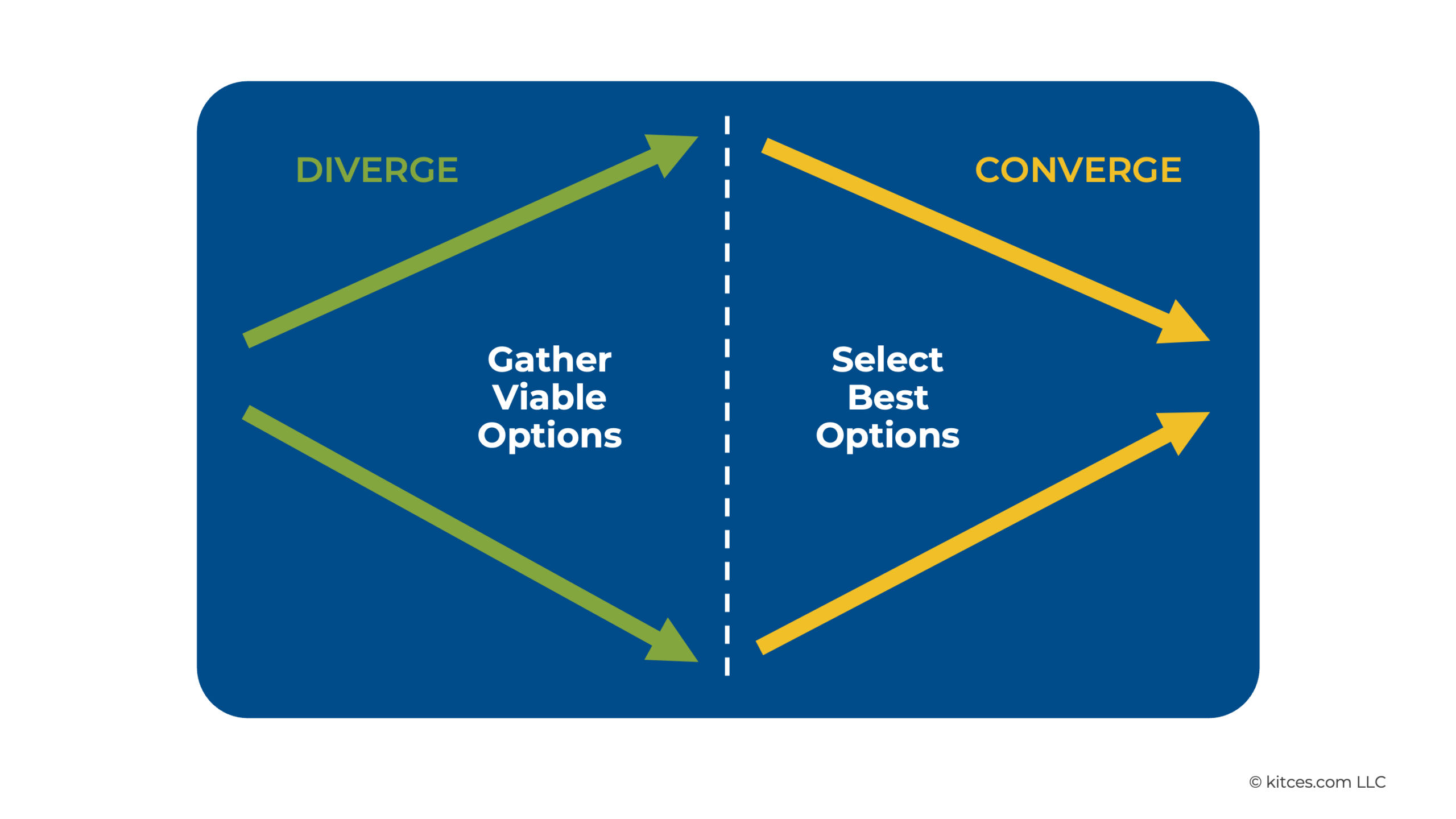
The advisor's challenge is two-fold – not only must they make the prospect's initial list, but they must also withstand this winnowing-down process. For prospects choosing their advisors, they might start by looking at general expertise – primarily through social proofs and other indicators that the advisor is worthy of their trust. Then, they tend to dive deeper into the advisor's information and content – likely on their website or socials – looking for an indication that the advisor can solve their specific problem.
In practice, prospects may run this process multiple times as they curate their short list of advisors, assessing an advisor's expertise from multiple angles. For example, they may begin their search by looking for financial advisors, compiling a list, and narrowing down options… then discover the difference that credentials and various pricing models can make. Armed with new information (and new potential decision criteria), the prospect then iterates through their divergent process of gathering potential fits again. Typically, this process continues until the prospect has a sufficient (or overwhelming!) list of potential fits.
How Prospects Evaluate Potential Advisors
Given that the prospect hasn't (yet) spoken to the advisor, they rely on gathering options, then eliminating them through 'proofs': external validations of authority that they're making a sound decision. Often, they are looking for validation from peers and authoritative figures. This in turn highlights the risk that comes when a firm's marketing strategy targets a broad audience, rather than a narrow one. An advisor may pass the initial 'divergent' hurdle – they appear trustworthy and communicate their firm's value proposition clearly. But they may lose on the second, narrowing 'convergent' hurdle, when a prospect is trying to determine who really can solve their problem.
There are many methods prospects use when gauging their potential financial advisors. According to a Wealthtender 2025 Study of $100K+ Households Seeking Financial Advice (which surveys 500 U.S. households with annual incomes over $100K about their process for hiring a financial advisor), referrals remain the most important selection criterion. 62% of prospects rely on referrals from friends and family, and 49% use referrals from professionals. 50% of prospects use search engines, and 25% use AI search tools. (The study asked prospects to indicate all resources that they use, so results will add up to more than 100%.)
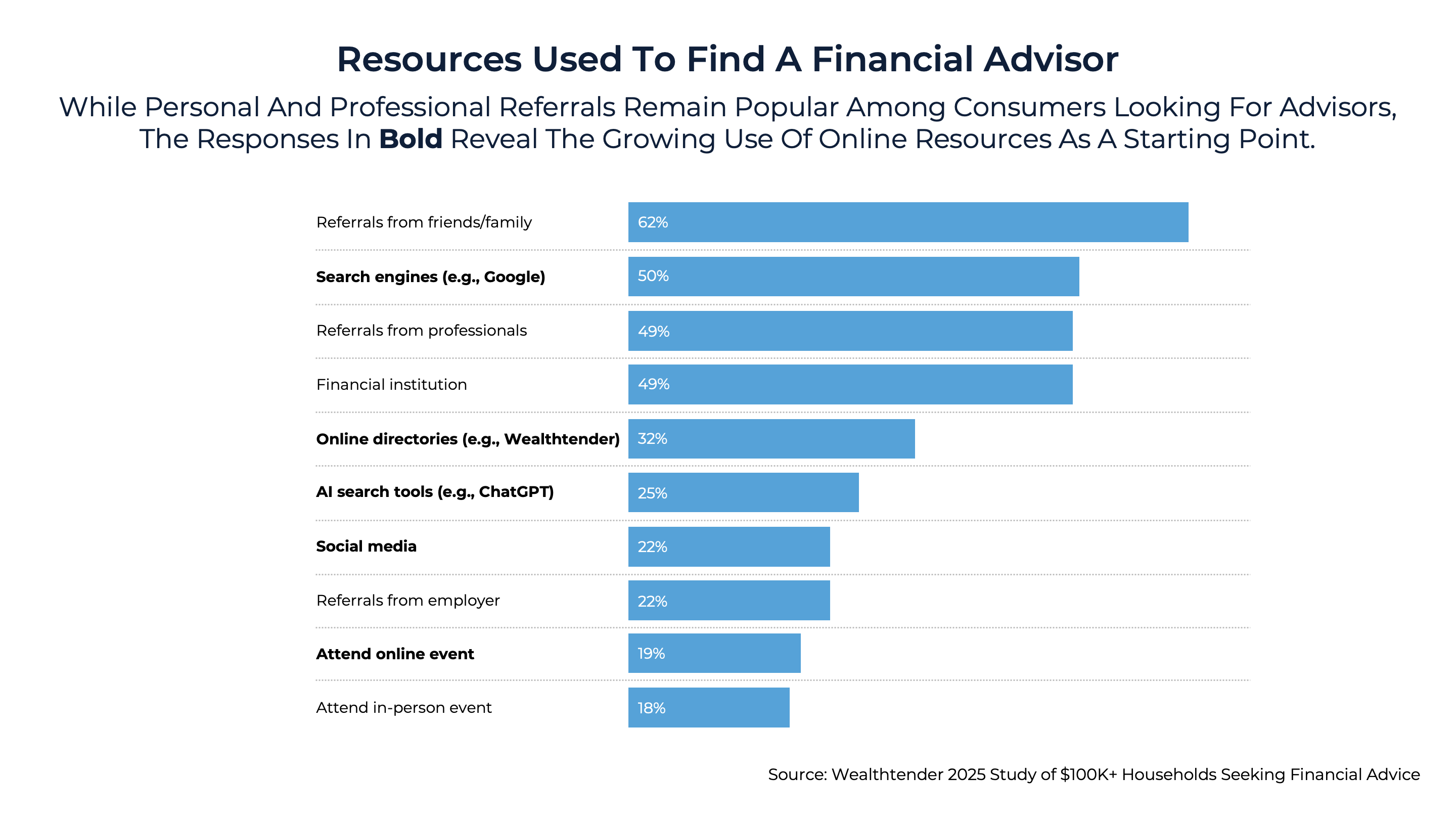
"96% [of prospects] intend to do further research online before making a hiring decision", according to the Wealthtender study – and for 72% percent of respondents, that includes a visit to a potential advisor's website, often seeking additional guidance on an advisor's fee/pricing structure and areas of specialization. This aligns with Kitces Research on How Financial Advisors Actually Market Their Services, which confirms that referrals are far and away the most effective source of new clients. A whopping 95% of firms that used referrals to get leads gained at least one client. But just because referrals are effective does not mean that it's a one-stop journey from referral to discovery call. Prospects still do some level of their own information gathering to decide whether they are ready to act.
These are called "supporting tactics" in the Kitces Research study: tactics which are used in tandem to boost the overall success of marketing. For example, a social media post may drive traffic to a blog. Client referrals are often used in conjunction with public-facing marketing tactics: namely, social media, SEO, and newsletters.
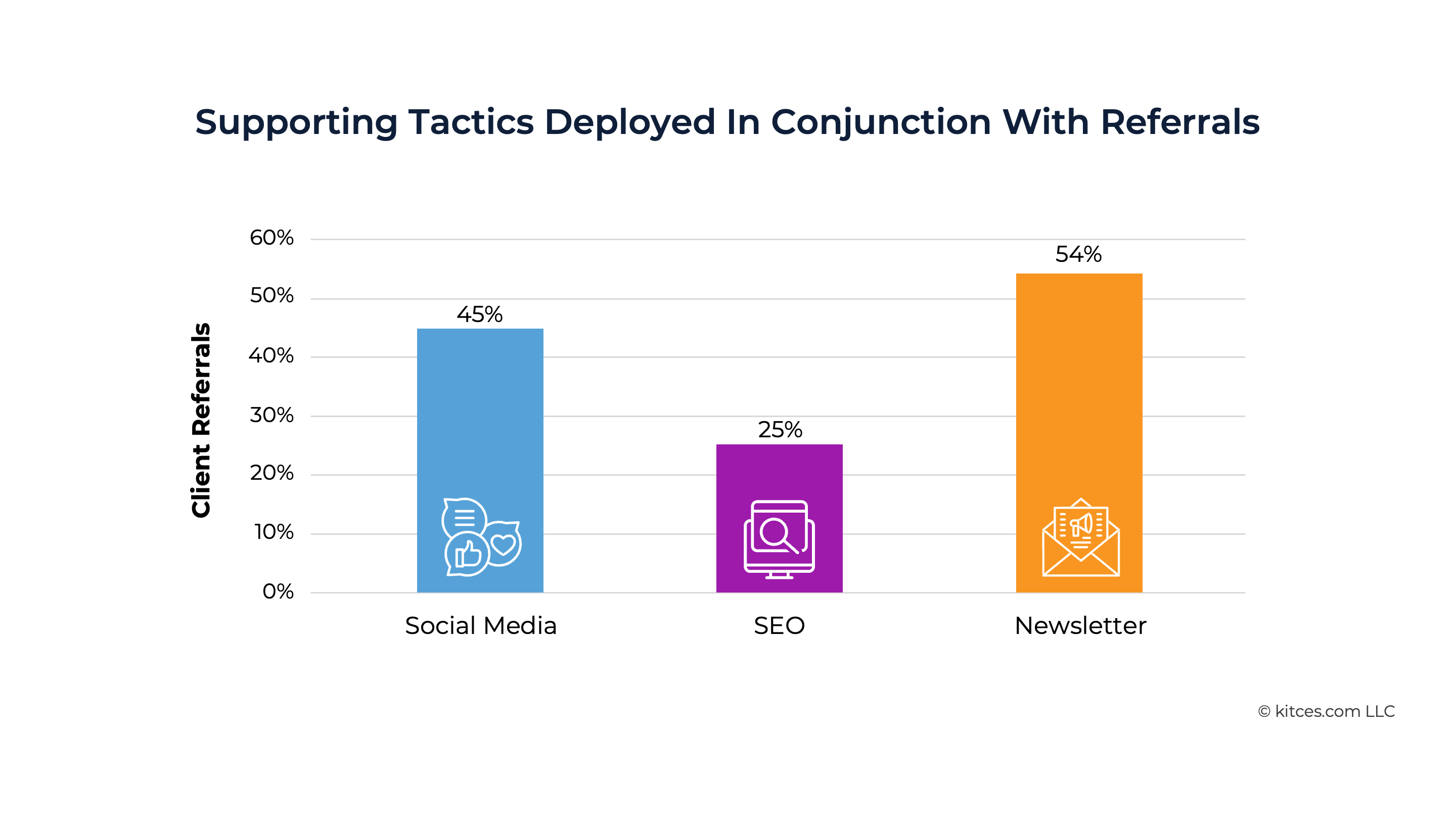
Put another way, while referrals help build trust, they don't guarantee a prospecting call, let alone a converted client, as a result. It's like starting a 400-meter race at the 100-meter line – it's an impressive leg up, but the race still needs to be run.
Advisors have myriad decisions to make, all centered on building trust in a clear, focused way. There is only so much space on a website – especially if it is optimized to be consumer-friendly – and prospective clients only linger for so long. Advisors are left in a bind as they try to present the depth of what they can offer clients in a way that is jargon-free, specific yet comprehensive, not overwhelming, compliant, focuses on the client's most present problems, and communicates the firm's values… in a brief, friendly, on-brand way.
As the saying goes, "It's not what you say, it's how you say it", and that is perhaps especially true when it comes to this fragile stage of building prospect trust. In the first call between prospect and advisor, questions and answers can be shared spontaneously – prospects can discuss their current problems, and advisors can share which of their services best fit the client's needs. However, to reach that stage, prospects first need to assess that this advisor is their best fit. In other words, they must have the visibility to show up in the options-gathering process… and the specificity to survive the elimination round(s).
The following is an example of the process a prospect might use to assess their options and eventually select a financial advisor. As we'll see, in reality, prospects do not move cleanly through an initial divergent phase straight into convergence. Instead, they may switch between the two modes as they sharpen their own decision-making criteria and shift from selecting for trust versus fit.
Visibility: Getting Seen As A Financial Advisor
The prospect's journey to find their right-fit advisor starts with visibility – it doesn't matter how perfect a fit the advisory firm is for a prospect if the prospect can't find them! Many prospects begin their search with some minimum criteria – whether it's an advisor's fee structure, location, or niche. This high-level visibility typically comes from one of two avenues: Search/Artificial Engine Optimization (SEO/AEO) or advisor listings.
For smaller firms, online advisor directories may be particularly helpful as a method for both 'proof' and 'visibility' – it is the faster route to visibility than traditional SEO/AEO. Kitces Research on Advisor Marketing finds that online listings are in the lowest tier of tactic groups: "while about 1 in 5 advisors make use of listing services, just 8% are monitoring review sites for leads. … [But] despite the relatively low usage and moderate satisfaction ratings, directory listings usage is among the more successful tactics and ranks best in terms of low client acquisition cost and highest of any tactic in regard to marketing efficiency", although review sites have lower total success rates. Below is an example of the providers of an online directory listing rated in the last Marketing Study.
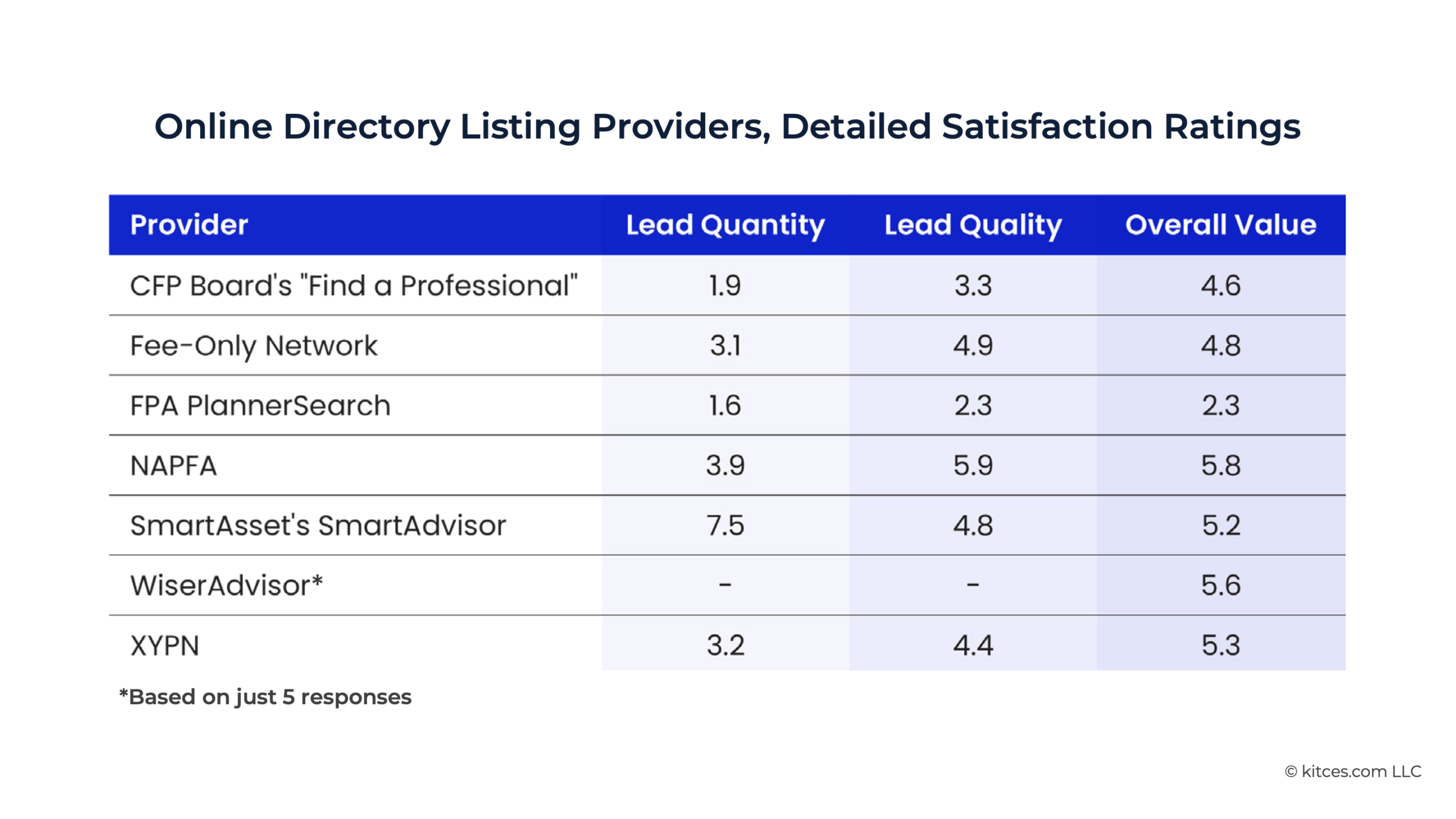
Given how lead quantity and quality are relatively low, directories may not be a wholly sufficient prospecting strategy – but they can be helpful as a supporting tactic, especially for smaller advisory firms looking for another 'proof' of their type of advice. For example, lead quality is rated as higher with fee-only providers, signaling a potential alignment between prospects seeking a certain type of business and advisors who provide it. By contrast, AEO/SEO is crucial for firms that have the time (and resources) to build momentum. This tactic rarely yields quick results, but it can be a fruitful endeavor over time; as the Kitces Research on Advisor Marketing notes, "High-growth practices, at every development stage, are particularly apt to apply search engine optimization… and those that do have an even greater tendency to use SEO in a supporting role relative to other users". As the graphic below details, advisors are typically optimizing for niche or location, or otherwise aiming for general visibility.
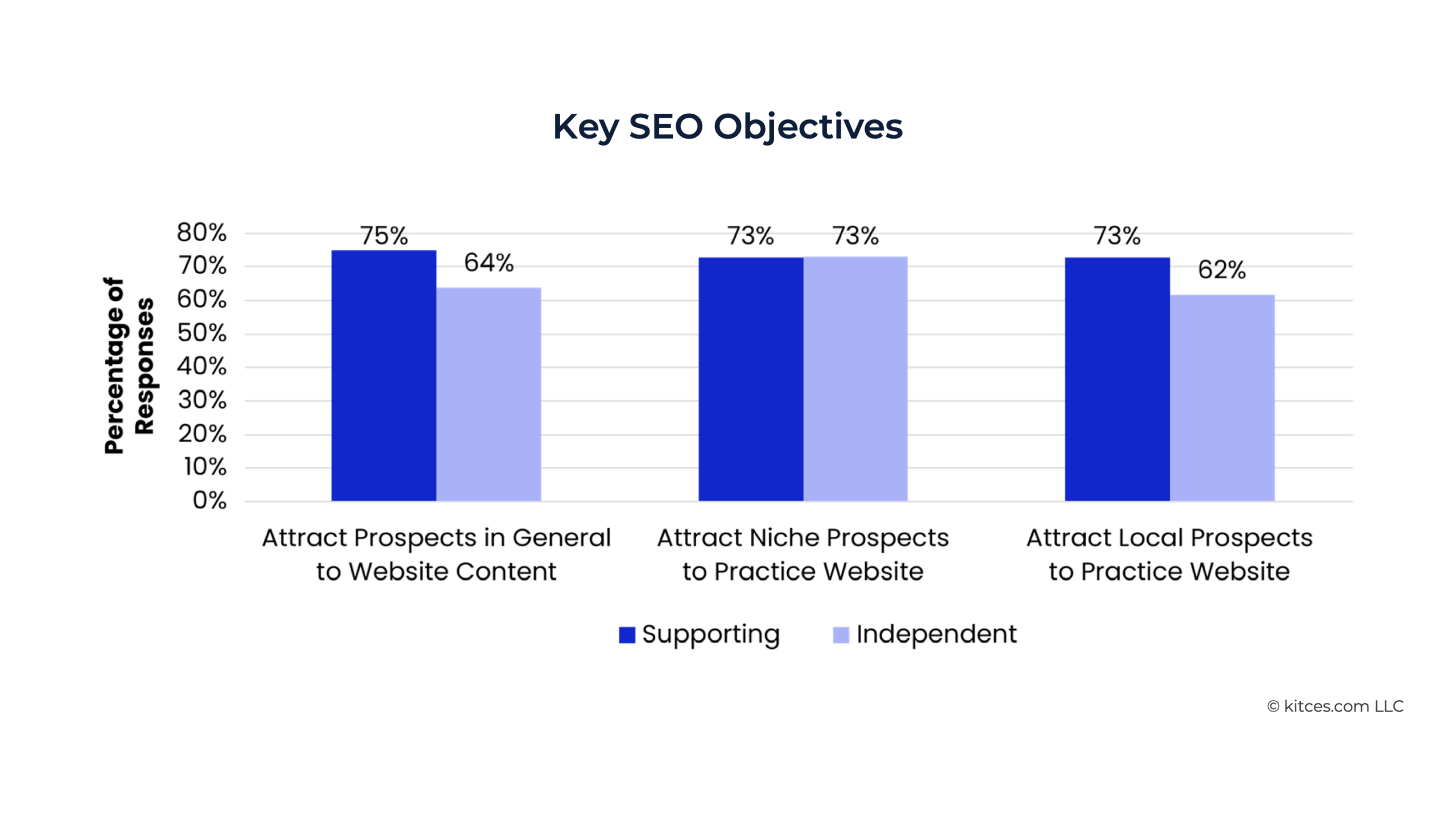
Whether the advisor chooses engine optimization or an advisory list, the goal is to appear in the 'right' results – in general, choosing one or two traits to be 'visible' for is plenty to optimize for. Tools such as Google Analytics, SEMRush, or Ahrefs can be crucial for analyzing traffic to an advisor's website!
The Initial Convergent Hurdle: The Online Experience
A separate, but still essential, component of brand proof is the function and flow of an advisory firm's website. The firm's website doesn't have to be incredibly intricate, but it does need to be nice enough not to detract from a client's trust. If a site is out of date or difficult to navigate, that is a detractor of trust – even if the advisor themselves is perfectly capable of helping the client. In a world where most client/advisor relationships are at least partially digital, a badly functioning site can feel like a signal of the future client experience.
Great design typically feels invisible, whereas terrible design feels grating and obnoxious (as a parallel example, most people don't think, "Man, it's easy to read the text of this book." But if the font is too small, too cramped, or impractically large, then that can detract from the reading experience immensely, or cause the reader to put the book down). So while it's unlikely that a great website will 'win' a prospect by itself, it is likely that a bad website will push a prospect away.
For those who are unfamiliar with web design, it can be helpful to start with extremes: what would the very worst advisory firm look like? (E.g., it is difficult to read the text, it is challenging to read the website, the text comes off as too 'sales-y' and isn't informative.) What would the very best advisory firm website look like? (Easy to navigate, easy to see where "I" fit into the firm's offering.) The best web design tends to be 'invisible', while terrible web design feels very visible and obvious – and can push a prospect away before they've even reviewed what the advisor has to offer.
The good news is the best websites don't have to be incredibly intricate or expensive – but they do need to be easy to read, easy to navigate, and feel personable. That's a good starting point!
The Second Divergent Hurdle: Authority And Knowledge
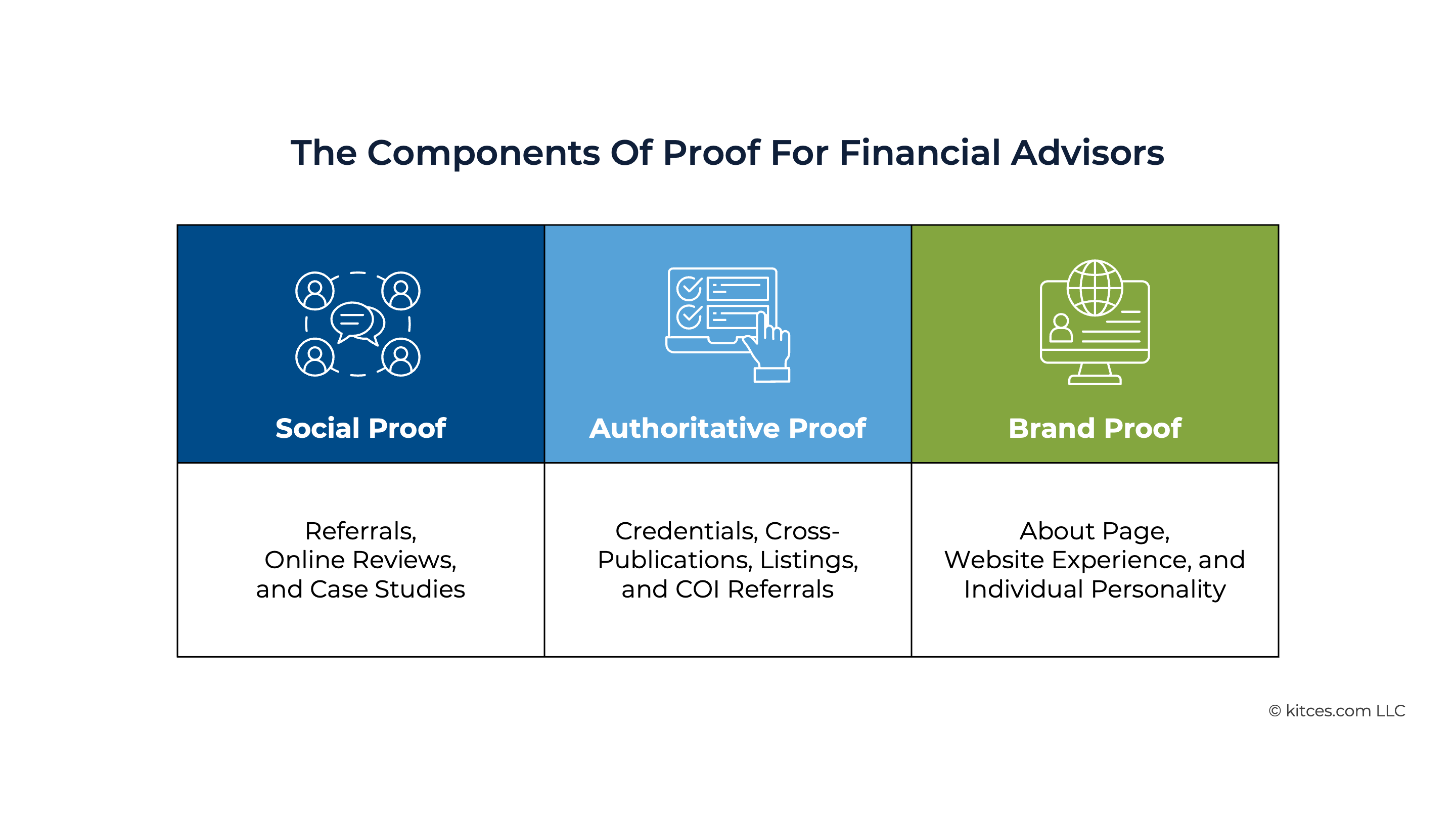
The second dimension of trust is authoritative proof. Rather than relying on a jury of (prospect's) peers, like social proof, authoritative proof relies on a validation of skill from an external authority, such as holding a CFP certification and being published on third-party sites. Center-of-influence (COI) referrals also fall into this category, since COIs tend to be tax preparers, estate planning attorneys, or business contacts.
Humans are inherently social, and perhaps that comes out most strongly in how deeply prospects seek social proof before contacting an advisor. Much like scrolling reviews on Yelp before going into a restaurant, we like seeing that other people have liked – and looking for any warnings about what we may be getting into. This is an example of social proof, and for the advisor, it includes referrals, online reviews, and listings.
In a prospect's review, this involves referrals, of course, but it also includes client reviews – both on the advisor's website and via Google.
However, the component that advisors can truly control is case studies. A properly anonymized client scenario provides a clear-cut affirmation not only of an advisor's base of knowledge but also of their ideal client. It can provide a clear signal to prospects about exactly whom the advisor helps and who else they're seeking.
In authoritative proof, "You are the company you keep" tends to ring true. While prospects may not appreciate the nuances of which industry experts' podcasts an advisory has appeared on, seeing awards, "As seen on" media listings, and other options to review what authoritative figures think of the advisory firm is powerful for prospects, who are looking for an indication that an expert has 'signed off' on this advisory firm.
From the prospect's perspective, this is where they often transition from broader searches to narrower ones. For example, they may have a list of advisors in their city, but here, they may be looking through the advisor's site for proof that the advisor has experience with their specific problem. This is where, for example, the dentist looking for an advisor is reviewing the advisor's social media and website to see if they can solve their specific problem.
The Second Convergent Hurdle: Solving The Prospect's Specific Problem Relative To Their (Perceived) Value Of Advice
The final dimension of trust comes down to the (perceived) personality of the advisor or the firm's brand. This is especially true for small advisory firms, where the firm is the advisor (or just a few advisors), which can be both an advantage and a disadvantage. Morningstar's 2023 research on why prospects hire their advisor (discussed in more depth here) further affirms this: of the 11 total reasons, 3 were about the advisor itself: the quality of the relationship, the quality of communication, the delivery of behavioral coaching, and the advisor's self-presentation.
As an extension of this, the 'About' and Process pages are often one of the most visited on an advisor's website for a reason – it is arguably as much about evaluating authoritative proof (listed above) as it is about trying to imagine what it would be like to work with this financial advisor. Social media, too, often functions as a place where prospects can 'sample' the advisor's voice and what it would be like to work together.
Lastly, fee transparency is also a crucial component of branding proof. According to the aforementioned study by Wealthtender, it is the top-rated difference in consumer perception of an advisor's trust – even above professional certifications.
Communicating (The Whole) Value Of Advice
All of these components come together as a prospect refines their individual concept of a prospective advisor. What begins as a broad experience becomes increasingly targeted over time as the prospect attempts to vet their prospective advisor.
No single component stands on its own, but advisors can make improvements incrementally. A helpful method is to follow a basic funnel from broad to narrow: how would a prospect find this advisory firm? Why would they remain on the firm's page? If it's not already a habit, ask prospects how they found the advisory firm in the first place. While it is unlikely that the prospect will lay out their entire journey unprompted, this can at least lead to a high-level overview of the process. For example, "Steve had mentioned you might be able to help, so I hopped on over to your site" indicates that referrals and the advisor's website were crucial.
Additionally, review notes from prospecting calls and issues discussed in clients' first year with the firm. Which present and pressing issues consistently came up over those initial calls? Is that explicit on the firm's website? Many prospects and first-year clients have the same issues and priorities, especially if the advisor is working with a niche.
Finally, go deeper than 'table stakes' planning. For instance, retirement planning is a high need for clients – but what does that mean for this client? What is the actual 'job' being done? For example, high-net-worth and business owners are looking for different reassurances and types of results. Focusing on what advisors do differently, and the solutions they have built for their niche, allows them to get more yield from their marketing efforts – and to stand out further as prospects winnow their lists and decide who to contact!
Ultimately, the key point is that prospects are looking for many things in their advisors – but if this complex decision can be summarized simply, prospects are searching for someone who can solve their issue and someone they can trust. Breaking down elements of trust into a few categories can help advisors highlight what they are doing well – and their opportunities for improvement going forward. When advisors can point to multiple points of 'proof' for their prospects, they can create a holistic view of their capabilities – and the value of their services!





Leave a Reply