
Executive Summary
Business ownership can be an all-encompassing endeavor, from the time spent working on – and in – the business to the significant portion of an owner's net worth that the business may represent. And entrepreneurs whose businesses grow substantially over time can end up with an asset worth many millions of dollars, creating a potential 'problem' of exceeding the estate tax exemption amount. Which, in turn, can lead some of these individuals to ask their financial advisors for ideas on how to reduce or eliminate their potential estate tax exposure.
In this guest post, Anna Pfaehler, CFP, AEP, a Partner and Wealth Advisor at Constellation Wealth Advisors, explores one powerful tool to reduce the size of a business owner's estate: gifting shares in the business, whether directly to individuals or to a trust that removes those shares from the owner's estate. Notably, this strategy can be especially effective when shares are gifted before a dramatic increase in the value of the business or before the business is sold at a premium, as the gift and estate tax exemption applies to the value of the shares at the time of the gift. Which means that future appreciation in the value of the shares occurs outside of their estate.
Another way to increase the value of gifting shares in a business is to apply valuation discounts, which can reduce the dollar value of gifts and use up less of the business owner's remaining gift and estate tax exemption. Such discounts can be applied for lack of control (as an arm's-length investor would likely pay less for shares of a company for which they have no say in decision-making) and lack of marketability (as an investor might pay less for shares in a company that is relatively illiquid). Importantly, though, given close IRS scrutiny of valuation discounts, having a professional valuation of the business can help avoid challenges to the transaction and ensure that the gifted shares are valued appropriately.
Despite the potential benefits of executing a gifting strategy, some business-owner clients might be reluctant to go through with it, perhaps because they don't want to give up control of or upside in the business, even though the strategy can potentially be structured to keep control of voting shares in the hands of the owner. Some business owners might also assume they don't need to engage in such a strategy because their business is currently worth well below the estate tax exemption amount. In those cases, an advisor could note that future appreciation in the business could push the owner past the exemption level and that gifting when the business value is lower may use less of the exemption.
Ultimately, the key point is that because businesses have the potential for significant appreciation over time, they can create unexpected estate tax exposure for their owners. This gives financial advisors an opportunity to potentially help business-owner clients save millions of dollars in estate taxes by working with clients and related professionals, such as estate attorneys and valuation professionals, to create a gifting plan that aligns with the client's financial needs and legacy goals!

The one thing all business owners have in common is a stomach for risk. Business owners are willing to accept that things might not work out for the chance that they will. In return for taking risk, the owner receives not only income from the business's operations but also an asset. The business is an investment, and its associated risk creates the potential for returns in the form of asset appreciation. Just as a concentrated investment in a risky stock can swing a portfolio, a business can swing a balance sheet and a client's planning priorities.
Owners of fast-growing, closely held businesses may find themselves faced with two good-to-have problems in quick succession: 1) crossing the threshold into having a taxable estate and 2) pressure to cash out of the business. The convergence of these two 'problems' creates a tremendous planning opportunity. By capitalizing on anticipated appreciation and leveraging business valuation, gifting interests in a closely held business, especially in advance of a sale, can create transfer tax savings for the business owner.
Basics Of Gifting A Business Interest
Gifting a business interest can be an especially powerful estate tax planning strategy. But to understand why, it helps to start with how business growth can quickly reshape the business owner's net worth and planning needs.
Navigating A Changing Landscape
Business owners tend to have a significant portion, if not nearly all, of their net worth tied up in the business. On the downside, it could go to $0 if the business folds. On the upside, with the right mix of hard work and luck, the business could be a home run. Growth of the business can dramatically change a business owner's net worth, which in turn changes their planning needs.
Typically, advisors don't need to discuss estate tax planning in detail until the client is at or near the threshold for having a taxable estate. In 2026, this is $15,000,000 for a single person and $30,000,000 for a married couple. Before that point, many people are hesitant about making gifts because doing so means giving assets away now in exchange for a future tax benefit that may never be needed. In many cases, the added complexity simply is not warranted.
With a concentrated position in the business, a jump in the value can push an owner into taxable estate territory relatively quickly, and suddenly these estate tax concerns become real. The following case study illustrates how quickly that shift can happen.
Case Study – Part I: From Business Growth To Estate Tax Risk
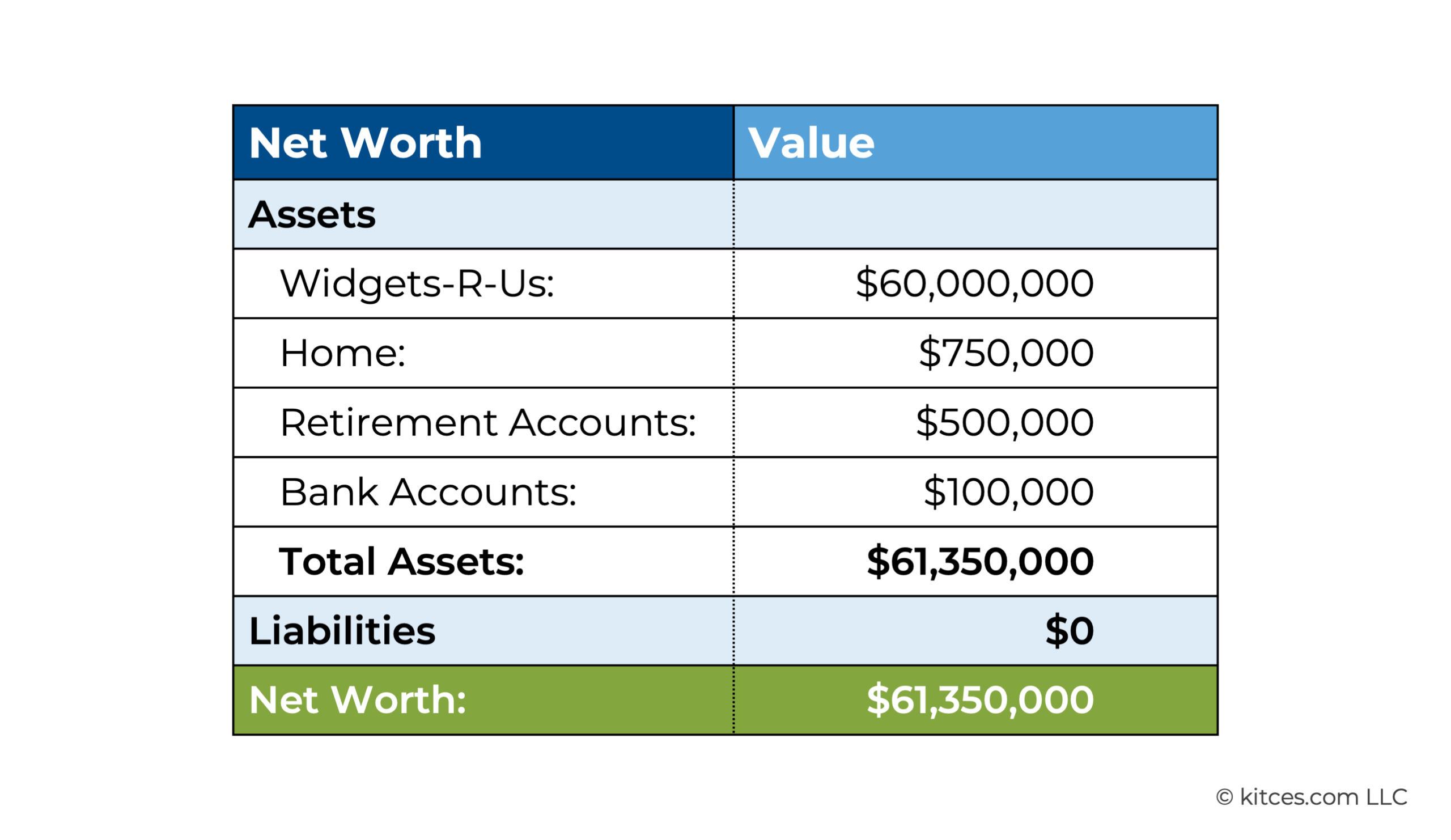
Gwen (45) and Gavin (47) own a widget business, Widgets-R-Us, which has grown considerably over the last five years, in part because of industry tailwinds. What was worth about $15,000,000 a few years ago is now worth $60,000,000. Furthermore, the business is projected to continue growing at 20% per year. They have $500,000 saved in retirement accounts, $100,000 in their bank savings account, and a $750,000 home they own without a mortgage. They have three minor children.
Gwen and Gavin have previously taken a DIY approach to their planning. They contribute the maximum to their retirement accounts and have paid off their mortgage, but they have reinvested heavily in the business. They drafted their wills and created revocable trusts four years ago, when the business value was still relatively modest, and have made no gifts. Gwen is in a networking group for business owners and was encouraged by her peers to have a financial advisor take another look at their planning. After following up on that recommendation, Gwen and Gavin met with an advisor to review whether their existing plan still fit their current circumstances.
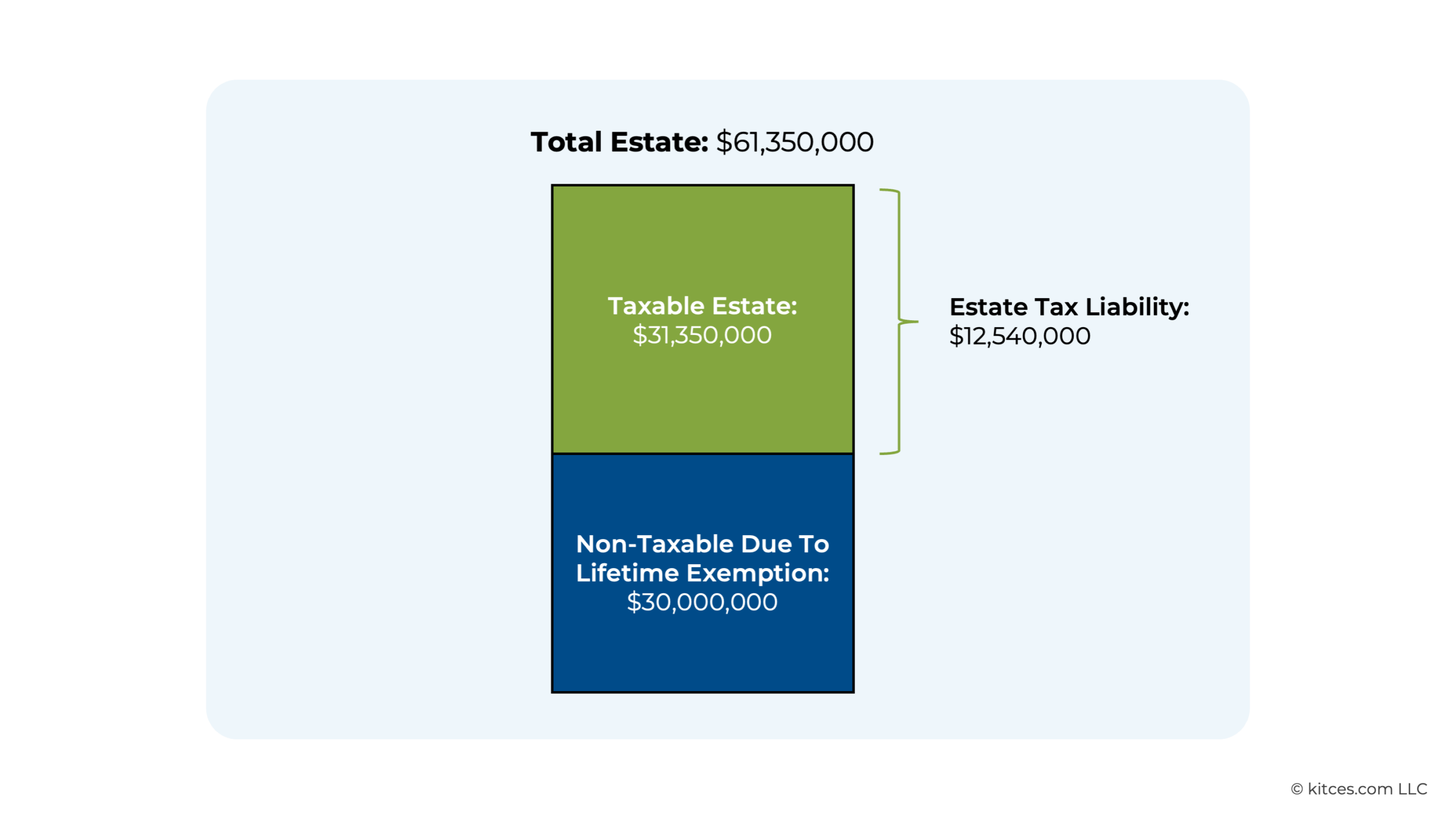
Their financial advisor notes that they have approximately $61,350,000 in their estate. The first $30,000,000 is not taxable because of their lifetime exemptions. The remaining $31,350,000 would be subject to estate tax at 40% at the surviving spouse's death. Their estate would owe ($61,350,000 – $30,000,000) × 40% = $12,540,000 in estate tax at the second death.
Gavin and Gwen's legacy intentions are simple – they want their children to receive as much as possible and pay as little as possible in estate tax. They then engage the new financial advisor to help them create a plan to reduce their eventual estate tax liability.
Harnessing Appreciation
The growth trajectory of a concentrated interest in a business is often what triggers the need for estate tax planning, and this same trajectory is what can make a business interest an excellent gift.
The tax code offers two key planning opportunities for estate planning: 1) lifetime exemption and 2) annual exclusion. Lifetime exemption is the amount any person can give away during lifetime or at death without paying transfer taxes. The lifetime exemption thresholds for 2026 (used in the earlier case study) are $15,000,000 for a single person and $30,000,000 for a married couple. The One Big Beautiful Bill Act (OBBBA) made this historically high exemption amount permanent, or as permanent as anything can be in Washington DC. Planning to use the exemption before OBBBA had an element of 'use it before it's gone'. Planning to use it after OBBBA is about the power of shifting not only the asset but also its future appreciation.
The ideal assets to gift are ones that are expected to grow – the faster the growth, the more ideal the asset. This is because the value of the gift – that is, the amount of lifetime exemption it consumes – is frozen at the value as of the date of the gift. If a fast-growing asset is gifted, future appreciation occurs outside the donor's estate, which can generate estate tax savings in short order (rather than further compounding estate tax liability by remaining in the estate). The growth trajectory of the business can make it the best asset on the balance sheet for gifting.
Case Study – Part II: Using A SLAT To Shift Business Appreciation
With the help of their advisor, Gavin and Gwen decide Gwen will gift shares of Widgets-R-Us to a Spousal Lifetime Access Trust (SLAT) for the benefit of Gavin. They each own 4,900 non-voting shares and 100 voting shares (10,000 shares combined), and Gwen will give 2,500 of her non-voting shares to the SLAT. If the business is worth $60,000,000, Gwen's gift will be valued at (2,500 ÷ 10,000) × $60,000,000 = $15,000,000. This gift will use her entire lifetime exemption. (Note that, for the sake of simplicity, this example ignores valuation discounts.)
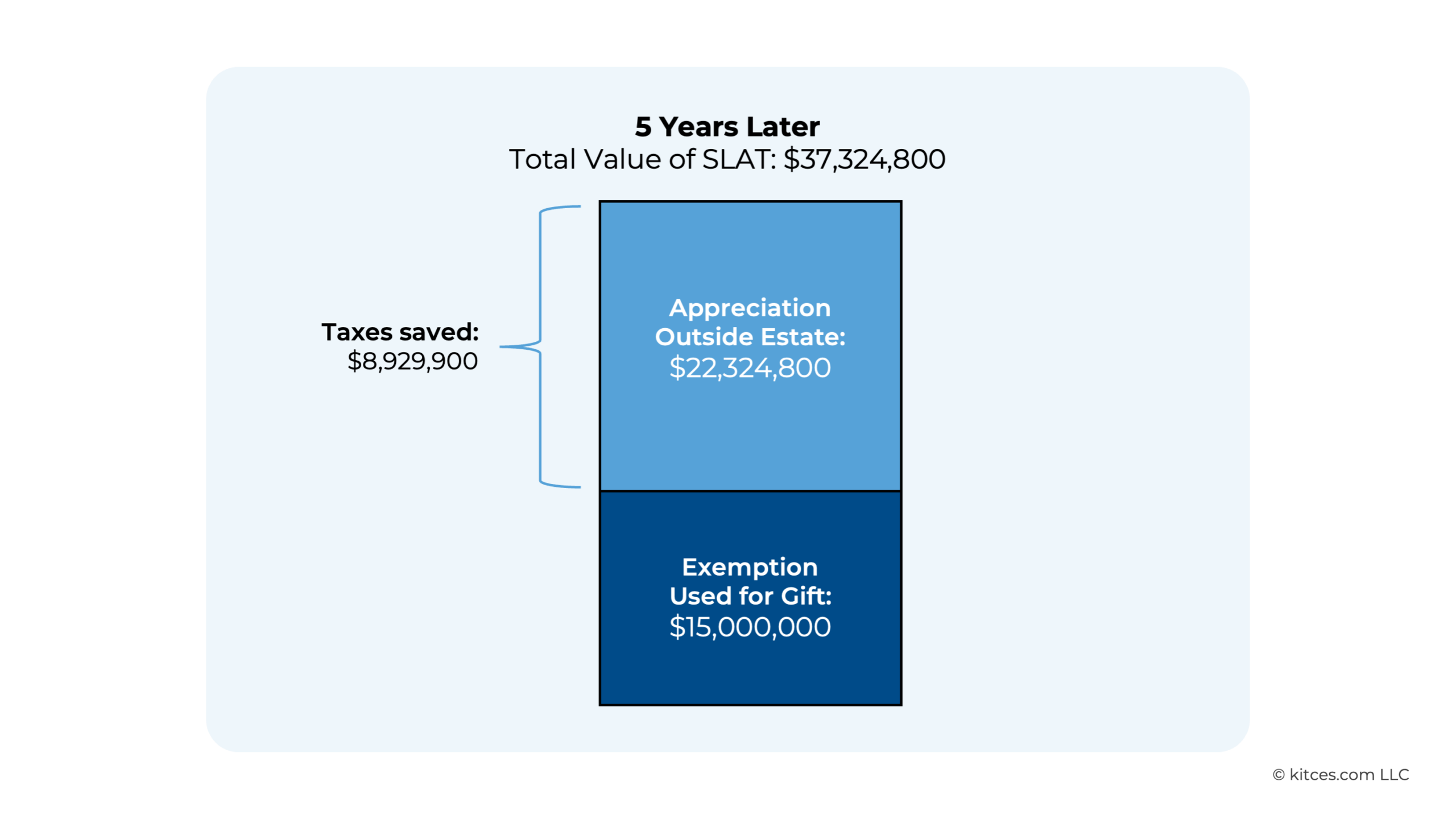
If the shares continue to grow at 20% compounded annually, in five years the shares in the SLAT will be worth $37,324,800. Gwen's gift will have shifted $37,324,800 (future value) – $15,000,000 (gift basis) = $22,324,800 of appreciation, which saves ($37,324,800 – $15,000,000) × 40% = $8,929,920 in estate taxes.
Business interests are not always good gifts. The risk that creates the opportunity for growth is balanced by the risk of loss. If the environment that caused a spike in value is an anomaly, and the situation is expected to normalize, it may be better to wait on gifting until the value decreases and uses less exemption. At the extreme, if the business goes under, the exemption would be wasted.

Nerd Note:
Start-up interests can be fantastic assets to gift because the value is low, particularly if the business is still in a pre-funding, no-revenue stage. If it ultimately goes under, little exemption will have been used. And if it succeeds, the upside can be substantial if the interest is gifted early enough.
A business owner who is particularly hesitant to gift the established business that created their wealth may be more willing to gift a scrappy spin-off company that is just getting started, because its success is not the foundation of their financial future. Looking at the entire estate in terms of future growth potential, not just current asset values, can help uncover these opportunities.
Applying Valuation Discounts
While shifting appreciation outside of a business owner's estate will create tax savings over time, the ability to apply valuation discounts to gifted business interests can create immediate tax savings for the owner. A 'discounted' value means the interest is valued at less than face value or its pro rata share of the value of the whole business. Valuation discounts may result from the ownership or management structure of the business. Two common discounts are lack of control and lack of marketability. The size of these discounts will vary by business, but they can be substantial.
If a gift is a minority interest or lacks voting rights, it may be eligible for a lack-of-control discount. The valuation is based on what a willing, arm's-length buyer would pay for the interest. A prospective buyer would typically expect a discount to buy a minority interest because they would have little meaningful say in how the business is managed or whether it makes distributions to shareholders. Without this element of control, the shares are worth less than their proportional share of the value of the business. To put it dramatically, the prospective buyer faces the uncertainty of a future in which others control their fate.
Similarly, an arm's-length buyer is going to want to be compensated for the illiquidity of the shares, resulting in a lack-of-marketability discount. Closely held businesses often have provisions regarding the transferability of stock. These protective structures are designed to keep the stock within a family or small circle. And unlike publicly traded stock, there is no established market for secondary buyers of ownership interests. Finding a buyer may involve a lengthy search, followed by an extended process of due diligence and execution. Because of their illiquidity and potential exit constraints, the shares are worth less than face value to the buyer. Here, the prospective buyer faces the uncertainty of a future with no way out.
Importantly, these discounts don't result in minority owners being paid less because they did not have voting control or because their shares were illiquid. If a business is sold, the minority owners still receive proceeds based on their proportional ownership.
Case Study – Part III: Transferring More Value With Less Exemption
Gavin and Gwen's advisor recommends obtaining a professional valuation of their business to support the value reported on the gift tax return. The valuation expert determines that, while the enterprise value of the business is $60,000,000, a single non-voting share is only $4,800.
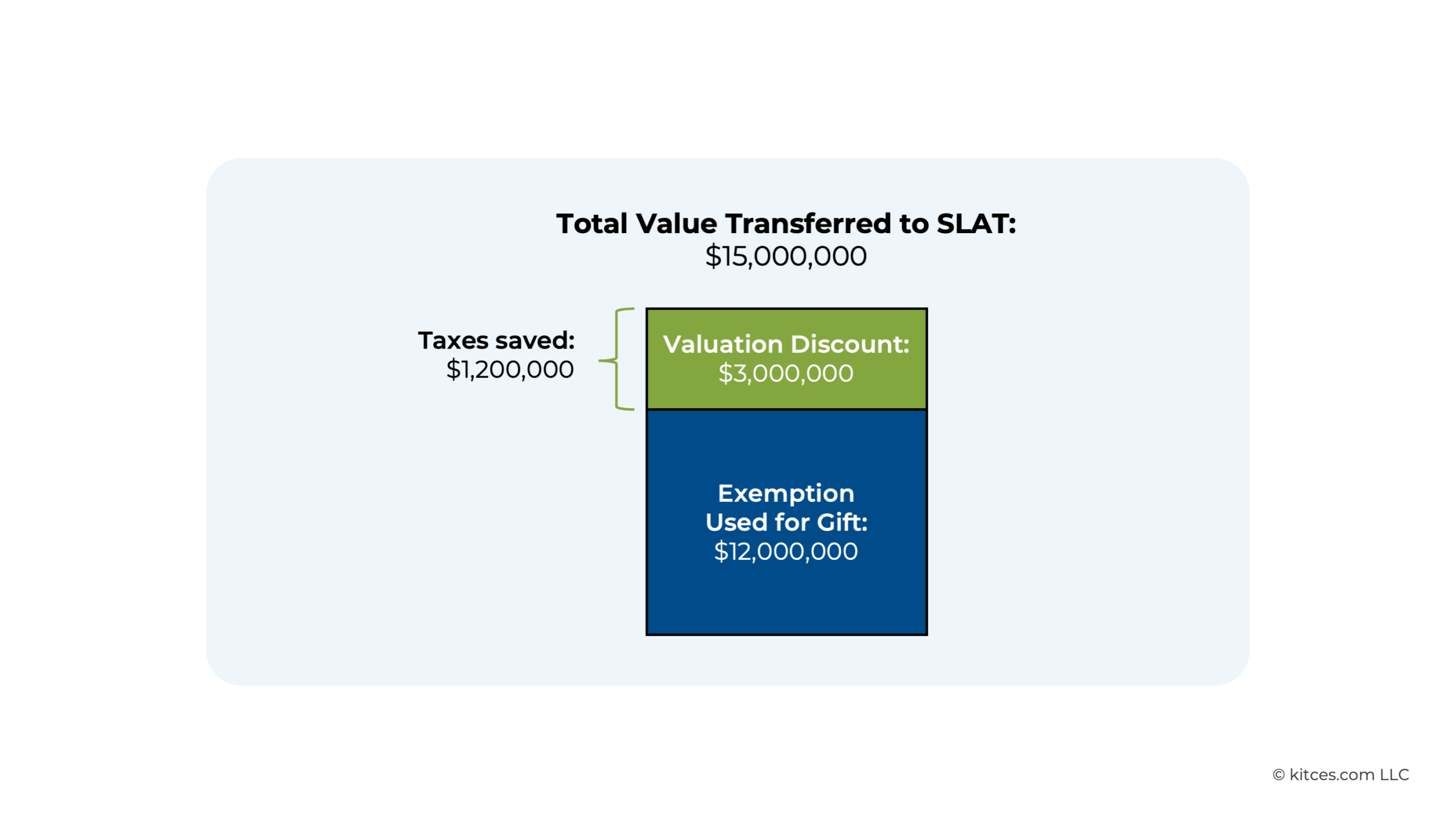
Gwen's gift of 2,500 non-voting shares to the SLAT therefore uses 2,500 × $4,800 = $12,000,000 of exemption. Consequently, Gwen retains $15,000,000 – $12,000,000 = $3,000,000 of her exemption, which she can use to shelter other assets from estate tax.
If Widgets-R-Us is sold for $60,000,000, the SLAT would receive (2,500 ÷ 10,000) × $60,000,000 = $15,000,000 of the proceeds. This creates an immediate estate tax savings because Gavin and Gwen were able to transfer $15,000,000 of value using only $12,000,000 of exemption. This results in a ($15,000,000 – $12,000,000) × 40% = $1,200,000 estate tax savings
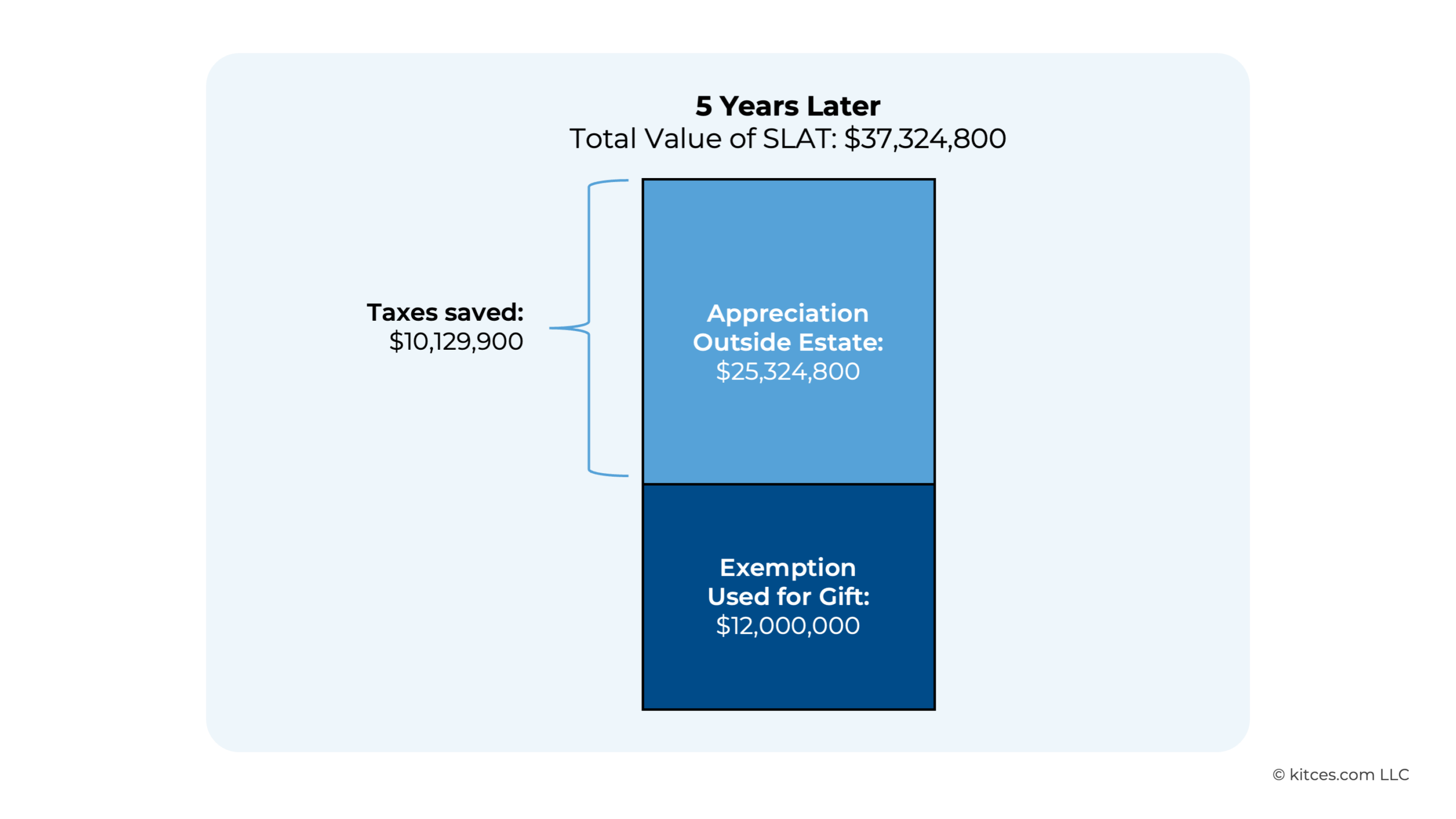
Suppose they had held the shares for five years before the sale. During those years, the business value continues to increase by 20% per year. The SLAT would receive $37,324,800 in proceeds. Gwen used only $12,000,000 in lifetime exemption, which allowed $25,324,800 in appreciation to avoid estate taxation. This produces an estate tax savings of ($37,324,800 – $12,000,000) × 40% = $10,129,920.
Nerd Note:
Valuation discounts have historically received scrutiny from the IRS, especially when they have been deemed particularly aggressive, which is a matter of facts and circumstances. With a difficult-to-value asset like a business, obtaining an expert valuation is worth the cost, even though it can be expensive. A proper valuation should include adequate support for the size of any applied discounts.
Gifting Business Interests In Advance Of A Sale
Leveraging valuation discounts creates an immediate win relative to the exemption used for the gift. Removing future appreciation creates another win over time as the exemption used is less than the ultimate value received. These factors make gifting a fast-growing business beneficial for estate planning in general. The benefits of gifting a business interest are even more pronounced in the event of a sale, which can command higher values and provide upside participation.
Harnessing Momentum
The same growth trajectory of the business that expanded the owner's balance sheet and led to the need for estate planning also makes the business attractive to buyers. This increased interest can be a catalyst for the business owner to engage in more meaningful planning around the business. When the business was less established, it may have felt too risky to do much planning with it for fear that it might decrease in value or go under entirely. When an exit is a real possibility, the increased certainty may be enough to compel the owner to (finally!) act.
They may also be compelled to capitalize on a period of strong performance or industry tailwinds. If they see the present moment as a peak in the industry, they may be willing to exit or 'get while the getting is good'. Regulatory and legal environments may also provide attractive exit points, and anticipated changes to these environments may further encourage an owner to seek an exit.
Selling At A Premium
Valuation discounts reflect that a hypothetical buyer would need to be enticed to purchase certain business interests. Such a buyer would require a lower price to compensate for the risk inherent in owning an illiquid minority share. By contrast, actual buyers may be willing to pay a premium to purchase those same shares.
A strategic buyer, like a competitor or a business in a related industry, may believe that they can increase the value of the business through synergies or reduced competition. Similarly, a sponsor, like private equity, may foresee adding value through their management know-how, industry consolidation, or the addition of growth capital (i.e., 'fueling the fire'). If the market is particularly hot, several buyers may compete for the business, which can drive up the price as well. With an eye on the potential of the business, not just its current position, certain buyers may be willing to pay higher multiples than the hypothetical buyer reflected in the gift valuation.
Case Study – Part IV: When A Third-Party Buyer Pays A Premium
Shortly after Gwen gifts shares to the SLAT, Gavin and Gwen are approached by ABC Partners, a private equity fund that focuses on founder-owned businesses. ABC Partners is looking to roll up several widget-making businesses to create scale in an otherwise fragmented industry. Their plan is to create the largest widget manufacturer in the Southeast, which would be able to collectively bargain for materials and share certain processes to reduce overhead costs. ABC Partners has offered Gavin and Gwen $80,000,000 for Widgets-R-Us.
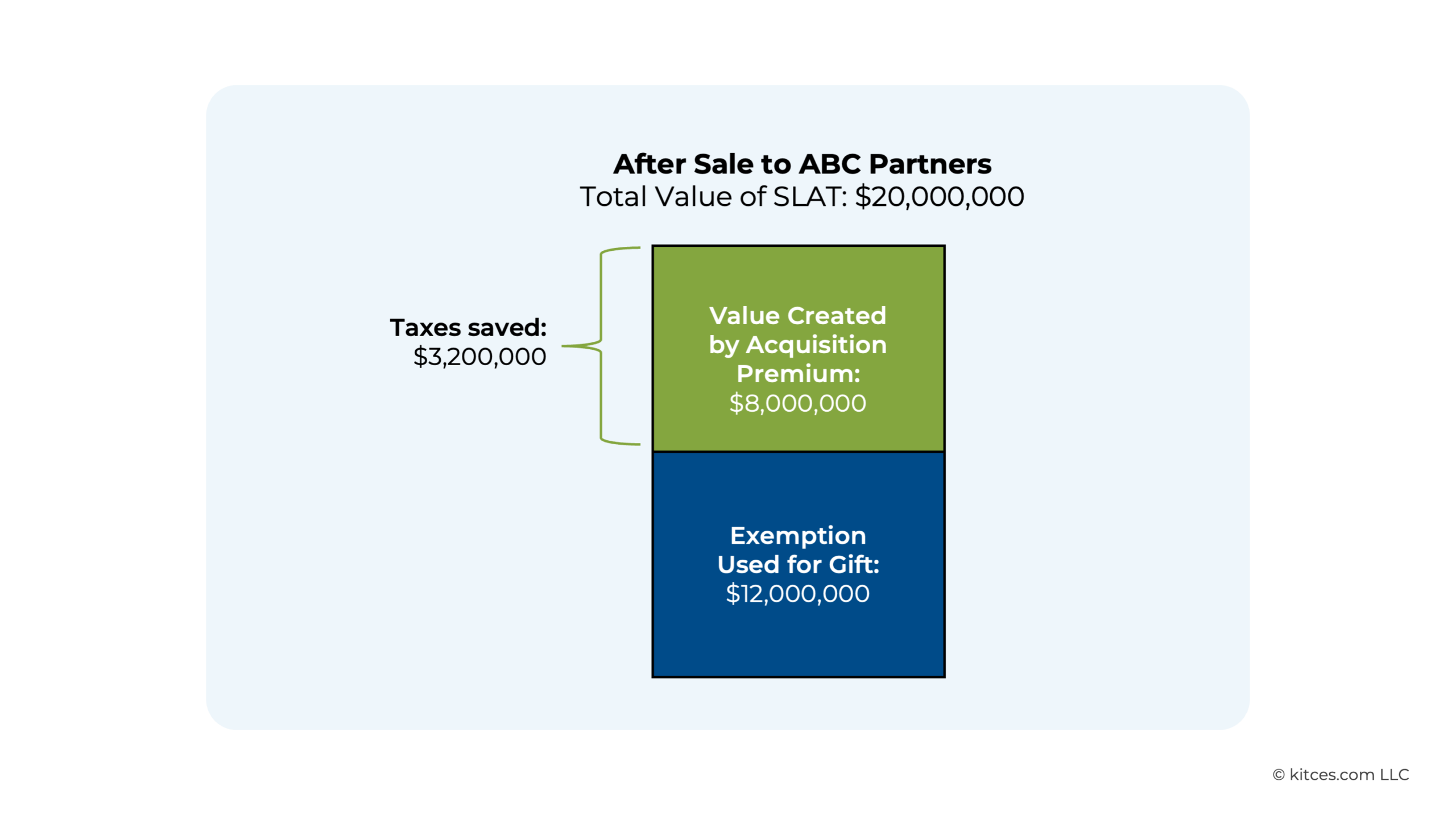
If Gavin and Gwen agree to sell to ABC Partners, the SLAT would receive (2,500 ÷ 10,000) × $80,000,000 = $20,000,000 of the proceeds. Having used only $12,000,000 of exemption to fund the SLAT, Gavin and Gwen have now saved ($20,000,000 – $12,000,000) × 40% = $3,200,000 in estate taxes.
While premiums can be common in sales to third parties, an internal sale is likely to be more in line with the gift valuation. An internal sale is a sale to key employees or other owners as a matter of succession planning. These sales are typically timed according to the seller's desire to retire and are less about capitalizing on momentum. To set appropriate expectations, gifting in advance of an internal sale is unlikely to create the same estate tax benefit for the business owner.
Harnessing Momentum. Again.
The buyer will want to make sure that the transition of ownership is as smooth as possible, with minimal disruption to the ongoing success of the business. They will also want the seller to be incentivized to support that smooth transition. To align their interests, the buyer may ask the seller to continue working in some capacity for a period, with sizable additional payouts tied to future metrics. This earnout serves as the 'carrot' for good behavior and is often coupled with legal non-compete and/or non-solicit agreements as the 'stick' discouraging bad behavior. The buyer protects their investment, and the seller can receive additional compensation for supporting the business's continued success after the ownership transition.
Especially in a private equity buyout, the seller may also be offered a continued ownership stake. This is called an equity roll because the seller 'rolls', or reinvests, a piece of their equity into the new deal. The seller can participate in the upside and receive the proverbial second bite of the apple in a future transaction when the private equity owner exits.
Nerd Note:
Private equity funds generally have a set lifespan of around 10 years, as detailed in the fund's operating agreement. At the end of that period, the fund winds down by selling its remaining investments and returning capital to its investors. Therefore, with a private equity purchase, there is often an expected exit within a few years given the purchaser's limited lifespan.
By contrast, if a competitor buys the business, they may continue to operate the business indefinitely. This is why a strategic buyer may be less likely to offer an equity roll: there is no natural break point, and the buyer may not want the seller along for the ride over the long term.
Case Study – Part V: Extending Estate Tax Savings Through An Equity Roll
Continuing our example, ABC Partners wants Gwen and Gavin to stay on for three years to help with the transition. To align interests, ABC Partners strongly encourages them to roll a portion of the Widgets-R-Us sale proceeds into the new widget company, Mega Widgets. ABC Partners projects that Mega Widgets will be worth 2.5 times its current value within three years.
With the help of their advisor, Gavin and Gwen decide to reinvest the SLAT's portion of the proceeds into Mega Widgets. While Gavin is the initial beneficiary of the SLAT, they do not anticipate needing its assets for their own support, and they consider it a vehicle for eventually transferring assets to their children. The SLAT has a long time horizon and can accept the risk and illiquidity of the Mega Widgets investment. By holding this investment in the SLAT, future appreciation will remain outside of their estate and will not compound their potential estate tax liability.
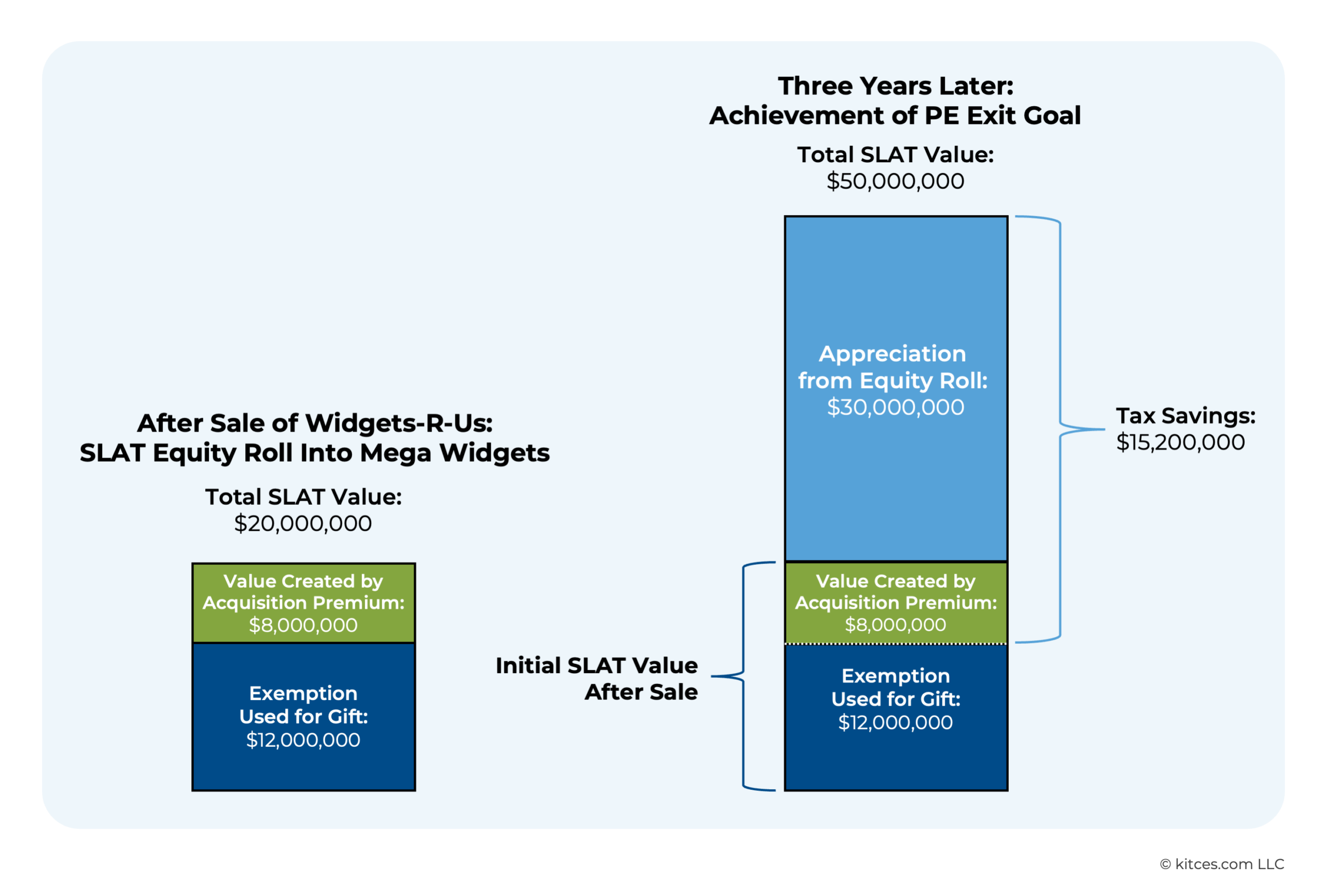
The SLAT's equity roll is initially $20,000,000. In three years, ABC Partners achieves its goal of a 2.5x exit and the SLAT receives $50,000,000 in proceeds. The initial $12,000,000 gift has shifted ($20,000,000 × 2.5) – $12,000,000 = $38,000,000 in appreciation outside of Gavin and Gwen's estate. As a result, they save $38,000,000 × 40% = $15,200,000 in estate taxes by gifting shares of their business to a SLAT and keeping the future appreciation from the equity roll outside of their estate.
A caveat about equity rolls – it is important to understand what happens if the seller does not stay with the business until the next exit. The entrepreneurial spirit that fueled the seller while building the business may make being an employee particularly difficult. Seeing someone else make key decisions and watching the corporate culture change is not easy. Sellers should be honest with themselves about the potential personal difficulty of staying on for a few years. The pre-sale due diligence process can help determine who may be workable partners after the sale and how likely this upside participation is to come to fruition.
Additional Considerations When Gifting Business Interests In Advance Of A Sale
Gifting shares of a business, particularly in advance of a sale, is a complex but powerful strategy when done right. Attention to detail will determine how successful it is in achieving the business owner's desired outcome. There are several steps an advisor can take to optimize the process.
Issuing Non-Voting Shares
One of the first considerations in optimizing the gift is the structure of the business and whether it may support valuation discounts. The business may need to be recapitalized before a gift is made. If all the original shares are voting shares, the business can issue non-voting shares pro rata based on ownership percentages. These non-voting shares may be eligible for the lack-of-control valuation discount discussed earlier.
Another consideration in recapitalization is the number of non-voting shares issued. The more shares issued, the lower the value per share. This allows more accurate targeting of a desired gift value, especially when trying to avoid fractional shares for ease of accounting.
For example, if there are 10 total shares of a $20,000,000 business with 5 voting and 5 non-voting shares – ignoring discounts for ease of calculation – the most non-voting value one could gift is $10,000,000. If there are 10,000 total shares, with 5 voting and 9,995 non-voting shares, one could gift $19,990,000 of value without giving up control. More shares overall, and more non-voting shares relative to voting shares, provide the most flexibility in structuring the estate plan.
Having voting and non-voting shares also allows the business owner to stay in control. They may be willing to part with a portion of the economic value of the business if they know they will still be making the key decisions, but giving up control will be a non-starter for many.
Nerd Note:
A gift can be structured as a certain value of shares, although a gifting a specific number of shares that equals a certain value is more common. While these may appear equivalent on the surface, there is a history of tax court cases suggesting that gifting a specified value of shares can be the riskier path. It is always important to work with an experienced attorney on structuring the gift and filing the gift tax return.
Keeping The Valuation Private
If an external sale is a probability, having a business owner's estate planning attorney engage the valuation expert can increase the likelihood of a successful outcome because of the privacy it provides. When the attorney requests the business valuation, the valuation report is covered by attorney-client privilege. It is confidential and would not need to be included in the data room when a potential buyer begins due diligence. Therefore, it won't influence the buyer's view of the value of the business.
Business owners may be somewhat disappointed by the gift valuation of their business because it is lower than what they would expect based on the market for their industry (or what a broker might be dangling in front of them). However, a lower valuation for gifting is desirable. As the earlier examples illustrate, the difference between the gift valuation and the potential sale price is what supercharges the gifting strategy and drives estate tax savings. The last thing a business owner wants is for the buyer to see that gift valuation and think, “I can get away with offering X…”. Instead, they want the buyer to arrive at their own – more expensive – conclusion based on expectations for the future of the business.
Timing Is Everything
Timing is the most important key to success when gifting business interests before a sale.
The lack-of-marketability discount relies on the difficulty of selling the asset. Exit visibility will affect this discount. If a sale is pending, the future is known, and a buyer no longer needs not be compensated for uncertainty. In the best-case scenario, the gift is completed before the business is taken to market and certainly before a letter of intent is signed.
Discounts aside, if the valuation report attached to the gift tax return reflects a $60,000,000 enterprise value and the business is sold one month later for $80,000,000 (remember, the IRS will see that gain on the income tax return!), the gift may not withstand scrutiny. The more time that can be put between the gift and the sale, the better. Anything could have happened in the period separating the two events, and that uncertainty improves the fact pattern if the gift is later reviewed by the IRS. Having the gift and the sale fall in separate tax years can also be helpful.
A business owner's personal 'board of advisors' – financial advisor, attorney, CPA, and valuation expert – can act quickly when called upon to do so. For financial advisors, getting the client on board is what often takes the most time. First-generation wealth creators, who likely have no experience with gifting or estate tax, will need education on estate planning, along with time to get comfortable with the use of certain trust structures. They will also need time to consider lifestyle and legacy goals after the transaction, which will affect the sizing decision. Importantly, if the business value has changed dramatically, their goals are likely to change dramatically, too. A proactive advisor can be instrumental in keeping the process moving. In my practice, ideally, I prefer to begin working with the client 12–18 months before the start of an expected sale process, and to check in at least monthly to educate, illustrate, and coordinate the gift.
If the optimal window has closed, there will still be opportunities on the other side of the transaction to make gifts and reduce estate tax. If the first exit opportunity is missed, an equity roll can create another opportunity to gift an illiquid asset with a high expected return. Plus, there are all the other tools available for reducing estate tax over time. Clients do not need to risk a bad fact pattern in an attempt to shelter every dollar from tax.
While media might glorify high-profile entrepreneurs setting out to become the next billionaire, most business owners are quietly plugging away, trying to support themselves financially in their own way. Sometimes preparation, hard work, and luck combine in such a way that business owners find themselves in a financial position they never imagined. The business that supported their family's immediate financial needs has achieved its aspirational potential and created generational wealth. While I have been working with business-owner clients for 20 years, I'm still amazed by how quickly, and to what magnitude, a business interest can change a balance sheet.
As their financial landscape changes, so does the focus of a business owner's financial planning. The question is no longer 'Do I have enough?' but 'How do I make the most of what I have?' Financial advisors can help clients navigate that change in landscape. The same business that created an estate tax 'problem' can also be the very vehicle that helps optimize estate tax planning. It may take a tremendous amount of hand-holding and number-crunching on the front end to get the client comfortable enough to act on planning advice; however, the advisor who guides the client through it successfully may be able to quantify estate tax savings for years to come. Rare is the opportunity to put a dollar amount on the value added by financial advice. Saving a client millions of dollars in estate tax can go a long way toward building a lasting relationship and demonstrating the value of that advice!





Leave a Reply