
Executive Summary
There is a lot of information to gather early on in a relationship between a financial advisor and their new client, from investment statements to risk tolerance data. Given that both parties might be focused initially on creating an initial financial plan and solving any 'pain points' that are on the client's mind, it can be easy to miss out on discussing each side's expectations for the broader relationship (e.g., when it's appropriate for the client to contact the advisor with a question). However, avoiding this conversation can create misaligned assumptions between the advisor and their client, potentially leading to frustration for one or both parties over time.
In this guest post, Meghaan Lurtz, a leading expert on the psychology of financial planning and Professor of Practice at Kansas State University, discusses the potential benefits of taking time early on in the advisor-client relationship to discuss and set clear expectations as well as nine questions advisors can use to get the conversation started and ensure they and their clients are on the same page.
To start, an advisor might ask a new client about their understanding of the advisor's planning process and what to expect regarding formal meetings and other touchpoints. An advisor might also ask about the client's expectations for the relationship, allowing the advisor to highlight areas where client expectations are in line with the advisor's service model and any client expectations that might be unrealistic (e.g., if the client expects the advisor to prepare their tax return but that service isn't offered).
A central issue in the advisor-client relationship is ensuring each party sets expectations for when communication is appropriate, as some clients may be unsure when they're 'allowed' to reach out to their advisor. By starting this conversation, advisors can note when they want clients to reach out (e.g., when they're planning to make a major purchase). This topic can also lead to a discussion of the best modes of communication for each side (e.g., phone versus email) to avoid assumptions that one particular mode is preferred by both the advisor and their client.
This conversation can also be used to set big-picture expectations for the relationship. For example, the advisor might ask their new client what a successful relationship would look like to them (which might include both a number [e.g., a particular retirement savings goal] and a feeling [e.g., a sense of financial freedom]), giving the advisor more information about what the client is seeking from their partnership. Similarly, an advisor might ask what the client wants to be true about their work together over the next year, giving the advisor clarity on shorter-term goals and creating a natural check-in point to see whether each side's expectations are being met. Also, to set expectations before conflict arises, an advisor can ask a client early on about how they would want to handle a potential disagreement with the advisor or between members of a client couple.
Ultimately, the key point is that the client onboarding process is not just about understanding a new client's financial situation and loading this information into the advisor's computer systems, but also represents a valuable opportunity for both the advisor and the client to communicate and discuss their mutual expectations for their work together. Which could result in greater trust and satisfaction for both sides over the course of what will hopefully be a long-term relationship!

Why Relationship Expectations Matter
First meetings set the tone for everything that follows. Yet some advisors underestimate just how much uncertainty clients carry into that initial conversation. To be clear, the problem isn't a lack of intelligence or motivation on the part of the client or prospective client, but rather a lack of shared understanding about what a professional financial planning relationship is supposed to look like.
Clients Don't Know The Rules Of The Game
Unlike professions with well-established social norms – sit in a waiting room and fill out annoying forms before seeing a doctor, lie on a couch and confess feelings to a therapist, begrudgingly hand over receipts to a tax preparer – financial planning lacks clear scripts. Clients don't know what will happen in that first meeting. And beyond the first meeting, they don't always know when they are 'supposed' to reach out to their financial planner – whether they should call before making a major purchase, whether it's acceptable to talk about fear, sadness, or other big emotions, or how much and how quickly financial transparency is expected or required. These paper-cut ambiguities add up and can lead to things like:
- Withholding information because they don't know what's relevant.
- Calling the advisor, then over-apologizing for taking up their time.
- Avoiding meetings when they feel uncertain or ashamed.
This happens because, without explicit guidance, clients fill the 'no-script' void with their own assumptions, judgments, guesses, and stories – which are often incorrect. To be fair, this is what all humans do. We all constantly make up stories in our minds to fill in gaps – we do this so often, there is a well-known term for it: confabulation. More to the point, advisors and their clients are not weird or abnormal if this is has happened. It is very normal not to know. And because it is very normal, advisors will want to be more proactive in setting expectations. When expectations go unsaid, assumptions often clash with reality, which brings everyone to a point of frustration and even mistrust.
Advisor Assumptions Create Frustration
Advisors, too, operate with assumptions – often unstated – about how good clients should behave. For example, many advisors may expect clients to:
- Call before making major financial decisions (buying a house, accepting a new job, retiring early).
- Proactively raise concerns rather than waiting for review meetings.
- Follow the plan, even when emotions or external pressures tempt them to deviate.
When clients don't meet these unspoken expectations, advisors can feel blindsided. They may think, "Why didn't they call me first?" or "I can't help them if they won't be honest". Meanwhile, clients may feel judged, not realizing they were violating an invisible rule.
This dynamic, the unstated expectations on both sides, is a recipe for misalignment. And misalignment, over time, erodes the very trust the relationship needs to thrive.
Clear Expectations Build Trust Faster
Research in psychotherapy, education, and organizational behavior consistently shows that explicit expectations improve satisfaction, engagement, and outcomes. When people know what's expected of them, and what they can expect in return, they are more likely to participate fully, communicate openly, and persist through challenges.
In financial planning, this principle is no different. Clients who understand the boundaries of the relationship – when to call, what to share, how disagreements will be handled – are more likely to engage authentically. They stop second-guessing whether they're "doing it right" and start focusing on the work itself.
Clear expectations also protect and support the advisor. By articulating what is and isn't part of the service, advisors reduce the risk of scope creep, unrealistic demands, and the emotional exhaustion that comes from feeling perpetually vigilant – I know many advisors who describe being tired simply because they are always feeling the need to check in and followup in fear that something will fall through the cracks, be misunderstood, or otherwise lead to the client will getting stuck and not say anything. What is more, advisors have told me that their most challenging clients are those whom they try to help more than the client wants or can help themselves. Moreover, I cannot state with certainty that all these "what if" relational stresses are caused by missing expectations, but I bet that if I had more data, I could build a strong correlation. Advisors and clients would worry less if everyone knew what everyone else was doing, not by being hypervigilant but by simply knowing the rules and expectations of the relationship.
Here is an example: the client assumes the advisor will call if there's a problem or concern. The advisor assumes the client will reach out before making a major decision. When these assumptions diverge, as they inevitably do, someone feels let down. The client thinks, Why didn't they warn me? The advisor thinks, Why didn't they ask first? Both are operating from their own internal logic, but without explicit agreements, that logic is never tested or aligned.
In short, don't assume clients know what their advisors expect. Even seemingly obvious norms, like calling before a major purchase, may not be obvious to someone new to financial planning. I, Meghaan Lurtz – a person with a well-loved financial planner, a PhD in financial planning, and knowledge of behavioral finance – did not call my advisor when I bought a house. I feel bad about that now, but it happened. In my mind, the only time I needed to call my planner was when I needed to withdraw from my investments. In this case, the money I needed was in my checking account. Moreover, this was not my first home purchase. My script said, "I've got what I need to buy a house". My script, at the time, did not say, "This is a major purchase, even though I have what I need…I still better tell my financial advisor". Making the implicit explicit, and doing so with kindness and curiosity, is a gift that will keep on giving for advisors and clients. For all of those who wonder, my advisor and I now have a rule that I am not to spend more than $10k in a day without telling him. Explicit expectations are so helpful.
Reframe The First Meeting As A Relationship Expectations Meeting
As noted at the beginning of this article, the first meeting is important for setting expectations. The traditional first meeting typically follows a predictable arc: introductions, a review of the client's goals, a discussion of assets and liabilities, and perhaps a walkthrough of the advisor's process. This structure isn't inherently wrong, but it often only prioritizes quantitative information and not the expectations of the relationship. As financial planners already know, when the relationship lacks a strong foundation, even the best financial plan can struggle to take root.
Moreover, reframing the first meeting as a Relationship Expectations Meeting shifts the focus. Instead of starting with "What do you own?" or "What are your goals?", the conversation begins with: What do you know about our process? What do you expect from me? What would success look like to you? The meeting actively discusses the act of working together, as this is the area that many client-advisor relationships get stuck on down the road.
Shift The Focus From Facts To Partnership
Of note, this does not mean abandoning fact-finding altogether. Financial data is essential. But starting with expectations (or at least having a relationship expectations talk somewhere in the first meeting) signals to the client that the relationship itself is valuable – not just a means to an end. It communicates: "Your experience of working with me matters. I want to get this right".
Moreover, when advisors lead with questions about expectations, they gain insight into the client's readiness, assumptions, and potential red flags. Wouldn't it be helpful if an advisor were to learn, up front, whether the client wants daily market updates or guaranteed returns? Relationship expectations information is often overlooked when not explicitly addressed, but it is easy to add back in.
Use Questions To Uncover Mutual Expectations
The point of expectations questions isn't to quiz the client or catch them off guard. These questions clarify boundaries and roles – and depending on how the advisor asks them – can feel very collaborative; a great way to start a financial planning relationship. Said another way, the best expectations conversations are dialogues, not monologues. Advisors will want to ask expectations questions in a way that invites the client to name what they need, while also giving the advisor space to articulate what they can – and can't – provide.
This approach also normalizes the idea that great relationships require negotiation and maintenance. Just as a financial plan evolves, so do relationship expectations and needs. Revisiting these questions during review meetings or transitions (marriage, retirement, inheritance) helps keep the partnership aligned and resilient.
The usefulness of a relationship-forward approach is that it creates space for clients to voice concerns before they become problems. A client who feels comfortable saying, "So you want me to call you whenever I have a financial question, even if it may be trivial?" in week one is far more likely to ask clarifying questions throughout the relationship. Conversely, a client who is unsure when it is appropriate to reach out may hesitate or never call at all.
Setting The Tone For Collaboration, Not Compliance
Expectations are agreements, not rules. Put another way, the language of expectations is critical. Instead of saying, "You should call me before making big decisions", try: "I've found that clients feel most supported when we talk through major decisions together. Does that feel right to you, or would you prefer more independence?" This phrasing invites collaboration and respects the client's agency. This collaborative tone sets the stage for a relationship built on mutual respect, not compliance. Pro tip: many people struggle to remember specific phrasing like this. Write down what you want to say and how exactly you want to say it, and bring that well-written list of questions to the meeting.
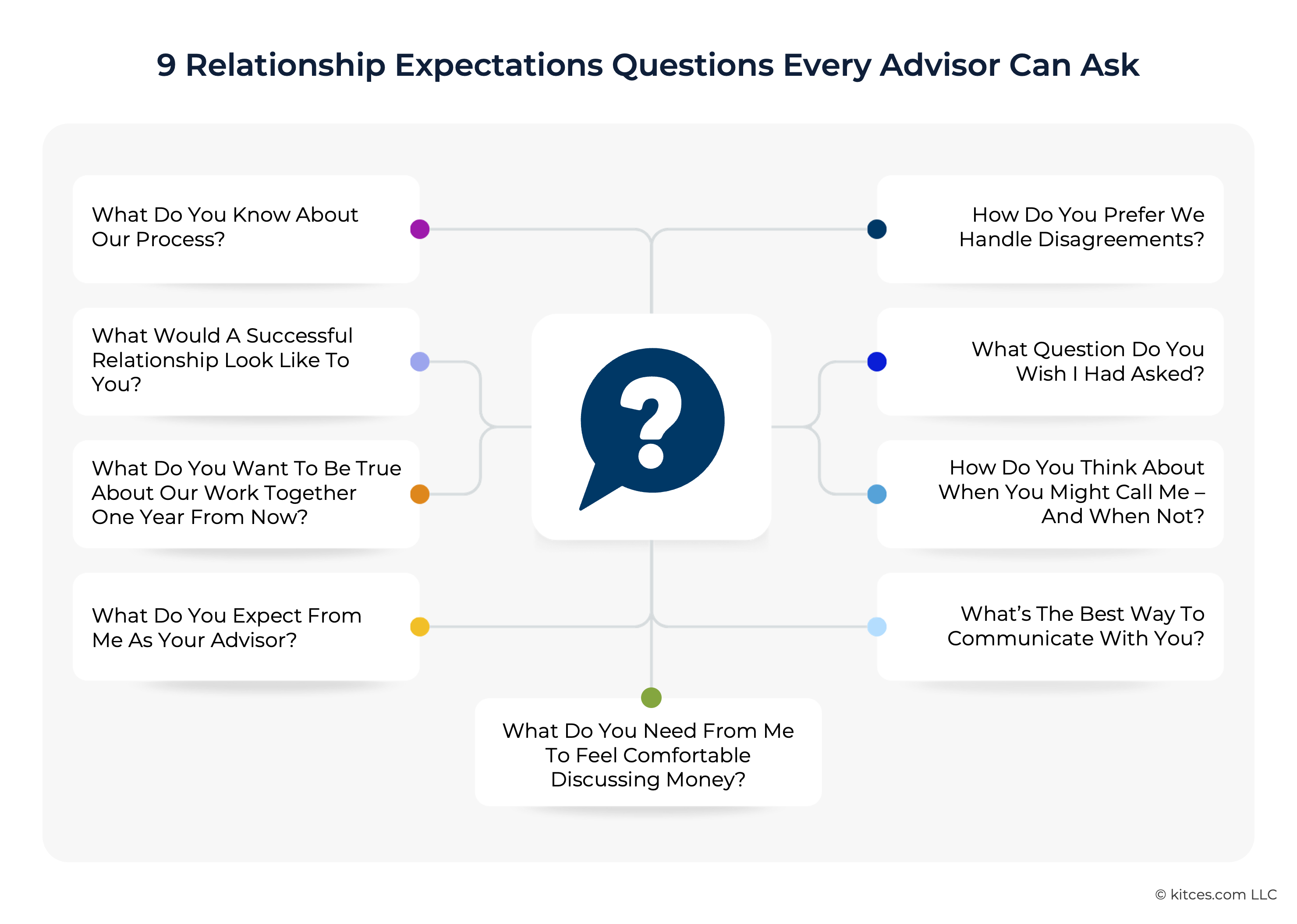
9 Relationship Expectations Questions Every Advisor Will Want to Ask
The following questions are designed to surface assumptions, clarify boundaries, and co-create a shared understanding of what it means for the advisor and client to work together. They can be woven into the first meeting or spread across early conversations. The key is to ask them with genuine curiosity and to listen not just for answers, but to look for alignment and opportunities to co-create.
Question 1. What Do You Know About Our Process?
This question reveals how much homework the client has done and, in turn, potentially how interested they are in the relationship. It also gives the advisor a chance to fill in gaps and correct misconceptions early.
Why it matters: A client who says, "Honestly, not much", isn't necessarily a bad fit; they may simply need more context and a few follow-up questions to help them converse about the value of working with your firm. On the other hand, a client who confidently describes a process or other information from the website indicates they have done their research and are ready, and likely more 'bought-in'.
Advisor tip: For those prospective clients who say, "Honestly, not much", advisors can follow up with an invitation to review the process. An example might be, "No problem, would it be helpful to you if we review it now? A quick review can help us set the tone for today but also what comes next. Sound good?" Invitation-style questions feel inclusive and inviting to the client's brain, which is more relationship-building focused compared to "No problem. Let me tell you about it now". This isn't a dealbreaker, but read them aloud and feel the difference for yourself. One just feels a little friendlier.
Question 2. What Do You Expect From Me As Your Advisor?
This question surfaces the client's assumptions about the advisor's role. Again, not many cultural scripts – besides things like The Wolf of Wall Street, Boiler Room, or Gordon Gekko from Wall Street – exist. At least for the scripts listed here, planners would say they are the exact opposite of what they do and how they act. The client is hopefully going to ask the advisor questions. They may even respond to the advisor's question with a question, "Hm, I am not totally sure…I suppose I expect you to help me organize my money? I am not sure what else?" Prospective clients might even respond with, "I am not sure what you mean?" and then turn the question back on the advisor with, "Can you give me an example?" Regardless of what happens, this is an important dialogue.
Why it matters: For those clients who come in with ideas, they will share them. Perhaps they had a prior planner, and they say things like: "manage money, scenario plan, and help with taxes". These are great and correct answers, AND the advisor might say, "Yes, exactly, and here at our firm we also…" The goal is engagement, get them talking, and then join in. For clients who have no idea, no problem. To continue from the conversation above where the prospective client ask for an example. The advisor might say, "No problem, happy to provide an example. Many clients have questions about how this all happens and how we will work together. If you have never had a financial planner before…how would you know? Here is a common question we get and how we work with clients to solve it…"
Advisor tip: Listen for unrealistic expectations (e.g., guaranteed returns, daily communication) or simply those that do not fit with the firm (e.g., tax preparation, crypto) and address them with empathy. Instead of saying, "That's not possible," try: "I hear that certainty/options/communication is important to you. Let me share what I can offer, and we can decide if there is a mutual fit".
Question 3. How Do You Think About When You Might Call Me – And When Not?
This question addresses one of the most common sources of advisor frustration: clients who don't reach out when the advisor would have wanted them to.
Why it matters: Clients often feel uncertain about when they're 'allowed' to call. Any advisor who has ever received a phone call from a client that started with an apology, "Hi, Sorry for calling you, I know you are really busy, but I just had a question about X…" has had a client that didn't feel certain. Moreover, by explicitly naming situations that warrant a call: job change, inheritance, major purchase, advisors give clients permission to engage proactively. Advisors can also say things like, "I want to hear from you if you are worried or pondering an idea; plans do not have to be fully formed in order for us to talk". Statements like that assure clients their advisor is there not just for planning but also for brainstorming and information gathering.
Advisor tip: Clients have been living their lives and making financial decisions for a long time without a planner. As much as they may value financial planning, getting used to the idea and process of calling an advisor is new. It will take time for clients to become more comfortable, let alone proactive, about calling. Reminding them through newsletters, emails, and client appreciation nights that their advisor wants to hear from them is always great, as is providing stories that model proactive and collaborative work.
Question 4. What Would A Successful Relationship Look Like To You?
Success means different things to different clients. For some, it's peace of mind; for others, it's hitting specific financial milestones. This question invites clients to define success in their own terms.
Why it matters: How a client defines success becomes an important thing to measure. It is how the client will measure their success in working with their advisor and even potentially impact how they see and feel about themselves, and if they are 'successful'.
Advisor tip: Revisit this question periodically. Success metrics evolve as clients move through life stages, and regularly checking in on what 'success' means helps keep the relationship aligned with their current needs. Also, keep in mind that 'success' metrics often have a number AND a feeling. A client might say, "I need $10 million to retire." Seen in the simplest terms, success is getting to $10 million. Yet, what does that $10 million represent? Safety, freedom? Advisors will want to be curious and seek both quantitative and qualitative measures of success, or the meaning behind a number.
Question 5. How Do You Prefer We Handle Disagreements?
Conflict is inevitable in any long-term relationship. By normalizing disagreement and discussing how to handle it, advisors create psychological safety for honest communication.
Why it matters: Clients who know how disagreement will be handled may be more likely to speak up when something feels off. This question and discussion signal that the advisor values the client's perspective, even when it differs from their own. It also signals, when discussing what happens in a dispute within a couple, that the couple-ship has value. In other words, advisors are not there to take sides between the two members of the couple. They are there to serve the couple-ship. Setting expectations about how the advisor may hear from both members of the couple and how, collectively, the coupled client might work toward a solution signals how important alignment and transparency are to financial planning and the relationship.
Advisor tip: Think long and hard about this one. Advisors reading this article – ask yourselves, how do I want to handle an upset client? Outside of "apologize well and repair the relationship", this question is not as straightforward as it seems. Imagine the client wants to invest in a risky asset or business venture and is pushing very hard. Does the advisor just fire the client? Does the advisor tell them they can do whatever they want with gritted teeth? Or does the advisor have a process they can articulate calmly for how they and their clients will talk through disagreements? To be fair, there is no guarantee that the client will come around; they may still invest. Yet the advisor-client relationship would likely be in a better, more open place. The same applies to couples. It is hard to work with a feuding couple. Advisors can wait it out; some may try to facilitate. Yet, what if the protocol was to call a financial therapist? Disagreements are inevitable and not necessarily the enemy. 'Fighting well' is possible and is done so with respect for boundaries and expectation setting before the advisor and client(s) step into the proverbial ring.
Question 6. What's The Best Way To Communicate With You?
Some clients prefer email; others want phone calls or text messages. Mismatched communication preferences may not be a huge deal every now and again, but they do add up over time.
Why it matters: A client who expects same-day responses but gets weekly emails may feel neglected. An advisor who texts may overwhelm a client who prefers structured quarterly reviews. Aligning on communication norms prevents these mismatches.
Advisor tip: Be explicit about response times. "I typically respond to emails within 48 hours. If something is urgent, text me and I'll get back to you the same day". This clarity helps manage expectations and reduce unnecessary anxiety.
Question 7. What Do You Want To Be True About Our Work Together One Year From Now?
This question shifts the conversation to the future and invites clients to articulate their hopes for the working relationship.
Why it matters: It creates near-term benchmarks for relational trust and satisfaction. A client might say, "I want to feel confident that my retirement is on track", or "I want to stop worrying about money all the time". Advisors can write these down and check back on them throughout the year.
Advisor tip: Revisit this question at the one-year mark. Did the relationship deliver on what the client hoped for? If not, why not? This reflection deepens the partnership and demonstrates accountability.
Question 8. What Question Do You Wish I Had Asked?
This meta-question invites clients to take the lead. It signals that the advisor values their perspective. It is a slight twist on questions like, "Anything else on your mind that we need to discuss?"
Why it matters: Clients may reveal concerns or priorities the advisor hadn't considered or known about. For instance, a client might sit patiently through what the advisor shares during a meeting and yet have a question of their own.
Advisor tip: Again, because financial planning meetings are somewhat 'script-less' in the eyes of the client, they may not interrupt the advisor or ask to veer off course. This simple question at the end of a meeting or can bring up additional concerns the client may have been waiting to share.
Question 9. What Do You Need From Me To Feel Comfortable Discussing Money?
This question directly addresses vulnerability and psychological safety. It acknowledges that financial conversations can be uncomfortable and that trust must be earned.
Why it matters: Some clients need reassurance that they won't be judged for past mistakes. Others may just value hearing the question because it normalizes how different this process and these conversations are for many people. By asking this question, the advisor signals that openness is valued and that creating a safe space for it is a priority.
Advisor tip: This can also be a time for planners to discuss how they talk about money. Yes, numbers and facts. And also, feelings, values, aspirations, the why behind the plan. Letting clients in on questions, conversations, and meetings where the advisor already knows that they typically go a little deeper sets expectation and creates psychological safety.
From Client Onboarding To Relationship Design
Many advisors want long-term relationships. They value loyalty, trust, and depth. Yet few design the first meeting to clarify what long-term actually means. What does it look like to work together for five years? Ten years? Twenty? And what does the client need to feel supported, engaged, and understood along the way?
By centering the first meeting on relationship expectations, advisors move from onboarding to relationship design. They shift the conversation from "What do you own?" to "What do you need?" From "Here's my process" to "Here's how we'll work together". And this shift is an important one for those advisors who want to place value on and discuss value in the relationship.
The questions outlined here – from "What do you know about our process?" to "What do you need from me to feel comfortable discussing money?" – are not scripts to be followed rigidly. This is not a list of 9 questions to ask in any and all first meetings. This list offers a set of invitations that advisors can use in various meetings to dialogue and co-create with clients. Some questions will resonate more with some clients or advisors than with others. Some will surface unexpected insights; others will confirm what the advisor already suspected. The idea is to just start asking these questions, or similar ones, because in doing nothing differently, everyone is left without a script.
When advisors ask these questions, they reduce surprises, improve alignment, and give clients the answer they're really looking for in that first meeting: "Yes – I know what it means to work with this planner".
That clarity doesn't just make the relationship easier. It makes it stronger, more resilient, and more likely to last. And in a profession built on trust, that might be the most valuable outcome of all.
The practical application of these principles is straightforward: spend 15 to 20 minutes on expectations in a first meeting. Invite clients to share what they know and what they want, and respond to that information, either building on it or clarifying it.
Finally, remember that expectations aren't one-time agreements. They evolve as the relationship deepens and as clients' lives change. The expectations a 45-year-old has about retirement planning differ from those of a 65-year-old nearing their career finish line. The expectations of a newly married couple differ from those of parents planning for college. By treating expectations as living agreements rather than static rules, advisors create relationships that can adapt, grow, and withstand the inevitable challenges that come with navigating decades of financial life together.
Ultimately, the most successful advisory relationships aren't built on perfect portfolios or flawless execution. They're built on shared understanding, mutual respect, and the willingness to talk openly about what's working and what isn't. And that foundation begins in the very first meeting – when advisors take the time to ask not just what clients want, but how they want to work together to get there.





Leave a Reply